• About
  • Privacy Policy
  • Terms of Use
  • Donation
  • Contact
No Result
View All Result
Archaeology News
  • Home
  • News
    • Archaeology
    • Anthropology
    • Paleontology
  • Academic
    • Books
    • Conferences
    • Universities
  • Articles
  • VR Tours
  • Quiz & Game
  • Download
  • Encyclopedia
  • Forum
Archaeology News
No Result
View All Result
Home News Archaeology

6,000-year-old settlement was home to Europe’s first megalithic builders

by Dario Radley
February 21, 2023

Archaeologists excavating in France have discovered evidence of a 6,300-year-old fortified compound and residential site used by Europe’s first megalithic builders.
6,000-year-old settlement was home to Europe’s first megalithic builders
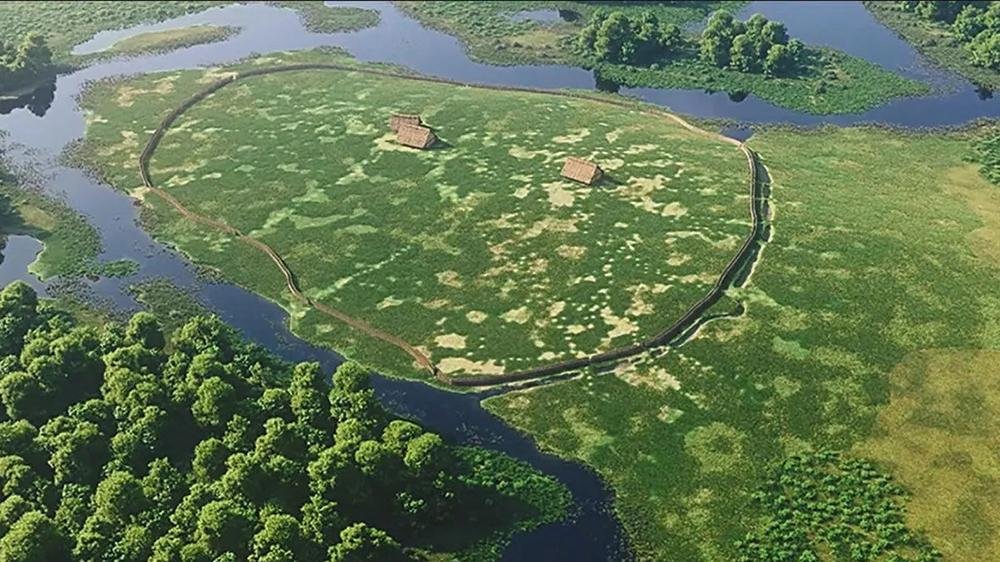
3D reconstruction of the enclosure of Le Peu and its environment from archaeological data. Credit: Vincent Ard et al / Antiquity Publications Ltd

People in west-central France built barrows and dolmens during the Neolithic period, and the people who built these structures have long been admired for their engineering prowess. Archaeologists have been trying to figure out where they lived for over a century.

A team of researchers has now identified the elusive Le Peu enclosure in southwestern France as where some of them lived. The site was discovered in 2011.

The researchers discovered evidence of an early settlement during an aerial survey of the Le Peu enclosure. Their findings were published in the journal Antiquity, along with a digital reconstruction of the site where these megalithic workers lived, just a few kilometers from their work site.

6,000-year-old settlement was home to Europe’s first megalithic builders
3D reconstruction of the enclosure of Le Peu and its environment from archaeological data. Credit: Vincent Ard et al / Antiquity Publications Ltd

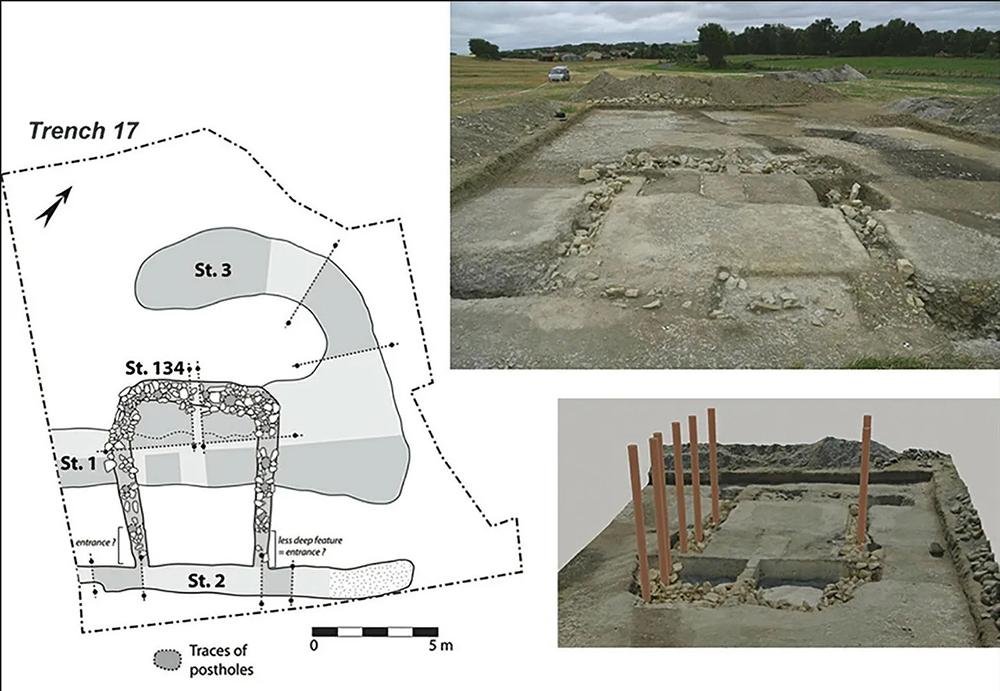
The study uncovered a palisade encircling several timber homes built during the fifth millennium BC. At least three homes, each about 13 meters long, were discovered clustered together near the top of a small hill surrounded by the palisade.

RelatedStories

Ancient DNA reveals male lineage and family ties in Neolithic Scotland tombs

Ancient DNA reveals male lineage and family ties in Neolithic Scotland tombs

April 16, 2026
How ancient communities adapted their diets and farming strategies in prehistoric Poland

How ancient communities adapted their diets and farming strategies in prehistoric Poland

February 26, 2026

This makes them the region’s oldest wooden structures and the first residential site contemporary with the Neolithic monument builders.

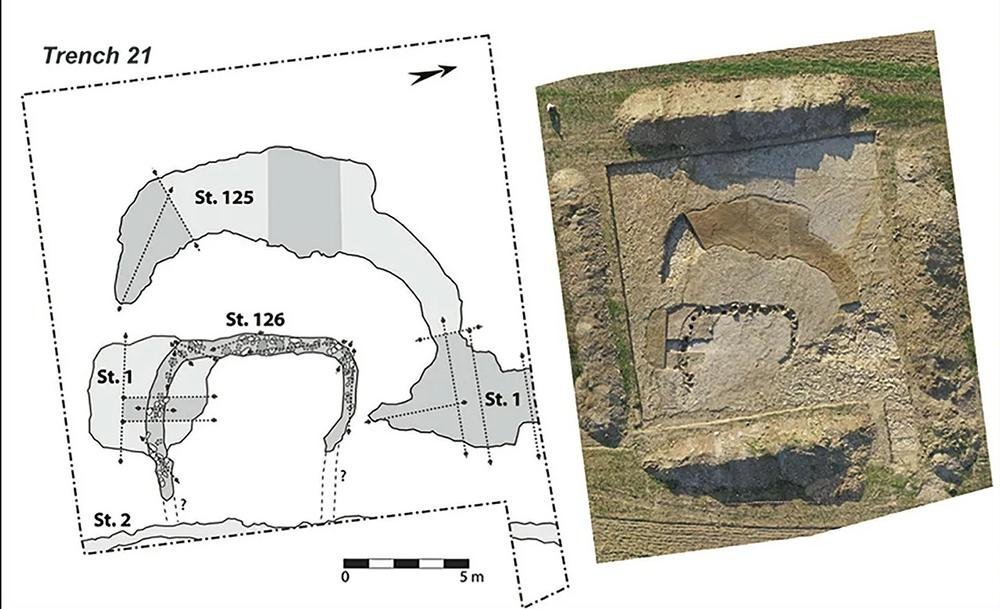
The researchers put together information about the settlement, the people who lived there, and potential cause of the site’s destruction. An analysis of the palaeosols recovered from the site suggests that  it was located on a promontory bordered by marsh. These natural defenses were reinforced by a ditch palisade wall with two monumental structures guarding the enclosure’s entrance.

About 4,400 BC, all of the buildings at the site were destroyed by fire, suggesting that the defenses at Le Peu weren’t able to defend the inhabitants during a conflict.

“In fact, this fortified compound at the Le Peu archaeological site near Charmé, a village in southwestern France, is one of hundreds of enclosures erected between the Loire and Dordogne rivers thousands of years ago,” said Dr. Vincent Ard from the French National Centre for Scientific Research, lead author of a paper published Tuesday in the journal Antiquity.
6,000-year-old settlement was home to Europe’s first megalithic builders

6,000-year-old settlement was home to Europe’s first megalithic builders
Plans and views of the entrances to two of the monumental buildings. CAD: V. Ard; orthophotography and 3D model: A. Laurent. Credit: Vincent Ard et al / Antiquity Publications Ltd

Radiocarbon study has been done at these sites, he said, but he and his colleagues believe the Le Peu enclosure, the homes, and palisade date back to the fourth or fifth millennium B.C.E.

Researchers are divided as to whether such monumental construction arose independently in Europe or spread from the Near East, where impressively massive stone complexes first appeared at least 12,000 years ago; anyway, for decades archaeologists have questioned how the people who built these things lived.

“The site reveals the existence of unique monumental architectures, probably defensive. This demonstrates a rise in Neolithic social tensions,” Dr. Ard added.

More information: Ard, V., Onfray, M., Aoustin, D., Bouchet, É, Bruniaux, G., Dandurand, G., . . . Vitté, H. (2023). The emergence of monumental architecture in Atlantic Europe: A fortified fifth-millennium BC enclosure in western France. Antiquity, 97(391), 50-69. doi:10.15184/aqy.2022.169

Share1Tweet1ShareShareSend

You May Also Like...

CT scans reveal hidden details of 2,300-year-old Egyptian mummies
Anthropology

CT scans reveal hidden details of 2,300-year-old Egyptian mummies

April 26, 2026
Rare 2,000-year-old Roman bread found at Vindonissa reveals early military life in Switzerland
Archaeology

Rare 2,000-year-old Roman bread found at Vindonissa reveals early military life in Switzerland

April 25, 2026
Over 1,000 archaeological features uncovered along Czech railway
Archaeology

Over 1,000 archaeological features uncovered along Czech railway

April 25, 2026
Ancient ship burial in Norway dates to CE 700, rewriting early Viking Age origins
Archaeology

Ancient ship burial in Norway dates to CE 700, rewriting early Viking Age origins

April 25, 2026
Ramses II statue found in Egypt’s eastern Nile Delta shows ancient reuse of royal monuments
Archaeology

Ramses II statue found in Egypt’s eastern Nile Delta shows ancient reuse of royal monuments

April 24, 2026
Late Bronze Age bronze ring hoard near Dresden reveals ritual practices and social life 1300–1100 BCE
Archaeology

Late Bronze Age bronze ring hoard near Dresden reveals ritual practices and social life 1300–1100 BCE

April 21, 2026

Follow us


Instagram
244K

Facebook
118K

Threads
46K

LinkedIn
14K

Twitter
6K

YouTube
1K
  • Trending
  • Comments
  • Latest
Shipwreck Salvage. Credit: rawpixel.com / Public Domain

2,000-year-old shipwreck discovered off Turkish coast with remarkably preserved stacked ceramics

July 2, 2025
Viking age DNA reveals 9,000-year-old HIV-resistant gene originating near the Black Sea

Viking age DNA reveals 9,000-year-old HIV-resistant gene originating near the Black Sea

May 18, 2025
A new study suggests the mysterious Voynich Manuscript may be a medieval cipher

A new study suggests the mysterious Voynich Manuscript may be a medieval cipher

January 3, 2026
3D analysis reveals Shroud of Turin image likely came from sculpture, not Jesus’ body

3D analysis reveals Shroud of Turin image likely came from sculpture, not Jesus’ body

August 3, 2025
Moses may be named in ancient Egyptian mine inscriptions, sparking debate over earliest biblical references

Moses may be named in ancient Egyptian mine inscriptions, sparking debate over earliest biblical references

July 31, 2025
3D analysis reveals Shroud of Turin image likely came from sculpture, not Jesus’ body

3D analysis reveals Shroud of Turin image likely came from sculpture, not Jesus’ body

Moses may be named in ancient Egyptian mine inscriptions, sparking debate over earliest biblical references

Moses may be named in ancient Egyptian mine inscriptions, sparking debate over earliest biblical references

$1 million prize offered to decipher 5,300-year-old Indus Valley script

$1 million prize offered to decipher 5,300-year-old Indus Valley script

Oldest ever genetic data from a human relative found in 2-million-year-old fossilized teeth

Oldest ever genetic data from a human relative found in 2-million-year-old fossilized teeth

Exceptionally large Roman shoes discovered at Magna fort near Hadrian’s Wall

Exceptionally large Roman shoes discovered at Magna fort near Hadrian’s Wall

CT scans reveal hidden details of 2,300-year-old Egyptian mummies

CT scans reveal hidden details of 2,300-year-old Egyptian mummies

April 26, 2026
Rare 2,000-year-old Roman bread found at Vindonissa reveals early military life in Switzerland

Rare 2,000-year-old Roman bread found at Vindonissa reveals early military life in Switzerland

April 25, 2026
Over 1,000 archaeological features uncovered along Czech railway

Over 1,000 archaeological features uncovered along Czech railway

April 25, 2026
Ancient ship burial in Norway dates to CE 700, rewriting early Viking Age origins

Ancient ship burial in Norway dates to CE 700, rewriting early Viking Age origins

April 25, 2026
Ramses II statue found in Egypt’s eastern Nile Delta shows ancient reuse of royal monuments

Ramses II statue found in Egypt’s eastern Nile Delta shows ancient reuse of royal monuments

April 24, 2026

Archaeology News online magazine

Archaeology News is an international online magazine that covers all aspects of archaeology.


Categories

  • Academics
    • Books
    • Conferences
    • Universities
  • Articles
  • Download
  • Game
  • News
    • Anthropology
    • Archaeology
    • Paleontology
  • Quiz
  • Tours

Subscribe to our newsletter

© 2024 - Archaeology News Online Magazine. All Rights Reserved.

  • About
  • Privacy Policy
  • Terms of Use
  • Donation
  • Contact

Manage Consent
To provide the best experiences, we use technologies like cookies to store and/or access device information. Consenting to these technologies will allow us to process data such as browsing behavior or unique IDs on this site. Not consenting or withdrawing consent, may adversely affect certain features and functions.
Functional Always active
The technical storage or access is strictly necessary for the legitimate purpose of enabling the use of a specific service explicitly requested by the subscriber or user, or for the sole purpose of carrying out the transmission of a communication over an electronic communications network.
Preferences
The technical storage or access is necessary for the legitimate purpose of storing preferences that are not requested by the subscriber or user.
Statistics
The technical storage or access that is used exclusively for statistical purposes. The technical storage or access that is used exclusively for anonymous statistical purposes. Without a subpoena, voluntary compliance on the part of your Internet Service Provider, or additional records from a third party, information stored or retrieved for this purpose alone cannot usually be used to identify you.
Marketing
The technical storage or access is required to create user profiles to send advertising, or to track the user on a website or across several websites for similar marketing purposes.
  • Manage options
  • Manage services
  • Manage {vendor_count} vendors
  • Read more about these purposes
View preferences
  • {title}
  • {title}
  • {title}
  • Home
  • News
    • Archaeology
    • Anthropology
    • Paleontology
  • Academic
    • Books
    • Conferences
    • Universities
  • Articles
  • VR Tours
  • Quiz & Game
  • Download
  • Encyclopedia
  • Forum

About  .  Contact  .  Donation

© 2024 - Archaeology News Online Magazine. All Rights Reserved