• About
  • Privacy Policy
  • Terms of Use
  • Donation
  • Contact
No Result
View All Result
Archaeology News
  • Home
  • News
    • Archaeology
    • Anthropology
    • Paleontology
  • Academic
    • Books
    • Conferences
    • Universities
  • Articles
  • VR Tours
  • Quiz & Game
  • Download
  • Encyclopedia
  • Forum
Archaeology News
No Result
View All Result
Home News Archaeology

Archaeological excavation reveals quartz path in Dartmoor

by Dario Radley
October 3, 2023

Archaeologists have discovered a quartz-paved surface at Piles Hill, located within the expansive Dartmoor region in southwestern England. This exciting find was made during a week-long excavation that involved the collaborative efforts of Dartmoor National Park Archaeologists, Isca Archaeology, and a dedicated team of volunteers.
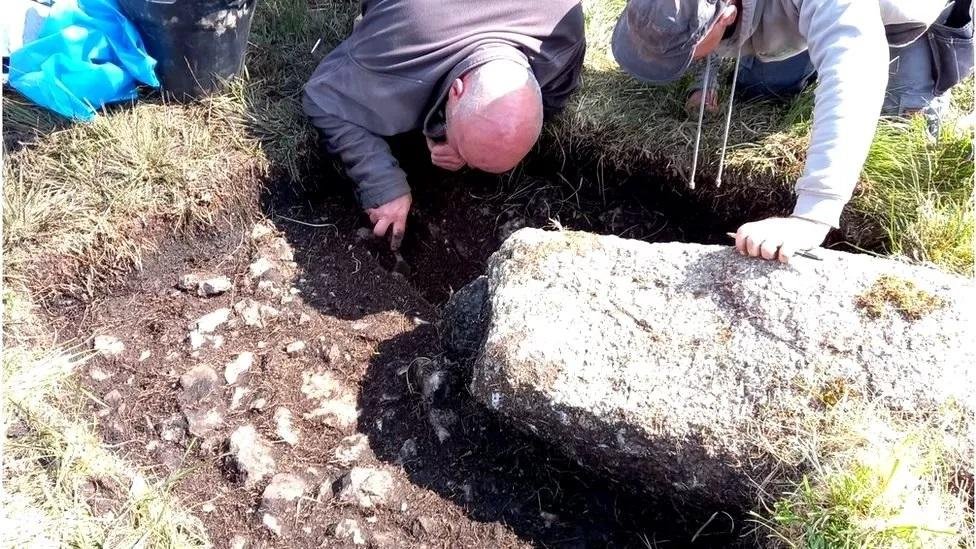
Archaeological excavation reveals quartz path in Dartmoor
Credit: Dartmoor National Park

The excavation, funded by the National Lottery Heritage Fund, Historic England, and the Dartmoor Preservation Association, is part of the “Our Upland Commons” initiative. This initiative is aimed at enhancing our knowledge of upland commons across Dartmoor and similar areas.

The setting for this discovery, Piles Hill, is home to a remarkable double stone row, a monument of considerable historical and ritual significance. Stretching over an impressive 850 meters across Ugborough and Harford Moors, this stone row aligns itself east to west and gently curves upwards, forming a shape akin to a smile.

It is believed to date back to the Neolithic or Early Bronze Age, and it’s comprised of around 40 visible stones. Some of these stones stand upright, while others lie recumbent on the ground, concealed by the surrounding vegetation.

The manner in which the stones lie flat has long intrigued archaeologists and posed questions about whether this positioning was intentional, a result of stones toppling over, or if the monument once had a different alignment. To answer these queries and delve deeper into the mysteries of Piles Hill, the recent excavation was undertaken. To everyone’s surprise, this excavation unveiled yet another enigmatic aspect of Dartmoor’s past—a quartz-paved surface.

The leader of the excavation, National Park Archaeologist Andy Crabb, shared their findings, saying, “As we’d hoped, excavations uncovered large socket holes underneath the ends of the fallen stones, demonstrating that stones once stood upright. This confirmed findings from a geophysical survey last year. But we also made a new discovery. In our last trench, we uncovered a paved cobble-like surface made of angular rocks, consisting predominantly of white quartz. At first, we thought it was the natural geology, but further investigations showed otherwise. We think the rocks were brought to the site and laid there deliberately, possibly to enhance the setting of the stone row.”

The intriguing aspect of this discovery is that the paved path appears to have been intentionally created, potentially to enhance the significance and setting of the stone row. This sheds light on the careful thought and planning that went into the design of such ancient monuments.

This recent discovery of the quartz-paved path at Piles Hill is not unprecedented in the field of Dartmoor archaeology. A similar paved causeway was found at The Hurlers, a prehistoric complex situated on the granite uplands of Bodmin Moor, during an excavation in the 1930s.

The excavation at Piles Hill, conducted in August, has concluded, but post-excavation analysis is ongoing. The team aims to extract precise dating evidence and environmental information from the site samples. Moreover, efforts to secure funding for the restoration of the fallen stones to their original upright positions are underway, potentially making this site an even more prominent and visible scheduled monument.

Share:

Share on Facebook Share on X (Twitter) Share on LinkedIn Share on Pinterest Share on WhatsApp Share on Email

Related Posts

Stone Age humans built complex grass beds at Border Cave 200,000 years ago, study finds
Archaeology

Stone Age humans built complex grass beds at Border Cave 200,000 years ago, study finds

May 30, 2026
Radiocarbon dating confirms Teutonic Knights built Feldioara Fortress in 13th-century Transylvania
Archaeology

Radiocarbon dating confirms Teutonic Knights built Feldioara Fortress in 13th-century Transylvania

May 30, 2026
Ancient shipwreck with 300 amphorae found off Italy could reshape views of Mediterranean wine trade
Archaeology

Ancient shipwreck with 300 amphorae found off Italy could reshape views of Mediterranean wine trade

May 29, 2026
Ancient DNA reveals 700-kilometer migration along Peru’s coast before the Inca Empire
Anthropology

Ancient DNA reveals 700-kilometer migration along Peru’s coast before the Inca Empire

May 29, 2026
6,000-year-old mega-structure unearthed at prehistoric settlement in Romania
Archaeology

6,000-year-old mega-structure unearthed at prehistoric settlement in Romania

May 29, 2026
Medieval bone study identifies microbial communities driving archaeological bone degradation and preservation
Anthropology

Medieval bone study identifies microbial communities driving archaeological bone degradation and preservation

May 28, 2026

Follow us


Instagram
242K

Facebook
117K

Threads
47K

LinkedIn
15K

Twitter
6K

YouTube
1K

Archaeology News online magazine

Archaeology News is an international online magazine that covers all aspects of archaeology.


Categories

  • Academics
    • Books
    • Conferences
    • Universities
  • Articles
  • Download
  • Game
  • News
    • Anthropology
    • Archaeology
    • Paleontology
  • Quiz
  • Tours

Subscribe to our newsletter

© 2024 - Archaeology News Online Magazine. All Rights Reserved.

  • About
  • Privacy Policy
  • Terms of Use
  • Donation
  • Contact

Manage Consent
To provide the best experiences, we use technologies like cookies to store and/or access device information. Consenting to these technologies will allow us to process data such as browsing behavior or unique IDs on this site. Not consenting or withdrawing consent, may adversely affect certain features and functions.
Functional Always active
The technical storage or access is strictly necessary for the legitimate purpose of enabling the use of a specific service explicitly requested by the subscriber or user, or for the sole purpose of carrying out the transmission of a communication over an electronic communications network.
Preferences
The technical storage or access is necessary for the legitimate purpose of storing preferences that are not requested by the subscriber or user.
Statistics
The technical storage or access that is used exclusively for statistical purposes. The technical storage or access that is used exclusively for anonymous statistical purposes. Without a subpoena, voluntary compliance on the part of your Internet Service Provider, or additional records from a third party, information stored or retrieved for this purpose alone cannot usually be used to identify you.
Marketing
The technical storage or access is required to create user profiles to send advertising, or to track the user on a website or across several websites for similar marketing purposes.
  • Manage options
  • Manage services
  • Manage {vendor_count} vendors
  • Read more about these purposes
View preferences
  • {title}
  • {title}
  • {title}
  • Home
  • News
    • Archaeology
    • Anthropology
    • Paleontology
  • Academic
    • Books
    • Conferences
    • Universities
  • Articles
  • VR Tours
  • Quiz & Game
  • Download
  • Encyclopedia
  • Forum

About  .  Contact  .  Donation

© 2024 - Archaeology News Online Magazine. All Rights Reserved