• About
  • Privacy Policy
  • Terms of Use
  • Donation
  • Contact
No Result
View All Result
Archaeology News
  • Home
  • News
    • Archaeology
    • Anthropology
    • Paleontology
  • Academic
    • Books
    • Conferences
    • Universities
  • Articles
  • VR Tours
  • Quiz & Game
  • Download
  • Encyclopedia
  • Forum
Archaeology News
No Result
View All Result
Home News Archaeology

Archaeomagnetic analysis reveals construction timeline of Babylon’s Ishtar Gate

by Dario Radley
January 18, 2024

Babylon’s iconic Ishtar Gate, a brilliant blue glazed-brick structure commissioned by King Nebuchadnezzar II, has long been shrouded in mystery regarding its construction timeline. A recent study, titled “An archaeomagnetic study of the Ishtar Gate, Babylon,” published in the journal PLOS One, sheds light on the historical puzzle by employing advanced techniques to measure geomagnetic fields preserved in clay bricks.
Archaeomagnetic analysis reveals construction timeline of Babylon's Ishtar Gate
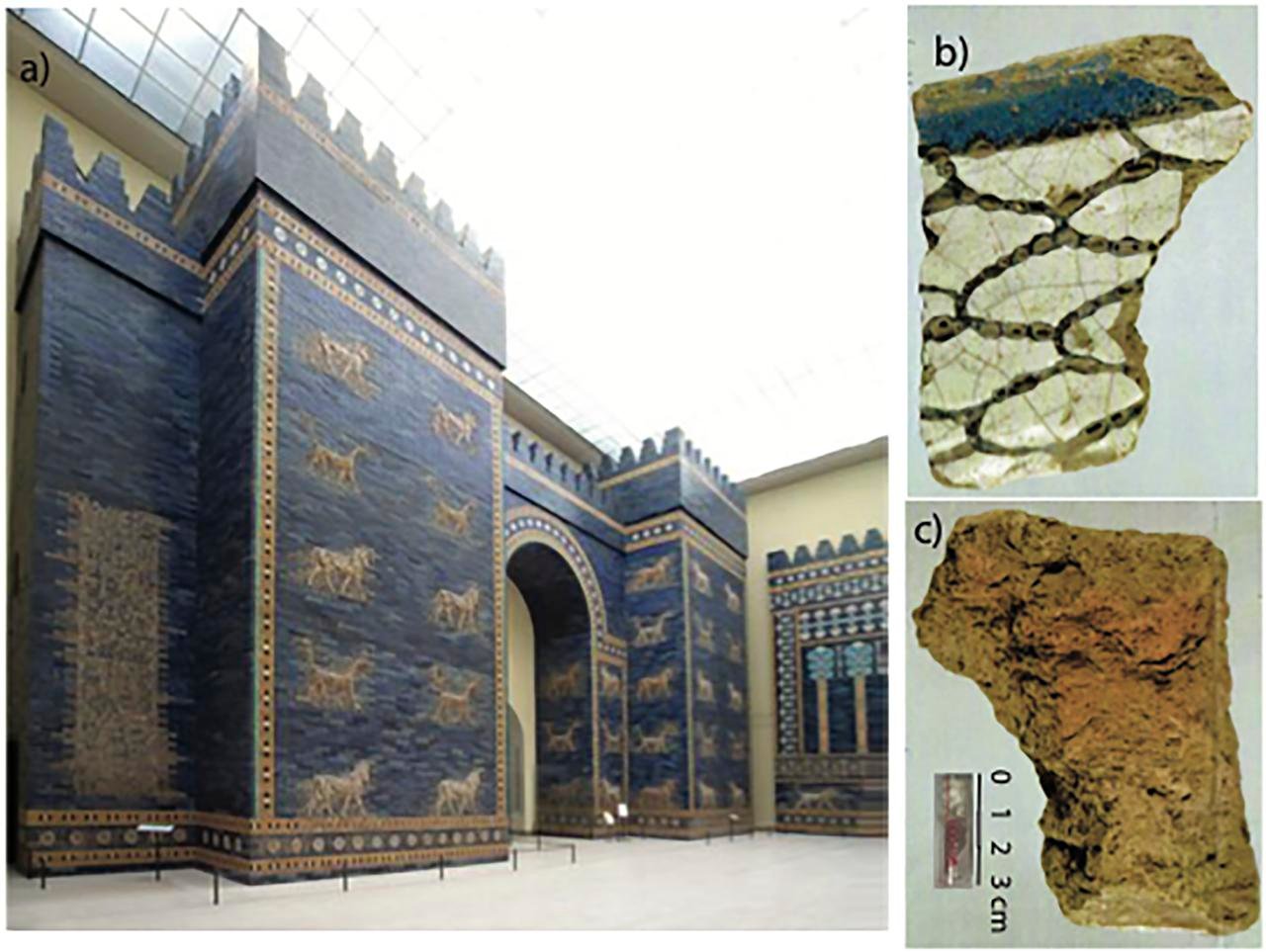
a) Ishtar Gate as reconstructed in the Pergamon Museum in Berlin, Germany. b) Brick (VA 17504) with blue glaze on the left hand side. Blue glaze was on the top of the brick. c) Back side of brick. Small fragments (0.1 gm) were taken from the brick and placed in specimen tubes like that shown in the inset. Credit: Staatliche Museen zu Berlin, Vorderasiatisches Museum / Olaf M. Teßmer/ Anita Di Chiara et al., PLOS One (2024)

Previous beliefs tied the construction of the Ishtar Gate to the celebration of the Babylonian conquest of Jerusalem. However, a comprehensive analysis challenges this notion, suggesting that the gate’s purpose may have been different than initially thought. The gate, featuring wild bulls and mušhuššu-dragons, was erected in three phases and served as the entrance to the ancient city of Babylon in southern Mesopotamia.

Archaeologists faced uncertainties about the timeline of construction phases following Nebuchadnezzar II’s initial order. Some researchers even questioned if the king had died before the gate’s completion. To resolve these uncertainties, the research team collected tiny samples from five fired mud bricks representing the three construction phases of the Ishtar Gate, now housed at the Pergamon Museum in Berlin.

Utilizing archaeomagnetism, a method that measures the preserved geomagnetic fields in archaeological objects, the team aimed to establish a more precise construction timeframe than traditional radiocarbon dating. This analysis revealed that there were no substantial chronological gaps between the construction phases, providing a unified construction period around 583 BCE.

Archaeomagnetic analysis reveals construction timeline of Babylon's Ishtar Gate
The Ishtar Gate of Babylon as seen at the Pergamon Museum in Germany. Credit: youngrobv via flickr

As the authors write in their paper, “The gate complex was constructed some time after the Babylonian conquest of Jerusalem in 586 BCE, and there were no substantial chronological gaps in the construction of each consecutive phase.” The researchers emphasized that the magnetic field measurements in the bricks were consistent, indicating a cohesive construction process during Nebuchadnezzar II’s reign.

RelatedStories

Archaeologists identify forgotten city of Alexandria on the Tigris in southern Iraq

Archaeologists identify forgotten city of Alexandria on the Tigris in southern Iraq

February 3, 2026
Unexpected discovery: sand layer beneath Ishtar Temple in Assur reveals city’s founding and ancient ritual practices

Unexpected discovery: sand layer beneath Ishtar Temple in Assur reveals city’s founding and ancient ritual practices

February 2, 2026

Contrary to previous speculations, the study challenges the idea that the Ishtar Gate’s style evolved during construction. Instead, it suggests that phases II and III are integral to the original design, reflecting the construction process rather than later additions detached from the initial phase.

Standing at a height exceeding 38 feet, the Ishtar Gate derives its name from the Babylonian goddess Ishtar. Its facade is embellished with alternating rows of dragons and bulls, showcasing a combination of glazed bricks in yellow and brown tiles, encased by blue bricks thought to be crafted from lapis lazuli. Functioning as the majestic entrance to the city, this remarkable gate held a distinguished place on the original roster of the Seven Wonders of the Ancient World.

Archaeomagnetic analysis reveals construction timeline of Babylon's Ishtar Gate
One of the Mushkhusshu (mušḫuššu) dragons from the gate. Pergamon Museum, Berlin. Credit: Raffaele Pagani via Wikimedia Commons

The study’s findings not only provide clarity about the Ishtar Gate’s construction timeline but also open avenues for further archaeomagnetic analyses on other ancient structures in Mesopotamia. Fired mud bricks, common in that era, have proven to be reliable sources for archaeomagnetic studies. Researchers aim to expand their investigations to enhance the understanding of ancient structures in southern Mesopotamia.


More information: Di Chiara A, Tauxe L, Gries H, Helwing B, Howland MD, Ben-Yosef E (2024) An archaeomagnetic study of the Ishtar Gate, Babylon. PLoS ONE 19(1): e0293014. doi.org/10.1371/journal.pone.0293014
Share22Tweet14Share4ShareSend

You May Also Like...

Roman cemetery in Egypt reveals golden tongues, mummies, and rare Iliad papyrus
Anthropology

Roman cemetery in Egypt reveals golden tongues, mummies, and rare Iliad papyrus

April 19, 2026
Basel plague study finds young workers had highest death rates in 17th century outbreak
Anthropology

Basel plague study finds young workers had highest death rates in 17th century outbreak

April 17, 2026
Ancient DNA reveals male lineage and family ties in Neolithic Scotland tombs
Anthropology

Ancient DNA reveals male lineage and family ties in Neolithic Scotland tombs

April 16, 2026
Council houses reveal shift from royal rule to collective governance in Terminal Classic Maya society
Archaeology

Council houses reveal shift from royal rule to collective governance in Terminal Classic Maya society

April 11, 2026
Bronze Age loom found inside ancient Spanish home reveals early textile production
Archaeology

Bronze Age loom found inside ancient Spanish home reveals early textile production

April 8, 2026
Pompeii ash analysis reveals Romans burned wine and imported frankincense in household rituals
Archaeology

Pompeii ash analysis reveals Romans burned wine and imported frankincense in household rituals

April 3, 2026

Follow us


Instagram
244K

Facebook
118K

Threads
46K

LinkedIn
14K

Twitter
6K

YouTube
1K
  • Trending
  • Comments
  • Latest
Shipwreck Salvage. Credit: rawpixel.com / Public Domain

2,000-year-old shipwreck discovered off Turkish coast with remarkably preserved stacked ceramics

July 2, 2025
Viking age DNA reveals 9,000-year-old HIV-resistant gene originating near the Black Sea

Viking age DNA reveals 9,000-year-old HIV-resistant gene originating near the Black Sea

May 18, 2025
A new study suggests the mysterious Voynich Manuscript may be a medieval cipher

A new study suggests the mysterious Voynich Manuscript may be a medieval cipher

January 3, 2026
3D analysis reveals Shroud of Turin image likely came from sculpture, not Jesus’ body

3D analysis reveals Shroud of Turin image likely came from sculpture, not Jesus’ body

August 3, 2025
Moses may be named in ancient Egyptian mine inscriptions, sparking debate over earliest biblical references

Moses may be named in ancient Egyptian mine inscriptions, sparking debate over earliest biblical references

July 31, 2025
3D analysis reveals Shroud of Turin image likely came from sculpture, not Jesus’ body

3D analysis reveals Shroud of Turin image likely came from sculpture, not Jesus’ body

Moses may be named in ancient Egyptian mine inscriptions, sparking debate over earliest biblical references

Moses may be named in ancient Egyptian mine inscriptions, sparking debate over earliest biblical references

$1 million prize offered to decipher 5,300-year-old Indus Valley script

$1 million prize offered to decipher 5,300-year-old Indus Valley script

Oldest ever genetic data from a human relative found in 2-million-year-old fossilized teeth

Oldest ever genetic data from a human relative found in 2-million-year-old fossilized teeth

Exceptionally large Roman shoes discovered at Magna fort near Hadrian’s Wall

Exceptionally large Roman shoes discovered at Magna fort near Hadrian’s Wall

Roman cemetery in Egypt reveals golden tongues, mummies, and rare Iliad papyrus

Roman cemetery in Egypt reveals golden tongues, mummies, and rare Iliad papyrus

April 19, 2026
Basel plague study finds young workers had highest death rates in 17th century outbreak

Basel plague study finds young workers had highest death rates in 17th century outbreak

April 17, 2026
Ancient DNA reveals male lineage and family ties in Neolithic Scotland tombs

Ancient DNA reveals male lineage and family ties in Neolithic Scotland tombs

April 16, 2026
Council houses reveal shift from royal rule to collective governance in Terminal Classic Maya society

Council houses reveal shift from royal rule to collective governance in Terminal Classic Maya society

April 11, 2026
Bronze Age loom found inside ancient Spanish home reveals early textile production

Bronze Age loom found inside ancient Spanish home reveals early textile production

April 8, 2026

Archaeology News online magazine

Archaeology News is an international online magazine that covers all aspects of archaeology.


Categories

  • Academics
    • Books
    • Conferences
    • Universities
  • Articles
  • Download
  • Game
  • News
    • Anthropology
    • Archaeology
    • Paleontology
  • Quiz
  • Tours

Subscribe to our newsletter

© 2024 - Archaeology News Online Magazine. All Rights Reserved.

  • About
  • Privacy Policy
  • Terms of Use
  • Donation
  • Contact

Manage Consent
To provide the best experiences, we use technologies like cookies to store and/or access device information. Consenting to these technologies will allow us to process data such as browsing behavior or unique IDs on this site. Not consenting or withdrawing consent, may adversely affect certain features and functions.
Functional Always active
The technical storage or access is strictly necessary for the legitimate purpose of enabling the use of a specific service explicitly requested by the subscriber or user, or for the sole purpose of carrying out the transmission of a communication over an electronic communications network.
Preferences
The technical storage or access is necessary for the legitimate purpose of storing preferences that are not requested by the subscriber or user.
Statistics
The technical storage or access that is used exclusively for statistical purposes. The technical storage or access that is used exclusively for anonymous statistical purposes. Without a subpoena, voluntary compliance on the part of your Internet Service Provider, or additional records from a third party, information stored or retrieved for this purpose alone cannot usually be used to identify you.
Marketing
The technical storage or access is required to create user profiles to send advertising, or to track the user on a website or across several websites for similar marketing purposes.
  • Manage options
  • Manage services
  • Manage {vendor_count} vendors
  • Read more about these purposes
View preferences
  • {title}
  • {title}
  • {title}
  • Home
  • News
    • Archaeology
    • Anthropology
    • Paleontology
  • Academic
    • Books
    • Conferences
    • Universities
  • Articles
  • VR Tours
  • Quiz & Game
  • Download
  • Encyclopedia
  • Forum

About  .  Contact  .  Donation

© 2024 - Archaeology News Online Magazine. All Rights Reserved