• About
  • Privacy Policy
  • Terms of Use
  • Donation
  • Contact
No Result
View All Result
Archaeology News
  • Home
  • News
    • Archaeology
    • Anthropology
    • Paleontology
  • Academic
    • Books
    • Conferences
    • Universities
  • Articles
  • VR Tours
  • Quiz & Game
  • Download
  • Encyclopedia
  • Forum
Archaeology News
No Result
View All Result
Home News Archaeology

12,500-year-old rock art in Colombian Amazon reveals complex human-animal relationships

by Dario Radley
July 27, 2024

A recent study of rock art in the Colombian Amazon provides new insights into the complex relationships between the region’s earliest settlers and the animals they encountered. The research, published in the Journal of Anthropological Archaeology, focuses on the Cerro Azul site in the Serranía de la Lindosa, a region adorned with thousands of ochre paintings on rocky outcrops.
12,500-year-old rock art in Colombian Amazon reveals complex human-animal relationships
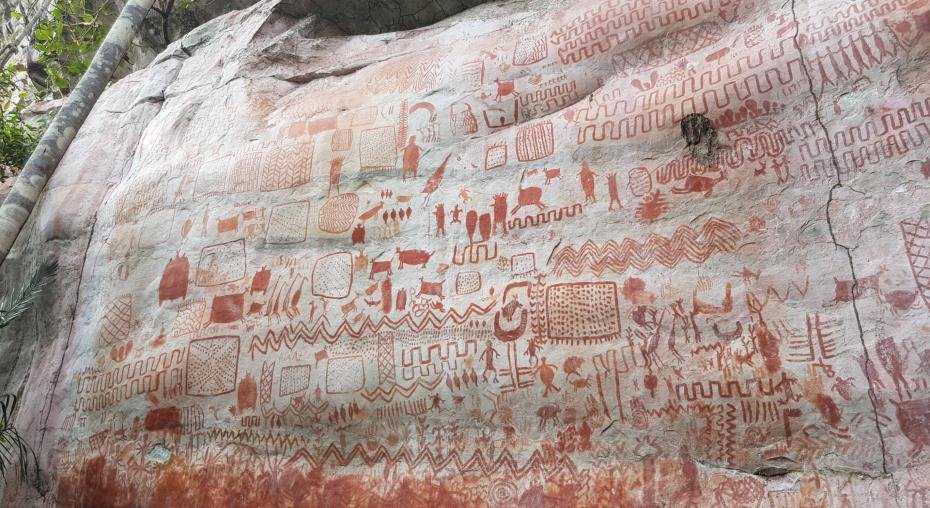
The rock art at Cerro Azul is the earliest evidence of humans living in western Amazonia. Credit: University of Exeter

The rock art at Cerro Azul, dating back approximately 12,500 years, represents some of the earliest evidence of human presence in western Amazonia. “These rock art sites include the earliest evidence of humans in western Amazonia,” said Dr. Mark Robinson, an Associate Professor of Archaeology at the University of Exeter.

The research team cataloged 3,223 images using drone photogrammetry and traditional photography. These images were categorized by form, with 58% being figurative. Of these, more than half depicted animals, including deer, birds, peccary, lizards, turtles, and tapir. In total, at least 22 different animal species were identified.

Interestingly, the proportions of animal bones found in nearby excavations do not align with the frequency of animals depicted in the art. This suggests that the ancient artists did not simply paint the animals they commonly ate. The animal bones revealed a varied diet including fish, small to large mammals, and reptiles such as turtles, snakes, and crocodiles.
12,500-year-old rock art in Colombian Amazon reveals complex human-animal relationships
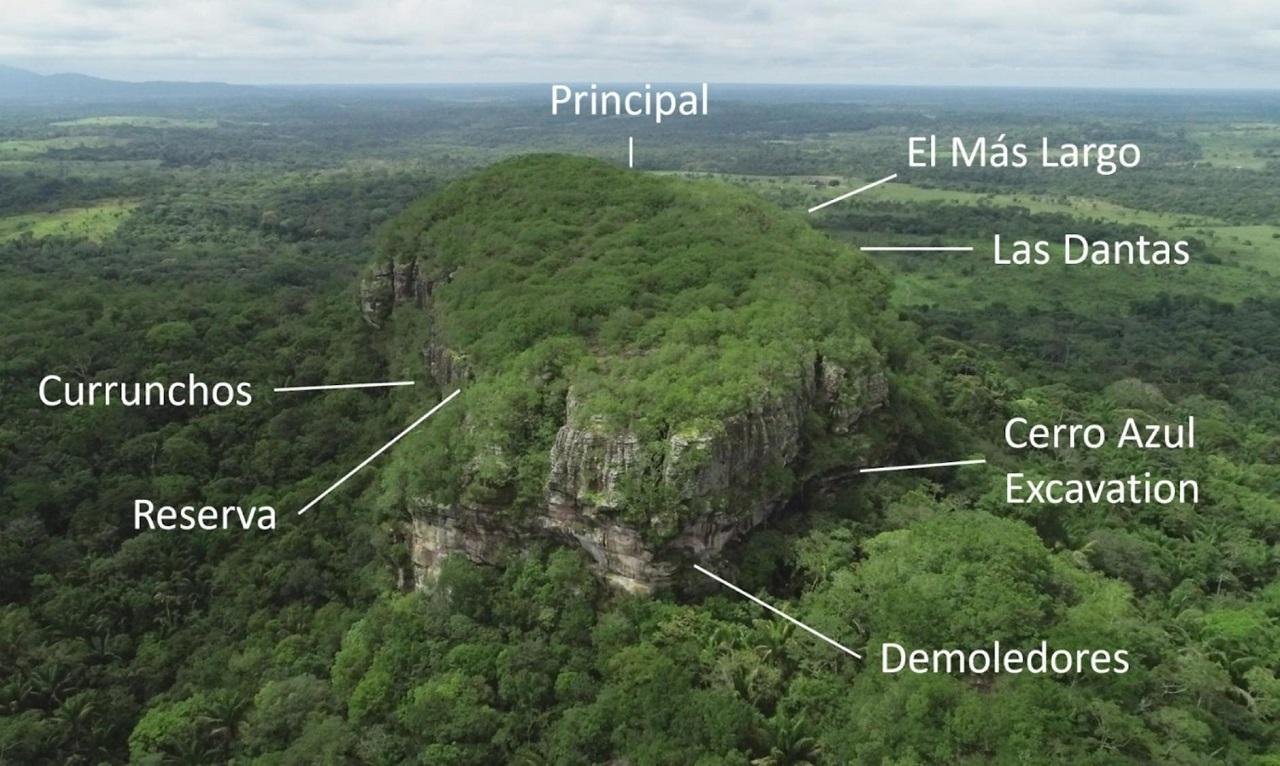
Cerro Azul with the location of the rock art panels and the excavation site analyzed in this study. Credit: Robinson et al., Journal of Anthropological Archaeology (2024)

“The context demonstrates the complexity of Amazonian relationships with animals, both as a food source but also as revered beings, which had supernatural connections and demanded complex negotiations from ritual specialists,” Dr. Robinson explained.


RelatedStories

5,000 year old rock art in Sinai shows early Egyptian conquest and control of copper mines

5,000 year old rock art in Sinai shows early Egyptian conquest and control of copper mines

January 30, 2026
Masters behind Nordic Bronze Age rock art and their social role

Masters behind Nordic Bronze Age rock art and their social role

January 27, 2026

The art also reveals a rich mythology that guided generations of indigenous Amazonians. Some images depict transformations between humans and animals, highlighting a complex belief system. “Though we cannot be certain what meaning these images have, they certainly do offer greater nuance to our understanding of the power of myths in indigenous communities,” noted Professor José Iriarte of the University of Exeter. “They are particularly revealing when it comes to more cosmological aspects of Amazonian life, such as what is considered taboo, where power resides, and how negotiations with the supernatural were conducted.”

Among the 16 ‘panels’ of ochre drawings at Cerro Azul, six were studied in detail. These ranged from the expansive 40-meter-by-10-meter El Más Largo, containing over 1,000 images, to the smaller 10-meter-by-6-meter Principal, which holds 244 images. Many of these images are well-preserved and vividly red.
12,500-year-old rock art in Colombian Amazon reveals complex human-animal relationships
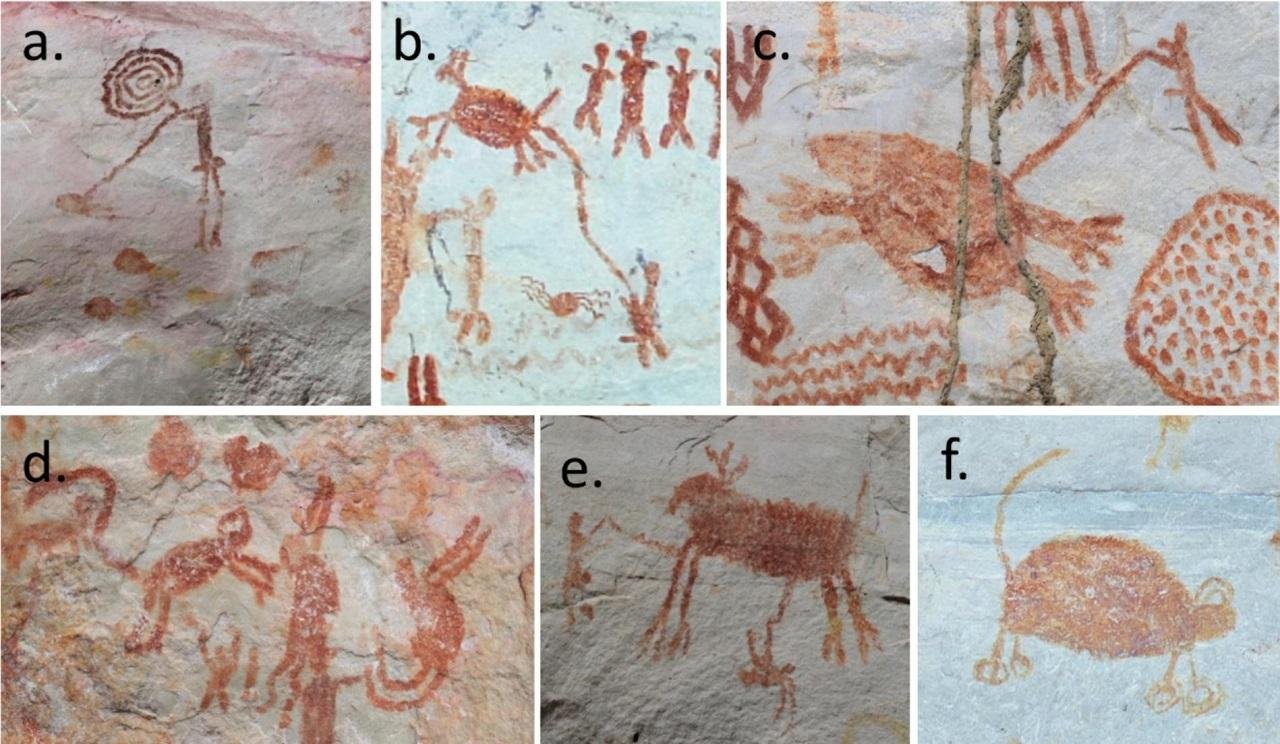
Images of potential a) fishing; b, c, e) hunting; d) monkey leaping/transforming sequence; f) and an unknown animal with circular feet and curved head elements. Credit: Robinson et al., Journal of Anthropological Archaeology (2024)

Despite the abundance of fish remains found in archaeological sites, their depiction in the art is limited, appearing in just two panels in what seem to be fishing scenes. Notably absent are big cats, such as jaguars, despite their significance as apex predators in the region. This absence might indicate a cultural restriction on depicting such powerful animals.

Dr. Javier Aceituno of Universidad de Antioquia said: “The Indigenous people of Cerro Azul and the surrounding lands hunted and depicted a diverse array of animals from different ecologies – from aquatic fish to arboreal monkeys; terrestrial deer to aerial birds, both nocturnal and diurnal.” This broad subsistence strategy involved tracking and hunting animals and harvesting plants from various habitats, including savannahs, flooded forests, and rivers.

By comparing the depicted animals with the remains found, the researchers concluded that rock art was not merely a record of daily life but also a representation of the settlers’ spiritual and cultural beliefs. “Our approach reveals differences between what indigenous communities exploited for food and what is conceptually important to represent – and not represent – in art,” Professor Iriarte concluded.


University of Exeter

More information: Robinson, M., Hampson, J., Osborn, J., Aceituno, F. J., Morcote-Ríos, G., Ziegler, M. J., & Iriarte, J. (2024). Animals of the Serranía de la Lindosa: Exploring representation and categorisation in the rock art and zooarchaeological remains of the Colombian Amazon. Journal of Anthropological Archaeology, 75(101613), 101613. doi:10.1016/j.jaa.2024.101613
Share21Tweet13Share4ShareSend

You May Also Like...

Scents of ancient Egypt: tracing embalming recipes by analyzing air around mummies
Anthropology

Scents of ancient Egypt: tracing embalming recipes by analyzing air around mummies

February 6, 2026
New study reveals advanced lead pipeline system in Petra’s ancient aqueduct
Archaeology

New study reveals advanced lead pipeline system in Petra’s ancient aqueduct

February 6, 2026
Early human innovation in southern Africa tied to mobility and social networks rather than climate alone, new study shows
Archaeology

Early human innovation in southern Africa tied to mobility and social networks rather than climate alone, new study shows

February 6, 2026
LiDAR mapping reveals over 630,000 historic charcoal kiln sites across Poland’s forests
Archaeology

LiDAR mapping reveals over 630,000 historic charcoal kiln sites across Poland’s forests

February 5, 2026
CT scans of ancient Egyptian mummies reveal lifespans, health, and daily life of priests
Anthropology

CT scans of ancient Egyptian mummies reveal lifespans, health, and daily life of priests

February 4, 2026
14,000-year-old Alaska campsite helps trace how the first people arrived in North America
Archaeology

14,000-year-old Alaska campsite helps trace how the first people arrived in North America

February 4, 2026

Comments 1

  1. Editorial Team says:
    1 second ago

    Disclaimer: This website is a science-focused magazine that welcomes both academic and non-academic audiences. Comments are written by users and may include personal opinions or unverified claims. They do not necessarily reflect the views of our editorial team or rely on scientific evidence.

    Comment Policy: We kindly ask all commenters to engage respectfully. Comments that contain offensive, insulting, degrading, discriminatory, or racist content will be automatically removed.

  2. Sf. R. Careaga, creator of EPEMC says:
    1 year ago

    The single most important art on this set of rocks, is not even mentioned. Amazing.

Follow us


Instagram
244K

Facebook
118K

Threads
45K

LinkedIn
14K

Twitter
6K

YouTube
1K
  • Trending
  • Comments
  • Latest
Shipwreck Salvage. Credit: rawpixel.com / Public Domain

2,000-year-old shipwreck discovered off Turkish coast with remarkably preserved stacked ceramics

July 2, 2025
Viking age DNA reveals 9,000-year-old HIV-resistant gene originating near the Black Sea

Viking age DNA reveals 9,000-year-old HIV-resistant gene originating near the Black Sea

May 18, 2025
A new study suggests the mysterious Voynich Manuscript may be a medieval cipher

A new study suggests the mysterious Voynich Manuscript may be a medieval cipher

January 3, 2026
Moses may be named in ancient Egyptian mine inscriptions, sparking debate over earliest biblical references

Moses may be named in ancient Egyptian mine inscriptions, sparking debate over earliest biblical references

July 31, 2025
Mystery of Armenia’s 6,000-year-old dragon stones solved

Mystery of Armenia’s 6,000-year-old dragon stones solved

September 23, 2025
3D analysis reveals Shroud of Turin image likely came from sculpture, not Jesus’ body

3D analysis reveals Shroud of Turin image likely came from sculpture, not Jesus’ body

Moses may be named in ancient Egyptian mine inscriptions, sparking debate over earliest biblical references

Moses may be named in ancient Egyptian mine inscriptions, sparking debate over earliest biblical references

$1 million prize offered to decipher 5,300-year-old Indus Valley script

$1 million prize offered to decipher 5,300-year-old Indus Valley script

Oldest ever genetic data from a human relative found in 2-million-year-old fossilized teeth

Oldest ever genetic data from a human relative found in 2-million-year-old fossilized teeth

Exceptionally large Roman shoes discovered at Magna fort near Hadrian’s Wall

Exceptionally large Roman shoes discovered at Magna fort near Hadrian’s Wall

Scents of ancient Egypt: tracing embalming recipes by analyzing air around mummies

Scents of ancient Egypt: tracing embalming recipes by analyzing air around mummies

February 6, 2026
New study reveals advanced lead pipeline system in Petra’s ancient aqueduct

New study reveals advanced lead pipeline system in Petra’s ancient aqueduct

February 6, 2026
Early human innovation in southern Africa tied to mobility and social networks rather than climate alone, new study shows

Early human innovation in southern Africa tied to mobility and social networks rather than climate alone, new study shows

February 6, 2026
LiDAR mapping reveals over 630,000 historic charcoal kiln sites across Poland’s forests

LiDAR mapping reveals over 630,000 historic charcoal kiln sites across Poland’s forests

February 5, 2026
CT scans of ancient Egyptian mummies reveal lifespans, health, and daily life of priests

CT scans of ancient Egyptian mummies reveal lifespans, health, and daily life of priests

February 4, 2026

Archaeology News online magazine

Archaeology News is an international online magazine that covers all aspects of archaeology.


Categories

  • Academics
    • Books
    • Conferences
    • Universities
  • Articles
  • Download
  • Game
  • News
    • Anthropology
    • Archaeology
    • Paleontology
  • Quiz
  • Tours

Subscribe to our newsletter

© 2024 - Archaeology News Online Magazine. All Rights Reserved.

  • About
  • Privacy Policy
  • Terms of Use
  • Donation
  • Contact

Welcome Back!

Login to your account below

Forgotten Password? Sign Up

Create New Account!

Fill the forms below to register

All fields are required. Log In

Retrieve your password

Please enter your username or email address to reset your password.

Log In

Add New Playlist

Manage Consent
To provide the best experiences, we use technologies like cookies to store and/or access device information. Consenting to these technologies will allow us to process data such as browsing behavior or unique IDs on this site. Not consenting or withdrawing consent, may adversely affect certain features and functions.
Functional Always active
The technical storage or access is strictly necessary for the legitimate purpose of enabling the use of a specific service explicitly requested by the subscriber or user, or for the sole purpose of carrying out the transmission of a communication over an electronic communications network.
Preferences
The technical storage or access is necessary for the legitimate purpose of storing preferences that are not requested by the subscriber or user.
Statistics
The technical storage or access that is used exclusively for statistical purposes. The technical storage or access that is used exclusively for anonymous statistical purposes. Without a subpoena, voluntary compliance on the part of your Internet Service Provider, or additional records from a third party, information stored or retrieved for this purpose alone cannot usually be used to identify you.
Marketing
The technical storage or access is required to create user profiles to send advertising, or to track the user on a website or across several websites for similar marketing purposes.
  • Manage options
  • Manage services
  • Manage {vendor_count} vendors
  • Read more about these purposes
View preferences
  • {title}
  • {title}
  • {title}
  • Home
  • News
    • Archaeology
    • Anthropology
    • Paleontology
  • Academic
    • Books
    • Conferences
    • Universities
  • Articles
  • VR Tours
  • Quiz & Game
  • Download
  • Encyclopedia
  • Forum

About  .  Contact  .  Donation

© 2024 - Archaeology News Online Magazine. All Rights Reserved