• About
  • Privacy Policy
  • Terms of Use
  • Donation
  • Contact
No Result
View All Result
Archaeology News
  • Home
  • News
    • Archaeology
    • Anthropology
    • Paleontology
  • Academic
    • Books
    • Conferences
    • Universities
  • Articles
  • VR Tours
  • Quiz & Game
  • Download
  • Encyclopedia
  • Forum
Archaeology News
No Result
View All Result
Home News Anthropology

Gladiator mauled by lion 1,800 years ago in Roman Britain, study finds

by Dario Radley
April 24, 2025

Archaeologists have revealed strong evidence that bloody events once occurred in Roman Britain, far from Rome’s great amphitheaters. A recently examined skeleton from York, England, thought to be from the third century CE, displays unmistakable signs of a fatal encounter with a large predatory cat, perhaps a lion. The discovery represents what researchers describe as the first physical evidence of human-animal combat from the Roman era anywhere in Europe.

Gladiator mauled by lion 1,800 years ago in Roman Britain, study finds
Detail of the Gladiator mosaic floor, a Venator fighting a leopard, Römerhalle, Bad Kreuznach, Germany. Credit: Carole Raddato

The skeleton, which belonged to a male aged 26–35 years, was found nearly two decades ago during an archaeological excavation at Driffield Terrace, a burial site near the Roman city of Eboracum, the current city of York. For years, it has been assumed that this burial ground contained gladiator graves since, aside from a high incidence of decapitations, it showed markers in the bone signifying a violent lifestyle and intense physical training.

New research led by Professor Tim Thompson of Maynooth University and published in the journal PLOS ONE confirms that the man had been bitten on his pelvis in a pattern that matched the jaws of a large cat such as a lion, leopard, or tiger. The team, using 3D scanning technology and comparisons with bite patterns from zoo animals, determined that the injuries were most likely inflicted during the man’s final moments.

“The shape is entirely consistent with documented cases of large cat bite,” the team wrote in the paper. They added that the bite marks would not have been directly lethal, but most likely happened as the man was dying or soon after. “It suggests that they were not part of an attack per se, but rather the result of scavenging around the time of death.”

Gladiator mauled by lion 1,800 years ago in Roman Britain, study finds
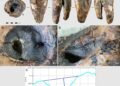
Lesion on the left iliac spine of the individual. Credit: Thompson et al., PLOS One (2025), CC-BY 4.0

Adding to the mystery, the man had been decapitated—a common feature of most of the 80-plus skeletons found at the site, which range from the first to the fourth century CE. The researchers suggested that beheading might have occurred either to end the man’s suffering or as a display of Roman custom.


RelatedStories

Roman cemetery in Egypt reveals golden tongues, mummies, and rare Iliad papyrus

Roman cemetery in Egypt reveals golden tongues, mummies, and rare Iliad papyrus

April 19, 2026
Pompeii ash analysis reveals Romans burned wine and imported frankincense in household rituals

Pompeii ash analysis reveals Romans burned wine and imported frankincense in household rituals

April 3, 2026

What is so remarkable about this find is that physical evidence of gladiator combat with wild animals is very rare, considering the widespread artistic and literary depictions. While mosaics and Roman texts frequently show venationes—bloody spectacles in which humans fought beasts—skeletal remains that indicate such encounters have been virtually non-existent until now.

“This is the first physical evidence for human-animal gladiatorial combat from the Roman period seen anywhere in Europe,” the authors wrote.

Transporting a lion all the way to northern Britain would have been an arduous sea, river, and land journey. According to the study, the creature would most likely have originated from North Africa because there are no native species of big cats in the British Isles.

Whether or not the man was a professional gladiator or a condemned prisoner who was forced to fight is uncertain. But either possibility reflects the brutal conditions of life and death in the Roman arena, even in the farthest corners of the empire, like Britain.


More information: Thompson TJU, Errickson D, McDonnell C, Holst M, Caffell A, Pearce J, et al. (2025) Unique osteological evidence for human-animal gladiatorial combat in Roman Britain. PLoS ONE 20(4): e0319847. doi:10.1371/journal.pone.0319847
Share3Tweet2ShareShareSend

You May Also Like...

Roman cemetery in Egypt reveals golden tongues, mummies, and rare Iliad papyrus
Anthropology

Roman cemetery in Egypt reveals golden tongues, mummies, and rare Iliad papyrus

April 19, 2026
Basel plague study finds young workers had highest death rates in 17th century outbreak
Anthropology

Basel plague study finds young workers had highest death rates in 17th century outbreak

April 17, 2026
Ancient DNA reveals male lineage and family ties in Neolithic Scotland tombs
Anthropology

Ancient DNA reveals male lineage and family ties in Neolithic Scotland tombs

April 16, 2026
Council houses reveal shift from royal rule to collective governance in Terminal Classic Maya society
Archaeology

Council houses reveal shift from royal rule to collective governance in Terminal Classic Maya society

April 11, 2026
Bronze Age loom found inside ancient Spanish home reveals early textile production
Archaeology

Bronze Age loom found inside ancient Spanish home reveals early textile production

April 8, 2026
Pompeii ash analysis reveals Romans burned wine and imported frankincense in household rituals
Archaeology

Pompeii ash analysis reveals Romans burned wine and imported frankincense in household rituals

April 3, 2026

Comments 1

  1. Editorial Team says:
    1 second ago

    Disclaimer: This website is a science-focused magazine that welcomes both academic and non-academic audiences. Comments are written by users and may include personal opinions or unverified claims. They do not necessarily reflect the views of our editorial team or rely on scientific evidence.

    Comment Policy: We kindly ask all commenters to engage respectfully. Comments that contain offensive, insulting, degrading, discriminatory, or racist content will be automatically removed.

  2. Raymond Lee says:
    12 months ago

    Not necessarily a gladiator. Could have been a victim for punishment or entertainment.
    Where’s the proof?

Follow us


Instagram
244K

Facebook
118K

Threads
46K

LinkedIn
14K

Twitter
6K

YouTube
1K
  • Trending
  • Comments
  • Latest
Shipwreck Salvage. Credit: rawpixel.com / Public Domain

2,000-year-old shipwreck discovered off Turkish coast with remarkably preserved stacked ceramics

July 2, 2025
Viking age DNA reveals 9,000-year-old HIV-resistant gene originating near the Black Sea

Viking age DNA reveals 9,000-year-old HIV-resistant gene originating near the Black Sea

May 18, 2025
A new study suggests the mysterious Voynich Manuscript may be a medieval cipher

A new study suggests the mysterious Voynich Manuscript may be a medieval cipher

January 3, 2026
3D analysis reveals Shroud of Turin image likely came from sculpture, not Jesus’ body

3D analysis reveals Shroud of Turin image likely came from sculpture, not Jesus’ body

August 3, 2025
Moses may be named in ancient Egyptian mine inscriptions, sparking debate over earliest biblical references

Moses may be named in ancient Egyptian mine inscriptions, sparking debate over earliest biblical references

July 31, 2025
3D analysis reveals Shroud of Turin image likely came from sculpture, not Jesus’ body

3D analysis reveals Shroud of Turin image likely came from sculpture, not Jesus’ body

Moses may be named in ancient Egyptian mine inscriptions, sparking debate over earliest biblical references

Moses may be named in ancient Egyptian mine inscriptions, sparking debate over earliest biblical references

$1 million prize offered to decipher 5,300-year-old Indus Valley script

$1 million prize offered to decipher 5,300-year-old Indus Valley script

Oldest ever genetic data from a human relative found in 2-million-year-old fossilized teeth

Oldest ever genetic data from a human relative found in 2-million-year-old fossilized teeth

Exceptionally large Roman shoes discovered at Magna fort near Hadrian’s Wall

Exceptionally large Roman shoes discovered at Magna fort near Hadrian’s Wall

Roman cemetery in Egypt reveals golden tongues, mummies, and rare Iliad papyrus

Roman cemetery in Egypt reveals golden tongues, mummies, and rare Iliad papyrus

April 19, 2026
Basel plague study finds young workers had highest death rates in 17th century outbreak

Basel plague study finds young workers had highest death rates in 17th century outbreak

April 17, 2026
Ancient DNA reveals male lineage and family ties in Neolithic Scotland tombs

Ancient DNA reveals male lineage and family ties in Neolithic Scotland tombs

April 16, 2026
Council houses reveal shift from royal rule to collective governance in Terminal Classic Maya society

Council houses reveal shift from royal rule to collective governance in Terminal Classic Maya society

April 11, 2026
Bronze Age loom found inside ancient Spanish home reveals early textile production

Bronze Age loom found inside ancient Spanish home reveals early textile production

April 8, 2026

Archaeology News online magazine

Archaeology News is an international online magazine that covers all aspects of archaeology.


Categories

  • Academics
    • Books
    • Conferences
    • Universities
  • Articles
  • Download
  • Game
  • News
    • Anthropology
    • Archaeology
    • Paleontology
  • Quiz
  • Tours

Subscribe to our newsletter

© 2024 - Archaeology News Online Magazine. All Rights Reserved.

  • About
  • Privacy Policy
  • Terms of Use
  • Donation
  • Contact

Manage Consent
To provide the best experiences, we use technologies like cookies to store and/or access device information. Consenting to these technologies will allow us to process data such as browsing behavior or unique IDs on this site. Not consenting or withdrawing consent, may adversely affect certain features and functions.
Functional Always active
The technical storage or access is strictly necessary for the legitimate purpose of enabling the use of a specific service explicitly requested by the subscriber or user, or for the sole purpose of carrying out the transmission of a communication over an electronic communications network.
Preferences
The technical storage or access is necessary for the legitimate purpose of storing preferences that are not requested by the subscriber or user.
Statistics
The technical storage or access that is used exclusively for statistical purposes. The technical storage or access that is used exclusively for anonymous statistical purposes. Without a subpoena, voluntary compliance on the part of your Internet Service Provider, or additional records from a third party, information stored or retrieved for this purpose alone cannot usually be used to identify you.
Marketing
The technical storage or access is required to create user profiles to send advertising, or to track the user on a website or across several websites for similar marketing purposes.
  • Manage options
  • Manage services
  • Manage {vendor_count} vendors
  • Read more about these purposes
View preferences
  • {title}
  • {title}
  • {title}
  • Home
  • News
    • Archaeology
    • Anthropology
    • Paleontology
  • Academic
    • Books
    • Conferences
    • Universities
  • Articles
  • VR Tours
  • Quiz & Game
  • Download
  • Encyclopedia
  • Forum

About  .  Contact  .  Donation

© 2024 - Archaeology News Online Magazine. All Rights Reserved