• About
  • Privacy Policy
  • Terms of Use
  • Donation
  • Contact
No Result
View All Result
Archaeology News
  • Home
  • News
    • Archaeology
    • Anthropology
    • Paleontology
  • Academic
    • Books
    • Conferences
    • Universities
  • Articles
  • VR Tours
  • Quiz & Game
  • Download
  • Encyclopedia
  • Forum
Archaeology News
No Result
View All Result
Home News Anthropology

Ancient Cretans held final feasts to ‘kill’ their tombs amid Bronze Age upheaval

by Dario Radley
April 23, 2025

Archaeologists on Crete have revealed telling evidence that Bronze Age populations did not just give up on their ancient burial grounds—rather, they entombed them in complex rituals that reflected profound societal changes. In a paper recently published in the journal Antiquity, the researchers studied the Sissi cemetery, where around 3,800 years ago, the local community gathered in a symbolic and carefully orchestrated ceremony to “kill” their collective tombs.

Ancient Cretans held final feasts to 'kill' their tombs amid Bronze Age upheaval
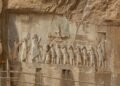
Cretans Bringing Gifts, Tomb of Rekhmire, by Nina de Garis Davies. Metropolitan Museum of Art

This act was not an act of vandalism or abandonment but instead a public ritual that symbolized the end of an epoch—one that was shaped by centuries of communal burial traditions that had defined Cretan life. The cemetery of Sissi, located near the island’s north coast, offers a vivid impression of this process.

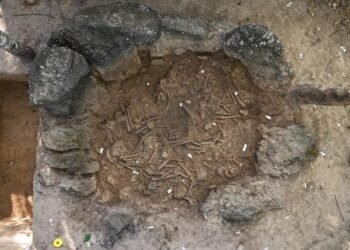
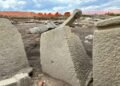
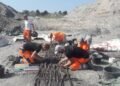
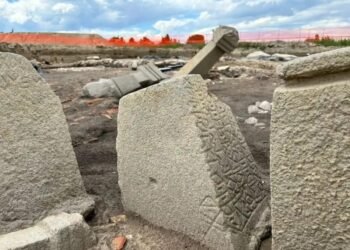
The Belgian School at Athens has led excavations at the site since 2007. Their findings show that around 1700 BCE, in an area known as Zone 9, the inhabitants dismantled their common tombs in a highly ritualized way. The tombs, which generations of one family had used for burials and communal rites, were deliberately cleared. Final burials were held in small pits or ceramic vessels, and subsequently, the walls of the tombs were dismantled, some of the remains partially crushed, and the earth leveled.

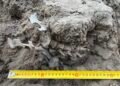
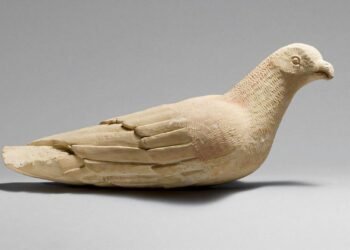
A communal feast followed. There were thousands of pottery fragments—cups, cooking pots, plates—all of the same date—scattered throughout the ground, a layer which unambiguously records a large event. The study’s authors believe this was not refuse but the remnants of a ritual gathering—an act of closure.

This ritual closure was then followed by the thorough burial of the site with soil and stones. Interestingly, later communities continued to refuse to disturb the ground, implying that a collective memory of its sacred nature persisted long after the site was abandoned.
RelatedStories

Scientists uncover Ireland’s largest prehistoric hillfort settlement, reshaping views of Bronze Age society

Scientists uncover Ireland’s largest prehistoric hillfort settlement, reshaping views of Bronze Age society

January 1, 2026
A 4,000-year-old sheep may reveal how the Bronze Age plague spread across Eurasia

A 4,000-year-old sheep may reveal how the Bronze Age plague spread across Eurasia

December 28, 2025

This process, however, was not confined to Sissi. Comparable termination rites have been found elsewhere in Crete, for instance at Moni Odigitria and Kephala Petras, where tombs were emptied out, filled with stones, or sealed off, sometimes accompanied by feasting rituals of their own. Not all Minoan cemeteries, however, ended in such a dramatic act. In most areas, burial grounds simply fell out of use, though they were sometimes still visited for non-funerary rites.

During the Middle Bronze Age (around 2050–1600 BCE), Crete was undergoing a fundamental transformation. With the rise of palatial centers like Knossos, there was a tendency toward centralization and individual status. As people were integrated into wider networks of political and religious activity, local practices like family tombs lost social significance. New ritual sites—mountain sanctuaries, caves, and palace-centered courtyards—started to replace cemeteries as the focal points for community gatherings.

The research team noted that collective tomb abandonment was neither sudden nor uniform. In some areas, usage was slowly declining, while in others, like Sissi, dramatic and deliberate closings took place.

Above all, recent excavation techniques, such as stratigraphic analysis and osteological study, have allowed archaeologists to uncover these complex stories. Earlier digs lacked such detailed methodologies, so it is not surprising that similar evidence may have been overlooked elsewhere. As more sites are excavated using new procedures, researchers expect to put together a more complete picture of how ancient Cretans responded to the social upheavals of their day.
More information: Déderix S, Schmitt A, Caloi I. The death of collective tombs in Middle Bronze Age Crete: new evidence from Sissi. Antiquity. Published online 2025:1-19. doi:10.15184/aqy.2025.38
Share3Tweet2ShareShareSend

You May Also Like...

60,000-year-old poison arrows from South Africa reveal the world’s earliest poisoned weapons and advanced hunting techniques
Archaeology

60,000-year-old poison arrows from South Africa reveal the world’s earliest poisoned weapons and advanced hunting techniques

January 8, 2026
Inscribed clay cylinders reveal Nebuchadnezzar II’s restoration of the Kish Ziggurat
Archaeology

Inscribed clay cylinders reveal Nebuchadnezzar II’s restoration of the Kish Ziggurat

January 7, 2026
Rare Late Roman mosaic with Solomon’s Knot discovered beneath modern İzmir
Archaeology

Rare Late Roman mosaic with Solomon’s Knot discovered beneath modern İzmir

January 7, 2026
1130 depiction of Saxons, Jutes, and Angles crossing the sea to Britain. Credit: Wikimedia / CC BY-SA 4.0. Roots of medieval migration into England uncovered by large-scale bioarchaeological study
Anthropology

Roots of medieval migration into England uncovered by large-scale bioarchaeological study

January 6, 2026
Rare Celtic gold coins found in Swiss bog may reveal ancient ritual offerings
Archaeology

Rare Celtic gold coins found in Swiss bog may reveal ancient ritual offerings

January 5, 2026
Rare medieval gold ring unearthed in Tønsberg
Archaeology

Rare medieval gold ring unearthed in Tønsberg reveals beliefs and craftsmanship of its time

January 5, 2026

Follow us


Instagram
244K

Facebook
118K

Threads
45K

LinkedIn
14K

Twitter
6K

YouTube
1K
  • Trending
  • Comments
  • Latest
Shipwreck Salvage. Credit: rawpixel.com / Public Domain

2,000-year-old shipwreck discovered off Turkish coast with remarkably preserved stacked ceramics

July 2, 2025
Viking age DNA reveals 9,000-year-old HIV-resistant gene originating near the Black Sea

Viking age DNA reveals 9,000-year-old HIV-resistant gene originating near the Black Sea

May 18, 2025
A new study suggests the mysterious Voynich Manuscript may be a medieval cipher

A new study suggests the mysterious Voynich Manuscript may be a medieval cipher

January 3, 2026
Moses may be named in ancient Egyptian mine inscriptions, sparking debate over earliest biblical references

Moses may be named in ancient Egyptian mine inscriptions, sparking debate over earliest biblical references

July 31, 2025
Mystery of Armenia’s 6,000-year-old dragon stones solved

Mystery of Armenia’s 6,000-year-old dragon stones solved

September 23, 2025
3D analysis reveals Shroud of Turin image likely came from sculpture, not Jesus’ body

3D analysis reveals Shroud of Turin image likely came from sculpture, not Jesus’ body

Moses may be named in ancient Egyptian mine inscriptions, sparking debate over earliest biblical references

Moses may be named in ancient Egyptian mine inscriptions, sparking debate over earliest biblical references

$1 million prize offered to decipher 5,300-year-old Indus Valley script

$1 million prize offered to decipher 5,300-year-old Indus Valley script

Oldest ever genetic data from a human relative found in 2-million-year-old fossilized teeth

Oldest ever genetic data from a human relative found in 2-million-year-old fossilized teeth

Exceptionally large Roman shoes discovered at Magna fort near Hadrian’s Wall

Exceptionally large Roman shoes discovered at Magna fort near Hadrian’s Wall

60,000-year-old poison arrows from South Africa reveal the world’s earliest poisoned weapons and advanced hunting techniques

60,000-year-old poison arrows from South Africa reveal the world’s earliest poisoned weapons and advanced hunting techniques

January 8, 2026
Inscribed clay cylinders reveal Nebuchadnezzar II’s restoration of the Kish Ziggurat

Inscribed clay cylinders reveal Nebuchadnezzar II’s restoration of the Kish Ziggurat

January 7, 2026
Rare Late Roman mosaic with Solomon’s Knot discovered beneath modern İzmir

Rare Late Roman mosaic with Solomon’s Knot discovered beneath modern İzmir

January 7, 2026
1130 depiction of Saxons, Jutes, and Angles crossing the sea to Britain. Credit: Wikimedia / CC BY-SA 4.0. Roots of medieval migration into England uncovered by large-scale bioarchaeological study

Roots of medieval migration into England uncovered by large-scale bioarchaeological study

January 6, 2026
Rare Celtic gold coins found in Swiss bog may reveal ancient ritual offerings

Rare Celtic gold coins found in Swiss bog may reveal ancient ritual offerings

January 5, 2026

Archaeology News online magazine

Archaeology News is an international online magazine that covers all aspects of archaeology.


Categories

  • Academics
    • Books
    • Conferences
    • Universities
  • Articles
  • Download
  • Game
  • News
    • Anthropology
    • Archaeology
    • Paleontology
  • Quiz
  • Tours

Subscribe to our newsletter

© 2024 - Archaeology News Online Magazine. All Rights Reserved.

  • About
  • Privacy Policy
  • Terms of Use
  • Donation
  • Contact

Welcome Back!

Login to your account below

Forgotten Password? Sign Up

Create New Account!

Fill the forms below to register

All fields are required. Log In

Retrieve your password

Please enter your username or email address to reset your password.

Log In

Add New Playlist

Manage Consent
To provide the best experiences, we use technologies like cookies to store and/or access device information. Consenting to these technologies will allow us to process data such as browsing behavior or unique IDs on this site. Not consenting or withdrawing consent, may adversely affect certain features and functions.
Functional Always active
The technical storage or access is strictly necessary for the legitimate purpose of enabling the use of a specific service explicitly requested by the subscriber or user, or for the sole purpose of carrying out the transmission of a communication over an electronic communications network.
Preferences
The technical storage or access is necessary for the legitimate purpose of storing preferences that are not requested by the subscriber or user.
Statistics
The technical storage or access that is used exclusively for statistical purposes. The technical storage or access that is used exclusively for anonymous statistical purposes. Without a subpoena, voluntary compliance on the part of your Internet Service Provider, or additional records from a third party, information stored or retrieved for this purpose alone cannot usually be used to identify you.
Marketing
The technical storage or access is required to create user profiles to send advertising, or to track the user on a website or across several websites for similar marketing purposes.
  • Manage options
  • Manage services
  • Manage {vendor_count} vendors
  • Read more about these purposes
View preferences
  • {title}
  • {title}
  • {title}
  • Home
  • News
    • Archaeology
    • Anthropology
    • Paleontology
  • Academic
    • Books
    • Conferences
    • Universities
  • Articles
  • VR Tours
  • Quiz & Game
  • Download
  • Encyclopedia
  • Forum

About  .  Contact  .  Donation

© 2024 - Archaeology News Online Magazine. All Rights Reserved