• About
  • Privacy Policy
  • Terms of Use
  • Donation
  • Contact
No Result
View All Result
Archaeology News
  • Home
  • News
    • Archaeology
    • Anthropology
    • Paleontology
  • Academic
    • Books
    • Conferences
    • Universities
  • Articles
  • VR Tours
  • Quiz & Game
  • Download
  • Encyclopedia
  • Forum
Archaeology News
No Result
View All Result
Home News Archaeology

Ancient Tasmanians used fire 41,000 years ago to transform their environment, study reveals

by Dario Radley
November 17, 2024

A recent study published in Science Advances uncovers that over 41,000 years ago, Tasmania’s first human inhabitants, the Palawa/Pakana people, employed fire to modify and manage their environment. This discovery pushes back the earliest known use of fire for landscape shaping in the region by approximately 2,000 years.

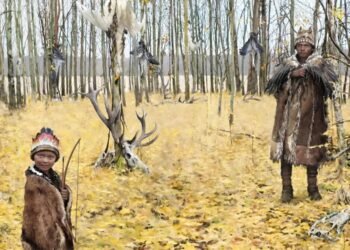
Ancient Tasmanians used fire 41,000 years ago to transform their environment, study reveals
A recent study uncovers that Tasmania’s first human inhabitants employed fire to modify and manage their environment. Public Domain

Researchers from the UK and Australia analyzed ancient mud cores collected from islands in the Bass Strait, a region that once formed a land bridge connecting Tasmania to mainland Australia. Charcoal and pollen samples from these cores revealed a sudden spike in charcoal deposits dating back 41,600 years. This was followed by significant changes in vegetation around 40,000 years ago. Lead author Dr. Matthew Adeleye, from the University of Cambridge, explained, “This suggests these early inhabitants were clearing forests by burning them, in order to create open spaces for subsistence and perhaps cultural activities.”

The use of fire likely allowed the Palawa/Pakana to penetrate Tasmania’s dense, wet forests, creating open areas that supported their needs. This method of environmental modification was part of broader fire-management practices employed by humans as they migrated across the glacial landscape of Sahul—a prehistoric supercontinent encompassing modern-day Australia, Tasmania, New Guinea, and eastern Indonesia.

“As natural habitats adapted to these controlled burnings, we see the expansion of fire-adapted species such as Eucalyptus, primarily on the wetter, eastern side of the Bass Strait islands,” Adeleye noted.

The Palawa/Pakana people’s arrival in Tasmania marked the southernmost point of human habitation during the last ice age. Approximately 65,000 years ago, humans reached northern Australia, and by 41,600 years ago, the Palawa/Pakana crossed the land bridge to settle in Tasmania, known to them as Lutruwita.


RelatedStories

New genetic study reveals how modern humans first arrived in Australia 60,000 years ago

New genetic study reveals how modern humans first arrived in Australia 60,000 years ago

December 1, 2025
Ancient Australian rock art site reveals 1,700 years of remarkably preserved Aboriginal fiber craft

Ancient Australian rock art site reveals 1,700 years of remarkably preserved Aboriginal fiber craft

November 21, 2025

The land bridge, formed due to low sea levels, remained intact until about 8,000 years ago, when rising seas severed Tasmania from the Australian mainland. This separation preserved the region’s unique ecological and cultural developments.

The researchers’ findings provide crucial evidence of early anthropogenic impacts on Tasmania’s environment. “Australia is home to the world’s oldest Indigenous culture, which has endured for over 50,000 years,” said Adeleye. “Earlier studies have shown that Aboriginal communities on the Australian mainland used fire to shape their habitats, but we haven’t had similarly detailed environmental records for Tasmania.”

Study co-author Professor Simon Haberle of the Australian National University, described the findings as “an affirmation that cultural burning and care for Country has been a feature of the landscape for many, many thousands of years.”

“These early Tasmanian communities were the island’s first land managers,” said Adeleye. “If we’re going to protect Tasmanian and Australian landscapes for future generations, it’s important that we listen to and learn from Indigenous communities who are calling for a greater role in helping to manage Australian landscapes into the future.”


University of Cambridge

More information: Adeleye, M. A., Hopf, F., Haberle, S. G., Stannard, G. L., Mcwethy, D. B., Harris, S., & Bowman, D. M. J. S. (2024). Landscape burning facilitated Aboriginal migration into Lutruwita/Tasmania 41,600 years ago. Science Advances, 10(46), eadp6579. doi:10.1126/sciadv.adp6579
Share4Tweet2Share1ShareSend

You May Also Like...

Reconstruction of a male Neanderthal with a child at the Natural History Museum, Vienna.
Anthropology

Did Preeclampsia contribute to Neanderthal extinction? new study explores a hidden reproductive risk

February 23, 2026
1,000-year-old elite tomb filled with gold uncovered at El Caño Archaeological Park in Panama
Anthropology

1,000-year-old elite tomb filled with gold uncovered at El Caño Archaeological Park in Panama

February 22, 2026
Ancient DNA reveals Golden Horde elites’ Mongolian roots and ties to Central Eurasian populations
Anthropology

Ancient DNA reveals Golden Horde elites’ Mongolian roots and ties to Central Eurasian populations

February 22, 2026
9,000-year-old evidence of dairy use discovered in Iran’s Zagros Mountains
Archaeology

9,000-year-old evidence of dairy use discovered in Iran’s Zagros Mountains

February 21, 2026
Oldest indigo-dyed textiles and nålbinding technique found in Bronze Age Anatolia
Archaeology

Oldest indigo-dyed textiles and nålbinding technique found in Bronze Age Anatolia

February 21, 2026
2,000-year-old human and animal footprints discovered at Lunan Bay, Scotland
Archaeology

2,000-year-old human and animal footprints discovered at Lunan Bay, Scotland

February 20, 2026

Follow us


Instagram
244K

Facebook
118K

Threads
45K

LinkedIn
14K

Twitter
6K

YouTube
1K
  • Trending
  • Comments
  • Latest
Shipwreck Salvage. Credit: rawpixel.com / Public Domain

2,000-year-old shipwreck discovered off Turkish coast with remarkably preserved stacked ceramics

July 2, 2025
Viking age DNA reveals 9,000-year-old HIV-resistant gene originating near the Black Sea

Viking age DNA reveals 9,000-year-old HIV-resistant gene originating near the Black Sea

May 18, 2025
A new study suggests the mysterious Voynich Manuscript may be a medieval cipher

A new study suggests the mysterious Voynich Manuscript may be a medieval cipher

January 3, 2026
Moses may be named in ancient Egyptian mine inscriptions, sparking debate over earliest biblical references

Moses may be named in ancient Egyptian mine inscriptions, sparking debate over earliest biblical references

July 31, 2025
Mystery of Armenia’s 6,000-year-old dragon stones solved

Mystery of Armenia’s 6,000-year-old dragon stones solved

September 23, 2025
3D analysis reveals Shroud of Turin image likely came from sculpture, not Jesus’ body

3D analysis reveals Shroud of Turin image likely came from sculpture, not Jesus’ body

Moses may be named in ancient Egyptian mine inscriptions, sparking debate over earliest biblical references

Moses may be named in ancient Egyptian mine inscriptions, sparking debate over earliest biblical references

$1 million prize offered to decipher 5,300-year-old Indus Valley script

$1 million prize offered to decipher 5,300-year-old Indus Valley script

Oldest ever genetic data from a human relative found in 2-million-year-old fossilized teeth

Oldest ever genetic data from a human relative found in 2-million-year-old fossilized teeth

Exceptionally large Roman shoes discovered at Magna fort near Hadrian’s Wall

Exceptionally large Roman shoes discovered at Magna fort near Hadrian’s Wall

Reconstruction of a male Neanderthal with a child at the Natural History Museum, Vienna.

Did Preeclampsia contribute to Neanderthal extinction? new study explores a hidden reproductive risk

February 23, 2026
1,000-year-old elite tomb filled with gold uncovered at El Caño Archaeological Park in Panama

1,000-year-old elite tomb filled with gold uncovered at El Caño Archaeological Park in Panama

February 22, 2026
Ancient DNA reveals Golden Horde elites’ Mongolian roots and ties to Central Eurasian populations

Ancient DNA reveals Golden Horde elites’ Mongolian roots and ties to Central Eurasian populations

February 22, 2026
9,000-year-old evidence of dairy use discovered in Iran’s Zagros Mountains

9,000-year-old evidence of dairy use discovered in Iran’s Zagros Mountains

February 21, 2026
Oldest indigo-dyed textiles and nålbinding technique found in Bronze Age Anatolia

Oldest indigo-dyed textiles and nålbinding technique found in Bronze Age Anatolia

February 21, 2026

Archaeology News online magazine

Archaeology News is an international online magazine that covers all aspects of archaeology.


Categories

  • Academics
    • Books
    • Conferences
    • Universities
  • Articles
  • Download
  • Game
  • News
    • Anthropology
    • Archaeology
    • Paleontology
  • Quiz
  • Tours

Subscribe to our newsletter

© 2024 - Archaeology News Online Magazine. All Rights Reserved.

  • About
  • Privacy Policy
  • Terms of Use
  • Donation
  • Contact

Manage Consent
To provide the best experiences, we use technologies like cookies to store and/or access device information. Consenting to these technologies will allow us to process data such as browsing behavior or unique IDs on this site. Not consenting or withdrawing consent, may adversely affect certain features and functions.
Functional Always active
The technical storage or access is strictly necessary for the legitimate purpose of enabling the use of a specific service explicitly requested by the subscriber or user, or for the sole purpose of carrying out the transmission of a communication over an electronic communications network.
Preferences
The technical storage or access is necessary for the legitimate purpose of storing preferences that are not requested by the subscriber or user.
Statistics
The technical storage or access that is used exclusively for statistical purposes. The technical storage or access that is used exclusively for anonymous statistical purposes. Without a subpoena, voluntary compliance on the part of your Internet Service Provider, or additional records from a third party, information stored or retrieved for this purpose alone cannot usually be used to identify you.
Marketing
The technical storage or access is required to create user profiles to send advertising, or to track the user on a website or across several websites for similar marketing purposes.
  • Manage options
  • Manage services
  • Manage {vendor_count} vendors
  • Read more about these purposes
View preferences
  • {title}
  • {title}
  • {title}
  • Home
  • News
    • Archaeology
    • Anthropology
    • Paleontology
  • Academic
    • Books
    • Conferences
    • Universities
  • Articles
  • VR Tours
  • Quiz & Game
  • Download
  • Encyclopedia
  • Forum

About  .  Contact  .  Donation

© 2024 - Archaeology News Online Magazine. All Rights Reserved