• About
  • Privacy Policy
  • Terms of Use
  • Donation
  • Contact
No Result
View All Result
Archaeology News
  • Home
  • News
    • Archaeology
    • Anthropology
    • Paleontology
  • Academic
    • Books
    • Conferences
    • Universities
  • Articles
  • VR Tours
  • Quiz & Game
  • Download
  • Encyclopedia
  • Forum
Archaeology News
No Result
View All Result
Home News Anthropology

Oldest human face in Western Europe found in Spain, rewriting early European settlement history

by Dario Radley
March 19, 2025

A fascinating fossil find in Spain’s Atapuerca Mountains has revealed that the beginnings of human habitation in Western Europe predate what scientists previously believed. A fragment of a human face, discovered in 2022 at the Sima del Elefante archaeological site, has been estimated to be between 1.1 million and 1.4 million years old, making it the earliest human face found to date in Western Europe. The fossil, cataloged as ATE7-1 and nicknamed “Pink,” was identified as Homo affinis erectus (H. aff. erectus)—an extinct human relative.

Oldest human face in Western Europe found in Spain, rewriting early European settlement history
Original fossil alongside a 3D recreation of the right side of the face of H. aff. erectus from Sima del Elefante, Spain. Credit: Maria D. Guillén / IPHES-CERCA

The findings, published recently in the journal Nature, were led by Dr. Rosa Huguet of IPHES-CERCA, together with researchers from various institutions, including the National Center for Research on Human Evolution (CENIEH) and Rovira i Virgili University. “This fossil provides the earliest human remains found so far in Western Europe, documenting a previously unknown population in the region,” explained Dr. María Martinón-Torres, director of CENIEH.

The discovery of Pink’s facial bones includes the left side of the maxilla (upper jaw) and part of the cheekbone, display some notable differences from previously known European hominin fossils. Hominin fossils from Atapuerca’s Gran Dolina site dated to about 860,000 years ago were classified as Homo antecessor, a species thought to share some facial traits with modern humans. But Pink’s features suggest a more primitive lineage.

Given these skeletal features, researchers have provisionally assigned Pink to H. aff. erectus, acknowledging its similarities with Homo erectus while leaving open the possibility that it represents a distinct species.
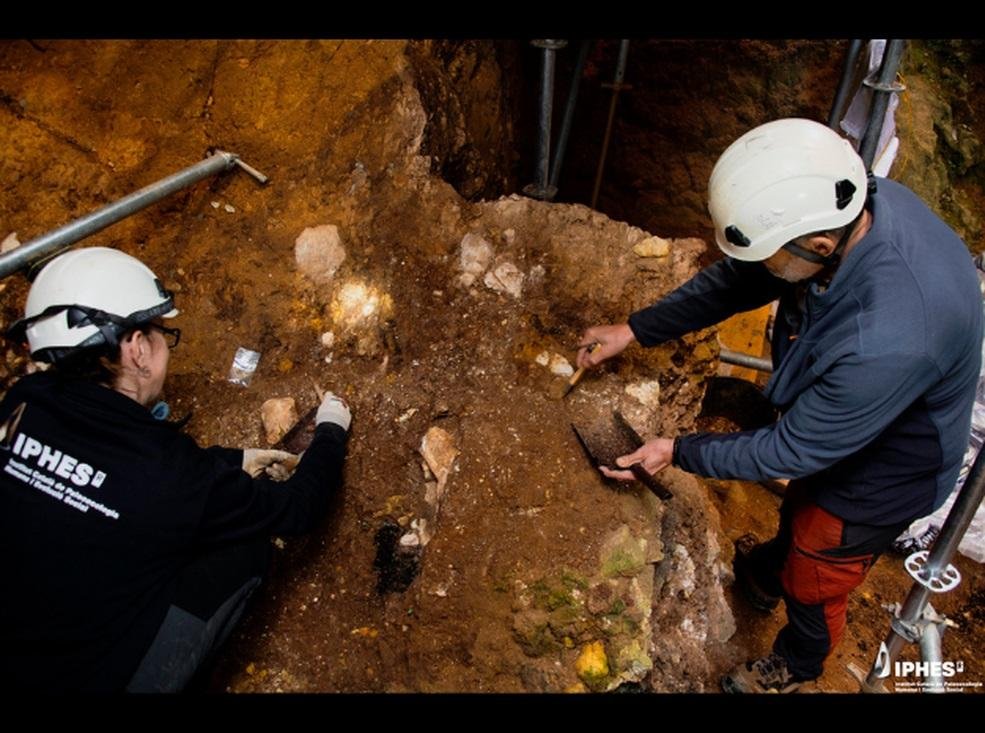
Oldest human face in Western Europe found in Spain, rewriting early European settlement history
Researchers excavate at Sima del Elefante. Credit: Maria D. Guillén / IPHES-CERCA

The discovery challenges prior assumptions about the Western European settlement by the first hominins. For a long time, scientists have believed that some of the earliest hominins to migrate to the region were Homo antecessor, but Pink is hundreds of thousands of years older than previous fossils implying an earlier migration wave.

Artifacts, including stone tools typically made from quartz and flint, have also been uncovered along with animal bones with cut marks from the TE7 level of Sima del Elefante. These findings suggest that early humans engaged in butchery and used simple tools for processing food.

Paleoecological analysis of the site suggests that the Atapuerca region during the Lower Pleistocene was a diverse environment with forests, grasslands, and seasonal water sources, ideal ecological conditions for early humans.

This latest finding marks a major step forward in understanding human evolution in Europe. Dr. Marina Mosquera, director of IPHES-CERCA, emphasized Atapuerca’s role in global paleoanthropological research, stating, “This site continues to be a key reference point for understanding our origins.”

The recent discoveries are yet another advance in the efforts to better understand early human evolutionary history in Europe. Despite gaining valuable insights from Pink, researchers still have unanswered questions. What happened to this group? Did changes in the environment contribute to their disappearance? Or did they share the land with later hominins—like Homo antecessor?

Harsh climatic conditions around 1.1 million years ago may have led to the disappearance of Homo aff. erectus in the region, allowing Homo antecessor to establish itself there. At the same time, it is entirely possible that small groups of both species coexisted, at least for a time.

More information: IPHES

Huguet, R., Rodríguez-Álvarez, X.P., Martinón-Torres, M. et al. (2025). The earliest human face of Western Europe. Nature. doi:10.1038/s41586-025-08681-0

Share:

Share on Facebook Share on X (Twitter) Share on LinkedIn Share on Pinterest Share on WhatsApp Share on Email

You May Also Like...

Rare funerary cache discovered at ancient Heliopolis site
Archaeology

Rare funerary cache discovered at ancient Heliopolis site

June 2, 2026
Archaeologists find Queen Elisenda’s remains among 25 medieval skeletons, including individuals with unexplained stab wounds
Anthropology

Archaeologists find Queen Elisenda’s remains among 25 medieval skeletons, including individuals with unexplained stab wounds

June 1, 2026
Copper Age children in Spain suffered widespread respiratory disease, skeletal study suggests
Anthropology

Copper Age children in Spain suffered widespread respiratory disease, skeletal study suggests

June 1, 2026
Unknown World War II mass grave with 14 German soldiers uncovered at quarry site in Poland
Anthropology

Unknown World War II mass grave with 14 German soldiers uncovered at quarry site in Poland

May 31, 2026
Volunteers restore England’s mysterious Cerne Abbas Giant as climate and erosion threaten ancient landmark
Archaeology

Volunteers restore England’s mysterious Cerne Abbas Giant as climate and erosion threaten ancient landmark

May 31, 2026
Buried church bell found in Poland after decades hidden beneath roadside
Archaeology

Buried church bell found in Poland after decades hidden beneath roadside

May 31, 2026

Comments 1

  1. Editorial Team says:
    1 second ago

    Disclaimer: This website is a science-focused magazine that welcomes both academic and non-academic audiences. Comments are written by users and may include personal opinions or unverified claims. They do not necessarily reflect the views of our editorial team or rely on scientific evidence.

    Comment Policy: We kindly ask all commenters to engage respectfully. Comments that contain offensive, insulting, degrading, discriminatory, or racist content will be automatically removed.

  2. Stephen Joseph says:
    1 year ago

    Archeology is the most interesting science in the world. Amazing information is always being uncovered by these professionals and it never gets old and only goes forward for all of us to learn.

Follow us


Instagram
242K

Facebook
117K

Threads
47K

LinkedIn
15K

Twitter
6K

YouTube
1K

Archaeology News online magazine

Archaeology News is an international online magazine that covers all aspects of archaeology.


Categories

  • Academics
    • Books
    • Conferences
    • Universities
  • Articles
  • Download
  • Game
  • News
    • Anthropology
    • Archaeology
    • Paleontology
  • Quiz
  • Tours

Subscribe to our newsletter

© 2024 - Archaeology News Online Magazine. All Rights Reserved.

  • About
  • Privacy Policy
  • Terms of Use
  • Donation
  • Contact

Manage Consent
To provide the best experiences, we use technologies like cookies to store and/or access device information. Consenting to these technologies will allow us to process data such as browsing behavior or unique IDs on this site. Not consenting or withdrawing consent, may adversely affect certain features and functions.
Functional Always active
The technical storage or access is strictly necessary for the legitimate purpose of enabling the use of a specific service explicitly requested by the subscriber or user, or for the sole purpose of carrying out the transmission of a communication over an electronic communications network.
Preferences
The technical storage or access is necessary for the legitimate purpose of storing preferences that are not requested by the subscriber or user.
Statistics
The technical storage or access that is used exclusively for statistical purposes. The technical storage or access that is used exclusively for anonymous statistical purposes. Without a subpoena, voluntary compliance on the part of your Internet Service Provider, or additional records from a third party, information stored or retrieved for this purpose alone cannot usually be used to identify you.
Marketing
The technical storage or access is required to create user profiles to send advertising, or to track the user on a website or across several websites for similar marketing purposes.
  • Manage options
  • Manage services
  • Manage {vendor_count} vendors
  • Read more about these purposes
View preferences
  • {title}
  • {title}
  • {title}
  • Home
  • News
    • Archaeology
    • Anthropology
    • Paleontology
  • Academic
    • Books
    • Conferences
    • Universities
  • Articles
  • VR Tours
  • Quiz & Game
  • Download
  • Encyclopedia
  • Forum

About  .  Contact  .  Donation

© 2024 - Archaeology News Online Magazine. All Rights Reserved