• About
  • Privacy Policy
  • Terms of Use
  • Donation
  • Contact
No Result
View All Result
Archaeology News
  • Home
  • News
    • Archaeology
    • Anthropology
    • Paleontology
  • Academic
    • Books
    • Conferences
    • Universities
  • Articles
  • VR Tours
  • Quiz & Game
  • Download
  • Encyclopedia
  • Forum
Archaeology News
No Result
View All Result
Home News Archaeology

4,000-year-old ˁAin Samiya goblet reveals a Bronze Age vision of cosmic creation and order

by Dario Radley
November 17, 2025

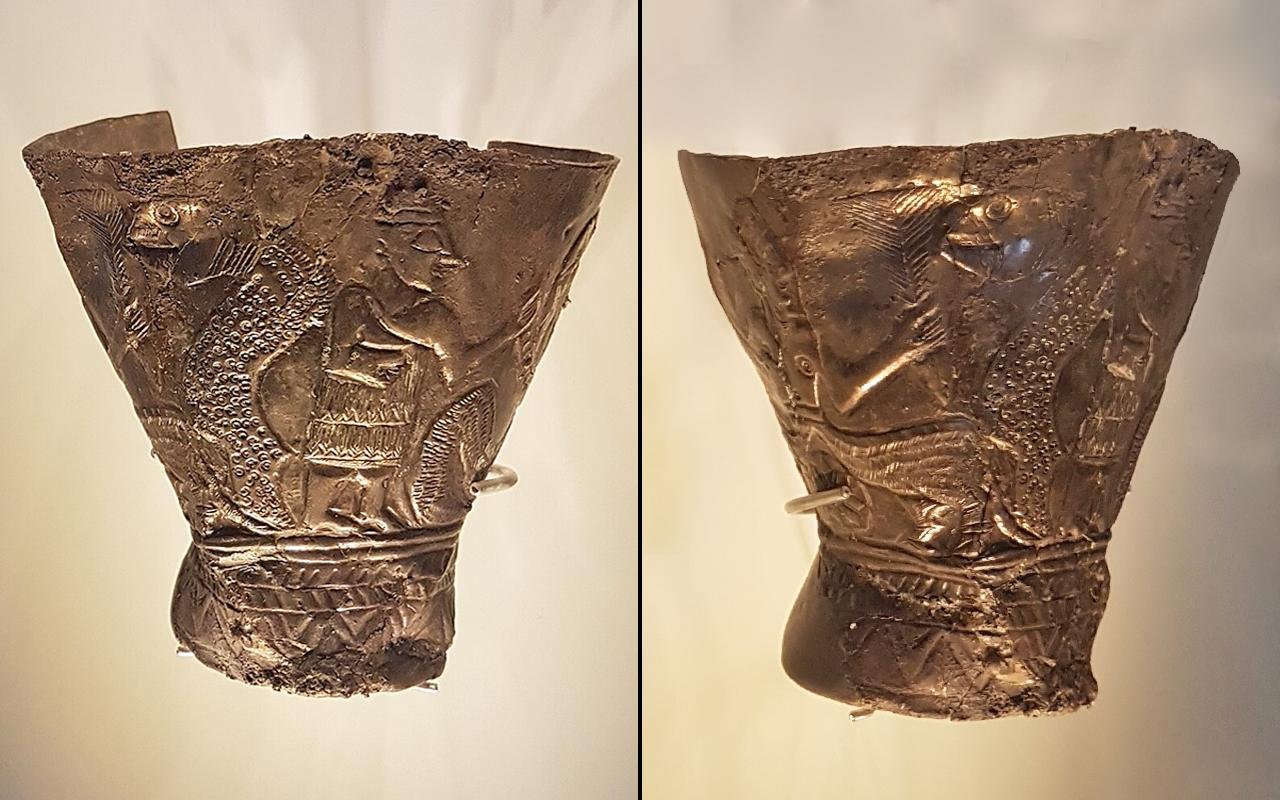
Archaeologists are reexamining one of the most fascinating artifacts ever discovered in the southern Levant: the ˁAin Samiya goblet, a small but remarkably intricate silver vessel dating to the Intermediate Bronze Age.
4,000-year-old ˁAin Samiya goblet reveals a Bronze Age vision of cosmic creation and order
ˁAin Samiya goblet. CC BY-SA 4.0

Discovered more than 55 years ago in a high-status tomb in the Judean Hills, the 8-centimeter goblet has long baffled scholars with its densely packed images of mythological scenes. For decades, many assumed that the images were connected to the Babylonian creation epic, the Enuma Elish. A new study, however, argues the vessel depicts a different—and much earlier—narrative about how ancient people imagined the cosmos taking shape.

The goblet is generally regarded as the only true work of art to have survived from this period in the Levant. On its exterior, there are two interconnected scenes filled with hybrid creatures, serpents, plant motifs, and celestial symbols. Part of it has been damaged, leaving that part of the narrative incomplete, but enough survives to show a brilliant visual sequence. On one side is a chimera-like figure next to a large serpent. The human upper body of the figure merges into the legs of two bulls, and a small rosette, interpreted as a newborn sun, appears between its limbs. The scene has often been interpreted as chaotic and untamed, with the serpent symbolizing primordial disorder.

The second scene is quite the opposite. Two human figures lift the ends of a crescent form that cradles a radiant sun depicted face-on. The serpent now lies flat beneath the celestial boat, no longer the dominant feature. In the new study, the sequence indicates an orderly universe that emerges after chaos has been subdued. Instead of illustrating a particular myth, the imagery seems to symbolize the broader ancient Near Eastern idea of cosmic organization and renewal.
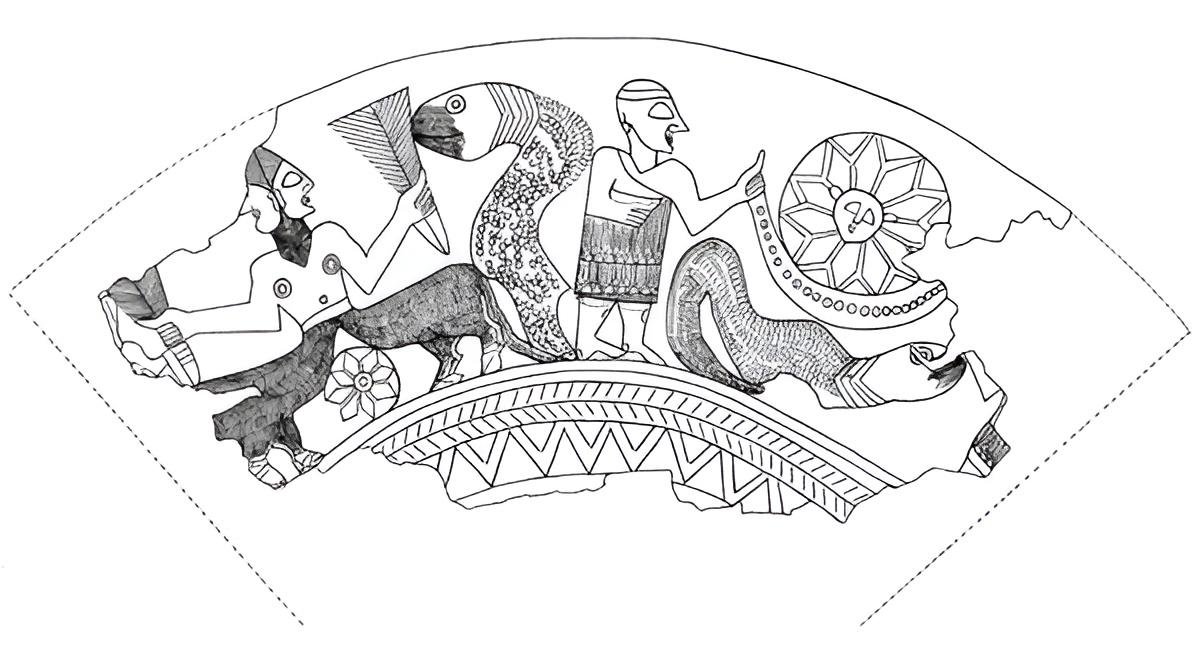
4,000-year-old ˁAin Samiya goblet reveals a Bronze Age vision of cosmic creation and order
A flat rendering of the scenes depicted on the ˁAin Samiya Goblet. Credit: Nattering Nabob of Nanofabrication / CC BY-SA 4.0

Researchers note that this provides strong parallels with Sumerian and Akkadian beliefs in the division of the world into two hemispheres—one for the living and one for the dead—both under the governance of the cyclical rebirth of the sun, moon, and seasons. The crescent, they note, represents the Celestial Boat, a common motif throughout Egypt, Mesopotamia, Anatolia, and other areas, used to transport the sun across the sky. The progression from a small, newly “born” sun in the first scene to a powerful, fully developed sun in the second scene reveals a cosmological journey rather than a violent mythic battle.

Iconographic comparisons indicate that the designer of the goblet was a southern Mesopotamian artist who traveled to the north during the 23rd century BCE. The vessel itself, however, was likely produced in northern Syria, where access to silver was more readily available, and then moved south through trade routes. When it was placed in its tomb around 2200 BCE, the goblet may have been used ritually to guide the soul of the deceased along the same cyclical path as the rising sun.
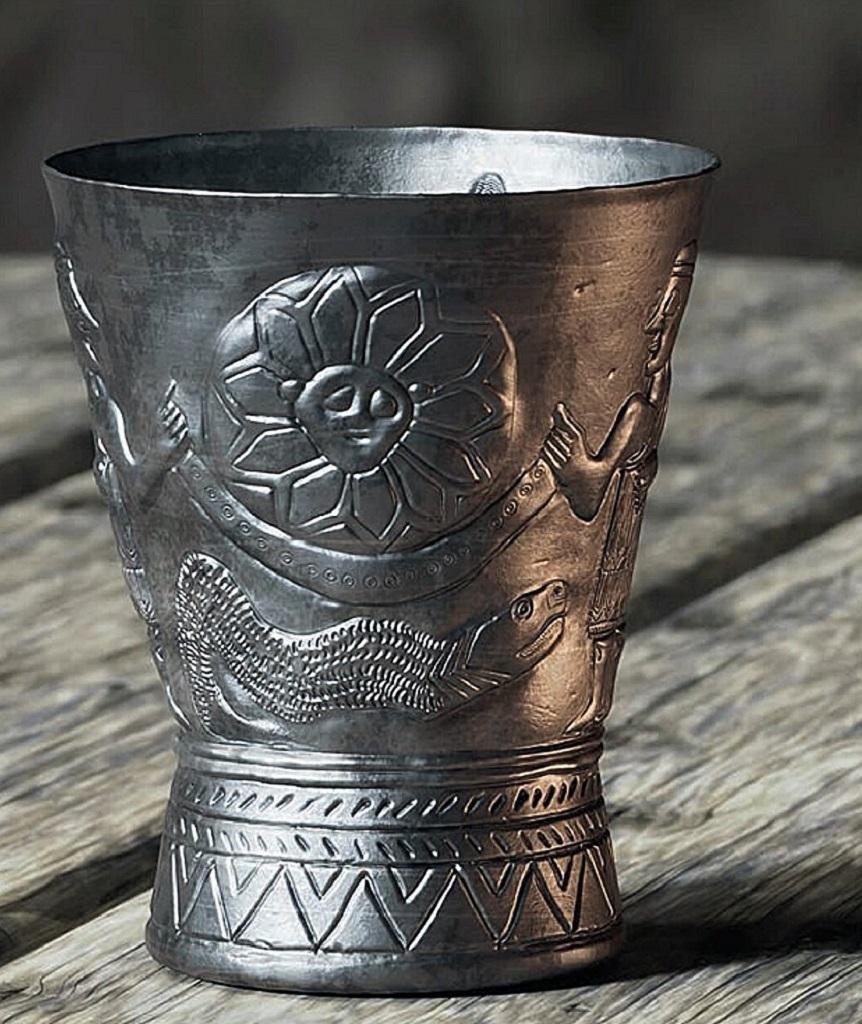
4,000-year-old ˁAin Samiya goblet reveals a Bronze Age vision of cosmic creation and order
Artist’s reconstruction of the ˁAin Samiya goblet (Luwian Studies #5053). Credit: Zangger, E., Sarlo, D., & Haas Dantes, F., Journal of the Ancient Near Eastern Society ‘Ex oriente lux’ (2025)

Although some scholars still urge caution about definitive conclusions, the new study places the ˁAin Samiya goblet within a long tradition of cosmological storytelling stretching across the ancient Near East.
More information: Zangger, E., Sarlo, D., & Haas Dantes, F. (2025). The Earliest Cosmological Depictions: Reconsidering the Imagery on the ˁAin Samiya Goblet. In JEOL – Journal of the Ancient Near Eastern Society ‘Ex oriente lux’ (Vol. 49, pp. 49–84). Zenodo. https://doi.org/10.5281/zenodo.17594730

Share:

Share on Facebook Share on X (Twitter) Share on LinkedIn Share on Pinterest Share on WhatsApp Share on Email

You May Also Like...

Ancient city of Ihnasya reveals Aphrodite statue, Senusret III inscription, and Roman basilica remains in Egypt
Archaeology

Ancient city of Ihnasya reveals Aphrodite statue, Senusret III inscription, and Roman basilica remains in Egypt

June 2, 2026
Rare funerary cache discovered at ancient Heliopolis site
Archaeology

Rare funerary cache discovered at ancient Heliopolis site

June 2, 2026
Archaeologists find Queen Elisenda’s remains among 25 medieval skeletons, including individuals with unexplained stab wounds
Anthropology

Archaeologists find Queen Elisenda’s remains among 25 medieval skeletons, including individuals with unexplained stab wounds

June 1, 2026
Copper Age children in Spain suffered widespread respiratory disease, skeletal study suggests
Anthropology

Copper Age children in Spain suffered widespread respiratory disease, skeletal study suggests

June 1, 2026
Unknown World War II mass grave with 14 German soldiers uncovered at quarry site in Poland
Anthropology

Unknown World War II mass grave with 14 German soldiers uncovered at quarry site in Poland

May 31, 2026
Volunteers restore England’s mysterious Cerne Abbas Giant as climate and erosion threaten ancient landmark
Archaeology

Volunteers restore England’s mysterious Cerne Abbas Giant as climate and erosion threaten ancient landmark

May 31, 2026

Comments 0

  1. Editorial Team says:
    1 second ago

    Disclaimer: This website is a science-focused magazine that welcomes both academic and non-academic audiences. Comments are written by users and may include personal opinions or unverified claims. They do not necessarily reflect the views of our editorial team or rely on scientific evidence.

    Comment Policy: We kindly ask all commenters to engage respectfully. Comments that contain offensive, insulting, degrading, discriminatory, or racist content will be automatically removed.

    Reply

Leave a Reply Cancel reply

Your email address will not be published. Required fields are marked *

Follow us


Instagram
242K

Facebook
117K

Threads
47K

LinkedIn
15K

Twitter
6K

YouTube
1K

Archaeology News online magazine

Archaeology News is an international online magazine that covers all aspects of archaeology.


Categories

  • Academics
    • Books
    • Conferences
    • Universities
  • Articles
  • Download
  • Game
  • News
    • Anthropology
    • Archaeology
    • Paleontology
  • Quiz
  • Tours

Subscribe to our newsletter

© 2024 - Archaeology News Online Magazine. All Rights Reserved.

  • About
  • Privacy Policy
  • Terms of Use
  • Donation
  • Contact

Manage Consent
To provide the best experiences, we use technologies like cookies to store and/or access device information. Consenting to these technologies will allow us to process data such as browsing behavior or unique IDs on this site. Not consenting or withdrawing consent, may adversely affect certain features and functions.
Functional Always active
The technical storage or access is strictly necessary for the legitimate purpose of enabling the use of a specific service explicitly requested by the subscriber or user, or for the sole purpose of carrying out the transmission of a communication over an electronic communications network.
Preferences
The technical storage or access is necessary for the legitimate purpose of storing preferences that are not requested by the subscriber or user.
Statistics
The technical storage or access that is used exclusively for statistical purposes. The technical storage or access that is used exclusively for anonymous statistical purposes. Without a subpoena, voluntary compliance on the part of your Internet Service Provider, or additional records from a third party, information stored or retrieved for this purpose alone cannot usually be used to identify you.
Marketing
The technical storage or access is required to create user profiles to send advertising, or to track the user on a website or across several websites for similar marketing purposes.
  • Manage options
  • Manage services
  • Manage {vendor_count} vendors
  • Read more about these purposes
View preferences
  • {title}
  • {title}
  • {title}
  • Home
  • News
    • Archaeology
    • Anthropology
    • Paleontology
  • Academic
    • Books
    • Conferences
    • Universities
  • Articles
  • VR Tours
  • Quiz & Game
  • Download
  • Encyclopedia
  • Forum

About  .  Contact  .  Donation

© 2024 - Archaeology News Online Magazine. All Rights Reserved