• About
  • Privacy Policy
  • Terms of Use
  • Donation
  • Contact
No Result
View All Result
Archaeology News
  • Home
  • News
    • Archaeology
    • Anthropology
    • Paleontology
  • Academic
    • Books
    • Conferences
    • Universities
  • Articles
  • VR Tours
  • Quiz & Game
  • Download
  • Encyclopedia
  • Forum
Archaeology News
No Result
View All Result
Home News Archaeology

Ancient Roman villa emerges from Lake Fusaro in Italy

by Dario Radley
March 2, 2025

A remarkable finding has emerged in Italy, where the remains of a luxurious Roman villa have arisen from the waters of Lake Fusaro, which is near Naples. This phenomenon has been attributed to bradyseism, which is a geological process brought about by the movements of magma or hydrothermal fluids beneath the Earth’s surface.

Lake Fusaro is located in the comune of Bacoli in the province of Naples, an area known for its geological volatility. This lake is part of the Phlegraean Fields, a huge volcanic caldera dotted with fumaroles and volcanic structures such as the Solfatara volcano. Bradyseism has, for centuries, affected the region, with ground levels rising and falling periodically, primarily due to subsurface magma movements. Since 2005, the land in this area has risen by approximately 138 centimeters, including a 20-centimeter increase recorded in 2024, according to a study by the National Institute of Geophysics and Volcanology.

Rapid uplift has led to the retreat of the shoreline and the elevation of the seabed, negatively impacting local ports and marinas. However, it has also uncovered the foundation of a Roman villa, which was previously submerged beneath the lake’s waters. The villa was identified through aerial photography and is under examination by the Superintendence of Archaeology, Fine Arts, and Landscape of Naples.

Josi Gerardo Della Ragione, the Mayor of Bacoli, confirmed the significance of the discovery: “They were under the water! Walls and rooms from the Roman era have been discovered in Lake Fusaro. They probably belonged to a luxurious mansion,” he said. He further speculated that the building presumably had thermal baths, a feature of elite Roman residences.

This region, first settled during the 8th century BCE by Greek colonists, has been shaped by continuous volcanic and seismic activity. As a result, the Greeks named it “Campi Ardenti” or “Campi Flegrei” (the Burning Fields) in recognition of its steaming craters and restless geology.


RelatedStories

Roman marching camps discovered in Saxony-Anhalt reveal early military advances deep into Germania

Roman marching camps discovered in Saxony-Anhalt reveal early military advances deep into Germania

January 15, 2026
Rare Late Roman mosaic with Solomon’s Knot discovered beneath modern İzmir

Rare Late Roman mosaic with Solomon’s Knot discovered beneath modern İzmir

January 7, 2026

The area around Lake Fusaro has long been known for its Roman heritage. Nearby, the partially submerged ruins of Baiae remain, an ancient Roman resort town that prospered during the late Republic and early Empire. Baiae was famous for its opulent villas and lavish lifestyle, often frequented by Roman aristocrats and emperors. As the poet Sextus Propertius described it, Baiae was a “vortex of luxury” and a “harbor of vice,” a reputation that has persisted through historical accounts.
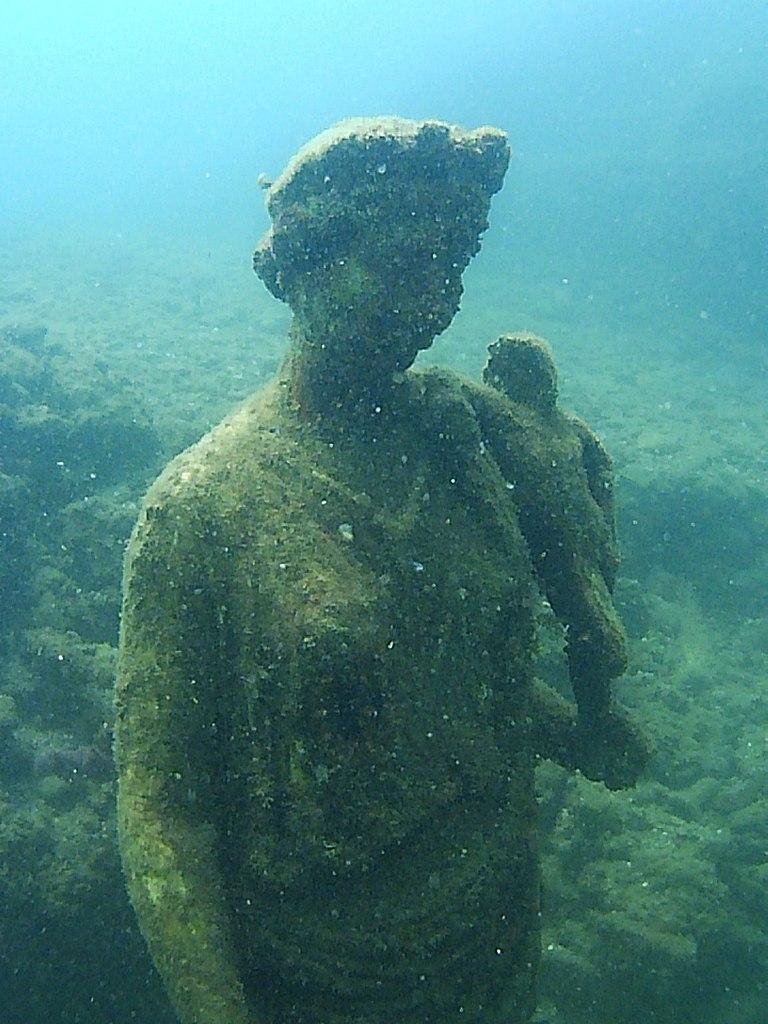
Ancient Roman villa emerges from Lake Fusaro in Italy
Underwater Archaeological Park of Baiae, Antonia Minor statue, Submerged remains of Emperor Claudius’ nymphaeum. CC0 1.0

Like the newly revealed villa, Baiae also suffered from bradyseism in ancient times, but in a descending phase. As the land lowered, much of it was completely submerged in the waters of the Gulf of Naples. Today, its submerged ruins are a major archaeological attraction, with mosaics and statues still visible underwater.

Not far from Bacoli are the ruins of Pompeii and Herculaneum, two Roman cities tragically buried by the catastrophic eruption of Mount Vesuvius in 79 CE. While those cities were entombed under layers of volcanic ash and pumice, the recent developments at Lake Fusaro demonstrate how volcanic activity can also bring ancient structures back into view.

Near Bacoli lie the ruins of Pompeii and Herculaneum, two Roman cities buried by the catastrophic eruption of Mount Vesuvius in 79 CE. The recent discovery at Lake Fusaro demonstrates that an active volcano can sometimes bring ancient structures back into view.


Share5Tweet3Share1ShareSend

You May Also Like...

Oldest known rock art dated to 67,800 years discovered in Sulawesi cave
Archaeology

Oldest known rock art dated to 67,800 years discovered in Sulawesi cave

January 20, 2026
Roman marching camps discovered in Saxony-Anhalt reveal early military advances deep into Germania
Archaeology

Roman marching camps discovered in Saxony-Anhalt reveal early military advances deep into Germania

January 15, 2026
Casablanca fossils dated 773,000 years back reveal African origin of last common ancestor of humans and Neanderthals
Anthropology

Casablanca fossils dated 773,000 years back reveal African origin of last common ancestor of humans and Neanderthals

January 10, 2026
60,000-year-old poison arrows from South Africa reveal the world’s earliest poisoned weapons and advanced hunting techniques
Archaeology

60,000-year-old poison arrows from South Africa reveal the world’s earliest poisoned weapons and advanced hunting techniques

January 8, 2026
Inscribed clay cylinders reveal Nebuchadnezzar II’s restoration of the Kish Ziggurat
Archaeology

Inscribed clay cylinders reveal Nebuchadnezzar II’s restoration of the Kish Ziggurat

January 7, 2026
Rare Late Roman mosaic with Solomon’s Knot discovered beneath modern İzmir
Archaeology

Rare Late Roman mosaic with Solomon’s Knot discovered beneath modern İzmir

January 7, 2026

Follow us


Instagram
244K

Facebook
118K

Threads
45K

LinkedIn
14K

Twitter
6K

YouTube
1K
  • Trending
  • Comments
  • Latest
Shipwreck Salvage. Credit: rawpixel.com / Public Domain

2,000-year-old shipwreck discovered off Turkish coast with remarkably preserved stacked ceramics

July 2, 2025
Viking age DNA reveals 9,000-year-old HIV-resistant gene originating near the Black Sea

Viking age DNA reveals 9,000-year-old HIV-resistant gene originating near the Black Sea

May 18, 2025
A new study suggests the mysterious Voynich Manuscript may be a medieval cipher

A new study suggests the mysterious Voynich Manuscript may be a medieval cipher

January 3, 2026
Moses may be named in ancient Egyptian mine inscriptions, sparking debate over earliest biblical references

Moses may be named in ancient Egyptian mine inscriptions, sparking debate over earliest biblical references

July 31, 2025
Mystery of Armenia’s 6,000-year-old dragon stones solved

Mystery of Armenia’s 6,000-year-old dragon stones solved

September 23, 2025
3D analysis reveals Shroud of Turin image likely came from sculpture, not Jesus’ body

3D analysis reveals Shroud of Turin image likely came from sculpture, not Jesus’ body

Moses may be named in ancient Egyptian mine inscriptions, sparking debate over earliest biblical references

Moses may be named in ancient Egyptian mine inscriptions, sparking debate over earliest biblical references

$1 million prize offered to decipher 5,300-year-old Indus Valley script

$1 million prize offered to decipher 5,300-year-old Indus Valley script

Oldest ever genetic data from a human relative found in 2-million-year-old fossilized teeth

Oldest ever genetic data from a human relative found in 2-million-year-old fossilized teeth

Exceptionally large Roman shoes discovered at Magna fort near Hadrian’s Wall

Exceptionally large Roman shoes discovered at Magna fort near Hadrian’s Wall

Oldest known rock art dated to 67,800 years discovered in Sulawesi cave

Oldest known rock art dated to 67,800 years discovered in Sulawesi cave

January 20, 2026
Roman marching camps discovered in Saxony-Anhalt reveal early military advances deep into Germania

Roman marching camps discovered in Saxony-Anhalt reveal early military advances deep into Germania

January 15, 2026
Casablanca fossils dated 773,000 years back reveal African origin of last common ancestor of humans and Neanderthals

Casablanca fossils dated 773,000 years back reveal African origin of last common ancestor of humans and Neanderthals

January 10, 2026
60,000-year-old poison arrows from South Africa reveal the world’s earliest poisoned weapons and advanced hunting techniques

60,000-year-old poison arrows from South Africa reveal the world’s earliest poisoned weapons and advanced hunting techniques

January 8, 2026
Inscribed clay cylinders reveal Nebuchadnezzar II’s restoration of the Kish Ziggurat

Inscribed clay cylinders reveal Nebuchadnezzar II’s restoration of the Kish Ziggurat

January 7, 2026

Archaeology News online magazine

Archaeology News is an international online magazine that covers all aspects of archaeology.


Categories

  • Academics
    • Books
    • Conferences
    • Universities
  • Articles
  • Download
  • Game
  • News
    • Anthropology
    • Archaeology
    • Paleontology
  • Quiz
  • Tours

Subscribe to our newsletter

© 2024 - Archaeology News Online Magazine. All Rights Reserved.

  • About
  • Privacy Policy
  • Terms of Use
  • Donation
  • Contact

Welcome Back!

Login to your account below

Forgotten Password? Sign Up

Create New Account!

Fill the forms below to register

All fields are required. Log In

Retrieve your password

Please enter your username or email address to reset your password.

Log In

Add New Playlist

Manage Consent
To provide the best experiences, we use technologies like cookies to store and/or access device information. Consenting to these technologies will allow us to process data such as browsing behavior or unique IDs on this site. Not consenting or withdrawing consent, may adversely affect certain features and functions.
Functional Always active
The technical storage or access is strictly necessary for the legitimate purpose of enabling the use of a specific service explicitly requested by the subscriber or user, or for the sole purpose of carrying out the transmission of a communication over an electronic communications network.
Preferences
The technical storage or access is necessary for the legitimate purpose of storing preferences that are not requested by the subscriber or user.
Statistics
The technical storage or access that is used exclusively for statistical purposes. The technical storage or access that is used exclusively for anonymous statistical purposes. Without a subpoena, voluntary compliance on the part of your Internet Service Provider, or additional records from a third party, information stored or retrieved for this purpose alone cannot usually be used to identify you.
Marketing
The technical storage or access is required to create user profiles to send advertising, or to track the user on a website or across several websites for similar marketing purposes.
  • Manage options
  • Manage services
  • Manage {vendor_count} vendors
  • Read more about these purposes
View preferences
  • {title}
  • {title}
  • {title}
  • Home
  • News
    • Archaeology
    • Anthropology
    • Paleontology
  • Academic
    • Books
    • Conferences
    • Universities
  • Articles
  • VR Tours
  • Quiz & Game
  • Download
  • Encyclopedia
  • Forum

About  .  Contact  .  Donation

© 2024 - Archaeology News Online Magazine. All Rights Reserved