• About
  • Privacy Policy
  • Terms of Use
  • Donation
  • Contact
No Result
View All Result
Archaeology News
  • Home
  • News
    • Archaeology
    • Anthropology
    • Paleontology
  • Academic
    • Books
    • Conferences
    • Universities
  • Articles
  • VR Tours
  • Quiz & Game
  • Download
  • Encyclopedia
  • Forum
Archaeology News
No Result
View All Result
Home News Anthropology

Ancient genomes rewrite the story of Shimao’s origins and its gendered ritual practices

by Dario Radley
November 29, 2025

A new genetic study is providing the most detailed picture to date of the people who built Shimao, a vast fortified settlement in northern Shaanxi that flourished more than four millennia ago. The research, published in Nature, helps clarify the ancestry, social organization, and ritual practices of one of late Neolithic China’s most influential early urban centers.
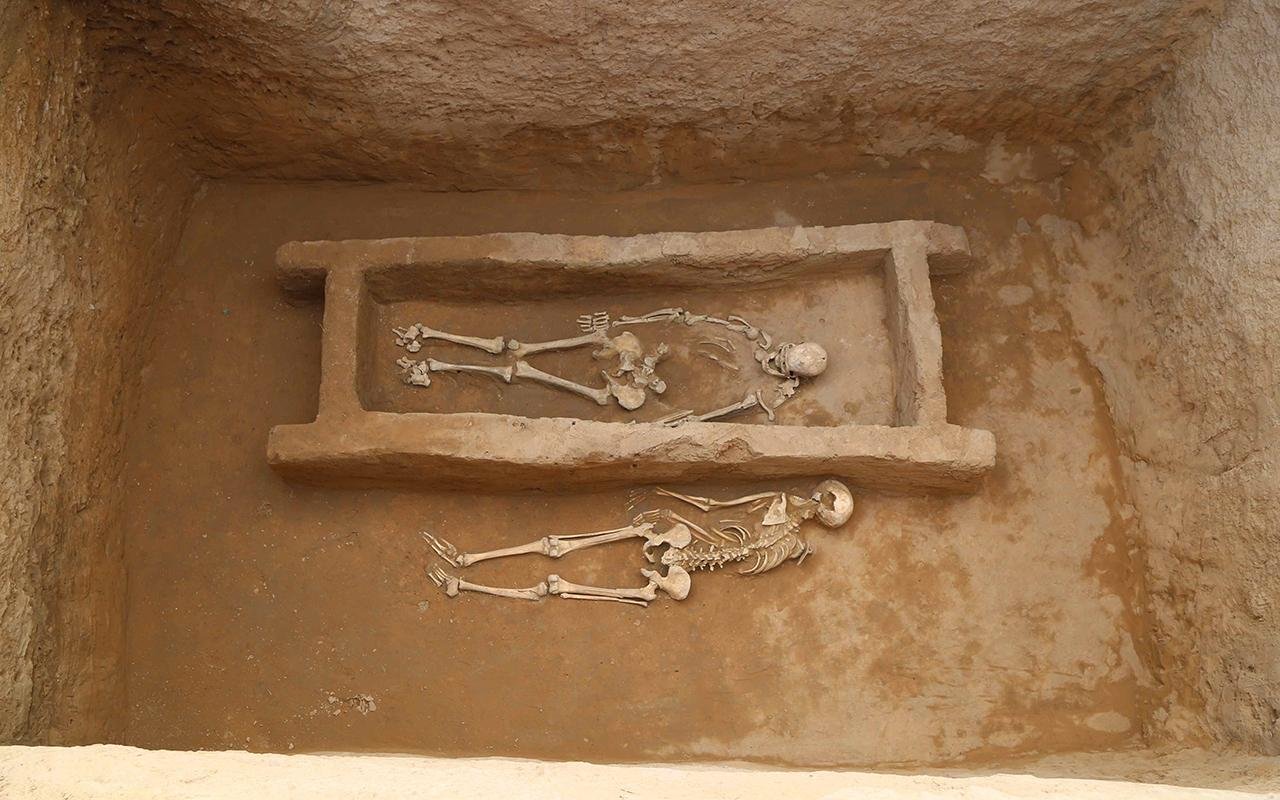
Ancient DNA from Shimao’s male skulls overturns assumptions about Neolithic rites
High-level burial (tomb 2020M4) at Zhaishan site (a tomb owner and a sacrificed victim). Credit: IVPP

Shimao was occupied from approximately 4,200–3,700 years ago, stretching over nearly four square kilometers and divided into specialized zones marked by complex architecture, elite residences, and evidence of large-scale ritual activity. While archaeologists have long recognized the city’s sophisticated planning and stratified society, key questions remained about where its founders came from and how they organized power within an emerging state-level community.

To better understand these issues, an interdisciplinary team of researchers from the Institute of Vertebrate Paleontology and Paleoanthropology spent over a decade analyzing ancient genomes from 169 individuals excavated at Shimao, its satellite settlements, and sites in southern Shanxi. Their sequencing of 144 unrelated individuals enabled them to reconstruct multigenerational pedigrees and track broader patterns of ancestry across the region.

The results indicate that most of Shimao’s builders descended from local groups in the Yangshao tradition, a Neolithic culture centered on the Loess Plateau. This continuity goes back at least a millennium, meaning Shimao could not have emerged as a sudden migration or replacement. Instead, the development of Shimao reflects long-term regional growth with steady contact with neighboring communities.
Ancient DNA from Shimao’s male skulls overturns assumptions about Neolithic rites
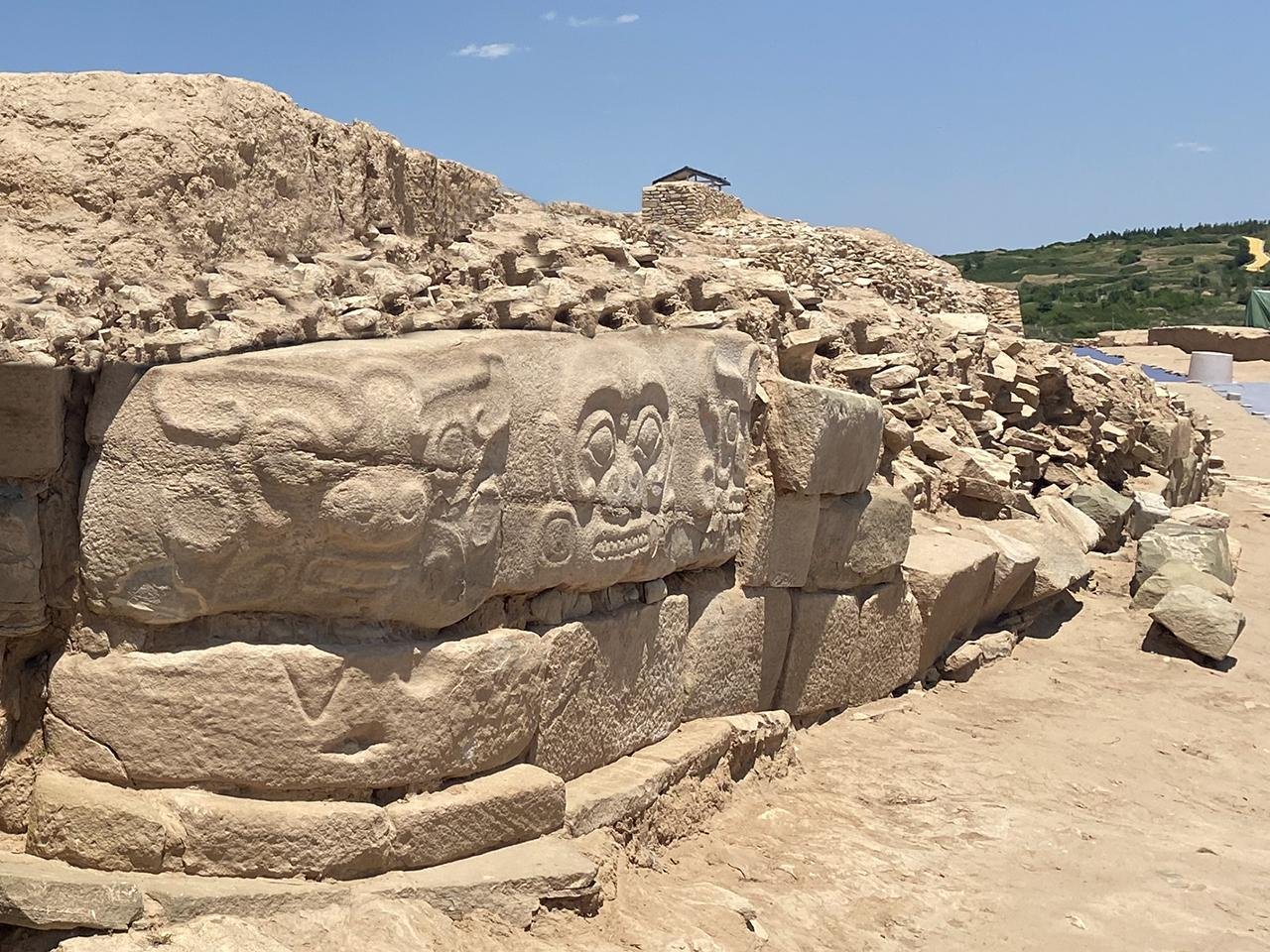
Shimao’s decorated wall in the central citadel (ca. 2300 BCE). Credit: Bilaterian / CC BY-SA 4.0

The study also uncovered genetic inputs from various directions: populations related to the Taosi culture of southern Shanxi, Yumin-related groups from the steppe, and communities farther south associated with early rice farming. These results suggest interactions among northern farmers, pastoralists, and groups from more subtropical regions, indicating broader cultural and economic connections than previously thought.
RelatedStories

6,000-year-old necropolis in Spain rewrites origins of Europe’s first megalithic tombs

6,000-year-old necropolis in Spain rewrites origins of Europe’s first megalithic tombs

May 18, 2026
Ancient Danes kept fishing for millennia after farming arrived, study finds

Ancient Danes kept fishing for millennia after farming arrived, study finds

May 14, 2026

Perhaps the most striking contribution of this study concerns Shimao’s social structure. The team identified several family lines with multiple generations—up to four—which indicates a strongly patrilineal and patrilocal society wherein both social position and residence were passed through male lines. This pattern also seems to have influenced the ritual practices of the community.

Excavations at the East Gate of Shimao revealed around 80 human skulls, one of the largest such concentrations known from Neolithic China. While earlier interpretations suggested that women may have dominated these sacrificial events, genetic analysis now confirms that the vast majority of the individuals there were men. Women who were sacrificed, on the other hand, were more commonly found in elite cemetery zones such as Huangchengtai and Hanjiagedan. This division implies a highly structured ritual system at Shimao, with gender tied to certain ceremonial roles and locations.

Together, these new findings form the first direct genetic evidence for exploring how early political authority was organized in northern China. They also reveal the interconnected cultural, biological, and economic forces that gave Shimao its shape as one of the earliest large-scale urban societies in East Asia.

More information: Chinese Academy of Sciences
Publication: Chen, Z., Gardner, J.D., Sun, Z. et al. (2025). Ancient DNA from Shimao city records kinship practices in Neolithic China. Nature. doi:10.1038/s41586-025-09799-x

Share:

Share on Facebook Share on X (Twitter) Share on LinkedIn Share on Pinterest Share on WhatsApp Share on Email

You May Also Like...

100 Abbasid-era gold jewelry pieces found at ancient Dariyah site in Saudi Arabia
Archaeology

100 Abbasid-era gold jewelry pieces found at ancient Dariyah site in Saudi Arabia

May 22, 2026
Neanderthals gathered shellfish like modern humans 115,000 years ago, study finds
Anthropology

Neanderthals gathered shellfish like modern humans 115,000 years ago, study finds

May 21, 2026
Ancient pigeons were already living alongside humans 3,400 years ago, study finds
Archaeology

Ancient pigeons were already living alongside humans 3,400 years ago, study finds

May 21, 2026
Ancient Venetic sanctuary with rare inscriptions unearthed beneath road project in Italy
Archaeology

Ancient Venetic sanctuary with rare inscriptions unearthed beneath road project in Italy

May 21, 2026
1,000-year-old dingo burial in Australia reveals deep ties between Barkindji people and dingoes
Archaeology

1,000-year-old ritually buried dingo in Australia reveals deep ties between Barkindji people and dingoes

May 20, 2026
Ancient texts reveal how Persian and Greek rule shaped language in Central Asia
Archaeology

Ancient texts reveal how Persian and Greek rule shaped language in Central Asia

May 20, 2026

Comments 0

  1. Editorial Team says:
    1 second ago

    Disclaimer: This website is a science-focused magazine that welcomes both academic and non-academic audiences. Comments are written by users and may include personal opinions or unverified claims. They do not necessarily reflect the views of our editorial team or rely on scientific evidence.

    Comment Policy: We kindly ask all commenters to engage respectfully. Comments that contain offensive, insulting, degrading, discriminatory, or racist content will be automatically removed.

    Reply

Leave a Reply Cancel reply

Your email address will not be published. Required fields are marked *

Follow us


Instagram
242K

Facebook
117K

Threads
46K

LinkedIn
14K

Twitter
6K

YouTube
1K
100 Abbasid-era gold jewelry pieces found at ancient Dariyah site in Saudi Arabia

100 Abbasid-era gold jewelry pieces found at ancient Dariyah site in Saudi Arabia

May 22, 2026
Neanderthals gathered shellfish like modern humans 115,000 years ago, study finds

Neanderthals gathered shellfish like modern humans 115,000 years ago, study finds

May 21, 2026
Ancient pigeons were already living alongside humans 3,400 years ago, study finds

Ancient pigeons were already living alongside humans 3,400 years ago, study finds

May 21, 2026
Ancient Venetic sanctuary with rare inscriptions unearthed beneath road project in Italy

Ancient Venetic sanctuary with rare inscriptions unearthed beneath road project in Italy

May 21, 2026

Archaeology News online magazine

Archaeology News is an international online magazine that covers all aspects of archaeology.


Categories

  • Academics
    • Books
    • Conferences
    • Universities
  • Articles
  • Download
  • Game
  • News
    • Anthropology
    • Archaeology
    • Paleontology
  • Quiz
  • Tours

Subscribe to our newsletter

© 2024 - Archaeology News Online Magazine. All Rights Reserved.

  • About
  • Privacy Policy
  • Terms of Use
  • Donation
  • Contact

Manage Consent
To provide the best experiences, we use technologies like cookies to store and/or access device information. Consenting to these technologies will allow us to process data such as browsing behavior or unique IDs on this site. Not consenting or withdrawing consent, may adversely affect certain features and functions.
Functional Always active
The technical storage or access is strictly necessary for the legitimate purpose of enabling the use of a specific service explicitly requested by the subscriber or user, or for the sole purpose of carrying out the transmission of a communication over an electronic communications network.
Preferences
The technical storage or access is necessary for the legitimate purpose of storing preferences that are not requested by the subscriber or user.
Statistics
The technical storage or access that is used exclusively for statistical purposes. The technical storage or access that is used exclusively for anonymous statistical purposes. Without a subpoena, voluntary compliance on the part of your Internet Service Provider, or additional records from a third party, information stored or retrieved for this purpose alone cannot usually be used to identify you.
Marketing
The technical storage or access is required to create user profiles to send advertising, or to track the user on a website or across several websites for similar marketing purposes.
  • Manage options
  • Manage services
  • Manage {vendor_count} vendors
  • Read more about these purposes
View preferences
  • {title}
  • {title}
  • {title}
  • Home
  • News
    • Archaeology
    • Anthropology
    • Paleontology
  • Academic
    • Books
    • Conferences
    • Universities
  • Articles
  • VR Tours
  • Quiz & Game
  • Download
  • Encyclopedia
  • Forum

About  .  Contact  .  Donation

© 2024 - Archaeology News Online Magazine. All Rights Reserved