• About
  • Privacy Policy
  • Terms of Use
  • Donation
  • Contact
No Result
View All Result
Archaeology News
  • Home
  • News
    • Archaeology
    • Anthropology
    • Paleontology
  • Academic
    • Books
    • Conferences
    • Universities
  • Articles
  • VR Tours
  • Quiz & Game
  • Download
  • Encyclopedia
  • Forum
Archaeology News
No Result
View All Result
Home News Archaeology

Rare inscription of Pharaoh Ramses III discovered in southern Jordan’s Wadi Rum

by Dario Radley
April 22, 2025

Archaeologists have discovered a rare hieroglyphic inscription of Pharaoh Ramses III in southern Jordan, providing new proof of Egypt’s ancient ties with the Arabian Peninsula. The find is the first discovery of an Egyptian royal cartouche in Jordan.

Rare inscription of Pharaoh Ramses III discovered in southern Jordan’s Wadi Rum
One of the painted walls of the tomb of Ramses III (Tomb KV11) located in the main valley of the Valley of the Kings, Egypt. Credit:
kairoinfo4u (CC BY-NC-SA 2.0)

The inscription was carved into a rock face southeast of the Wadi Rum Reserve, near the border with Saudi Arabia. It bears two cartouches—one with Ramses III’s birth name and the other with his throne name—confirming his reign over Upper and Lower Egypt between 1186 BCE and 1155 BCE.

“This is a landmark discovery that enhances our understanding of ancient connections between Egypt, Jordan, and the Arabian Peninsula,” Jordan’s Minister of Tourism and Antiquities Lina Annab said at a press conference. She called Jordan “an open library” of cultural heritage and the discovery a “qualitative addition” to Jordan’s extensive collection of inscriptions.

Dr. Zahi Hawass, Egypt’s most prominent archaeologist, also spoke at the event. “The discovery is crucial,” he said. “It could open the door to a deeper understanding of Egypt’s interactions with the southern Levant and the Arabian Peninsula over 3,000 years ago.” Hawass said that finding Ramses III’s name in Jordan points to Egypt’s broader influence than previously known.

The joint excavation is being conducted by Jordan’s Ministry of Tourism and Antiquities and the Saudi Heritage Commission. The project is part of a broader initiative to document evidence of Ramses III’s military and cultural campaigns beyond Egypt’s borders.

Ramses III ruled during a time of upheaval in the Eastern Mediterranean. As the Hittite and Mycenaean Greek kingdoms collapsed, Egypt was repeatedly attacked by land and sea. Ramses led successful defenses, most famously in the Battle of the Delta against the Sea Peoples, a mysterious group of invaders.

The Wadi Rum inscription can tell us about Egypt’s actions in regions east of the Sinai. Jordan was never part of the Egyptian Empire but lay on significant trade routes connecting Egypt with the Levant and Arabia. That a royal seal has been discovered in this desert region shows that Egypt’s influence—military, political, or cultural—extended further than previously attested.

Full analysis of the inscription is underway. Officials will release full findings once research is complete and may conduct additional excavations in the area.

More information: Jordan’s Ministry of Tourism and Antiquities

Share:

Share on Facebook Share on X (Twitter) Share on LinkedIn Share on Pinterest Share on WhatsApp Share on Email

You May Also Like...

Archaeologists find Queen Elisenda’s remains among 25 medieval skeletons, including individuals with unexplained stab wounds
Anthropology

Archaeologists find Queen Elisenda’s remains among 25 medieval skeletons, including individuals with unexplained stab wounds

June 1, 2026
Copper Age children in Spain suffered widespread respiratory disease, skeletal study suggests
Anthropology

Copper Age children in Spain suffered widespread respiratory disease, skeletal study suggests

June 1, 2026
Unknown World War II mass grave with 14 German soldiers uncovered at quarry site in Poland
Anthropology

Unknown World War II mass grave with 14 German soldiers uncovered at quarry site in Poland

May 31, 2026
Volunteers restore England’s mysterious Cerne Abbas Giant as climate and erosion threaten ancient landmark
Archaeology

Volunteers restore England’s mysterious Cerne Abbas Giant as climate and erosion threaten ancient landmark

May 31, 2026
Buried church bell found in Poland after decades hidden beneath roadside
Archaeology

Buried church bell found in Poland after decades hidden beneath roadside

May 31, 2026
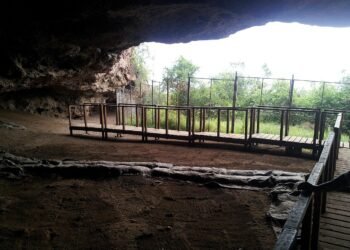
Stone Age humans built complex grass beds at Border Cave 200,000 years ago, study finds
Archaeology

Stone Age humans built complex grass beds at Border Cave 200,000 years ago, study finds

May 30, 2026

Comments 1

  1. Editorial Team says:
    1 second ago

    Disclaimer: This website is a science-focused magazine that welcomes both academic and non-academic audiences. Comments are written by users and may include personal opinions or unverified claims. They do not necessarily reflect the views of our editorial team or rely on scientific evidence.

    Comment Policy: We kindly ask all commenters to engage respectfully. Comments that contain offensive, insulting, degrading, discriminatory, or racist content will be automatically removed.

  2. MissTiff says:
    1 year ago

    It looks like directions to a process of some sort. Very interesting.

Follow us


Instagram
242K

Facebook
117K

Threads
47K

LinkedIn
15K

Twitter
6K

YouTube
1K

Archaeology News online magazine

Archaeology News is an international online magazine that covers all aspects of archaeology.


Categories

  • Academics
    • Books
    • Conferences
    • Universities
  • Articles
  • Download
  • Game
  • News
    • Anthropology
    • Archaeology
    • Paleontology
  • Quiz
  • Tours

Subscribe to our newsletter

© 2024 - Archaeology News Online Magazine. All Rights Reserved.

  • About
  • Privacy Policy
  • Terms of Use
  • Donation
  • Contact

Manage Consent
To provide the best experiences, we use technologies like cookies to store and/or access device information. Consenting to these technologies will allow us to process data such as browsing behavior or unique IDs on this site. Not consenting or withdrawing consent, may adversely affect certain features and functions.
Functional Always active
The technical storage or access is strictly necessary for the legitimate purpose of enabling the use of a specific service explicitly requested by the subscriber or user, or for the sole purpose of carrying out the transmission of a communication over an electronic communications network.
Preferences
The technical storage or access is necessary for the legitimate purpose of storing preferences that are not requested by the subscriber or user.
Statistics
The technical storage or access that is used exclusively for statistical purposes. The technical storage or access that is used exclusively for anonymous statistical purposes. Without a subpoena, voluntary compliance on the part of your Internet Service Provider, or additional records from a third party, information stored or retrieved for this purpose alone cannot usually be used to identify you.
Marketing
The technical storage or access is required to create user profiles to send advertising, or to track the user on a website or across several websites for similar marketing purposes.
  • Manage options
  • Manage services
  • Manage {vendor_count} vendors
  • Read more about these purposes
View preferences
  • {title}
  • {title}
  • {title}
  • Home
  • News
    • Archaeology
    • Anthropology
    • Paleontology
  • Academic
    • Books
    • Conferences
    • Universities
  • Articles
  • VR Tours
  • Quiz & Game
  • Download
  • Encyclopedia
  • Forum

About  .  Contact  .  Donation

© 2024 - Archaeology News Online Magazine. All Rights Reserved