• About
  • Privacy Policy
  • Terms of Use
  • Donation
  • Contact
No Result
View All Result
Archaeology News
  • Home
  • News
    • Archaeology
    • Anthropology
    • Paleontology
  • Academic
    • Books
    • Conferences
    • Universities
  • Articles
  • VR Tours
  • Quiz & Game
  • Download
  • Encyclopedia
  • Forum
Archaeology News
No Result
View All Result
Home News Archaeology

Valencina: a sustainable, egalitarian mega-village of the Copper Age

by Dario Radley
April 8, 2025

New excavation of the Valencina de la Concepción Chalcolithic site in Seville, Spain, is defying old assumptions regarding its purpose and social structure. Not a temporary gathering point or reserved for ritual activity, but rather, a recent Universitat Autònoma de Barcelona (UAB) research published in the Journal of Archaeological Science: Reports reveals Valencina to have been a thriving, permanent settlement occupied continuously for well over a millennium—from around 3300 to 2150 BCE.
Valencina: a sustainable, egalitarian mega-village of the Copper Age
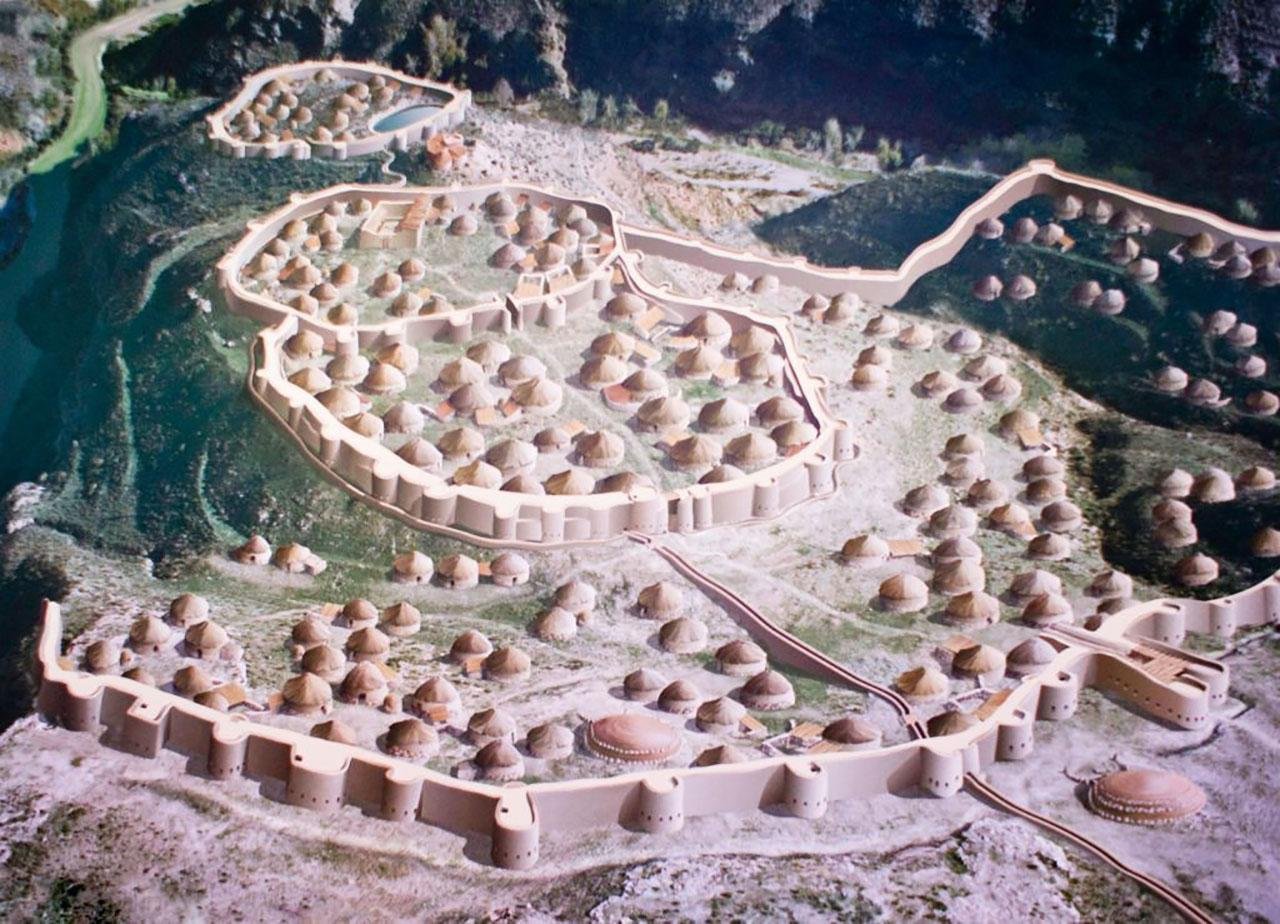
Painting of a Copper Age walled settlement, Los Millares, Spain. Credit: Jose Mª Yuste / Miguel Salvatierra Cuenca

Researchers analyzed 635 macrolithic tools from the site’s northern section, an area long comparatively overlooked relative to the site’s more prominent necropolis. It was part of the larger Valencina Nord Project, undertaken in collaboration with the German Archaeological Institute in Madrid, the University of Würzburg, and the Autonomous University of Madrid. Excavations focused on sites such as Cerro de la Cabeza and Pabellón Cubierto, examining habitation structures, workshops, and storage pits.

According to Marina Eguíluz, a predoctoral researcher at the Department of Prehistory of UAB and lead author of the study, “This indicates a permanent occupation of the settlement. The only observable changes between the three major phases of occupation could be due to the density of occupation of the area.”

The findings reveal a stable and sustainable way of life centered on diversified domestic and subsistence tasks. These included grain processing, animal husbandry, leather work, fiber work, and working with organic and inorganic materials. The tools were built using locally sourced raw materials—within a 30-kilometer radius—and revealed extensive evidence of use and reuse, indicating a connection to local environments and efficient resource management.

Significantly, no traces of surplus accumulation or central storage were identified by the study, and this convinced scholars that the inhabitants practiced an egalitarian and cooperative economy. UAB prehistorian Roberto Risch, the coordinator of the study, explained: “The observed continuity highlights the sustainability of the socioeconomic model present during the Copper Age, based on cooperativism and the lack of accumulation and centralization.” In his view, these findings reinforce the theory of “cooperative societies of abundance,” contrary to typical models which locate prehistoric society as having taken a linear path toward hierarchy and state formation.

RelatedStories

6,000-year-old skeleton reveals survival after a violent lion attack in ancient Bulgaria

6,000-year-old skeleton reveals survival after a violent lion attack in ancient Bulgaria

December 13, 2025
CT scans reveal how ancient Iranian metallurgists smelted copper

CT scans reveal how ancient Iranian metallurgists smelted copper

November 20, 2025

Previous interpretations of Valencina have given great emphasis to its necropolis and elite burials and burial goods, often overlooking the settlement area. Stone tools had been viewed primarily in ritual terms before because they were fragmented. But this research turns the spotlight onto daily life and economic activity, rewriting our knowledge of one of the biggest Copper Age sites in Europe, covering a remarkable 450 hectares.

Autonomous University of Barcelona

More information: Eguíluz Valentini, M., Risch, R., Peres, M., Mederos Martín, A., Falkenstein, F., & Schuhmacher, T. X. (2025). Economy of a long-term Chalcolithic ditched enclosure: Analysis of the macrolithic tool assemblage of valencina de la Concepción (Sevilla, Spain). Journal of Archaeological Science, Reports, 63(105039), 105039. doi:10.1016/j.jasrep.2025.105039
Share5Tweet3Share1ShareSend

You May Also Like...

Scents of ancient Egypt: tracing embalming recipes by analyzing air around mummies
Anthropology

Scents of ancient Egypt: tracing embalming recipes by analyzing air around mummies

February 6, 2026
New study reveals advanced lead pipeline system in Petra’s ancient aqueduct
Archaeology

New study reveals advanced lead pipeline system in Petra’s ancient aqueduct

February 6, 2026
Early human innovation in southern Africa tied to mobility and social networks rather than climate alone, new study shows
Archaeology

Early human innovation in southern Africa tied to mobility and social networks rather than climate alone, new study shows

February 6, 2026
LiDAR mapping reveals over 630,000 historic charcoal kiln sites across Poland’s forests
Archaeology

LiDAR mapping reveals over 630,000 historic charcoal kiln sites across Poland’s forests

February 5, 2026
CT scans of ancient Egyptian mummies reveal lifespans, health, and daily life of priests
Anthropology

CT scans of ancient Egyptian mummies reveal lifespans, health, and daily life of priests

February 4, 2026
14,000-year-old Alaska campsite helps trace how the first people arrived in North America
Archaeology

14,000-year-old Alaska campsite helps trace how the first people arrived in North America

February 4, 2026

Follow us


Instagram
244K

Facebook
118K

Threads
45K

LinkedIn
14K

Twitter
6K

YouTube
1K
  • Trending
  • Comments
  • Latest
Shipwreck Salvage. Credit: rawpixel.com / Public Domain

2,000-year-old shipwreck discovered off Turkish coast with remarkably preserved stacked ceramics

July 2, 2025
Viking age DNA reveals 9,000-year-old HIV-resistant gene originating near the Black Sea

Viking age DNA reveals 9,000-year-old HIV-resistant gene originating near the Black Sea

May 18, 2025
A new study suggests the mysterious Voynich Manuscript may be a medieval cipher

A new study suggests the mysterious Voynich Manuscript may be a medieval cipher

January 3, 2026
Moses may be named in ancient Egyptian mine inscriptions, sparking debate over earliest biblical references

Moses may be named in ancient Egyptian mine inscriptions, sparking debate over earliest biblical references

July 31, 2025
Mystery of Armenia’s 6,000-year-old dragon stones solved

Mystery of Armenia’s 6,000-year-old dragon stones solved

September 23, 2025
3D analysis reveals Shroud of Turin image likely came from sculpture, not Jesus’ body

3D analysis reveals Shroud of Turin image likely came from sculpture, not Jesus’ body

Moses may be named in ancient Egyptian mine inscriptions, sparking debate over earliest biblical references

Moses may be named in ancient Egyptian mine inscriptions, sparking debate over earliest biblical references

$1 million prize offered to decipher 5,300-year-old Indus Valley script

$1 million prize offered to decipher 5,300-year-old Indus Valley script

Oldest ever genetic data from a human relative found in 2-million-year-old fossilized teeth

Oldest ever genetic data from a human relative found in 2-million-year-old fossilized teeth

Exceptionally large Roman shoes discovered at Magna fort near Hadrian’s Wall

Exceptionally large Roman shoes discovered at Magna fort near Hadrian’s Wall

Scents of ancient Egypt: tracing embalming recipes by analyzing air around mummies

Scents of ancient Egypt: tracing embalming recipes by analyzing air around mummies

February 6, 2026
New study reveals advanced lead pipeline system in Petra’s ancient aqueduct

New study reveals advanced lead pipeline system in Petra’s ancient aqueduct

February 6, 2026
Early human innovation in southern Africa tied to mobility and social networks rather than climate alone, new study shows

Early human innovation in southern Africa tied to mobility and social networks rather than climate alone, new study shows

February 6, 2026
LiDAR mapping reveals over 630,000 historic charcoal kiln sites across Poland’s forests

LiDAR mapping reveals over 630,000 historic charcoal kiln sites across Poland’s forests

February 5, 2026
CT scans of ancient Egyptian mummies reveal lifespans, health, and daily life of priests

CT scans of ancient Egyptian mummies reveal lifespans, health, and daily life of priests

February 4, 2026

Archaeology News online magazine

Archaeology News is an international online magazine that covers all aspects of archaeology.


Categories

  • Academics
    • Books
    • Conferences
    • Universities
  • Articles
  • Download
  • Game
  • News
    • Anthropology
    • Archaeology
    • Paleontology
  • Quiz
  • Tours

Subscribe to our newsletter

© 2024 - Archaeology News Online Magazine. All Rights Reserved.

  • About
  • Privacy Policy
  • Terms of Use
  • Donation
  • Contact

Welcome Back!

Login to your account below

Forgotten Password? Sign Up

Create New Account!

Fill the forms below to register

All fields are required. Log In

Retrieve your password

Please enter your username or email address to reset your password.

Log In

Add New Playlist

Manage Consent
To provide the best experiences, we use technologies like cookies to store and/or access device information. Consenting to these technologies will allow us to process data such as browsing behavior or unique IDs on this site. Not consenting or withdrawing consent, may adversely affect certain features and functions.
Functional Always active
The technical storage or access is strictly necessary for the legitimate purpose of enabling the use of a specific service explicitly requested by the subscriber or user, or for the sole purpose of carrying out the transmission of a communication over an electronic communications network.
Preferences
The technical storage or access is necessary for the legitimate purpose of storing preferences that are not requested by the subscriber or user.
Statistics
The technical storage or access that is used exclusively for statistical purposes. The technical storage or access that is used exclusively for anonymous statistical purposes. Without a subpoena, voluntary compliance on the part of your Internet Service Provider, or additional records from a third party, information stored or retrieved for this purpose alone cannot usually be used to identify you.
Marketing
The technical storage or access is required to create user profiles to send advertising, or to track the user on a website or across several websites for similar marketing purposes.
  • Manage options
  • Manage services
  • Manage {vendor_count} vendors
  • Read more about these purposes
View preferences
  • {title}
  • {title}
  • {title}
  • Home
  • News
    • Archaeology
    • Anthropology
    • Paleontology
  • Academic
    • Books
    • Conferences
    • Universities
  • Articles
  • VR Tours
  • Quiz & Game
  • Download
  • Encyclopedia
  • Forum

About  .  Contact  .  Donation

© 2024 - Archaeology News Online Magazine. All Rights Reserved