• About
  • Privacy Policy
  • Terms of Use
  • Donation
  • Contact
No Result
View All Result
Archaeology News
  • Home
  • News
    • Archaeology
    • Anthropology
    • Paleontology
  • Academic
    • Books
    • Conferences
    • Universities
  • Articles
  • VR Tours
  • Quiz & Game
  • Download
  • Encyclopedia
  • Forum
Archaeology News
No Result
View All Result
Home News Anthropology

6,000-year-old skeleton reveals survival after a violent lion attack in ancient Bulgaria

by Dario Radley
December 13, 2025

Archaeologists working in eastern Bulgaria have discovered one of the most unusual forms of prehistoric evidence: the skeletal remains of a young man who survived a violent lion attack more than 6,000 years ago, lived long enough to show clear signs of healing, and received community care.

6,000-year-old skeleton reveals survival after a violent lion attack in ancient Bulgaria
The discovery in the Kozareva Mogila necropolis. Credit: N. Karastoyanova et al., Journal of Archaeological Science, Reports (2026); (This image is used under the terms of the CC BY-NC-ND license for non-commercial, educational, and informational purposes. If you are the copyright holder and have any concerns regarding its use, please contact us for prompt removal.)

The find was made in a Late Eneolithic, or Copper Age, necropolis near Kozareva Mogila, or “Goat Mound,” not far from the Black Sea coast. The burial, which dates to the fifth millennium BCE, contained the remains of a tall adolescent or young adult male who is estimated to have stood about 5 feet 7–9 inches (171–177 cm) tall. He had been laid in a grave in a crouched position on his side, with no grave goods, and in a grave that was deeper than many of the graves at the site.

What makes the burial exceptional, however, are the extreme injuries visible on the skeleton. The skull shows evidence of several puncture and crushing wounds, most notably a large opening that penetrated the cranial cavity and would have exposed the brain. Small pits are present on both sides of the head, and further trauma was identified on the legs, shoulder, and arm, indicating muscle and tendon damage. Within the skull, a fragment of bone had fused to the inner surface, indicating a violent injury that was not immediately fatal.

Detailed forensic and archaeozoological examination excluded the use of weapons, interpersonal violence, or even ritual practices like trepanation. Rather, researchers compared the lesions to tooth marks made by large carnivores using precision molds and skeletal collections. The size, shape, depth, and spacing of the wounds all conform to the teeth of a lion (Panthera leo), an animal known to have roamed the Balkans during the Copper Age. Smaller predators, like lynx or leopards, were excluded both anatomically and based on regional evidence.

6,000-year-old skeleton reveals survival after a violent lion attack in ancient Bulgaria
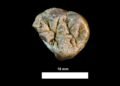
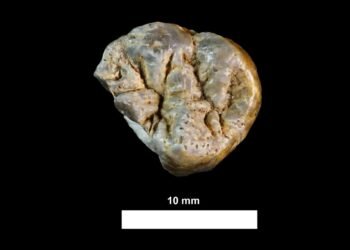
Reconstructed cranial vault, Grave # 59, defects. 4.1–2. Defects on the left and right parietals adjacent to the coronal suture. 4.3.1. Defect – perforation of the left parietal squama, outer cranial surface. 4.3.2. Defect – perforation of the left parietal squama, inner cranial surface; splinter, fused to the inner cranial surface (scale 10 mm). Credit: N. Karastoyanova et al., Journal of Archaeological Science, Reports (2026); CC BY-NC-ND 4.0

The pattern of the injuries suggests that the young man was likely knocked to the ground and repeatedly bitten, including at least one powerful bite to the head. It would have been a miracle to survive such an attack in any era; however, he did indeed survive, at least for several months. All major injuries show signs of healing, with new bone growth forming around the wounds and no indication of active infection at the time of death.
RelatedStories

1130 depiction of Saxons, Jutes, and Angles crossing the sea to Britain. Credit: Wikimedia / CC BY-SA 4.0. Roots of medieval migration into England uncovered by large-scale bioarchaeological study

Roots of medieval migration into England uncovered by large-scale bioarchaeological study

January 6, 2026
Africa’s oldest cremation: 9,500-year-old pyre reveals Stone Age rituals in Malawi

Africa’s oldest cremation: 9,500-year-old pyre reveals Stone Age rituals in Malawi

January 2, 2026

Despite this survival, the injuries would have left him seriously disabled. The open cranial wound and internal bone damage may have caused neurological problems, while trauma to his limbs likely led to difficulties in walking or performing physical labor. This continued survival strongly suggests that others in his community provided sustained care, helping him move, recover, and meet daily needs.

This example represents what researchers have termed the “bioarchaeology of care,” a field that examines how ancient societies supported injured or vulnerable individuals. Evidence from Kozareva Mogila suggests that this Eneolithic community made substantial investments of time and resources into caring for a member who had suffered devastating injuries, even though he may no longer have been fully productive.

At the same time, his burial raises questions about social perception. The absence of grave goods and the unusual depth of the grave may reflect a low social status; however, researchers suppose that his scarred appearance or possible behavioral changes after the attack could have made him a figure viewed with fear or ambiguity in death.

Taken together, the remains represent a rare, profoundly human glimpse into prehistoric life: a violent encounter with one of Europe’s most dangerous predators, followed by survival for months afterward, facilitated not by medicine alone, but by compassion and support.
More information: Karastoyanova, N., Russeva, V., Georgieva, P., & Danov, V. (2026). Bones, bites, and burials: investigating a skeleton from eneolithic necropolis for evidence of probable lion attack in Bulgaria. Journal of Archaeological Science, Reports, 69(105526), 105526. doi:10.1016/j.jasrep.2025.105526
Share31Tweet19Share5ShareSend

You May Also Like...

60,000-year-old poison arrows from South Africa reveal the world’s earliest poisoned weapons and advanced hunting techniques
Archaeology

60,000-year-old poison arrows from South Africa reveal the world’s earliest poisoned weapons and advanced hunting techniques

January 8, 2026
Inscribed clay cylinders reveal Nebuchadnezzar II’s restoration of the Kish Ziggurat
Archaeology

Inscribed clay cylinders reveal Nebuchadnezzar II’s restoration of the Kish Ziggurat

January 7, 2026
Rare Late Roman mosaic with Solomon’s Knot discovered beneath modern İzmir
Archaeology

Rare Late Roman mosaic with Solomon’s Knot discovered beneath modern İzmir

January 7, 2026
1130 depiction of Saxons, Jutes, and Angles crossing the sea to Britain. Credit: Wikimedia / CC BY-SA 4.0. Roots of medieval migration into England uncovered by large-scale bioarchaeological study
Anthropology

Roots of medieval migration into England uncovered by large-scale bioarchaeological study

January 6, 2026
Rare Celtic gold coins found in Swiss bog may reveal ancient ritual offerings
Archaeology

Rare Celtic gold coins found in Swiss bog may reveal ancient ritual offerings

January 5, 2026
Rare medieval gold ring unearthed in Tønsberg
Archaeology

Rare medieval gold ring unearthed in Tønsberg reveals beliefs and craftsmanship of its time

January 5, 2026

Comments 0

  1. Editorial Team says:
    1 second ago

    Disclaimer: This website is a science-focused magazine that welcomes both academic and non-academic audiences. Comments are written by users and may include personal opinions or unverified claims. They do not necessarily reflect the views of our editorial team or rely on scientific evidence.

    Comment Policy: We kindly ask all commenters to engage respectfully. Comments that contain offensive, insulting, degrading, discriminatory, or racist content will be automatically removed.

    Reply

Leave a Reply Cancel reply

Your email address will not be published. Required fields are marked *

Follow us


Instagram
244K

Facebook
118K

Threads
45K

LinkedIn
14K

Twitter
6K

YouTube
1K
  • Trending
  • Comments
  • Latest
Shipwreck Salvage. Credit: rawpixel.com / Public Domain

2,000-year-old shipwreck discovered off Turkish coast with remarkably preserved stacked ceramics

July 2, 2025
Viking age DNA reveals 9,000-year-old HIV-resistant gene originating near the Black Sea

Viking age DNA reveals 9,000-year-old HIV-resistant gene originating near the Black Sea

May 18, 2025
A new study suggests the mysterious Voynich Manuscript may be a medieval cipher

A new study suggests the mysterious Voynich Manuscript may be a medieval cipher

January 3, 2026
Moses may be named in ancient Egyptian mine inscriptions, sparking debate over earliest biblical references

Moses may be named in ancient Egyptian mine inscriptions, sparking debate over earliest biblical references

July 31, 2025
Mystery of Armenia’s 6,000-year-old dragon stones solved

Mystery of Armenia’s 6,000-year-old dragon stones solved

September 23, 2025
3D analysis reveals Shroud of Turin image likely came from sculpture, not Jesus’ body

3D analysis reveals Shroud of Turin image likely came from sculpture, not Jesus’ body

Moses may be named in ancient Egyptian mine inscriptions, sparking debate over earliest biblical references

Moses may be named in ancient Egyptian mine inscriptions, sparking debate over earliest biblical references

$1 million prize offered to decipher 5,300-year-old Indus Valley script

$1 million prize offered to decipher 5,300-year-old Indus Valley script

Oldest ever genetic data from a human relative found in 2-million-year-old fossilized teeth

Oldest ever genetic data from a human relative found in 2-million-year-old fossilized teeth

Exceptionally large Roman shoes discovered at Magna fort near Hadrian’s Wall

Exceptionally large Roman shoes discovered at Magna fort near Hadrian’s Wall

60,000-year-old poison arrows from South Africa reveal the world’s earliest poisoned weapons and advanced hunting techniques

60,000-year-old poison arrows from South Africa reveal the world’s earliest poisoned weapons and advanced hunting techniques

January 8, 2026
Inscribed clay cylinders reveal Nebuchadnezzar II’s restoration of the Kish Ziggurat

Inscribed clay cylinders reveal Nebuchadnezzar II’s restoration of the Kish Ziggurat

January 7, 2026
Rare Late Roman mosaic with Solomon’s Knot discovered beneath modern İzmir

Rare Late Roman mosaic with Solomon’s Knot discovered beneath modern İzmir

January 7, 2026
1130 depiction of Saxons, Jutes, and Angles crossing the sea to Britain. Credit: Wikimedia / CC BY-SA 4.0. Roots of medieval migration into England uncovered by large-scale bioarchaeological study

Roots of medieval migration into England uncovered by large-scale bioarchaeological study

January 6, 2026
Rare Celtic gold coins found in Swiss bog may reveal ancient ritual offerings

Rare Celtic gold coins found in Swiss bog may reveal ancient ritual offerings

January 5, 2026

Archaeology News online magazine

Archaeology News is an international online magazine that covers all aspects of archaeology.


Categories

  • Academics
    • Books
    • Conferences
    • Universities
  • Articles
  • Download
  • Game
  • News
    • Anthropology
    • Archaeology
    • Paleontology
  • Quiz
  • Tours

Subscribe to our newsletter

© 2024 - Archaeology News Online Magazine. All Rights Reserved.

  • About
  • Privacy Policy
  • Terms of Use
  • Donation
  • Contact

Welcome Back!

Login to your account below

Forgotten Password? Sign Up

Create New Account!

Fill the forms below to register

All fields are required. Log In

Retrieve your password

Please enter your username or email address to reset your password.

Log In

Add New Playlist

Manage Consent
To provide the best experiences, we use technologies like cookies to store and/or access device information. Consenting to these technologies will allow us to process data such as browsing behavior or unique IDs on this site. Not consenting or withdrawing consent, may adversely affect certain features and functions.
Functional Always active
The technical storage or access is strictly necessary for the legitimate purpose of enabling the use of a specific service explicitly requested by the subscriber or user, or for the sole purpose of carrying out the transmission of a communication over an electronic communications network.
Preferences
The technical storage or access is necessary for the legitimate purpose of storing preferences that are not requested by the subscriber or user.
Statistics
The technical storage or access that is used exclusively for statistical purposes. The technical storage or access that is used exclusively for anonymous statistical purposes. Without a subpoena, voluntary compliance on the part of your Internet Service Provider, or additional records from a third party, information stored or retrieved for this purpose alone cannot usually be used to identify you.
Marketing
The technical storage or access is required to create user profiles to send advertising, or to track the user on a website or across several websites for similar marketing purposes.
  • Manage options
  • Manage services
  • Manage {vendor_count} vendors
  • Read more about these purposes
View preferences
  • {title}
  • {title}
  • {title}
  • Home
  • News
    • Archaeology
    • Anthropology
    • Paleontology
  • Academic
    • Books
    • Conferences
    • Universities
  • Articles
  • VR Tours
  • Quiz & Game
  • Download
  • Encyclopedia
  • Forum

About  .  Contact  .  Donation

© 2024 - Archaeology News Online Magazine. All Rights Reserved