• About
  • Privacy Policy
  • Terms of Use
  • Donation
  • Contact
No Result
View All Result
Archaeology News
  • Home
  • News
    • Archaeology
    • Anthropology
    • Paleontology
  • Academics
    • Books
    • Conferences
    • Universities
  • Articles
  • VR Tours
  • Quiz & Game
  • Download
  • Encyclopedia
  • Forum
Archaeology News
No Result
View All Result
Home News Anthropology

Medieval man with crippled knee reveals disability care in Sweden

by Dario Radley
May 17, 2025

A recent archaeological study in southern Sweden has revealed new insights into the medieval disability experience. The study by Lund University researchers has examined a skeleton belonging to a man who had a disabling knee injury, revealing both the harsh realities and the unexpected compassion that characterized medieval disability attitudes.
Medieval man with crippled knee reveals disability care in Sweden
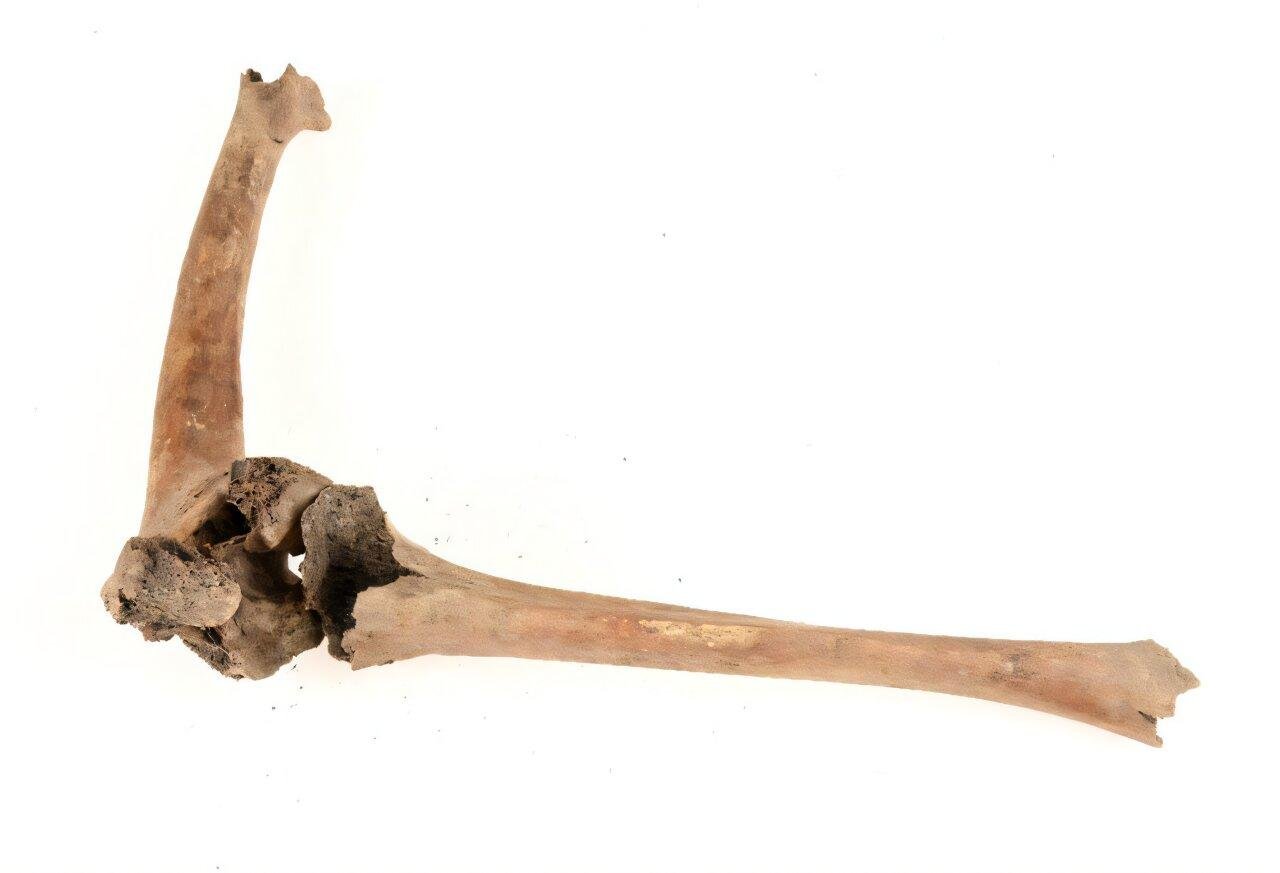
The femoral fracture in grave 2399 with the tibia repositioned to show the 45-degrees angulation. Credit: Nelly Hercberg, Cultural Museum in Lund

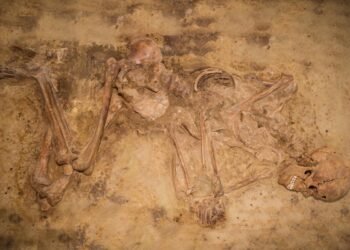
Published in Open Archaeology, the study centers on “individual 2399,” a man in his mid-30s who lived between 1300 and 1536 CE. His skeleton was discovered in Lund, a historic city in southern Sweden. The man had suffered a serious fracture and dislocation of his left knee as the result of some traumatic incident such as a horse kick or a dropped heavy object, presumably on the site where he used to work. This injury made it impossible for him to walk unaided for the rest of his life.

Led by Blair Nolan of Lund University, the team took a multidisciplinary approach through the use of traditional osteological analysis, digital excavation records, historical documents, and advanced 3D modeling. It was the first time this method was applied to medieval remains in the Nordic region. “Deducing social norms regarding physical impairment and disability from religious and legal texts is difficult because they present an idealized perspective,” Nolan said in a press release. “We can enrich our understanding of disability and identity through detailed osteological and archaeological analysis.”

The man’s skeleton shows obvious short- and long-term care. He would have received pain management immediately following his injury with ointments containing ingredients such as lavender oil, opium, and alcohol. He appears to have been repeatedly treated for osteomyelitis—a painful infection of the bone—meaning that his caregivers opened up the wound and drained it regularly. These medical interventions would have required access to resources, meaning that he was not impoverished.

Medieval man with crippled knee reveals disability care in Sweden
Integration of the 3D modelled remains into the legacy data from the context drawings of individual 2399’s grave in the excavation trench. Annotations represented by green orbs. Credit: B. Nolan et al., Open Archaeology (2025)

Indeed, his burial place attests to his relatively high status in society. Individual 2399 was interred atop the foundation stones at the base of a church tower, a prestigious spot usually reserved for wealthier citizens, particularly those from the burgher class. In medieval Sweden, proximity to sacred buildings like churches in burial practices signified a person’s status and respect within society.

RelatedStories

Ancient DNA reveals West African ancestry in 7th-century skeletons from England. Skeleton of the girl with West African ancestry buried at Updown, Kent. Credit: Duncan Sayer et al, Antiquity (2025). CC BY 4.0

Ancient DNA reveals West African ancestry in 7th-century skeletons from England

August 13, 2025
Gothic gold necklace and Roman-era treasures unearthed in Poland’s Grodziec Forest

Gothic gold necklace and Roman-era treasures unearthed in Poland’s Grodziec Forest

August 12, 2025

The study also draws on legal and religious contexts in order to provide an account of broader social attitudes towards disability at the time. Christian doctrine was ambivalent—disability might be seen as a divine punishment or test. The Church, however, had a dominant role in care, collecting alms, and running monastic hospitals. Legal codes, however, were harsh; amputation of the limbs was a punishment that created associations between crime and disability. Society’s attitudes also often assessed disabilities based on their visibility. Those injuries that could be hidden with hair or clothing were not seen as severe or stigmatizing.

Medieval man with crippled knee reveals disability care in Sweden
The city of Lund in the 1580s; engraving from volume 4 av of Civitates orbis terrarum (1588). Credit: Frans Hogenberg

Despite the cultural prejudices in society at the time, the man’s story is a reminder that compassion and sustained care for the disabled were not absent in medieval society. Surviving for a few years after he was injured, as well as his prominent burial location, suggests that he did have a respected position in his community. The evidence tends to indicate that while theological and legal texts conveyed hard or punitive attitudes towards disability, ordinary social practice may have been more accommodating and supportive, particularly to individuals of higher status.
More information: Nolan, B., Fritz, S. T., Derudas, P., Dininno, D., & Tornberg, A. (2025). Disability and care in Late Medieval Lund, Sweden: An analysis of trauma and intersecting identities, aided by photogrammetric digitization and visualization. Open Archaeology, 11(1). doi:10.1515/opar-2025-0043
Share42Tweet27Share7ShareSend

You May Also Like...

Human hair khipus reveal Inca record-keeping was used by both elites and commoners
Archaeology

Human hair khipus reveal Inca record-keeping was used by both elites and commoners

August 19, 2025
Genetic mutation in key enzyme may explain why humans survived while Neanderthals went extinct
Anthropology

Genetic mutation in key enzyme may explain why humans survived while Neanderthals went extinct

August 19, 2025
Ancient human relatives transported stones 2.6 million years ago, rewriting human history
Anthropology

Ancient human relatives transported stones 2.6 million years ago, rewriting human history

August 17, 2025
3,000-year-old hymn reveals musical links across Bronze Age civilizations from India to the Mediterranean
Archaeology

3,000-year-old hymn reveals musical links across Bronze Age civilizations from India to the Mediterranean

August 16, 2025
First confirmed artifacts from Emperor Nintoku’s 5th-century tomb in Japan
Archaeology

First confirmed artifacts from Emperor Nintoku’s 5th-century tomb in Japan

August 16, 2025
40,000 Celtic artifacts and rare bronze warrior figurine unearthed at Manching in Bavaria
Archaeology

40,000 Celtic artifacts and rare bronze warrior figurine unearthed at Manching in Bavaria

August 16, 2025

Comments 2

  1. Editorial Team says:
    56 years ago
    Disclaimer: This website is a science-focused magazine that welcomes both academic and non-academic audiences. Comments are written by users and may include personal opinions or unverified claims. They do not necessarily reflect the views of our editorial team or rely on scientific evidence.
    Reply
  2. MaryCarol Molin says:
    3 months ago

    Very very interesting and worth the time and trouble
    To research & pinpoint the origins of of this
    Piece oof history!!

    Reply
  3. Steven Martin says:
    3 months ago

    I remember seeing a similarly fused tibia/femur from the mass grave of the militia slaughtered outside Visby, Gotland by Danish king Valdemar’s forces in the 1300’s.

    Reply

Leave a Reply Cancel reply

Your email address will not be published. Required fields are marked *

Follow us


Instagram
246K

Facebook
113K

Threads
44K

LinkedIn
13K

Twitter
6K

YouTube
1K
  • Trending
  • Comments
  • Latest
Shipwreck Salvage. Credit: rawpixel.com / Public Domain

2,000-year-old shipwreck discovered off Turkish coast with remarkably preserved stacked ceramics

July 2, 2025
Viking age DNA reveals 9,000-year-old HIV-resistant gene originating near the Black Sea

Viking age DNA reveals 9,000-year-old HIV-resistant gene originating near the Black Sea

May 18, 2025
Mad emperor Caligula had surprising medical knowledge, new research reveals from ancient Roman texts

Mad emperor Caligula had surprising medical knowledge, new research reveals from ancient Roman texts

July 13, 2025
Moses may be named in ancient Egyptian mine inscriptions, sparking debate over earliest biblical references

Moses may be named in ancient Egyptian mine inscriptions, sparking debate over earliest biblical references

July 31, 2025
600-year-old amethyst jewel found in Polish castle moat reveals secrets of medieval nobility

600-year-old amethyst jewel found in Polish castle moat reveals secrets of medieval nobility

July 21, 2025
$1 million prize offered to decipher 5,300-year-old Indus Valley script

$1 million prize offered to decipher 5,300-year-old Indus Valley script

Moses may be named in ancient Egyptian mine inscriptions, sparking debate over earliest biblical references

Moses may be named in ancient Egyptian mine inscriptions, sparking debate over earliest biblical references

Oldest ever genetic data from a human relative found in 2-million-year-old fossilized teeth

Oldest ever genetic data from a human relative found in 2-million-year-old fossilized teeth

Exceptionally large Roman shoes discovered at Magna fort near Hadrian’s Wall

Exceptionally large Roman shoes discovered at Magna fort near Hadrian’s Wall

3D analysis reveals Shroud of Turin image likely came from sculpture, not Jesus’ body

3D analysis reveals Shroud of Turin image likely came from sculpture, not Jesus’ body

Human hair khipus reveal Inca record-keeping was used by both elites and commoners

Human hair khipus reveal Inca record-keeping was used by both elites and commoners

August 19, 2025
Genetic mutation in key enzyme may explain why humans survived while Neanderthals went extinct

Genetic mutation in key enzyme may explain why humans survived while Neanderthals went extinct

August 19, 2025
Ancient human relatives transported stones 2.6 million years ago, rewriting human history

Ancient human relatives transported stones 2.6 million years ago, rewriting human history

August 17, 2025
3,000-year-old hymn reveals musical links across Bronze Age civilizations from India to the Mediterranean

3,000-year-old hymn reveals musical links across Bronze Age civilizations from India to the Mediterranean

August 16, 2025
First confirmed artifacts from Emperor Nintoku’s 5th-century tomb in Japan

First confirmed artifacts from Emperor Nintoku’s 5th-century tomb in Japan

August 16, 2025

Archaeology News online magazine

Archaeology News is an international online magazine that covers all aspects of archaeology.


Categories

  • Academics
    • Books
    • Conferences
    • Universities
  • Articles
  • Download
  • Game
  • News
    • Anthropology
    • Archaeology
    • Paleontology
  • Quiz
  • Tours

Subscribe to our newsletter

© 2024 - Archaeology News Online Magazine. All Rights Reserved.

  • About
  • Privacy Policy
  • Terms of Use
  • Donation
  • Contact

Welcome Back!

Login to your account below

Forgotten Password? Sign Up

Create New Account!

Fill the forms below to register

All fields are required. Log In

Retrieve your password

Please enter your username or email address to reset your password.

Log In

Add New Playlist

Manage Consent
To provide the best experiences, we use technologies like cookies to store and/or access device information. Consenting to these technologies will allow us to process data such as browsing behavior or unique IDs on this site. Not consenting or withdrawing consent, may adversely affect certain features and functions.
Functional Always active
The technical storage or access is strictly necessary for the legitimate purpose of enabling the use of a specific service explicitly requested by the subscriber or user, or for the sole purpose of carrying out the transmission of a communication over an electronic communications network.
Preferences
The technical storage or access is necessary for the legitimate purpose of storing preferences that are not requested by the subscriber or user.
Statistics
The technical storage or access that is used exclusively for statistical purposes. The technical storage or access that is used exclusively for anonymous statistical purposes. Without a subpoena, voluntary compliance on the part of your Internet Service Provider, or additional records from a third party, information stored or retrieved for this purpose alone cannot usually be used to identify you.
Marketing
The technical storage or access is required to create user profiles to send advertising, or to track the user on a website or across several websites for similar marketing purposes.
Manage options Manage services Manage {vendor_count} vendors Read more about these purposes
View preferences
{title} {title} {title}
  • Home
  • News
    • Archaeology
    • Anthropology
    • Paleontology
  • Academics
    • Books
    • Conferences
    • Universities
  • Articles
  • VR Tours
  • Quiz & Game
  • Download
  • Encyclopedia
  • Forum

About  .  Contact  .  Donation

© 2024 - Archaeology News Online Magazine. All Rights Reserved