• About
  • Privacy Policy
  • Terms of Use
  • Donation
  • Contact
No Result
View All Result
Archaeology News
  • Home
  • News
    • Archaeology
    • Anthropology
    • Paleontology
  • Academic
    • Books
    • Conferences
    • Universities
  • Articles
  • VR Tours
  • Quiz & Game
  • Download
  • Encyclopedia
  • Forum
Archaeology News
No Result
View All Result
Home News Anthropology

6,200-year-old ‘cone-headed’ skull found in Iran reveals cranial modification and death by blunt force

by Dario Radley
June 13, 2025

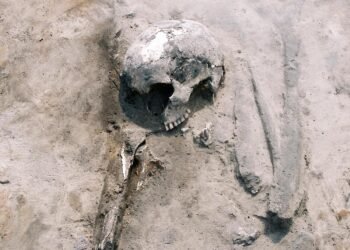
Archaeologists excavating a prehistoric cemetery in Chega Sofla, western Iran, uncovered the skull of a young woman who died over 6,000 years ago in violent circumstances. Not only does this discovery shed light on a traumatic event in her final moments, but it is also the first sign of the ancient practice of cranial modification.

6,200-year-old ‘cone-headed’ skull found in Iran reveals cranial modification and death by blunt force
The skull of a young woman (BG1.12) showing signs of cranial deformation and a fatal injury. Credit: Ramin Yashmi/ Moghaddam, A., & Miri, N. (2021). doi:10.11588/PROPYLAEUM.837.C10734 ( CC BY-NC-SA 4.0)

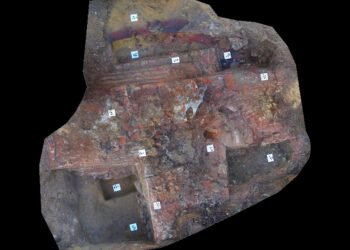
The site, Chega Sofla, lies on the northern edge of the Persian Gulf and dates back to the fifth millennium BCE (ca. 4700–3700 BCE). It is part of the Zohreh Prehistoric Project, a long-term archaeological venture directed by archaeologist Abbas Moghaddam. The team has excavated this Copper Age settlement for over a decade, unearthing homes, tools, pottery, and potentially the world’s oldest brick tombs. Interestingly, the site also features several individual and communal burials, some of which include elongated skulls from intentional head shaping.

One of the recent finds was the skull of a young woman, designated BG1.12, that included both signs of artificial cranial deformation as well as evidence of a lethal injury. Mahdi Alirezazadeh and Hamed Vahdati Nasab, researchers at Tarbiat Modares University, described their examination of the remains in the International Journal of Osteoarchaeology.

As the authors note, BG1.12 underwent cranial banding from a young age — an ancient cultural practice in many ancient societies in which a child’s head was wrapped in order to form it into an elongated shape. Although symbolic or aesthetic in the majority of societies, the process has biomechanical effects on the skull. According to the researchers, cranial bandaging deforms the skull and leads to thinner cranial bones and the diploe, the spongy layer within bone that absorbs shock.

Using CT scans, the researchers identified a triangular perimortem fracture extending from the front to the left parietal bone of BG1.12’s skull. The injury had yet to start healing, indicating it had happened at or around the time of death. The impact was most likely inflicted with a broad-edged tool, which did not penetrate the skull but was so forceful that it fractured it and caused a fatal injury.


RelatedStories

6,000-year-old skeleton reveals survival after a violent lion attack in ancient Bulgaria

6,000-year-old skeleton reveals survival after a violent lion attack in ancient Bulgaria

December 13, 2025
CT scans reveal how ancient Iranian metallurgists smelted copper

CT scans reveal how ancient Iranian metallurgists smelted copper

November 20, 2025

The blow fractured both the left parietal and frontal bones. The edges of the fracture still had contact, and the absence of bone remodeling confirms that the injury was perimortem. There were no signs of internal bleeding or penetration by a sharp object, even with the fragility of the skull, further supporting the conclusion that a blunt object had been used.

6,200-year-old ‘cone-headed’ skull found in Iran reveals cranial modification and death by blunt force
A mother carefully binds her young daughter’s head to shape it into the desired elongated form

While the reason for the blow is still unknown — accidental or otherwise — the discovery contributes to a growing understanding of trauma and violence in early human societies. Curiously, a second smashed skull uncovered at the site did not have any sign of cranial modification, suggesting that head injury was not exclusive to individuals with reshaped skulls.

BG1.12 was likely buried with other members of her group. However, the dense concentration of the bones has so far prevented archaeologists from identifying the rest of her skeleton, limiting the available information about her age, lifestyle, and social status.

Nevertheless, her skull is compelling evidence of the unintended consequences of cultural practice. The Zohreh Prehistoric Project aims to understand the social and cultural dynamics of early communities along the Persian Gulf. BG1.12’s remains are a mixture of cultural tradition and personal tragedy.

The work being done at Chega Sofla continues to bring to light the complexity of early human societies in the region, such as how they lived, believed, constructed, and, as in this case, died.


More information: Alirezazadeh, M., & Vahdati Nasab, H. (2025). A young woman from the fifth millennium BCE in Chega Sofla Cemetery with a modified and hinge fractured cranium, southwestern Iran. International Journal of Osteoarchaeology. doi:10.1002/oa.3415
Share317Tweet198Share55ShareSend

You May Also Like...

Iron Age pottery workshops unearthed in Iraq reveal a 2,800-year-old production chain
Archaeology

Iron Age pottery workshops unearthed in Iraq reveal a 2,800-year-old production chain

December 24, 2025
Model of a female Australopithecus afarensis.
Anthropology

New fossil evidence suggests that “Lucy” may not have been our direct human ancestor after all

December 23, 2025
Largest ancient stone labyrinth in India discovered in Maharashtra reveals 2,000-year-old trade links. Credit: Jennifer Bayers
Archaeology

Largest ancient stone labyrinth in India discovered in Maharashtra reveals 2,000-year-old trade links

December 22, 2025
New Stone Age rock paintings discovered in Tingvoll, revealing a hidden prehistoric art landscape in Norway
Archaeology

New Stone Age rock paintings discovered in Tingvoll, revealing a hidden prehistoric art landscape in Norway

December 22, 2025
Inscription on important Roman sitella found in Cartagena reveals unknown governor and casting-lot use
Archaeology

Inscription on Roman sitella in Cartagena reveals unknown governor and casting-lot use

December 21, 2025
Should archaeology rethink its reliance on the concept of “culture”?
Archaeology

Should archaeology rethink its reliance on the concept of “culture”?

December 21, 2025

Comments 1

  1. Editorial Team says:
    1 second ago

    Disclaimer: This website is a science-focused magazine that welcomes both academic and non-academic audiences. Comments are written by users and may include personal opinions or unverified claims. They do not necessarily reflect the views of our editorial team or rely on scientific evidence.

    Comment Policy: We kindly ask all commenters to engage respectfully. Comments that contain offensive, insulting, degrading, discriminatory, or racist content will be automatically removed.

    Reply
  2. Lee Williston says:
    6 months ago

    Excellent articles. Very interesting.

    Reply

Leave a Reply Cancel reply

Your email address will not be published. Required fields are marked *

Follow us


Instagram
245K

Facebook
117K

Threads
45K

LinkedIn
14K

Twitter
6K

YouTube
1K
  • Trending
  • Comments
  • Latest
Shipwreck Salvage. Credit: rawpixel.com / Public Domain

2,000-year-old shipwreck discovered off Turkish coast with remarkably preserved stacked ceramics

July 2, 2025
Viking age DNA reveals 9,000-year-old HIV-resistant gene originating near the Black Sea

Viking age DNA reveals 9,000-year-old HIV-resistant gene originating near the Black Sea

May 18, 2025
Complete copy of the Canopus Decree unearthed in Egypt after 150 years

Complete copy of the Canopus Decree unearthed in Egypt after 150 years

September 13, 2025
Mystery of Armenia’s 6,000-year-old dragon stones solved

Mystery of Armenia’s 6,000-year-old dragon stones solved

September 23, 2025
Moses may be named in ancient Egyptian mine inscriptions, sparking debate over earliest biblical references

Moses may be named in ancient Egyptian mine inscriptions, sparking debate over earliest biblical references

July 31, 2025
3D analysis reveals Shroud of Turin image likely came from sculpture, not Jesus’ body

3D analysis reveals Shroud of Turin image likely came from sculpture, not Jesus’ body

Moses may be named in ancient Egyptian mine inscriptions, sparking debate over earliest biblical references

Moses may be named in ancient Egyptian mine inscriptions, sparking debate over earliest biblical references

$1 million prize offered to decipher 5,300-year-old Indus Valley script

$1 million prize offered to decipher 5,300-year-old Indus Valley script

Oldest ever genetic data from a human relative found in 2-million-year-old fossilized teeth

Oldest ever genetic data from a human relative found in 2-million-year-old fossilized teeth

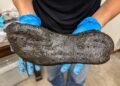
Exceptionally large Roman shoes discovered at Magna fort near Hadrian’s Wall

Exceptionally large Roman shoes discovered at Magna fort near Hadrian’s Wall

Iron Age pottery workshops unearthed in Iraq reveal a 2,800-year-old production chain

Iron Age pottery workshops unearthed in Iraq reveal a 2,800-year-old production chain

December 24, 2025
Model of a female Australopithecus afarensis.

New fossil evidence suggests that “Lucy” may not have been our direct human ancestor after all

December 23, 2025
Largest ancient stone labyrinth in India discovered in Maharashtra reveals 2,000-year-old trade links. Credit: Jennifer Bayers

Largest ancient stone labyrinth in India discovered in Maharashtra reveals 2,000-year-old trade links

December 22, 2025
New Stone Age rock paintings discovered in Tingvoll, revealing a hidden prehistoric art landscape in Norway

New Stone Age rock paintings discovered in Tingvoll, revealing a hidden prehistoric art landscape in Norway

December 22, 2025
Inscription on important Roman sitella found in Cartagena reveals unknown governor and casting-lot use

Inscription on Roman sitella in Cartagena reveals unknown governor and casting-lot use

December 21, 2025

Archaeology News online magazine

Archaeology News is an international online magazine that covers all aspects of archaeology.


Categories

  • Academics
    • Books
    • Conferences
    • Universities
  • Articles
  • Download
  • Game
  • News
    • Anthropology
    • Archaeology
    • Paleontology
  • Quiz
  • Tours

Subscribe to our newsletter

© 2024 - Archaeology News Online Magazine. All Rights Reserved.

  • About
  • Privacy Policy
  • Terms of Use
  • Donation
  • Contact

Welcome Back!

Login to your account below

Forgotten Password? Sign Up

Create New Account!

Fill the forms below to register

All fields are required. Log In

Retrieve your password

Please enter your username or email address to reset your password.

Log In

Add New Playlist

Manage Consent
To provide the best experiences, we use technologies like cookies to store and/or access device information. Consenting to these technologies will allow us to process data such as browsing behavior or unique IDs on this site. Not consenting or withdrawing consent, may adversely affect certain features and functions.
Functional Always active
The technical storage or access is strictly necessary for the legitimate purpose of enabling the use of a specific service explicitly requested by the subscriber or user, or for the sole purpose of carrying out the transmission of a communication over an electronic communications network.
Preferences
The technical storage or access is necessary for the legitimate purpose of storing preferences that are not requested by the subscriber or user.
Statistics
The technical storage or access that is used exclusively for statistical purposes. The technical storage or access that is used exclusively for anonymous statistical purposes. Without a subpoena, voluntary compliance on the part of your Internet Service Provider, or additional records from a third party, information stored or retrieved for this purpose alone cannot usually be used to identify you.
Marketing
The technical storage or access is required to create user profiles to send advertising, or to track the user on a website or across several websites for similar marketing purposes.
  • Manage options
  • Manage services
  • Manage {vendor_count} vendors
  • Read more about these purposes
View preferences
  • {title}
  • {title}
  • {title}
  • Home
  • News
    • Archaeology
    • Anthropology
    • Paleontology
  • Academic
    • Books
    • Conferences
    • Universities
  • Articles
  • VR Tours
  • Quiz & Game
  • Download
  • Encyclopedia
  • Forum

About  .  Contact  .  Donation

© 2024 - Archaeology News Online Magazine. All Rights Reserved