
A new 3D digital analysis offers compelling evidence that the Turin Shroud—long believed by many to be the burial cloth of Jesus—was likely not created by contact with a real person’s body, but was actually crafted as a form of medieval religious art.
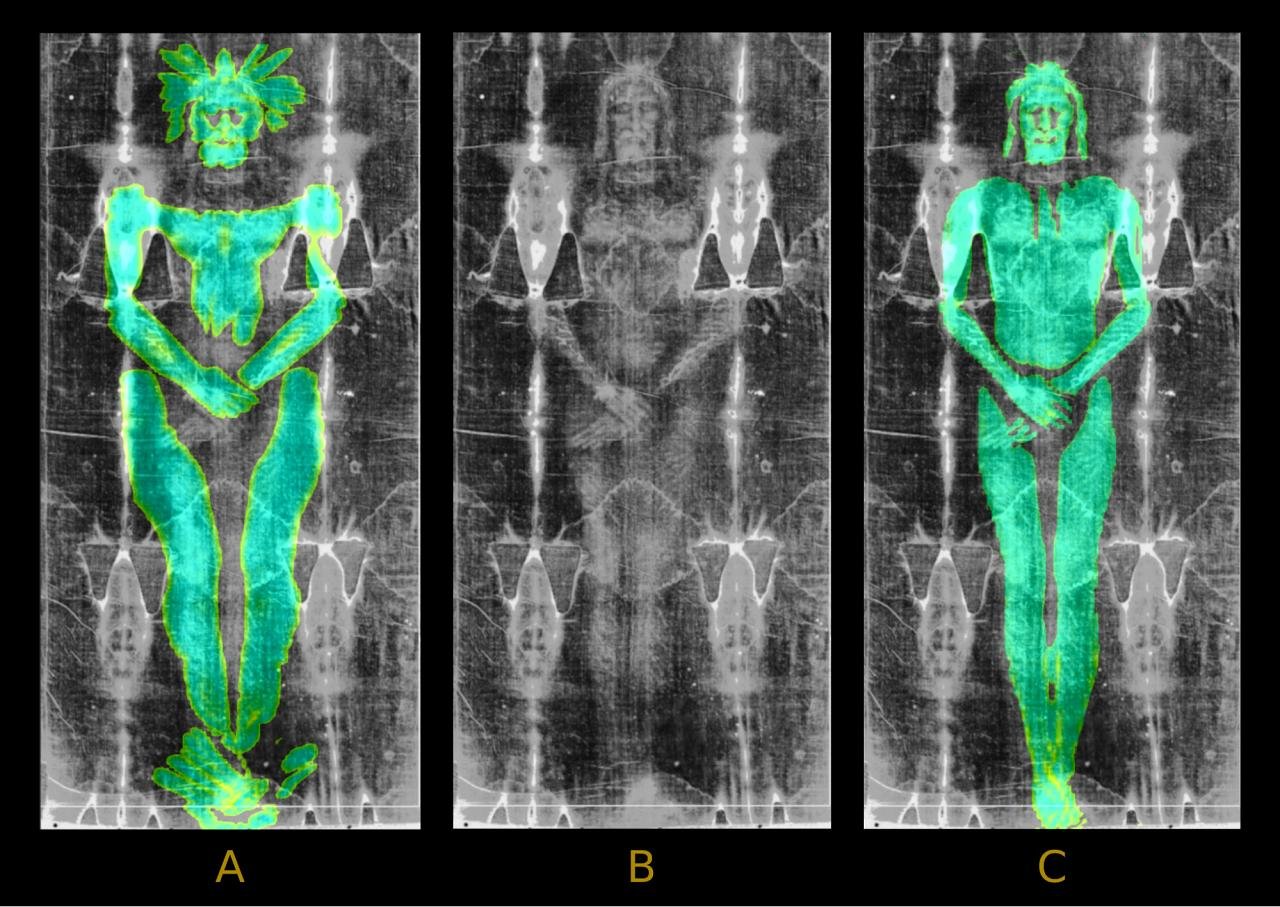
Published in the journal Archaeometry, the study was carried out by Brazilian digital graphics expert and 3D designer Cicero Moraes. Using free modeling software such as MakeHuman, Blender, and CloudCompare, Moraes modeled how clothing would move on two types of forms: a full three-dimensional human body and a low-relief sculpture—a flat surface with shallow, raised areas.
The Turin Shroud, measuring 14.5 feet by 3.7 feet, contains a faint image of a man with wounds that appear to be from crucifixion. It has been assumed for centuries that it wrapped the body of Jesus when he died over 2,000 years ago. Controversy, however, has surrounded its origins since the cloth first appeared in the 14th century. A 1989 radiocarbon dating test placed the origins of the shroud between 1260 and 1390 CE, in the medieval period. While later researchers disputed those findings, suggesting that the sample had possibly come from a repaired section of the cloth, the issue remains unresolved.
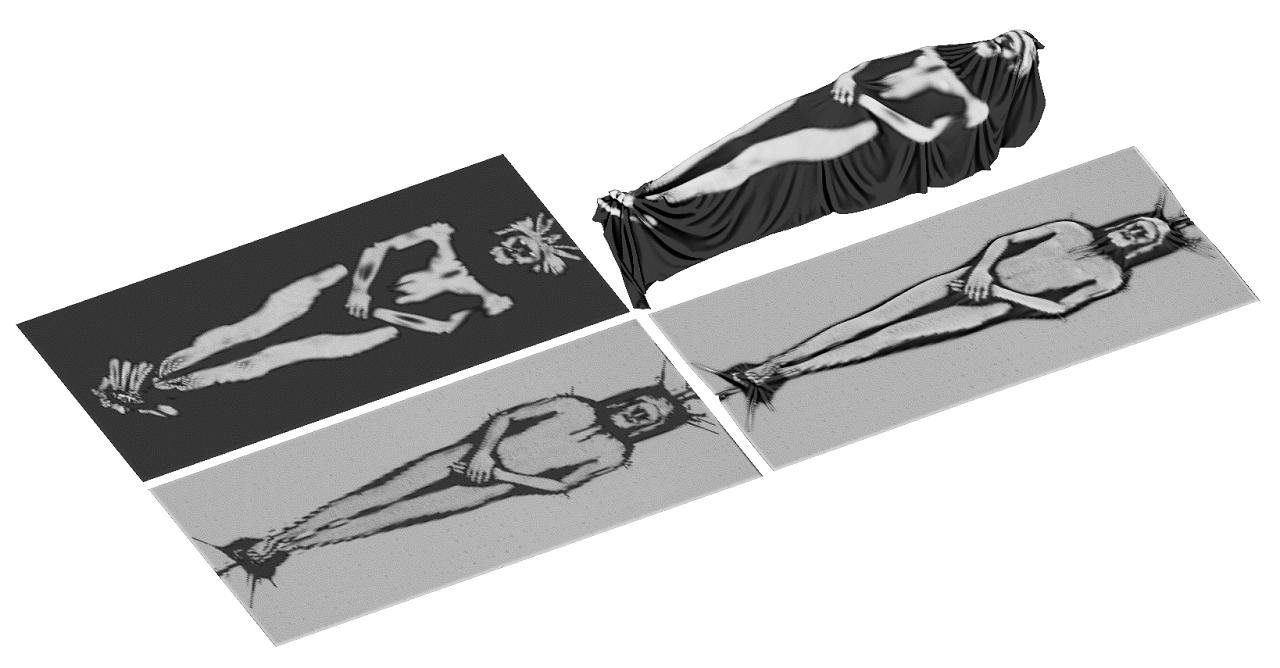
In Moraes’s recent digital test, the image that was produced when a cloth was virtually draped over a 3D human model appeared warped—wider and misshapen—due to the nature of fabric flowing over volume. That distortion is called the “Agamemnon Mask effect,” named after the wide gold funerary mask discovered at Mycenae, an ancient Greek archaeological site. On the other hand, the imprint from a low-relief sculpture closely matched the shape and dimensions of that on the Turin Shroud.
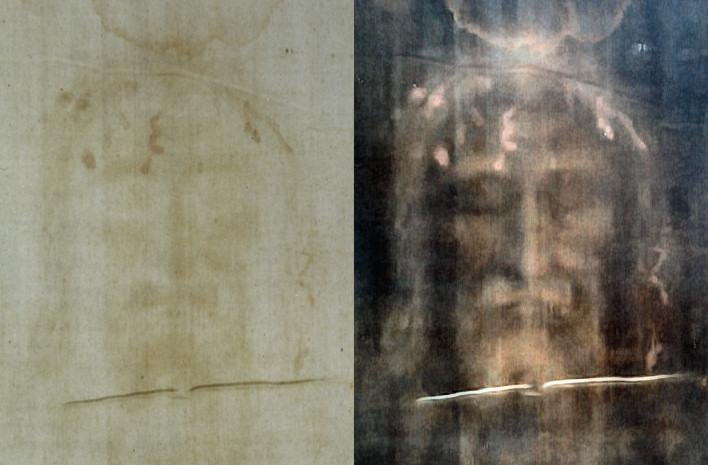
“The contact pattern generated by the low-relief model is more compatible with the Shroud’s image,” Moraes wrote in the study. “It shows less anatomical distortion and greater fidelity to the observed contours.”

He described how a shallow sculpture, maybe made of wood, stone, or metal, would be a strong candidate to serve as a mold. Heat or pigment may have been applied only to the embossed areas of the surface to create an imprint on the fabric. This way, Moraes contended, this method would explain the smooth, flat image one finds on the Shroud, unlike the distorted result one might find by wrapping fabric around a real human body.
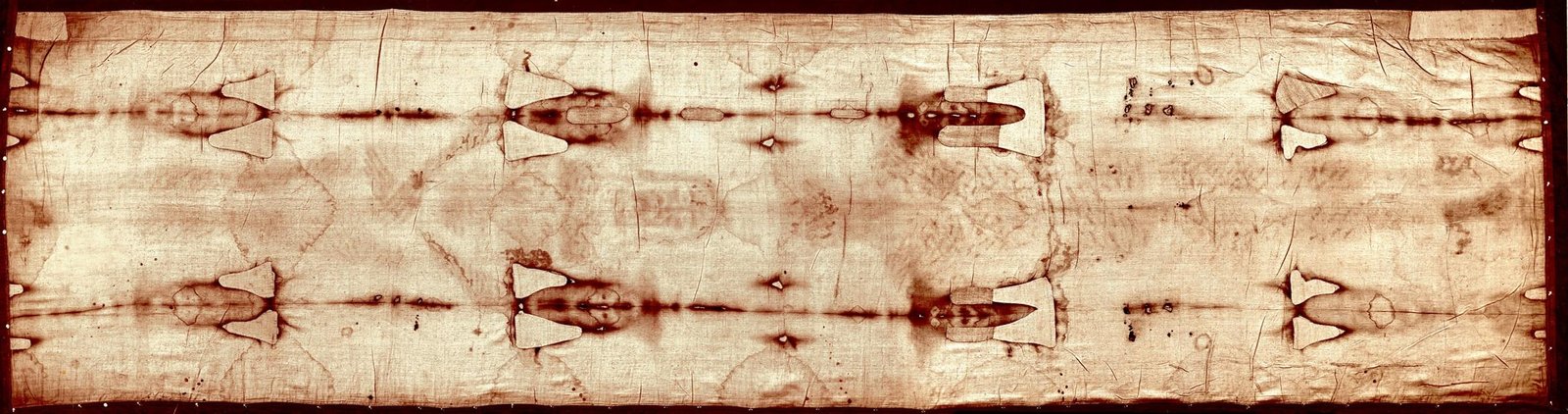
Moraes highlighted that while it remains remotely possible that the image might have originated from a real body, the evidence supports the view that the Shroud was an artistic creation. He did not explore the actual material and process used, but concluded that the artifact must be interpreted as best being a funerary object and a “masterwork of Christian art.”
This artistic representation is in keeping with the time. During the medieval period, low-relief depictions of religious individuals—particularly on tombstones—were common in Europe. Shallow carvings would have been a familiar practice to artists during this time.
While Moraes’s study does not attempt to answer the mystery of the Shroud’s age, it does cast new light on the manner in which the image might have been formed.
His findings do not disprove a religious interpretation but offer a scientific view of one of the world’s most enigmatic religious relics. Regardless of whether a medieval forgery or sacred relic, the Shroud of Turin is a persistent symbol—and a mystery that modern technology continues to investigate.












Disclaimer: This website is a science-focused magazine that welcomes both academic and non-academic audiences. Comments are written by users and may include personal opinions or unverified claims. They do not necessarily reflect the views of our editorial team or rely on scientific evidence.
Comment Policy: We kindly ask all commenters to engage respectfully. Comments that contain offensive, insulting, degrading, discriminatory, or racist content will be automatically removed.
Nice try. Not buying it. The “scientists” claimed it was from the middle ages for many years all the time knowing testing did not definitely show that. The journal that published it even retracted this. This issue doesn’t remain “unresolved” since they’ve admitted that they published erroneous information. You just don’t like the true results. WAXS testing shows an age of 2,000 years. How do you explain the soil and plant evidence from the fibers proven to come from Jerusalem? What about there being actual human blood? Shouldn’t that be disturbed if when was lifted off? But, it’s not. You say it’s “remotely possible” the shroud was on a real body. I’m not saying it’s definitely Jesus’s shroud. I can’t know that definitively. However, there’s at least enough evidence to say it more than likely came from Jerusalem and once covered the body of an adult man around the same time Jesus lived.
Totally agree!!
Another faulty argument against logic… This would only apply and be true if a pigment/paint were making the image, which it has been proven that it isn’t paint/dye/chemical/pigment.
The blood was applied prior to the image being formed.
This claim is majorly faulty.
The only way this theory could even be remotely possible, as if the low relief had channels cut into it into which blood could be poured into, or if the cloth existed as a blood stained one only – with no image. I have just posted a theory that you may be interested in. It is awaiting moderation
Correct
Sadly, the Bible is a aginst you. John (20:5–7) clearly describes two cloths – one for the body and another for the head. Whoever presented this medieval artifact as ‘the shroud’ obviously hadn’t read the Bible.
Not necessarily… they’re not absolutely mutually exclusive.
Does the Shroud of Turin contradict Scripture?
Actually more than one piece of linen was used for the body. In John 20:6-7, Peter enters the tomb and sees “the linen cloths (plural) lying there, and the soudarion, which had been folded up by itself, not lying with the linen cloths (plural).” So, clearly, more than one linen cloth for the body. Plus, Nicodemus and Joseph wrapped the body with spices–this was done by using strips of linen, and putting spices between the strips (likely to adhere the linen strips together).
Yes , I was thinking exactly the same things as you have cited here ! And also , I think the linen strips , which you mention , would have been wound around the body , not laid flat along it . Those details , given in the Gospel , sound quite detailed and realistic , not something which the writer would have made up .
You haven’t looked into anything. They actually have the headcloth that wrapped Christ’s head before the shroud wrapped the entire body. It is called the Sudarium of Oveido. The blood type is the same RH- blood type, it is from the same timeframe, 2000 years ago and the blood patterns match the shroud. The image was said to have only been cause by a billion + watts of light radiation or some other unknown radiation. The carbon 13 tests that indicated a 14th century fraud has been debunked. That result was flawed because the shroud was in a fire in the thirteen hundreds and it was burned on either side of the image of the body. Nuns attempted to repair it using modern cloth for the time and that happens to be where they took the linen samples for the carbon 13 testing. The blood could only remain red like it is if the dead man was tortured to death. The pollen on the shroud, much of it could only be from 1st century Jerusalem. The herring bone weave and the cloth material all indicate 1st century origins. The scurge marks, plucked beard, crown of thorns and the five wounds of Christ are all right in line with the Bible. There is so many more facts about the Shroud of Turin matching the Gospels
Well, no.
Having 1st century Shroud authenticity defenders degrade the observations of present art historians and contemporary scientists is the equivalent of having the arsonist critique the firefighter for working too slow.
Shroud is 14th century Gothic art.
There is no reason they need to be mutually exclusive, the shroud can still have the full image of the head as normal for jewish burial tradition where the shroud covers the body fully. I also suggest you look into the Face cloth of Oviedo, which is rumored to be the face cloth buried with Jesus. This artifact was in separate places from the shroud for the entirety of history but with modern technology we can see there are hundreds of exact details on both cloths showing the blood stains from the crown of thorns as well as a perfect match-up of all facial features.
LOL, your claim is backwards. The 1988 radiocarbon dating has not been retracted, three independent labs dated the cloth to 1260–1390 AD, and no later work has overturned that. If someone says a journal “admitted it was wrong,” ask them to name the retraction, there is none. To beat that result you would need a new, preregistered, multi-lab test on well documented samples from multiple areas of the cloth with full chain of custody and open data. No one has done that.
The WAXS “about 2,000 years” line is not a validated dating method. It is calibration dependent, sensitive to storage and heat history, and was applied to a tiny thread taken near the old sampling corner. It is not representative of the whole cloth and it is not accepted as a replacement for radiocarbon dating.
“Jerusalem soil and plants” do not prove origin. The famous pollen claims trace to work that has long been criticized for poor documentation and contamination risk. The so called Jerusalem limestone is not unique to Jerusalem, similar aragonite occurs in many places. These findings are not provenance.
“Actual human blood” does not rescue authenticity. Some tests detected blood markers, others detected pigments, and independent bloodstain pattern analysis found key stains inconsistent with transfer from a wrapped corpse. If the stains do not behave like real contact transfer, they cannot prove the cloth covered a body.
The secure historical trail starts in fourteenth century France, which matches the radiocarbon window. Until a modern, transparent, multi-site, multi-lab redating is done and replicated, the best supported conclusion is that the shroud is a medieval artifact. The burden of proof is on those claiming a first century origin, and they have not met it.
Was this a reply or to a comment or the study?
Appropriate response.
Also, blood stains on cloth would not be present after 2000 years.
Pollen would not survive 2000 years.
Shroud is 14th century Gothic art.
Pollen samples would not survive 2000 years.
Blood on cloth would no longer be present after 2000 years.
The Shroud’s weave is a three hop (3-over-1) herringbone twill with Z twist which wasn’t used prior to the Middle Ages. The manufacture of a fabric like that of the Shroud required the use of a horizontal treadle loom with four shafts. Knowledge of treadle looms came from China in the eleventh century AD and the loom with four shafts was introduced by the Flemish in the thirteenth century. No examples of its complex herringbone weave are known from the purported time of Jesus. The few samples of burial cloths that are known from the era are made using plain weave.
Microchemist McCrone (who is known as the Father of Modern Microscopy) analyzed the shroud and found traces of chemicals that were used in “two common artist’s pigments of the 14th century, red ochre and vermilion, with a collagen (gelatin) tempera binder” (McCrone 1998). His work was published in “The Shroud of Turin: Blood or Artist’s Pigment” (August 1989) and he made his complete case that the shroud is a medieval painting in “Judgment Day for the Shroud of Turin” (March 1999). For his work, McCrone was awarded the American Chemical Society’s Award in Analytical Chemistry in 2000.
Author: Dr Walter C McCrone Title: The Shroud of Turin: blood or artist’s pigment? Article first published: March 1, 1990 Journal: American Chemical Society
The image has faded over the centuries because the two-dimensional impression on the cloth is human-made art from ca. 1350.
The publications of researchers Cicero Moraes and Nicholas Allen provide empirically-valid insight into the marvels and intricacies of 14th century Gothic art, presently known as the Shroud.
The art historian Gary Vikan also provides the appropriate cultural-historical context for the Shroud’s 14th century creation.
The Shroud, a splendid achievement of medieval culture, demonstrates a stunning contribution to understanding the evolution of Gothic art in the 14th century.
Please understand that the predicated results of Shroud pro-authenticity research further emphasize the consummate elegance and intricacies of Gothic art.
The myriad failed attempts at empirical conclusions for Shroud authenticity equal the pseudo-sciences of creationism, flat-earth theory, and eugenics.
Studying the Shroud to understand the intricacies of medieval art is legitimate; promoting the Shroud as 1st century artifact is science fiction.
There are no 2 dimensional images with 3 D info in them except the shroud. And the negative qualities that photograph to a real image are the opposite of photography development
Pollen would not survive 2000 years.
Blood stain on cloth would no longer be present after 2000 years.
Shroud is authentic Gothic art, 14th century.
Pollen can easily survive for 2000 years due to its outer wall which is composed of sporopollenin, an extremely durable biopolymer that’s resistant to chemical degradation, enzymes, acids, bases, UV radiation, and physical stress. This resilience enables pollen to survive in fossils for hundreds of millions of years under favorable conditions like dry, anaerobic environments
One of the more interesting finds in recent times is learning that the blood type of the blood on the shroud is AB, which is a relatively new type that didn’t exist at the time of Jesus. Future finds may prove this to be incorrect, but thus far, AB post-dates Jesus by roughly 600 years. The biggest unanswered question about the shroud however is its purpose. Even IF it was produced in the 1300-1400s, there was no photography, thus no reason to have produced it solely for artistic effect that can’t even be appreciated today without a negative being produced first.
The time has come when we can’t tell what is real, true, and fact. This study came from some random person with a computer program. It was not conducted by a scientist or even a mathematical genius. The study didn’t take samples of the material, they are forgetting that there’s dna found in the blood. They are forgetting that the image is only seen by a “negative” image like when you take a photo and the shadow appears on the film. This study does not account for the pollen found in the fibers or for the fact that it matches the face cloth identically that was placed on his head.
yes, I just mentioned the dna in the blood, that came out a few years ago, I personally am sick of these so called experts, who want to trash our Lord Jesus Christ
I’m with ya 100%, sister!
Blood stain on the cloth would not remain after 2000 years.
Pollen would not survive 2000 years.
The Shroud’s weave is a three hop (3-over-1) herringbone twill with Z twist which wasn’t used prior to the Middle Ages. The manufacture of a fabric like that of the Shroud required the use of a horizontal treadle loom with four shafts. Knowledge of treadle looms came from China in the eleventh century AD and the loom with four shafts was introduced by the Flemish in the thirteenth century. No examples of its complex herringbone weave are known from the purported time of Jesus. The few samples of burial cloths that are known from the era are made using plain weave.
The image has faded over the centuries because the two-dimensional impression on the cloth is human-made art from ca. 1350.
The publications of researchers Cicero Moraes and Nicholas Allen provide empirically-valid insight into the marvels and intricacies of 14th century Gothic art, presently known as the Shroud.
The art historian Gary Vikan also provides the appropriate cultural-historical context for the Shroud’s 14th century creation.
The Shroud, a splendid achievement of medieval culture, demonstrates a stunning contribution to understanding the evolution of Gothic art in the 14th century.
These are the very miraculous reasons :
1. Blood stains present after 2000 years
2. Pollen present after 2000 years
3. Herringbone twill with Z twist
4. That AB blood group came from a body, long before AB blood is known to have come into existence
5. DNA is extremely sensitive to light and would denature but is still present,
6. The “negative effect” when the was no photography
7. Many of the facts of the shroud match the gospels
that can only confirm that the shroud is a miracle which confounds any reasonable explanation and shows that anyone trying to proof otherwise will not/never be able to do so.
There’s no way any person could have made this with all the details on the cloth, the same power that raised Jesus from the dead made that image on the shroud.
I believe you are correct, Craig. The scientific study of the Shroud (using the Shroud itself) done around 1980 by a world class team of scientists assembled by Dr. John Heller proved conclusively that there is no known artistic method that could have produced the image. Heller’s book details the state-of-the-art scientific tools and methods used to inform the final conclusion about the image. It is an artifact of a miracle: the resurrection of Jesus if Nazareth.
You are one of the first persons who believes the image on the Shroud was caused by an electrical implant. I have believed the Shroud is the authentic burial cloth of our Lord Jesus Christ. I believe the image was caused by the re-entering of the soul of our Lord Jesus into His body when He rose from the dead. It’s my own personal belief. Consider one thing: The Shroud shows the nail wounds to the hands go through the wrists….not the palms. And medical science believes Jesus was crucified through the wrists…not the palms of the hands. Medical science says if Jesus was crucified through the palms, his arms could have fallen off the cross. And as the Shroud clearly shows, the nail wounds to Jesus hands goes through the wrists, not the palms. The Shroud also shows blood on His head, indicating the crown of thorns. I have believed for many years the Shroud is authentic and always will. Thank you for reading this comment.
Yes. For myself, it looks real. It feels real. It matches the gospels.
How could this being made, as fake – when there was no photography being invented, say into the 1300-1400s,
and back then – like nowadays, it’s definitivly impossible with latest tech, to fake that cloth, this linen.
And as Kevin said, the amount of energy (light source) is immense, in terms of power, to create this picture, which
is only a few nm thick, inside the fabric. shroud here. How’s that possible, without burning the shroud to dust?
It was pretty clear, that divine intention was into place, and our lords ascension.
I am not 100% sure, if it was our lord, Jesus cloth. But it feels right and real, that’s all what counts.
Praise the lord. For me, it is real. One thing is for sure “Nobody dies for a lie” ~Mel Gibson.
L’immagine somatica dell’Uomo della Sindone (escludendo le macchie di sangue) per dirla in breve, è un effetto ottico prodotto da una scultura molecolare della cellulosa del lino, di cui è costituito il lenzuolo. E’ originata da una radiazione brevissima e molto potente che ha cristallizzato le vibrazioni delle molecole in rapporto alla loro distanza dal corpo del crocifisso. Mentre, se si fosse utilizzato un bassorilievo non si sarebbero impresse quelle zone che non erano a diretto contato con la Sindone, nella reliquia abbiamo un’impressione dell’immagine in rapporto alla sua distanza (si veda, ad esempio, il retro delle ginocchia che erano parecchi cm di distanza dalla tela distesa sul sepolcro). Dove la tela era a maggior contatto con il lenzuolo è più marcata l’immagine ma non il colore, semmai vi sono più fibrille di lino ingiallite per ogni millimetro quadrato. I punti che non erano a contatto con il lenzuolo sono meno marcati in quanto la radiazione era meno intensa. L’intelligenza artificiale non è la panacea di tutti i problemi. Bisogna dargli tutti i dati e, magari, anche quelli giusti. Altrimenti, fa pasticci; non dà risultati attendibili e genera altra confusione.
If you want to hear from someone who really knows what they’re talking about, check out Jeremiah Johnston’s reports.
Oh, and the image is uniformly only 2 MICRONS deep explain that from 2,000 years ago!
there is a fallacy in this approach: the body was not “levitating” so that the shroud would drape and hang over it (at least not before resurrecting!) but was laying flat on a slab, so the cloth would not have wrapped around the body. Picture yourself laying on a table with a tablecloth spread over you; the cloth would be hanging over the edges of the table, and actually leaving an air gap at your sides, it wouldn’t be tucked in at your sides, giving a more 2-dimensional impression, as we see on the shroud. This drape effect also doesn’t explain the image of the back side which appears “flattened” as if the body were on a hard flat surface.
This explanation provides a scientifically grounded argument undermining the Shroud’s authenticity as a direct relic of Jesus and supports the view it is a medieval religious artwork, not a genuine ancient burial shroud.
The first known record of the Shroud appears in the 14th century during a period noted for relic creation, which historically increases suspicion it’s a medieval creation. Experiments by researchers have demonstrated that pressing or rubbing cloth over such shallow sculptures, sometimes combined with pigments or heat to scorch the fabric, can produce images with notable three-dimensional qualities and negative photographic-like effects, much like the Shroud image. The shallow relief height allows the fabric to create light and shadow variation that can mimic a faint image without the complications of wrapping distortion seen with actual bodies.
However for many believers, the Shroud is not merely an artifact but a sacred religious symbol with deep spiritual significance connected to Jesus Christ. Accepting scientific findings that contradict its authenticity can feel like a threat to their faith or their worldview.
Evidence challenging the Shroud creates psychological discomfort because it conflicts with long-held beliefs. To reduce this discomfort, believers may reject or rationalize away contradictory scientific evidence
In essence, the dismissal of scientific research by believers arises from a complex mix of faith commitment, psychological defense mechanisms, cultural significance, and sometimes distrust or differing interpretations of evidence. For many, the spiritual and devotional value of the Shroud outweighs or supersedes empirical scientific conclusions, leading to continued belief despite contrary research.
I applaud your insights about the use of heat in the creation of this image on this cloth. As I noted below, I do not think enough attention has been paid to the adverse effects that radiated heat had on this cloth as a result of the 16th century fire not to mention the damage caused by the smoke.
Exactly.
The image has faded over the centuries because the two-dimensional impression on the cloth is human-made art from ca. 1350.
Studying the Shroud to understand the intricacies of medieval art is legitimate; promoting the Shroud as 1st century artifact is science fiction.
Humanity always tries to rationalize what it doesn’t understand. To someone of faith this appears childish. Jesus is real whether or not the shroud is, but what a wonderful worldly proof of his human existence if it is real!
The historical Jesus was real but how could he have been Christ raised from the dead if Jesus redivivus failed to make a speedy return as he had earlier prophesied over and over again he would. God certainly would not raise a prophet from the dead who prophesied presumptively (Matthew 10:23, 24:34; Mark 13:30, 14:62; and Luke 21:32), that is if the words found in Deuteronomy 18:18-22 are worth the papyri or parchment they were written on. So, no speedy return tells me there was no ascension; and no ascension leads me to believe there was no resurrection; and if there was no resurrection then I must conclude the “Shroud of Turin” is the “Hoax of Turin”. Furthermore, if there was such a shroud covering Jesus’ body which contained such an image when he was raised from the dead surely it would have been taken possession of by Mary Magdalene, Peter and Jesus’ Beloved Disciple and shown all over Jerusalem and Judea to prove the truth of the resurrection. Accordingly, it would have been named the “Shroud of Jerusalem” instead of the “Shroud of Turin”. As we hear in the real estate business, the mantra is “location, location and location”. But the way I see it, the mere fact this shroud suddenly showed up and made its first public appearance in of all places in Lirey, France and not in Jerusalem shows that its original location was not in Jerusalem, Palestine.
First of all, Jesus’ use of the word soon, or any words relating to timing, must be taken in the context of divine timing. To Jesus, his second coming is ‘soon’ compared to all of eternity, or even the history of the universe. It’s only been 2,000 years since he came, out of a universe that is 13.8 billion years old. Also, the jump from ‘no speedy return’ to ‘no ascension’ to ‘no resurrection ’ to ‘no shroud’ takes extreme and unconnected liberties. The connection between ‘faulty’ prophesies of a speedy return have no link to the ascension, likewise with the resurrection , and the shroud can never be a definite proof of the resurrection, so your point in useless. Turning to the handling of the shroud after Jesus’ ascension, your comment takes on a modern approach to the disciple’s handling of the cloth. Keep in mind that the shroud, when not negative, is much less impressive to look at. And the Christian’s were being persecuted, and such a precious art of at of a miracle is unlikely to be flippantly shown everywhere, where anti- Christian’s could rip it, throw things on it or steal it. There are a few references in history, however, to cloths matching the shrouds description that were revered, hidden in a jar between walls etc.
Microchemist McCrone (who is known as the Father of Modern Microscopy) analyzed the shroud and found traces of chemicals that were used in “two common artist’s pigments of the 14th century, red ochre and vermilion, with a collagen (gelatin) tempera binder” (McCrone 1998). His work was published in “The Shroud of Turin: Blood or Artist’s Pigment” (August 1989) and he made his complete case that the shroud is a medieval painting in “Judgment Day for the Shroud of Turin” (March 1999). For his work, McCrone was awarded the American Chemical Society’s Award in Analytical Chemistry in 2000.
Author: Dr Walter C McCrone Title: The Shroud of Turin: blood or artist’s pigment? Article first published: March 1, 1990 Journal: American Chemical Society
The historical Jesus was real but we are discussing here whether Jesus Christ (Messiah) was real which hinges on whether he was resurrected from the dead.
Good grief. The shroud is 14 feet long. The laid him on his back on top of half of the shroud, folded it over his head to cover the front. Then the three unclosed sides were sewn closed. That is not a 2D image. It couldn’t be more 3D when measured with the correct equipment.
Presentation here provides empirically-valid results.
Shroud is 14th century Gothic art.
Please clarify. Do you find the evidence proves the shroud is a hoax and not the cloth covering Jesus’s corpse? Thanks.
Well this power seemed to have gone AWOL or kaput by not ensuring this cloth bearing Jesus’ resurrected mage was taken into custody by the disciples and shown all over Jerusalem and Judea. Instead it remained in hiding until it suddenly appeared in, of all places, a far-away location in Livey, Italy (or was it France?) well over a millennia later. Even worse, not long after its first appearance religious leaders said it was a fraud, i.e., it was not Jesus’ burial cloth. Let me inquire: what possible reason would such Catholic men of the cloth have to debunk this shroud as they would have had natural a natural bias and inclination to prove it was Jesus’ burial cloth bearing his resurrected image? So far as I can tell, not enough attention has been paid to the adverse effects the radiated heat and the smoke from the fire in the 16th century had on this cloth. But just think of all the souls which could have been saved had this shroud been on display from the early first century up to the time it came out of hiding in the mid-14th century.
The Shroud, a splendid achievement of medieval culture, demonstrates a stunning contribution to understanding the evolution of Gothic art in the 14th century.
Please understand that the predicated results of Shroud pro-authenticity research further emphasize the consummate elegance and intricacies of Gothic art.
The myriad failed attempts at empirical conclusions for Shroud authenticity equal the pseudo-sciences of creationism, flat-earth theory, and eugenics.
The predicated results of all the generic Shroud pro-authenticity research emphasize the consummate elegance and intricacies of Gothic art.
Pseudo-science and pseudo-history do not transform medieval art into a 1st century burial cloth.
For goodness sake. Your 3D study is flawed with anomalies.
Better luck next time when you afford better equipment
No. The study offers empirically-valid results.
Shroud is authentic 14th century Gothic art.
I know you wish for this to be true, but you haven’t explained the myriad of other evidence such as pollen and the recently revised carbon dating. Read or watch content by Jeremiah Johnston who has studied this in-depth and speaks intelligently on it. I was a skeptic until I looked into this more.
So, here’s my idea. (Please excuse me if you’ve heard this before) I’m hoping someone will explain the science behind it, and more specifically, why my idea could NOT have produced the image ON TOP OF what was, at the time of creation, just the blood-stained, dirty, pollened, or otherwise chemically treated, ancient cloth. I’ll try to give just the basics. I can try answer any questions that go beyond those. Just know that I’m not presenting ALL of the case here.
Sunlight can yellow linen by dehydration and oxidation. Check.
The image areas are said to be caused by the same.
Check.
The image is more intense in direct relation to the contours of the human anatomy.
Check.
So……..
Let’s say you masked off all but the imagined body outline of the cloth. You position an anatomically correct, 3D molded piece of glass, that you think is what a crucified Jesus would look like, in front of the stretched out Shroud. (This is important, because we know that the image is cast in perpendicular lines onto the cloth. In other words, the cloth could not be at all wrinkled or bunched) This could consist of many parts, like just the face, the torso, etc. Crucially, they each would be only the outer halves of the body. So, for instance, think of the Halloween mask as an example. Only made of glass. And this glass could be so carefully shaped that certain parts might even be crafted to focus rays on certain areas, when they strike the cloth. But if not focus, then here is my hypothesis: (Which is probably flawed-so please correct)
When a ray passes through glass, it weakens the ray slightly. A ray that passes through a piece of glass that is father away from the cloth will be weaker than a ray that passes through the part of the glass that is closer to the cloth. (Important to keep in mind that something could be applied to the glass, or portions of it, that could also diffuse rays) Since the glass statue is anatomically perfect, then this could mean that the light cast on the cloth will exhibit the infinite shading that is seen in the Shrouds image. The tip of the nose would cause more yellowing than the neck, for instance. Etc.
One wonders what different kinds of light might produce? For instance, would the light produced on an overcast day cast a more diffused light and produce a more ghostly image?
What would an image look like that only had exposure for brief periods of a day, but over a long period of time-like even decades. Or a mixed exposure between direct sunlight and diffused sunlight? Or just the rays during the early morning and/or late afternoon? Or the light that is produced just before/after sunrise/sunset. How would the image look if the rays came through the wind-rocked leaves of a tree? The combinations are limitless.
I will point to one man, in particular, here for you to learn up on: (if you haven’t) English Clergyman/Scientist Roger Bacon. (And more generally to him and his Clergyman/Scientist circle) Few realize the scope and genius of this DaVinci-esque individual. He worked in the utmost secrecy. He revolutionized the study of optics and lenses. He lived in a time and place where glasswork was unparalleled. He had possible access to the church’s relics. Could it be possible that the Shroud, up to this point, had only some kind of super light stencil to show the faithful the body image around the blood stains, to enhance adoration? Perhaps the church and these pious Scientists wanted something more permanent instead? Something so convincing as to produce saving faith? Were there secret experiments on other linens to see if it would work first? And is there evidence of any mishaps of such an attempt on the Shroud? (Like forgetting to close the shades, etc.) What would the steady movement of the Sun do to the image? Was the Shroud image area only exposed when the Sun was overhead? Does the Shroud exhibit signs of glass sections of the body being employed, one at a time?
So there you have it. Bacon lived from 1220-1292. I note, just before the Shroud as we definitely know it, became known in a country frequented by Bacon. What probably was the Shroud vanished from Constantinople, no later than 1205. The timing seems right.
The fact that the image was produced over the blood stains, with the tiniest space, if any, between image and the blood-seems right. And the fact that places masked off from the Sun, and/or too far away, (and/or otherwise blocked), from the cloth would appear lighter than the yellowed image, in infinite gradations, seemingly impossible to replicate….seems right. Lastly, the fact that today’s image has been fading out, to match the background, seems to possibly indicate that it is doing so from the background’s exposure to Sunlight, that it may have been deprived of, possibly for decades. (Essentially, the background is catching up with the image)
(I’ll bet I’ve missed something that one, or more of you, will correct, that will blow this up in a most spectacular way. But I don’t feel bad. Isn’t that the way it is with this enigmatic cloth-you think the puzzle is solved, only to find that there are one or two pieces that don’t fit? And haven’t we seen that, occasionally, wild speculation will shake loose some crucial element, that wouldn’t have been noticed otherwise? So I offer mine. Thanks for engaging. I wonder if anyone will ever actually test this hypothesis-that is, take actual years or decades to mimic the exact processes and seemingly endless combination of processes suggested here?)
I want to Thank everyone for their enthusiasm and research to find out if the shroud is authentic. Once again, we have people on both sides searching for the truth of Jesus’s existence. Whether or not these wrappings are in fact real or not.
Yes after 3 days body look like a statue. (rigor mortis).
The stiffening of a dead body is called rigor mortis, which is a postmortem chemical change where muscles become rigid. It happens after death because the body’s muscles are no longer supplied with adenosine triphosphate (ATP), which is needed to allow muscle fibers to relax.
The main problem i see with this is he didnt model it correctly. The shroud isnt just one image of jesus it has two one of his front and one of his back and its way longer than what he modeled in 3d. The real shroud had fully covered his body and was wrapped completely differently than how he modeled it of course its going to look wonky and wrong when you only model half of the shroud and wrap it wrong
Before this study even occurred, those who spent time with the shroud and studied came to the conclusion that the image formation wasn’t created by physical contact with the body. There are parts of the body that we know didn’t touch the cloth yet appear on it. All this study does is confirm that.
This explanation does not explaine the X-ray qualities of the figure on the shroud which shows the teethe behind the lips, the bones in the arms hands and even the spine. It also dismisses the blood analysis which prove the blood on the shroud to be type AB.
One aspect of this shroud and it’s authenticity is that no one can determine what effect being “raised from the dead” had on this shroud, if it is indeed part of the burial cloth of Jesus Christ. According to scripture, Jesus Christ was raised from the dead and now had a “spiritual” body. Did this have some impact on his burial clothing? How was Jesus Christ prepared for his burial? Was he wrapped in linens or was he simply draped with linens. There is still no definitive conclusion as to it’s authenticity.
You can only see the image from the “Negative” portion from taking a picture. The positive portion of the picture does not show an image.
So how did people in the Middle Ages know how to create a “Negative” image from a camera picture that wasn’t invented for another 600 years?
Plus the Shroud was X-Ray dated using 3 different AI computers. And what was found was that the Shroud had been “repaired on the edges with wool, not Linen. That was where the sample in 1988 came from dating it to the 12th century. When it was indeed repaired by nuns due to fire. Linen not wool makes up the 95% of the Shroud. So 3 more samples have been taken and 3 different AI computers were used for X-Ray analysis and all three AI agree it dates from the 1st Century AD.
A very important fact missing from this article is whether the image the study formed was a positive or negative image. Can you tell me the nature of the research image as positive vs negative? Thanks!
Gary Habermas has studied the Shroud of Turin for many years. I first heard him speak on the subject when he returned from Oxford back in the mid ’80’s when I was a student at Liberty University, where he was a professor. His slides in chapel and more at another showing totally captivated me. He is still speaking on the subject. In this YouTube video he clearly debunks the claims of this 1988 study. He does a far better job at addressing the problems of this article and giving the strengths of the position on the opposite side than I ever could. For those seriously interested in knowing whether or not the Shroud of Turin may be the actual burial cloth of Jesus, please take a look at this lecture “New Shroud Lecture Featuring Stunning Photos! – Gary Habermas.” As some have alluded to, whether or not the Shroud of Turin is the actual burial cloth of Jesus Christ of Nazareth has no bearing on whether or not Jesus was who he claimed to be, the Son of God who was God himself born in human flesh to die for the sins of the world so that all who place their faith in him may have forgiveness of their sins and a right relationship with God forever. If the Shroud of Turin is indeed the genuine burial cloth of Jesus, it gives us an interesting look at him in his death and in the power of his resurrection. But knowing Jesus, or more accurately, Jesus’ knowing you, is the most important thing that can every happen in your life, regardless of the Shroud. See Matthew’s gospel chapter 7, verses 21 to 23. May God lead us each in our pursuit to know the Truth, whom to know is life eternal.
There’s a lot of people out there trying to put religion down and always commentating on this is real that’s not real
It’s been a battle for centuries science versus religion just take it for what it is it’s an amazing piece of archaeology
Most interesting.