• About
  • Privacy Policy
  • Terms of Use
  • Donation
  • Contact
No Result
View All Result
Archaeology News
  • Home
  • News
    • Archaeology
    • Anthropology
    • Paleontology
  • Academic
    • Books
    • Conferences
    • Universities
  • Articles
  • VR Tours
  • Quiz & Game
  • Download
  • Encyclopedia
  • Forum
Archaeology News
No Result
View All Result
Home News Archaeology

2,000-year-old human and animal footprints discovered at Lunan Bay, Scotland

by Dario Radley
February 20, 2026

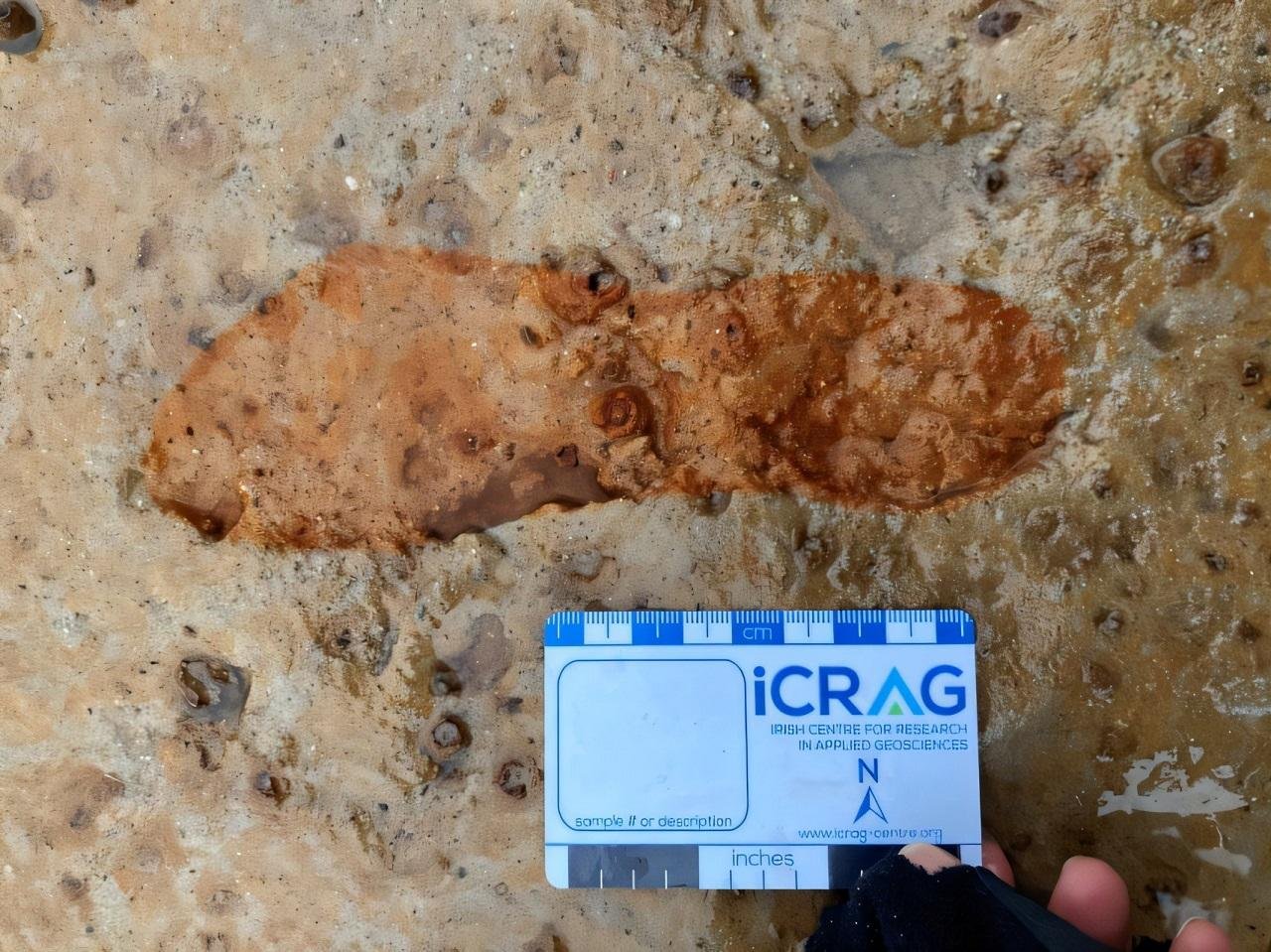
Winter storms along Scotland’s east coast stripped sand from the dunes at Lunan Bay near Montrose and exposed a layer of ancient clay. In late January, local residents Jenny Snedden and Ivor Campbell were walking their dogs when they noticed clear impressions pressed into the newly revealed surface. The marks showed human and animal feet, sharply outlined in mud that had hardened over centuries.
2,000-year-old human and animal footprints discovered at Lunan Bay, Scotland
Footprint marked with an outline left in the clay 2,000 years ago. Credit: University of Aberdeen

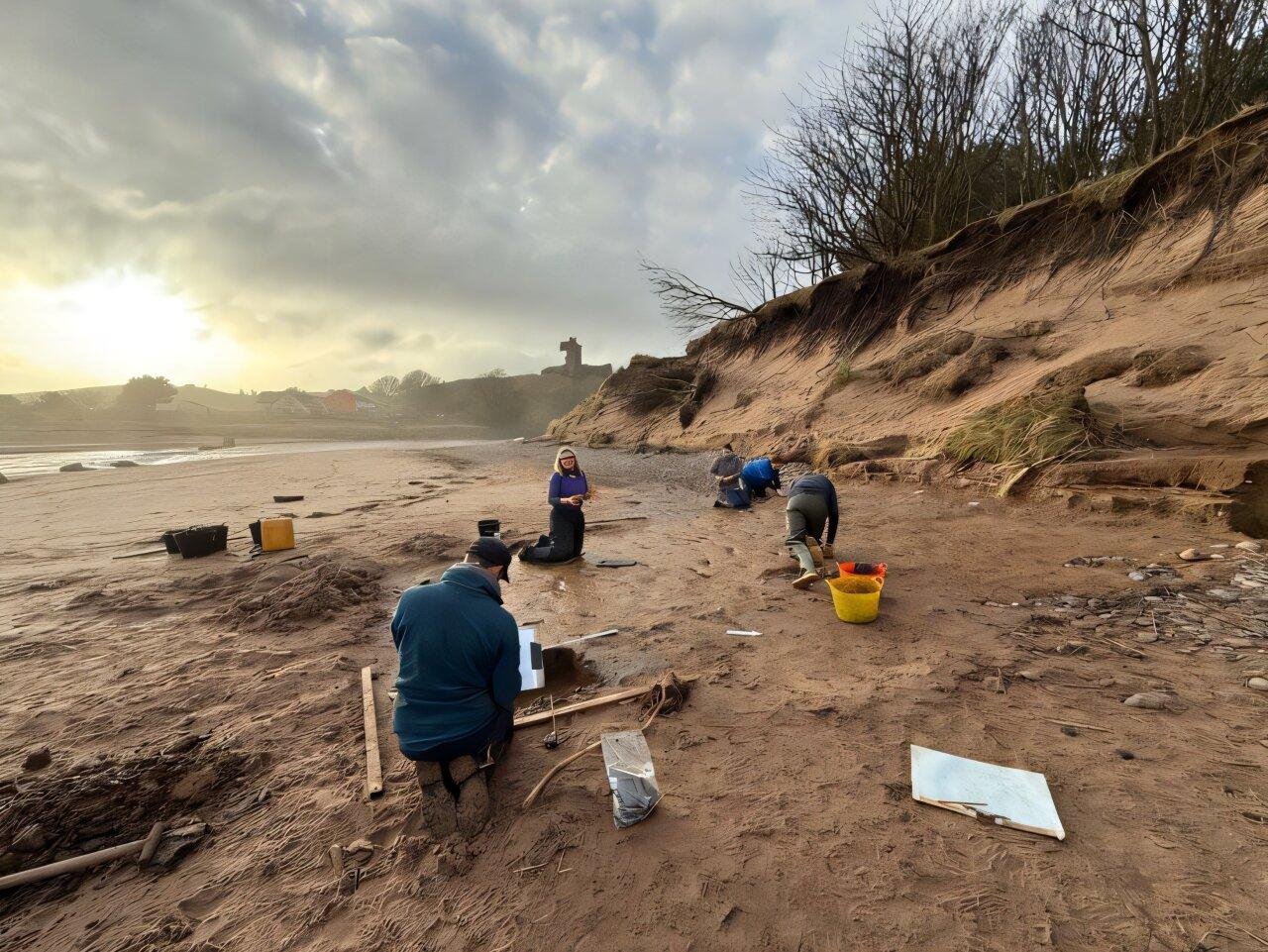
Ivor Campbell contacted regional archaeologist Bruce Mann on 26 January. By the next day, a team from the University of Aberdeen had reached the beach. They gathered equipment on the way, including plaster used to make casts, knowing the sea was already erasing parts of the site. Wind gusts topped 55 miles per hour. Sand blew across the clay, and waves tore at the edges with each tide.

Professor Kate Britton and her colleagues worked quickly. They cleaned sections of the surface, mapped the positions of each print, and produced detailed 3D models using photography and drone footage. During brief periods of calmer weather, the drone flights captured overhead images with millimeter accuracy. The team also made physical casts of selected prints before the next high tide arrived. Within 48 hours, the exposed clay had vanished.

Back in the laboratory, researchers examined plant remains preserved in sediments beneath the footprints. Radiocarbon dating placed the activity around 2,000 years ago, during the late Iron Age. This was the period of Roman expansion into Britain and the centuries before the emergence of the Picts in eastern Scotland.
2,000-year-old human and animal footprints discovered at Lunan Bay, Scotland
The team working at Lunan Bay. Credit: University of Aberdeen

Analysis of the impressions identified red deer, roe deer, other animals, and several barefoot humans. The size and spacing of the human prints suggest adults and possibly younger individuals moved across the wet ground. The clay surface formed in what had once been a muddy estuary or salt marsh. Today, Lunan Bay is a wide sandy beach, but two millennia ago the area likely supported marsh plants and attracted grazing deer. People may have come to hunt, fish, or gather coastal plants such as samphire.

RelatedStories

Ancient burials, Roman well, and Anglo-Saxon house uncovered during A46 Newark bypass excavations

Ancient burials, Roman well, and Anglo-Saxon house uncovered during A46 Newark bypass excavations

May 12, 2026
5,000-year-old artificial island hidden in Scottish loch predates Stonehenge

5,000-year-old artificial island hidden in Scottish loch predates Stonehenge

May 5, 2026

Sites of this kind are rare. Comparable footprint surfaces have been recorded at the Severn Estuary, Formby in Merseyside, and Happisburgh in Norfolk. No similar site had previously been documented in Scotland. The discovery adds direct evidence of human presence along the Angus coastline during the late Iron Age and shows how rapidly coastal landscapes have changed.
2,000-year-old human and animal footprints discovered at Lunan Bay, Scotland
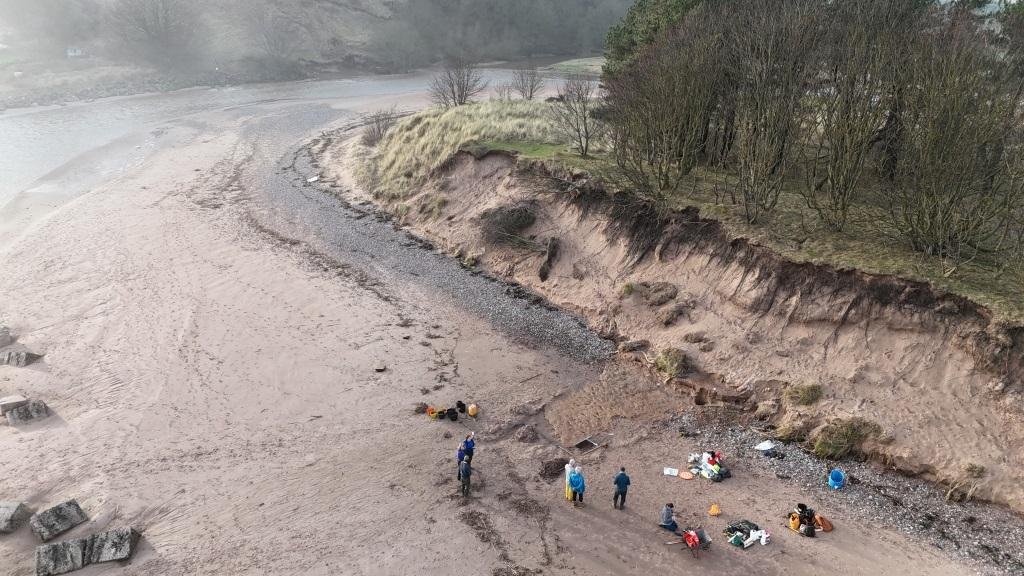
Aerial view of the Lunan Bay site. Credit: University of Aberdeen

Bruce Mann praised the quick action of the two walkers who reported what they saw. Without their call, the prints would have disappeared unrecorded. The storm that revealed the clay also destroyed it within days.

The drone images now serve another purpose. Researchers plan to use them as a baseline to measure ongoing coastal erosion in the Montrose basin area. Rising sea levels and stronger winter storms continue to reshape the shoreline. Similar clay deposits lie buried under sand nearby. If exposed again, they could hold further traces of people and animals who crossed this coast two thousand years ago.

More information: University of Aberdeen

Share22Tweet14Share4ShareSend

You May Also Like...

Rare Bronze Age burial in Sweden reveals unusual pair of Wendel neck rings and complex ritual landscape near Norrköping
Archaeology

Rare Bronze Age burial in Sweden reveals unusual pair of Wendel neck rings and complex ritual landscape near Norrköping

May 12, 2026
Kasta Tomb in Amphipolis fully revealed as restoration uncovers largest burial mound in Macedonia
Archaeology

Kasta Tomb in Amphipolis fully revealed as restoration uncovers largest burial mound in Macedonia

May 12, 2026
Rare Roman villa threatened by farming damage reveals rare mosaic and bathhouse remains in Devon
Archaeology

Rare Roman villa threatened by farming damage reveals rare mosaic and bathhouse remains in Devon

May 12, 2026
Ancient burials, Roman well, and Anglo-Saxon house uncovered during A46 Newark bypass excavations
Anthropology

Ancient burials, Roman well, and Anglo-Saxon house uncovered during A46 Newark bypass excavations

May 12, 2026
8-year-old boy finds 1,700-year-old Roman statuette fragment in Ramon Crater
Archaeology

8-year-old boy finds 1,700-year-old Roman statuette fragment in Ramon Crater

May 11, 2026
Slag from Paleopolis on Andros points to iron weapon and tool making during Macedonian rule in the 4th–3rd century BCE
Archaeology

Slag from Paleopolis on Andros points to iron weapon and tool making during Macedonian rule in the 4th–3rd century BCE

May 11, 2026

Comments 0

  1. Editorial Team says:
    1 second ago

    Disclaimer: This website is a science-focused magazine that welcomes both academic and non-academic audiences. Comments are written by users and may include personal opinions or unverified claims. They do not necessarily reflect the views of our editorial team or rely on scientific evidence.

    Comment Policy: We kindly ask all commenters to engage respectfully. Comments that contain offensive, insulting, degrading, discriminatory, or racist content will be automatically removed.

    Reply

Leave a Reply Cancel reply

Your email address will not be published. Required fields are marked *

Follow us


Instagram
242K

Facebook
117K

Threads
46K

LinkedIn
14K

Twitter
6K

YouTube
1K
  • Trending
  • Comments
  • Latest
Shipwreck Salvage. Credit: rawpixel.com / Public Domain

2,000-year-old shipwreck discovered off Turkish coast with remarkably preserved stacked ceramics

July 2, 2025
A new study suggests the mysterious Voynich Manuscript may be a medieval cipher

A new study suggests the mysterious Voynich Manuscript may be a medieval cipher

January 3, 2026
Viking age DNA reveals 9,000-year-old HIV-resistant gene originating near the Black Sea

Viking age DNA reveals 9,000-year-old HIV-resistant gene originating near the Black Sea

May 18, 2025
3D analysis reveals Shroud of Turin image likely came from sculpture, not Jesus’ body

3D analysis reveals Shroud of Turin image likely came from sculpture, not Jesus’ body

August 3, 2025
Moses may be named in ancient Egyptian mine inscriptions, sparking debate over earliest biblical references

Moses may be named in ancient Egyptian mine inscriptions, sparking debate over earliest biblical references

July 31, 2025
3D analysis reveals Shroud of Turin image likely came from sculpture, not Jesus’ body

3D analysis reveals Shroud of Turin image likely came from sculpture, not Jesus’ body

Moses may be named in ancient Egyptian mine inscriptions, sparking debate over earliest biblical references

Moses may be named in ancient Egyptian mine inscriptions, sparking debate over earliest biblical references

$1 million prize offered to decipher 5,300-year-old Indus Valley script

$1 million prize offered to decipher 5,300-year-old Indus Valley script

Oldest ever genetic data from a human relative found in 2-million-year-old fossilized teeth

Oldest ever genetic data from a human relative found in 2-million-year-old fossilized teeth

Exceptionally large Roman shoes discovered at Magna fort near Hadrian’s Wall

Exceptionally large Roman shoes discovered at Magna fort near Hadrian’s Wall

Rare Bronze Age burial in Sweden reveals unusual pair of Wendel neck rings and complex ritual landscape near Norrköping

Rare Bronze Age burial in Sweden reveals unusual pair of Wendel neck rings and complex ritual landscape near Norrköping

May 12, 2026
Kasta Tomb in Amphipolis fully revealed as restoration uncovers largest burial mound in Macedonia

Kasta Tomb in Amphipolis fully revealed as restoration uncovers largest burial mound in Macedonia

May 12, 2026
Rare Roman villa threatened by farming damage reveals rare mosaic and bathhouse remains in Devon

Rare Roman villa threatened by farming damage reveals rare mosaic and bathhouse remains in Devon

May 12, 2026
Ancient burials, Roman well, and Anglo-Saxon house uncovered during A46 Newark bypass excavations

Ancient burials, Roman well, and Anglo-Saxon house uncovered during A46 Newark bypass excavations

May 12, 2026
8-year-old boy finds 1,700-year-old Roman statuette fragment in Ramon Crater

8-year-old boy finds 1,700-year-old Roman statuette fragment in Ramon Crater

May 11, 2026

Archaeology News online magazine

Archaeology News is an international online magazine that covers all aspects of archaeology.


Categories

  • Academics
    • Books
    • Conferences
    • Universities
  • Articles
  • Download
  • Game
  • News
    • Anthropology
    • Archaeology
    • Paleontology
  • Quiz
  • Tours

Subscribe to our newsletter

© 2024 - Archaeology News Online Magazine. All Rights Reserved.

  • About
  • Privacy Policy
  • Terms of Use
  • Donation
  • Contact

Manage Consent
To provide the best experiences, we use technologies like cookies to store and/or access device information. Consenting to these technologies will allow us to process data such as browsing behavior or unique IDs on this site. Not consenting or withdrawing consent, may adversely affect certain features and functions.
Functional Always active
The technical storage or access is strictly necessary for the legitimate purpose of enabling the use of a specific service explicitly requested by the subscriber or user, or for the sole purpose of carrying out the transmission of a communication over an electronic communications network.
Preferences
The technical storage or access is necessary for the legitimate purpose of storing preferences that are not requested by the subscriber or user.
Statistics
The technical storage or access that is used exclusively for statistical purposes. The technical storage or access that is used exclusively for anonymous statistical purposes. Without a subpoena, voluntary compliance on the part of your Internet Service Provider, or additional records from a third party, information stored or retrieved for this purpose alone cannot usually be used to identify you.
Marketing
The technical storage or access is required to create user profiles to send advertising, or to track the user on a website or across several websites for similar marketing purposes.
  • Manage options
  • Manage services
  • Manage {vendor_count} vendors
  • Read more about these purposes
View preferences
  • {title}
  • {title}
  • {title}
  • Home
  • News
    • Archaeology
    • Anthropology
    • Paleontology
  • Academic
    • Books
    • Conferences
    • Universities
  • Articles
  • VR Tours
  • Quiz & Game
  • Download
  • Encyclopedia
  • Forum

About  .  Contact  .  Donation

© 2024 - Archaeology News Online Magazine. All Rights Reserved