• About
  • Privacy Policy
  • Terms of Use
  • Donation
  • Contact
No Result
View All Result
Archaeology News
  • Home
  • News
    • Archaeology
    • Anthropology
    • Paleontology
  • Academic
    • Books
    • Conferences
    • Universities
  • Articles
  • VR Tours
  • Quiz & Game
  • Download
  • Encyclopedia
  • Forum
Archaeology News
No Result
View All Result
Home News Anthropology

2,500-year-old Siberian mummy’s tattoos reveal Iron Age artistry and ancient techniques

by Dario Radley
August 1, 2025

A new study has unveiled incredibly detailed tattoos on a 2,500-year-old mummy unearthed in Siberia’s Altai Mountains, yielding unusual insights into the artistry, technology, and cultural significance of tattooing by Iron Age nomads. Using high-resolution near-infrared imaging, archaeologists have digitally reconstructed these ancient tattoos with unprecedented precision.
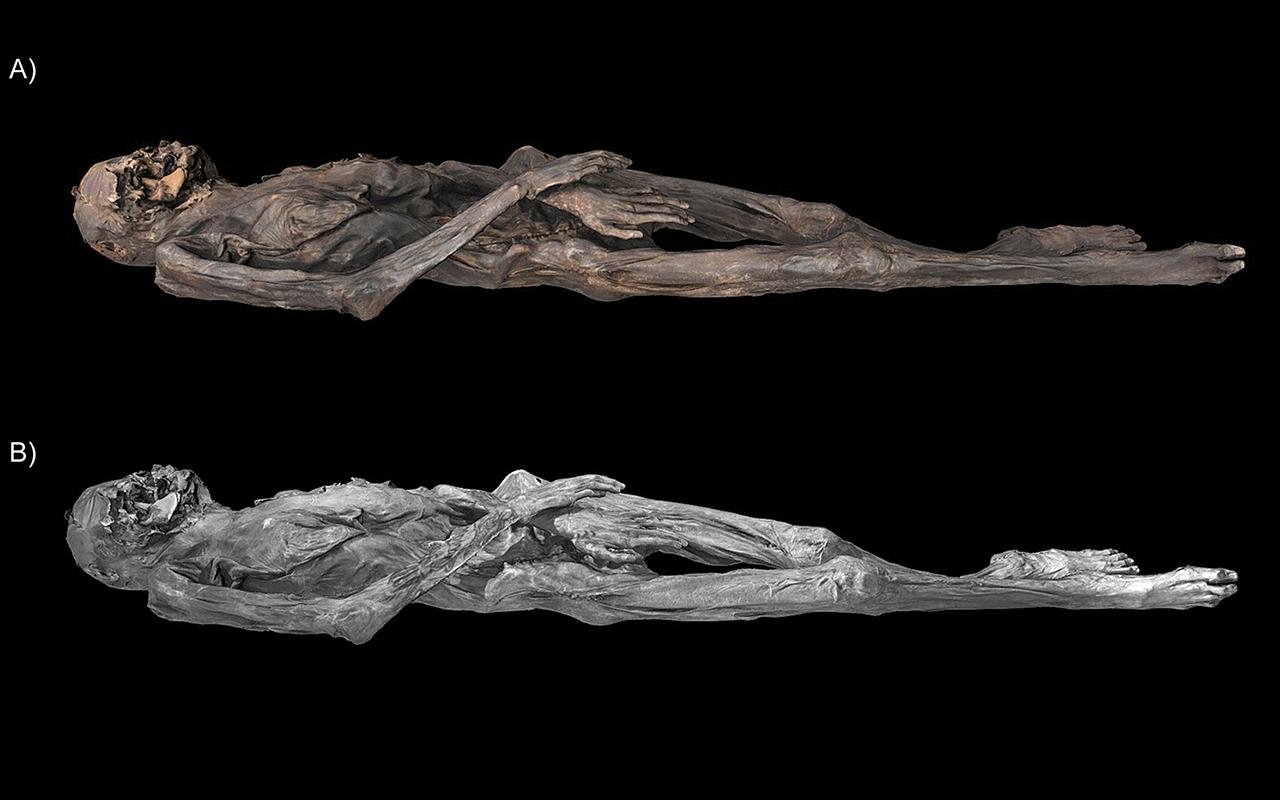
2,500-year-old Siberian mummy’s tattoos reveal Iron Age artistry and ancient techniques
Photogrammetrically created 3D model of the female mummy from Pazyryk tomb 5, showing: A) texture derived from visible-spectrum photographs; and B) texture derived from near-infrared photography (figure by M. Vavulin). Credit: G. Caspari et al., Antiquity (2025)

The mummy, a 50-year-old woman at the time of death, was part of the Pazyryk culture, a sixth-to-second-century BCE Iron Age society that lived on the Eurasian steppe. The Pazyryk were renowned for constructing massive burial mounds, or kurgans. They buried their deceased in chambers carved into permafrost, which preserved organic material such as skin and body art.

The research, published in the journal Antiquity, was conducted by Dr. Gino Caspari of the Max Planck Institute of Geoanthropology. His team used advanced near-infrared digital photography with submillimeter precision to reveal tattoos that had faded over time. While some tattoos were discovered on Pazyryk mummies in earlier decades, their condition and limitations of imaging technology left few designs properly documented, or made most visible only in schematic sketches.

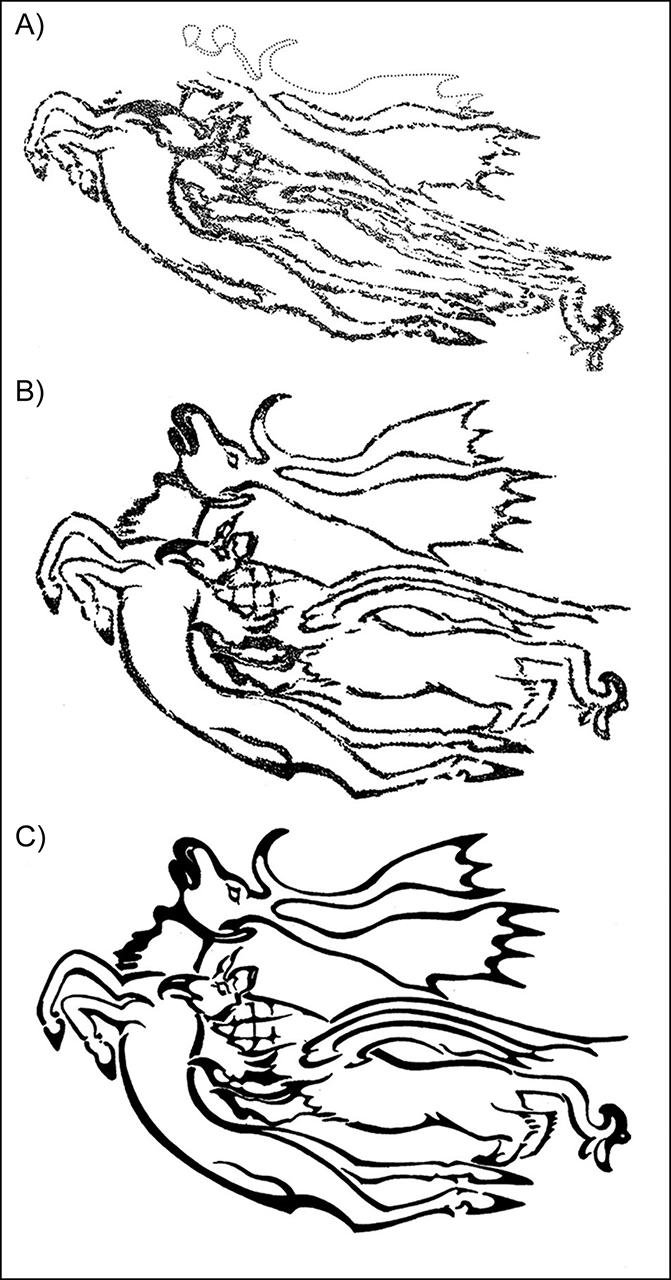
Now, sophisticated imaging has captured the entire extent of the tattoos. Among the images are a stag surrounded by leopards on the right forearm and a griffin beast battling a deer on the left arm. The designs are so fine that they have fascinated modern tattoo artists. According to Caspari, tattooing seems not only to have served as symbolic decoration but as a specialized art—one which demanded technique, aesthetic perception, and formal training.
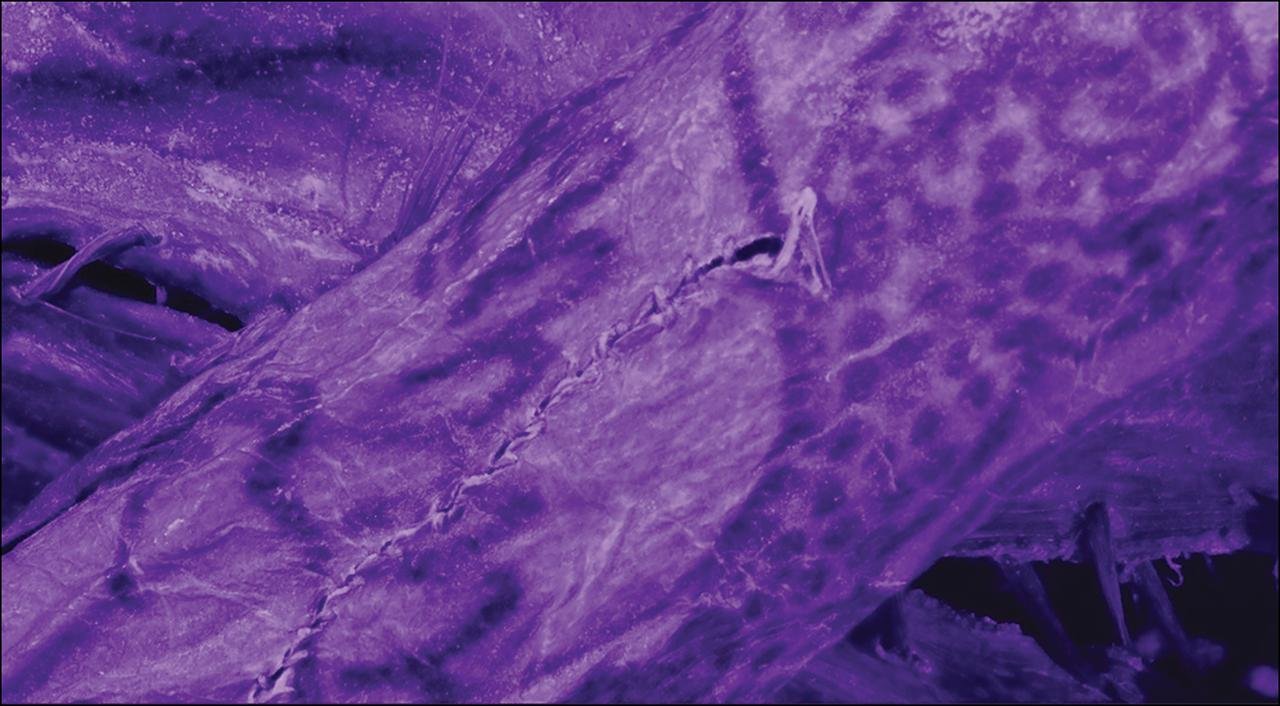
2,500-year-old Siberian mummy’s tattoos reveal Iron Age artistry and ancient techniques
Infrared light reveals an ancient tattoo and a postmortem suture, suggesting the art held no specific role in funerary rituals and may have lost its meaning after death (figure by G. Caspari & M. Vavulin). Credit: G. Caspari et al., Antiquity (2025)

The study uncovered striking contrasts between tattoos on each arm. The right arm features smooth lines and carefully placed motifs, suggesting they were completed in at least two separate sessions by an experienced artist. The left arm has less precise images, possibly the work of a novice or completed earlier in life.

RelatedStories

Iron Age mass killing in Serbia: 77 women and children found in 2,800-year-old grave at Gomolava

Iron Age mass killing in Serbia: 77 women and children found in 2,800-year-old grave at Gomolava

February 24, 2026
2,000-year-old human and animal footprints discovered at Lunan Bay, Scotland

2,000-year-old human and animal footprints discovered at Lunan Bay, Scotland

February 20, 2026

To discover more about the techniques, the researchers collaborated with Daniel Riday, a tattoo artist who recreates ancient artwork using traditional tools. His examination indicated that the lines were created by single-point and multipoint hand-poking instruments. No tattooing tools have been found at Pazyryk burials, but the researchers believe they were made from organic materials like horn or bone. The pigment may have been soot or burnt plant matter. Riday further suggested the designs may have been stenciled on the body before being tattooed.
2,500-year-old Siberian mummy’s tattoos reveal Iron Age artistry and ancient techniques
Right forearm tattoo: A) current state; B) deskewed, evening out skin folds and compensating for the desiccation process; C) idealised artistic rendering (illustrations by D. Riday). Credit: G. Caspari et al., Antiquity (2025)

Despite the preservation, the majority of the tattoos had been cut during the embalming process. This led researchers to wonder whether, unlike some other ancient societies, the Pazyryk may not have held tattoos to be spiritually significant in the afterlife. Instead, body art likely existed to reflect status, personal identity, or membership in a group during life.

The new find allows archaeologists to look at ancient body modification practices not just as evidence but as the product of human hands, each of them with some level of skill, purpose, and intent.

The Altai Mountains’ frozen tombs, initially excavated in the 19th century and rediscovered by Soviet and international expeditions in the 20th century, remain among the best-preserved archaeological contexts for the study of ancient tattooing. However, scientists warn that the permafrost graves are deteriorating faster due to climate change; therefore, high-tech documentation is urgent.

Caspari’s team believes that by digitally preserving these tattoos and comparing them with experimental reconstructions, it may become possible to trace individual artists’ techniques and better understand the spread of tattoo traditions across ancient Eurasia.


More information: Caspari, G., Deter-Wolf, A., Riday, D., Vavulin, M., & Pankova, S. (2025). High-resolution near-infrared data reveal Pazyryk tattooing methods. Antiquity, 1–15. doi:10.15184/aqy.2025.10150
Share129Tweet81Share23ShareSend

You May Also Like...

Lost medieval hillfort discovered in Poland’s Włodawa Forest reveals 244 artifacts from the 10th–13th centuries
Archaeology

Medieval hillfort discovered in Poland’s Włodawa Forest reveals 244 artifacts from the 10th–13th centuries

February 27, 2026
Male Neanderthals and female Homo sapiens shaped ancient interbreeding in the modern human genome, study finds
Anthropology

Male Neanderthals and female humans shaped modern DNA through ancient interbreeding, study finds

February 27, 2026
Medieval monastery remains discovered beneath Borken’s historic center in Germany
Archaeology

Medieval monastery remains discovered beneath Borken’s historic center in Germany

February 26, 2026
How ancient communities adapted their diets and farming strategies in prehistoric Poland
Anthropology

How ancient communities adapted their diets and farming strategies in prehistoric Poland

February 26, 2026
60,000-year-old ostrich eggshell engravings reveal humanity’s earliest geometric designs
Archaeology

60,000-year-old ostrich eggshell engravings reveal humanity’s earliest geometric designs

February 26, 2026
Mesolithic burials in Sweden show ancient fur and feather headgear uncovered by new microscopic analysis
Anthropology

Mesolithic burials in Sweden show ancient fur and feather headgear uncovered by new microscopic analysis

February 25, 2026

Comments 0

  1. Editorial Team says:
    1 second ago

    Disclaimer: This website is a science-focused magazine that welcomes both academic and non-academic audiences. Comments are written by users and may include personal opinions or unverified claims. They do not necessarily reflect the views of our editorial team or rely on scientific evidence.

    Comment Policy: We kindly ask all commenters to engage respectfully. Comments that contain offensive, insulting, degrading, discriminatory, or racist content will be automatically removed.

    Reply

Leave a Reply Cancel reply

Your email address will not be published. Required fields are marked *

Follow us


Instagram
244K

Facebook
118K

Threads
46K

LinkedIn
14K

Twitter
6K

YouTube
1K
  • Trending
  • Comments
  • Latest
Shipwreck Salvage. Credit: rawpixel.com / Public Domain

2,000-year-old shipwreck discovered off Turkish coast with remarkably preserved stacked ceramics

July 2, 2025
Viking age DNA reveals 9,000-year-old HIV-resistant gene originating near the Black Sea

Viking age DNA reveals 9,000-year-old HIV-resistant gene originating near the Black Sea

May 18, 2025
A new study suggests the mysterious Voynich Manuscript may be a medieval cipher

A new study suggests the mysterious Voynich Manuscript may be a medieval cipher

January 3, 2026
Moses may be named in ancient Egyptian mine inscriptions, sparking debate over earliest biblical references

Moses may be named in ancient Egyptian mine inscriptions, sparking debate over earliest biblical references

July 31, 2025
Mystery of Armenia’s 6,000-year-old dragon stones solved

Mystery of Armenia’s 6,000-year-old dragon stones solved

September 23, 2025
3D analysis reveals Shroud of Turin image likely came from sculpture, not Jesus’ body

3D analysis reveals Shroud of Turin image likely came from sculpture, not Jesus’ body

Moses may be named in ancient Egyptian mine inscriptions, sparking debate over earliest biblical references

Moses may be named in ancient Egyptian mine inscriptions, sparking debate over earliest biblical references

$1 million prize offered to decipher 5,300-year-old Indus Valley script

$1 million prize offered to decipher 5,300-year-old Indus Valley script

Oldest ever genetic data from a human relative found in 2-million-year-old fossilized teeth

Oldest ever genetic data from a human relative found in 2-million-year-old fossilized teeth

Exceptionally large Roman shoes discovered at Magna fort near Hadrian’s Wall

Exceptionally large Roman shoes discovered at Magna fort near Hadrian’s Wall

Lost medieval hillfort discovered in Poland’s Włodawa Forest reveals 244 artifacts from the 10th–13th centuries

Medieval hillfort discovered in Poland’s Włodawa Forest reveals 244 artifacts from the 10th–13th centuries

February 27, 2026
Male Neanderthals and female Homo sapiens shaped ancient interbreeding in the modern human genome, study finds

Male Neanderthals and female humans shaped modern DNA through ancient interbreeding, study finds

February 27, 2026
Medieval monastery remains discovered beneath Borken’s historic center in Germany

Medieval monastery remains discovered beneath Borken’s historic center in Germany

February 26, 2026
How ancient communities adapted their diets and farming strategies in prehistoric Poland

How ancient communities adapted their diets and farming strategies in prehistoric Poland

February 26, 2026
60,000-year-old ostrich eggshell engravings reveal humanity’s earliest geometric designs

60,000-year-old ostrich eggshell engravings reveal humanity’s earliest geometric designs

February 26, 2026

Archaeology News online magazine

Archaeology News is an international online magazine that covers all aspects of archaeology.


Categories

  • Academics
    • Books
    • Conferences
    • Universities
  • Articles
  • Download
  • Game
  • News
    • Anthropology
    • Archaeology
    • Paleontology
  • Quiz
  • Tours

Subscribe to our newsletter

© 2024 - Archaeology News Online Magazine. All Rights Reserved.

  • About
  • Privacy Policy
  • Terms of Use
  • Donation
  • Contact

Manage Consent
To provide the best experiences, we use technologies like cookies to store and/or access device information. Consenting to these technologies will allow us to process data such as browsing behavior or unique IDs on this site. Not consenting or withdrawing consent, may adversely affect certain features and functions.
Functional Always active
The technical storage or access is strictly necessary for the legitimate purpose of enabling the use of a specific service explicitly requested by the subscriber or user, or for the sole purpose of carrying out the transmission of a communication over an electronic communications network.
Preferences
The technical storage or access is necessary for the legitimate purpose of storing preferences that are not requested by the subscriber or user.
Statistics
The technical storage or access that is used exclusively for statistical purposes. The technical storage or access that is used exclusively for anonymous statistical purposes. Without a subpoena, voluntary compliance on the part of your Internet Service Provider, or additional records from a third party, information stored or retrieved for this purpose alone cannot usually be used to identify you.
Marketing
The technical storage or access is required to create user profiles to send advertising, or to track the user on a website or across several websites for similar marketing purposes.
  • Manage options
  • Manage services
  • Manage {vendor_count} vendors
  • Read more about these purposes
View preferences
  • {title}
  • {title}
  • {title}
  • Home
  • News
    • Archaeology
    • Anthropology
    • Paleontology
  • Academic
    • Books
    • Conferences
    • Universities
  • Articles
  • VR Tours
  • Quiz & Game
  • Download
  • Encyclopedia
  • Forum

About  .  Contact  .  Donation

© 2024 - Archaeology News Online Magazine. All Rights Reserved