• About
  • Privacy Policy
  • Terms of Use
  • Donation
  • Contact
No Result
View All Result
Archaeology News
  • Home
  • News
    • Archaeology
    • Anthropology
    • Paleontology
  • Academic
    • Books
    • Conferences
    • Universities
  • Articles
  • VR Tours
  • Quiz & Game
  • Download
  • Encyclopedia
  • Forum
Archaeology News
No Result
View All Result
Home News Anthropology

Iron Age mass killing in Serbia: 77 women and children found in 2,800-year-old grave at Gomolava

by Dario Radley
February 24, 2026

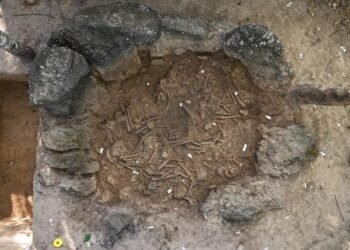
Archaeologists at Gomolava in northern Serbia have documented one of the largest prehistoric mass killings in Europe. Inside a shallow pit dating to the ninth century BCE, they found the remains of 77 people who died in a single episode of violence about 2,800 years ago. Most of the dead were women and children.
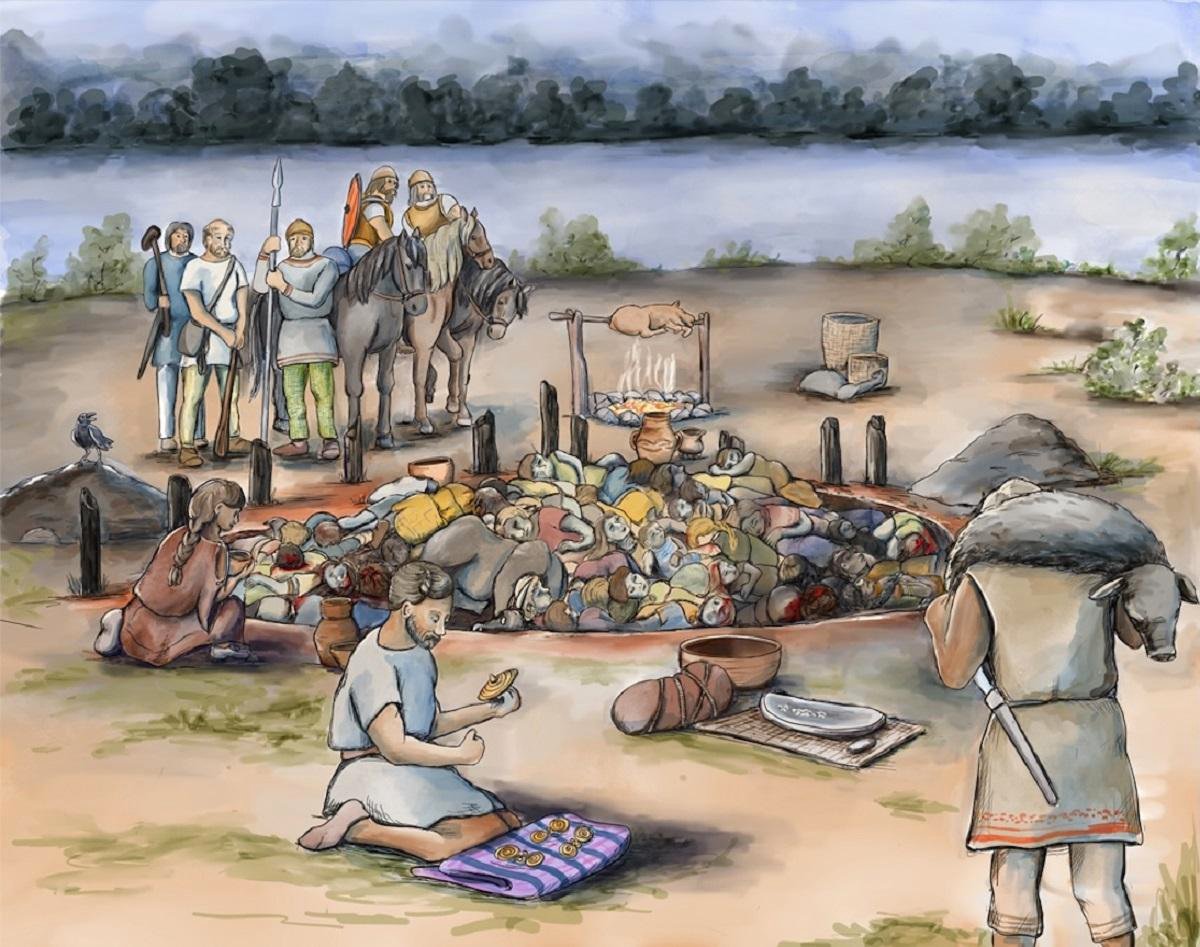
Iron Age mass killing in Serbia: 77 women and children found in 2,800-year-old grave at Gomolava
Reconstruction of the burial event at Gomolava. Credit: Sara Nylund / Fibiger et al., Nat Hum Behav (2026)

Gomolava stands near the modern village of Hrtkovci along the Sava River. People settled on the mound as early as the sixth millennium BCE, and different groups returned over thousands of years. By the Early Iron Age, communities across the Carpathian Basin were building enclosed settlements and reoccupying older fortified mounds. Control of land and grazing areas grew tense as mobile and semisedentary groups pressed against one another.

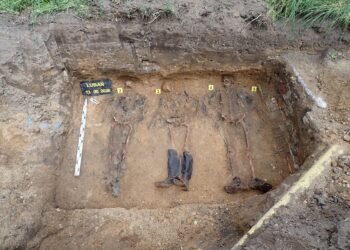
The grave itself was small, about 9.5 feet wide and 1.6 feet deep. Postholes around the pit suggest a structure or marker once stood above the burial. The dead were placed in a disused semi-subterranean house. Archaeologists recovered ceramic drinking vessels, bronze ornaments, and nearly 100 animal remains from the fill. A young calf lay at the bottom. Burned seeds and broken grinding stones were deposited over the bodies.

The way the dead were treated stands out. In many prehistoric mass graves, bodies were thrown into pits with little care. At Gomolava, the victims were not stripped of their valuables. Offerings were placed with them. The burial required time and planning.

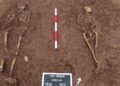
Bioarchaeological study shows how selective the violence was. Of the 77 individuals, 40 were children between one and twelve years old. Eleven were adolescents. Twenty-four were adults. About 87 percent were female. More than two-thirds of all individuals were children. The only infant identified was male.
RelatedStories

massive jar in Laos contained remains of 37 people, revealing ancient burial rituals and Asian trade links

Massive jar in Laos contained remains of 37 people, revealing ancient burial rituals and Asian trade links

May 19, 2026
Ancient burials, Roman well, and Anglo-Saxon house uncovered during A46 Newark bypass excavations

Ancient burials, Roman well, and Anglo-Saxon house uncovered during A46 Newark bypass excavations

May 12, 2026

Skeletal analysis revealed lethal trauma, mostly to the head. Injuries point to close-range blows from blunt weapons. The pattern suggests attackers who struck from above. Some wounds indicate assailants who were taller or mounted.

DNA results challenge the idea of a single family group attacked in one settlement. Researchers analyzed genetic data from 25 individuals. Few close biological ties appeared, even at distant levels. Strontium isotope analysis of tooth enamel shows varied childhood origins. More than one-third of those tested grew up outside the local area. The grave holds a mixed group drawn from different communities.

Such a demographic profile raises difficult questions. In many conflicts, women and children are taken captive. Here, they were killed in large numbers. Removing women and younger individuals would have disrupted reproduction, labor, and alliances built through marriage. Genealogical lines would have been broken.

A second mass grave uncovered at Gomolava in 1954 contained mostly female skeletons from the same era, along with metal objects and animal remains. Together, the burials point to repeated episodes of organized violence.

The study, published in Nature Human Behaviour, was carried out by researchers from University College Dublin, the University of Edinburgh, the University of Copenhagen, and the Museum of Vojvodina, with support from the European Research Council. Evidence from Gomolava shows a deliberate effort to eliminate selected segments of a regional population during a time of shifting power and contested land in the Early Iron Age.
Publication: Fibiger, L., Iraeta-Orbegozo, M., Koledin, J., Laffoon, J. E., Makarewicz, C. A., Mylopotamitaki, D., … Molloy, B. (2026). A large mass grave from the Early Iron Age indicates selective violence towards women and children in the Carpathian Basin. Nature Human Behaviour. doi:10.1038/s41562-025-02399-9
More information: University College Dublin
ShareTweetShareShareSend

You May Also Like...

World War II mass grave in Poland reveals remains of German officer killed during Battle of Lauban
Anthropology

World War II mass grave in Poland reveals remains of German officer killed during Battle of Lauban

May 19, 2026
massive jar in Laos contained remains of 37 people, revealing ancient burial rituals and Asian trade links
Anthropology

Massive jar in Laos contained remains of 37 people, revealing ancient burial rituals and Asian trade links

May 19, 2026
6,000-year-old necropolis in Spain rewrites origins of Europe’s first megalithic tombs
Archaeology

6,000-year-old necropolis in Spain rewrites origins of Europe’s first megalithic tombs

May 18, 2026
Ancient settlement with weaving workshop and longhouses uncovered in Germany gravel pit
Archaeology

Ancient settlement with weaving workshop and longhouses uncovered in Germany gravel pit

May 17, 2026
Pompeii victim identified as Roman physician killed while fleeing Vesuvius eruption
Anthropology

Pompeii victim identified as Roman physician killed while fleeing Vesuvius eruption

May 17, 2026
Archaeologists uncover hidden whisky smuggler bothy in Scottish Highlands with rare copper still piece
Archaeology

Archaeologists uncover hidden whisky smuggler bothy in Scottish Highlands with rare copper still piece

May 16, 2026

Comments 0

  1. Editorial Team says:
    1 second ago

    Disclaimer: This website is a science-focused magazine that welcomes both academic and non-academic audiences. Comments are written by users and may include personal opinions or unverified claims. They do not necessarily reflect the views of our editorial team or rely on scientific evidence.

    Comment Policy: We kindly ask all commenters to engage respectfully. Comments that contain offensive, insulting, degrading, discriminatory, or racist content will be automatically removed.

    Reply

Leave a Reply Cancel reply

Your email address will not be published. Required fields are marked *

Follow us


Instagram
242K

Facebook
117K

Threads
46K

LinkedIn
14K

Twitter
6K

YouTube
1K
World War II mass grave in Poland reveals remains of German officer killed during Battle of Lauban

World War II mass grave in Poland reveals remains of German officer killed during Battle of Lauban

May 19, 2026
massive jar in Laos contained remains of 37 people, revealing ancient burial rituals and Asian trade links

Massive jar in Laos contained remains of 37 people, revealing ancient burial rituals and Asian trade links

May 19, 2026
6,000-year-old necropolis in Spain rewrites origins of Europe’s first megalithic tombs

6,000-year-old necropolis in Spain rewrites origins of Europe’s first megalithic tombs

May 18, 2026
Ancient settlement with weaving workshop and longhouses uncovered in Germany gravel pit

Ancient settlement with weaving workshop and longhouses uncovered in Germany gravel pit

May 17, 2026

Archaeology News online magazine

Archaeology News is an international online magazine that covers all aspects of archaeology.


Categories

  • Academics
    • Books
    • Conferences
    • Universities
  • Articles
  • Download
  • Game
  • News
    • Anthropology
    • Archaeology
    • Paleontology
  • Quiz
  • Tours

Subscribe to our newsletter

© 2024 - Archaeology News Online Magazine. All Rights Reserved.

  • About
  • Privacy Policy
  • Terms of Use
  • Donation
  • Contact

Manage Consent
To provide the best experiences, we use technologies like cookies to store and/or access device information. Consenting to these technologies will allow us to process data such as browsing behavior or unique IDs on this site. Not consenting or withdrawing consent, may adversely affect certain features and functions.
Functional Always active
The technical storage or access is strictly necessary for the legitimate purpose of enabling the use of a specific service explicitly requested by the subscriber or user, or for the sole purpose of carrying out the transmission of a communication over an electronic communications network.
Preferences
The technical storage or access is necessary for the legitimate purpose of storing preferences that are not requested by the subscriber or user.
Statistics
The technical storage or access that is used exclusively for statistical purposes. The technical storage or access that is used exclusively for anonymous statistical purposes. Without a subpoena, voluntary compliance on the part of your Internet Service Provider, or additional records from a third party, information stored or retrieved for this purpose alone cannot usually be used to identify you.
Marketing
The technical storage or access is required to create user profiles to send advertising, or to track the user on a website or across several websites for similar marketing purposes.
  • Manage options
  • Manage services
  • Manage {vendor_count} vendors
  • Read more about these purposes
View preferences
  • {title}
  • {title}
  • {title}
  • Home
  • News
    • Archaeology
    • Anthropology
    • Paleontology
  • Academic
    • Books
    • Conferences
    • Universities
  • Articles
  • VR Tours
  • Quiz & Game
  • Download
  • Encyclopedia
  • Forum

About  .  Contact  .  Donation

© 2024 - Archaeology News Online Magazine. All Rights Reserved