• About
  • Privacy Policy
  • Terms of Use
  • Donation
  • Contact
No Result
View All Result
Archaeology News
  • Home
  • News
    • Archaeology
    • Anthropology
    • Paleontology
  • Academic
    • Books
    • Conferences
    • Universities
  • Articles
  • VR Tours
  • Quiz & Game
  • Download
  • Encyclopedia
  • Forum
Archaeology News
No Result
View All Result
Home News Archaeology

Roman horse cemetery with rare burial discovered in Stuttgart

by Dario Radley
April 17, 2025

Archaeologists in Stuttgart have unearthed the remains of over 100 Roman-era horses buried in what is now believed to be one of the largest known ancient Roman horse cemeteries in southern Germany. Found during a construction project in Bad Cannstatt, a historic district in Stuttgart, the find yields new information on the Roman military’s cavalry use and the relationship between soldiers and their horses.

Roman horse cemetery with rare burial discovered in Stuttgart
One of the horses uncovered in the ancient Roman cemetery in Stuttgart. Credit: State Office for Monument Preservation in the Stuttgart Regional Council / ArchaeoBW

The excavation, which began in July 2024, was prompted by a new housing project by the Stuttgart Housing and Urban Development Company (SWSG) between Düsseldorfer Straße and Bottroper Straße. Conducted by the archaeology firm ArchaeoBW under the supervision of the State Office for Monument Preservation (LAD), the dig unearthed more than 100 horse skeletons that date to the second century CE, when the site was a key military hub for Roman forces.

The horses belonged to a Roman cavalry unit known as an “Ala” that was stationed at Hallschlag between 100 and 150 CE, LAD lead archaeologist Sarah Roth said. “The troop with nearly 500 riders probably had at least 700 horses; losses had to be constantly replaced,” she said.

The burial site is approximately 400 meters from the ancient cavalry fort and 200 meters from the nearest Roman civilian settlement. The animals were interred in shallow graves, on their sides with bent or extended legs. Radiocarbon dating shows they were buried over time rather than in the direct wake of a single catastrophic event. Roth explained in an LAD press release, “The horses do not seem to have died suddenly all together due to some cataclysmic event like battle or epidemic. Rather, they died during the presence of the Ala due to illness, injuries, or other reasons, or were no longer able to fulfill their duty as military horses.

Roman horse cemetery with rare burial discovered in Stuttgart
A horse uncovered buried with several artifacts. Credit: State Office for Monument Preservation in the Stuttgart Regional Council / ArchaeoBW

The majority of the animals appeared to have been disposed of rather than ceremoniously buried—a practical and efficient process to dispose of the constant losses in a military context. In most cases, the bodies were likely pulled into pits and buried without much care. But one grave differed. A horse was buried with two jugs and a small oil lamp, carefully placed in the crook of its leg—grave goods typically reserved for humans. “Here we see a particularly close bond between the owner and the horse. Despite the passage of some 1,800 years, the grief over the loss of this animal can still be felt,” Roth said.


RelatedStories

Ancient settlement with weaving workshop and longhouses uncovered in Germany gravel pit

Ancient settlement with weaving workshop and longhouses uncovered in Germany gravel pit

May 17, 2026
Pompeii victim identified as Roman physician killed while fleeing Vesuvius eruption

Pompeii victim identified as Roman physician killed while fleeing Vesuvius eruption

May 17, 2026

This poignant detail shows that at least one Roman soldier did not regard his horse as military equipment, but as a good companion. It’s an emotional detail preserved in soil and bone.

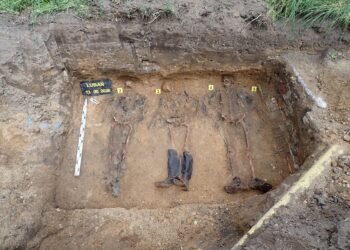
Offering a darker contrast to the site was the discovery of a human skeleton—that of an adult male, face down and devoid of any grave goods. Among horse remnants and far away from the human cemetery of the Roman settlement, the man is thought by archaeologists to have been a social outsider or a person who was not deserving of a proper burial.

Roman horse cemetery with rare burial discovered in Stuttgart
Archaeologists uncovered an ancient Roman graveyard with over 100 military horses at a construction site in Stuttgart. Credit: State Office for Monument Preservation in the Stuttgart Regional Council / ArchaeoBW

The discoveries affirm the long-standing interpretation of the site as a Roman-period horse cemetery, which was first voiced in the 1920s when remains of horses were unearthed in the area during earlier construction activities. The site had been referred to as a “Schindanger” or knacker’s yard—a term historically applied to animal disposal grounds. But the new findings suggest a more complex narrative of military logistics, animal management, and human-animal relations in the Roman world.

Now that fieldwork is finished, further archaeozoological analysis is underway to study the age, sex, size, and health of the horses at the time of death. These investigations aim to uncover more than simply how the animals were used, but also how they were fed, bred, and cared for. Scientists also wish to determine whether the first horses were imported from elsewhere or bred here, a question with particular relevance to Stuttgart, whose name comes from the Old High German stuotgarden, meaning “mare’s garden.”

More information: Regierungspräsidium Stuttgart
You May Also Like...

World War II mass grave in Poland reveals remains of German officer killed during Battle of Lauban
Anthropology

World War II mass grave in Poland reveals remains of German officer killed during Battle of Lauban

May 19, 2026
massive jar in Laos contained remains of 37 people, revealing ancient burial rituals and Asian trade links
Anthropology

Massive jar in Laos contained remains of 37 people, revealing ancient burial rituals and Asian trade links

May 19, 2026
6,000-year-old necropolis in Spain rewrites origins of Europe’s first megalithic tombs
Archaeology

6,000-year-old necropolis in Spain rewrites origins of Europe’s first megalithic tombs

May 18, 2026
Ancient settlement with weaving workshop and longhouses uncovered in Germany gravel pit
Archaeology

Ancient settlement with weaving workshop and longhouses uncovered in Germany gravel pit

May 17, 2026
Pompeii victim identified as Roman physician killed while fleeing Vesuvius eruption
Anthropology

Pompeii victim identified as Roman physician killed while fleeing Vesuvius eruption

May 17, 2026
Archaeologists uncover hidden whisky smuggler bothy in Scottish Highlands with rare copper still piece
Archaeology

Archaeologists uncover hidden whisky smuggler bothy in Scottish Highlands with rare copper still piece

May 16, 2026

Follow us


Instagram
242K

Facebook
117K

Threads
46K

LinkedIn
14K

Twitter
6K

YouTube
1K
Plugin Install : Widget Tab Post needs JNews - View Counter to be installed
  • Trending
  • Comments
  • Latest
World War II mass grave in Poland reveals remains of German officer killed during Battle of Lauban

World War II mass grave in Poland reveals remains of German officer killed during Battle of Lauban

May 19, 2026
massive jar in Laos contained remains of 37 people, revealing ancient burial rituals and Asian trade links

Massive jar in Laos contained remains of 37 people, revealing ancient burial rituals and Asian trade links

May 19, 2026
6,000-year-old necropolis in Spain rewrites origins of Europe’s first megalithic tombs

6,000-year-old necropolis in Spain rewrites origins of Europe’s first megalithic tombs

May 18, 2026
Ancient settlement with weaving workshop and longhouses uncovered in Germany gravel pit

Ancient settlement with weaving workshop and longhouses uncovered in Germany gravel pit

May 17, 2026
Pompeii victim identified as Roman physician killed while fleeing Vesuvius eruption

Pompeii victim identified as Roman physician killed while fleeing Vesuvius eruption

May 17, 2026

Archaeology News online magazine

Archaeology News is an international online magazine that covers all aspects of archaeology.


Categories

  • Academics
    • Books
    • Conferences
    • Universities
  • Articles
  • Download
  • Game
  • News
    • Anthropology
    • Archaeology
    • Paleontology
  • Quiz
  • Tours

Subscribe to our newsletter

[newsletter_form]

© 2024 - Archaeology News Online Magazine. All Rights Reserved.

  • About
  • Privacy Policy
  • Terms of Use
  • Donation
  • Contact

  • Home
  • News
    • Archaeology
    • Anthropology
    • Paleontology
  • Academic
    • Books
    • Conferences
    • Universities
  • Articles
  • VR Tours
  • Quiz & Game
  • Download
  • Encyclopedia
  • Forum

About  .  Contact  .  Donation

© 2024 - Archaeology News Online Magazine. All Rights Reserved