• About
  • Privacy Policy
  • Terms of Use
  • Donation
  • Contact
No Result
View All Result
Archaeology News
  • Home
  • News
    • Archaeology
    • Anthropology
    • Paleontology
  • Academic
    • Books
    • Conferences
    • Universities
  • Articles
  • VR Tours
  • Quiz & Game
  • Download
  • Encyclopedia
  • Forum
Archaeology News
No Result
View All Result
Home News Archaeology

Archaeologists uncover two new fragments of the Fasti Ostienses in the Ostia Antica archaeological park

by Dario Radley
August 20, 2023

Two newly discovered fragments of the Fasti Ostienses, an ancient Roman calendar inscribed on marble slabs, have shed light on the political and monumental history of both Rome and Ostia, offering an unprecedented glimpse into the daily activities of Emperor Hadrian, who reigned from 117 to 138 CE.

Archaeologists uncover two new fragments of the Fasti Ostienses in the Ostia Antica archaeological park
The newly uncovered fragments, combined with another already preserved in Ostia. Credit: Italian Ministry of Culture

The Fasti Ostienses are considered an invaluable historical chronicle, meticulously drafted by the pontifex Volcani, the highest local religious authority at the time.

This discovery, the result of the second excavation campaign of the Ops – Ostia Post Scriptum project, conducted in collaboration with the University of Catania and the Polytechnic University of Bari, is set to enhance our understanding of Hadrian’s reign and the ancient Ostian civilization.

These two fragments, found in Area B of the Ostia Antica Archaeological Park, corresponding to the Forum of Porta Marina, complete the existing narrative dating back to 128 CE, during Hadrian’s rule.
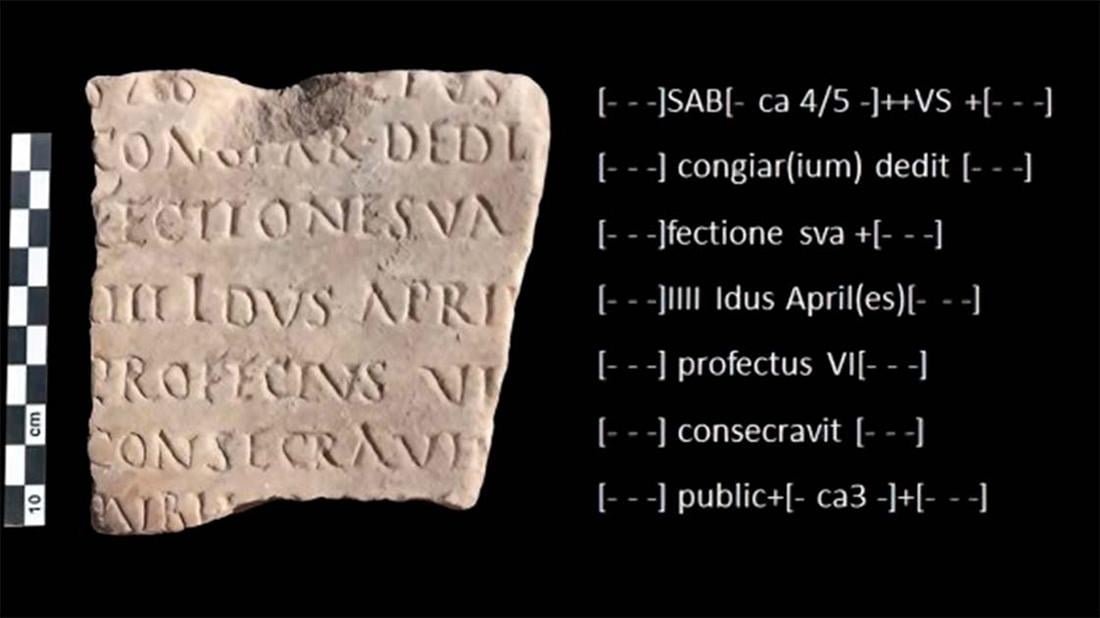
Archaeologists uncover two new fragments of the Fasti Ostienses in the Ostia Antica archaeological park
Fragment of the Fasti Ostienses with the transcript. Credit: Italian Ministry of Culture

The inscription on the first fragment reveals the remarkable events of that year, including Hadrian’s assumption of the title “pater patriae” (father of his country) on January 10, alongside the elevation of his wife, Sabina, to the status of “Augusta.” To commemorate these honors, Hadrian offered a generous “congiar dedit” or donation of money to the Roman people.

RelatedStories

Ancient Venetic sanctuary with rare inscriptions unearthed beneath road project in Italy

Ancient Venetic sanctuary with rare inscriptions unearthed beneath road project in Italy

May 21, 2026
Ancient settlement with weaving workshop and longhouses uncovered in Germany gravel pit

Ancient settlement with weaving workshop and longhouses uncovered in Germany gravel pit

May 17, 2026

On April 11, 128 CE, as indicated in the inscription, Hadrian embarked on a journey to Africa, returning to Rome between late July and early August. Before departing for Athens, the Emperor conducted a consecration, inscribed as “consecravit,” of a building within Rome itself.

Experts speculate that this building could either be the iconic Pantheon or the Temple of Venus and Roma, with August 11, 128 CE, marking a potential anniversary date of Hadrian’s accession to the throne in 117 CE.

Alessandro D’Alessio, the director of the Archaeological Park of Ancient Ostia, has described this discovery as “extraordinary,” emphasizing that it significantly contributes to our knowledge of Emperor Hadrian’s activities and underscores the historical significance of ancient Ostia.

Furthermore, Gennaro Sangiuliano, Italy’s Minister of Culture, applauded the excavations at the Ostia Archaeological Park, which not only unveiled the Fasti Ostienses fragments but also revealed extensive portions of a mosaic floor, soon to be accessible to the public. Sangiuliano emphasized the invaluable nature of these discoveries for understanding life in Ostia and Rome.

The Forum of Porta Marina, where these Fasti Ostienses fragments were unearthed, was a large rectangular building adorned with columns, where historical records were etched into columns.

The Fasti Ostienses were maintained by the priests of the Temple of Vulcan, Ostia’s chief deity and their creation began as early as the dictatorship of Sulla in 81 BC. The earliest surviving portion records events from 49 to 44 BC, while the last extant year is CE 175.

The newly uncovered fragments, combined with previously discovered pieces, now provide a continuous chronicle of the years 126-128 CE. Some of the calendar fragments, spanning the period from CE 49 to CE 175, are on display at the Vatican Museums.

Ostia Antica, situated just 19 miles from Rome, was originally established as an armed camp and later evolved into a thriving commercial center. Its strategic location at the mouth of the Tiber River made it a crucial harbor and base for Roman expansion. The site, which lay in ruins for centuries until the 19th century, boasts well-preserved structures, including a theater, Roman baths, schools, temples, and even a synagogue.
Share:

Share on Facebook Share on X (Twitter) Share on LinkedIn Share on Pinterest Share on WhatsApp Share on Email

You May Also Like...

Svalbard whalers show scurvy and extreme labor stress in “corpse point” cemetery
Anthropology

Svalbard whalers show scurvy and extreme labor stress in “corpse point” cemetery

May 25, 2026
'Patchwork families' lived in Europe over 5,000 years ago, Neolithic DNA study finds
Anthropology

‘Patchwork families’ lived in Europe over 5,000 years ago, Neolithic DNA study finds

May 25, 2026
100,000-year-old Homo sapiens bones from Ethiopia may preserve earliest evidence of human cremation
Anthropology

100,000-year-old Homo sapiens bones from Ethiopia may preserve earliest evidence of human cremation

May 24, 2026
Ancient Peruvian hairless dogs buried with Wari elites 1,200 years ago
Archaeology

Ancient Peruvian hairless dogs buried with Wari elites 1,200 years ago

May 24, 2026
4,000-year-old Mohenjo-daro study finds ancient city grew more equal over time
Archaeology

4,000-year-old Mohenjo-daro study finds ancient city grew more equal over time

May 24, 2026
Bronze Age towers in Sardinia remained centers of worship and ritual in the Iron Age
Archaeology

Bronze Age towers in Sardinia remained centers of worship and ritual in the Iron Age

May 23, 2026

Follow us


Instagram
242K

Facebook
117K

Threads
46K

LinkedIn
14K

Twitter
6K

YouTube
1K
Svalbard whalers show scurvy and extreme labor stress in “corpse point” cemetery

Svalbard whalers show scurvy and extreme labor stress in “corpse point” cemetery

May 25, 2026
'Patchwork families' lived in Europe over 5,000 years ago, Neolithic DNA study finds

‘Patchwork families’ lived in Europe over 5,000 years ago, Neolithic DNA study finds

May 25, 2026
100,000-year-old Homo sapiens bones from Ethiopia may preserve earliest evidence of human cremation

100,000-year-old Homo sapiens bones from Ethiopia may preserve earliest evidence of human cremation

May 24, 2026
Ancient Peruvian hairless dogs buried with Wari elites 1,200 years ago

Ancient Peruvian hairless dogs buried with Wari elites 1,200 years ago

May 24, 2026

Archaeology News online magazine

Archaeology News is an international online magazine that covers all aspects of archaeology.


Categories

  • Academics
    • Books
    • Conferences
    • Universities
  • Articles
  • Download
  • Game
  • News
    • Anthropology
    • Archaeology
    • Paleontology
  • Quiz
  • Tours

Subscribe to our newsletter

© 2024 - Archaeology News Online Magazine. All Rights Reserved.

  • About
  • Privacy Policy
  • Terms of Use
  • Donation
  • Contact

Manage Consent
To provide the best experiences, we use technologies like cookies to store and/or access device information. Consenting to these technologies will allow us to process data such as browsing behavior or unique IDs on this site. Not consenting or withdrawing consent, may adversely affect certain features and functions.
Functional Always active
The technical storage or access is strictly necessary for the legitimate purpose of enabling the use of a specific service explicitly requested by the subscriber or user, or for the sole purpose of carrying out the transmission of a communication over an electronic communications network.
Preferences
The technical storage or access is necessary for the legitimate purpose of storing preferences that are not requested by the subscriber or user.
Statistics
The technical storage or access that is used exclusively for statistical purposes. The technical storage or access that is used exclusively for anonymous statistical purposes. Without a subpoena, voluntary compliance on the part of your Internet Service Provider, or additional records from a third party, information stored or retrieved for this purpose alone cannot usually be used to identify you.
Marketing
The technical storage or access is required to create user profiles to send advertising, or to track the user on a website or across several websites for similar marketing purposes.
  • Manage options
  • Manage services
  • Manage {vendor_count} vendors
  • Read more about these purposes
View preferences
  • {title}
  • {title}
  • {title}
  • Home
  • News
    • Archaeology
    • Anthropology
    • Paleontology
  • Academic
    • Books
    • Conferences
    • Universities
  • Articles
  • VR Tours
  • Quiz & Game
  • Download
  • Encyclopedia
  • Forum

About  .  Contact  .  Donation

© 2024 - Archaeology News Online Magazine. All Rights Reserved