• About
  • Privacy Policy
  • Terms of Use
  • Donation
  • Contact
No Result
View All Result
Archaeology News
  • Home
  • News
    • Archaeology
    • Anthropology
    • Paleontology
  • Academic
    • Books
    • Conferences
    • Universities
  • Articles
  • VR Tours
  • Quiz & Game
  • Download
  • Encyclopedia
  • Forum
Archaeology News
No Result
View All Result
Home News Archaeology

5700-year-old Menga Dolmen is a marvel of Neolithic engineering, study reveals

by Dario Radley
December 6, 2023

A team of archaeologists, geologists, and historians from various Spanish institutions has uncovered the remarkable engineering prowess behind the Menga Dolmen, an ancient burial mound near Antequera, Málaga, Spain.
5700-year-old Menga Dolmen is a marvel of Neolithic engineering, study reveals
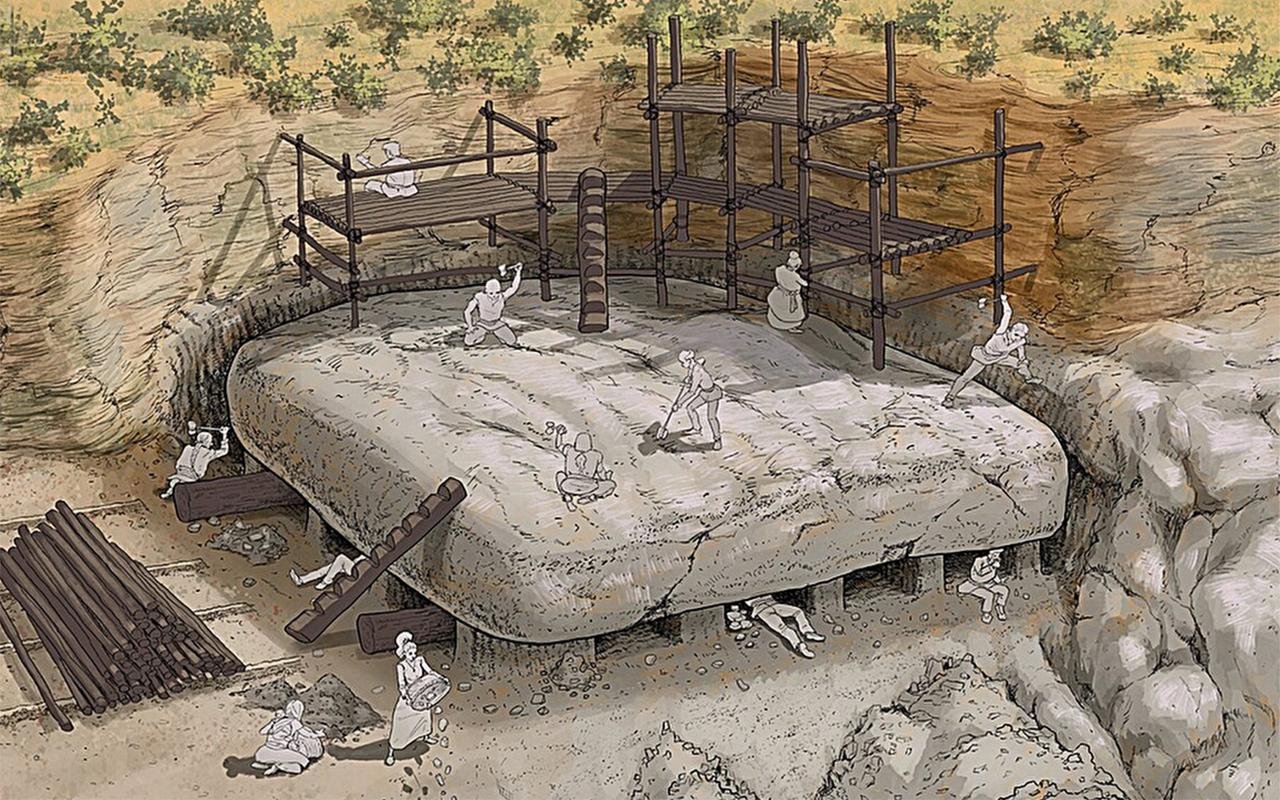
Artistic representation of quarrying activities for the extraction the capstone C-5 in Cerro de la Cruz Quarry, Drawing: Moisés Bellilty under guidance of José Antonio Lozano Rodríguez and Leonardo García Sanjuán. Credit: Rodríguez et al., Scientific Reports (2023).

Published in Scientific Reports, the research explores the intricate engineering behind this Neolithic burial mound, revealing it as one of the most remarkable achievements of its time, dating back approximately 5,700 years.

The Menga Dolmen, part of a UNESCO World Heritage site, stands as one of Europe’s largest megalithic structures, captivating researchers with its colossal stones, some exceeding 100 tons in weight. The recent study employed cutting-edge technology, including petrographic and stratigraphic analyses, to delve into the composition, origin, and construction methods of these monumental stones.

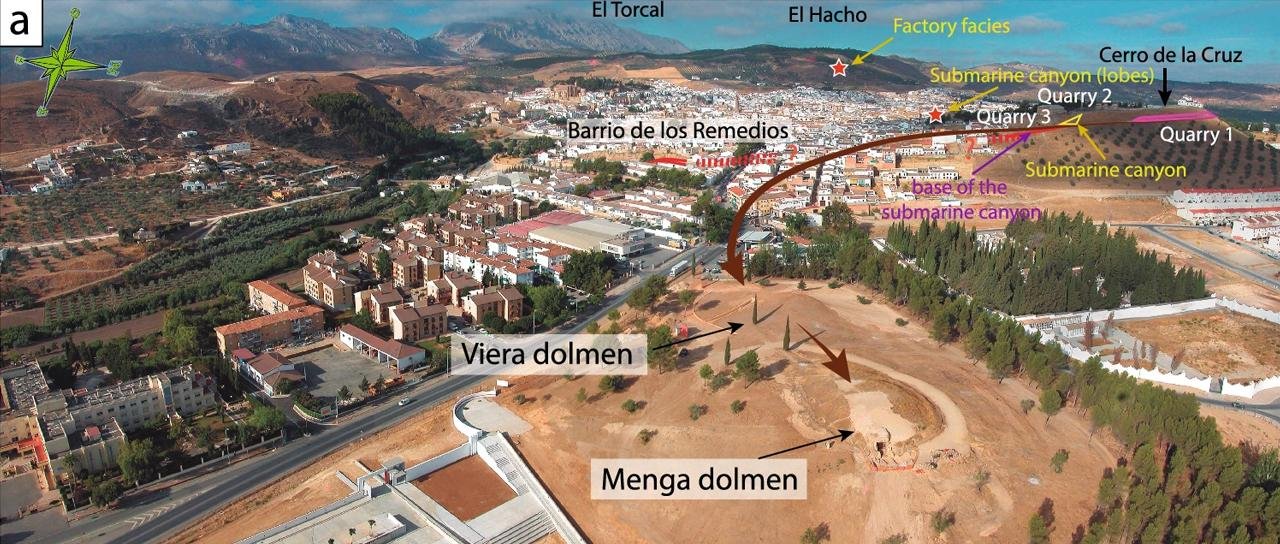
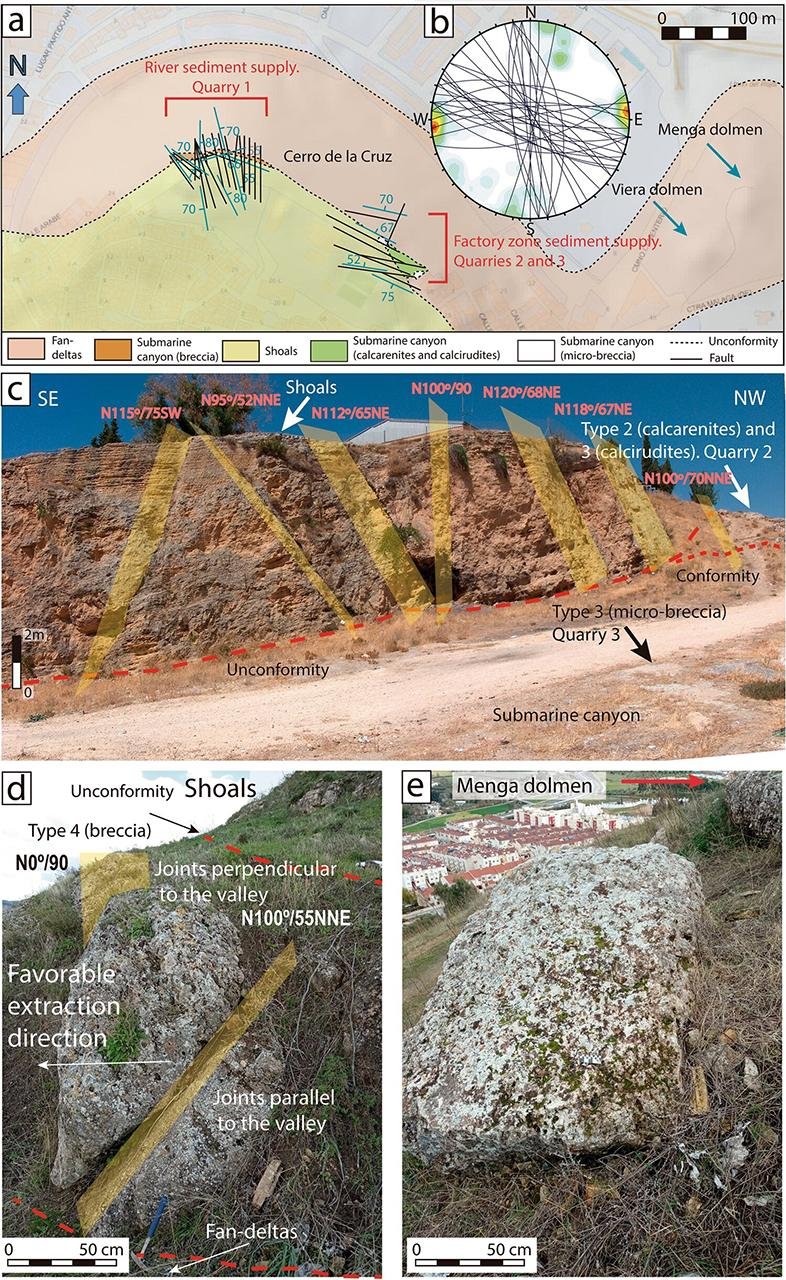
Geological investigations pinpointed the source of the stones to the Cerro de la Cruz quarries, approximately 1 km away from the construction site. Petrological examinations revealed that the stones were predominantly calcarenites, a type of soft sedimentary rock. This particular choice of material, considered fragile in modern terms, underscores the engineering challenges faced by ancient builders.
5700-year-old Menga Dolmen is a marvel of Neolithic engineering, study reveals
Overview of Menga, Viera, Los Remedios neighbourhood and Cerro de la Cruz from the NE. Credit: Rodríguez et al., Scientific Reports (2023).

Researchers emphasized the complexity involved in transporting these massive stones without causing damage. The study suggests that the Neolithic engineers meticulously planned the movement of stones, requiring not only smooth roads but also the use of scaffolds and ropes for precise placement.

The heart of the dolmen’s engineering marvel lies in its capstone, weighing an astonishing 150 tons, strategically positioned as the roof of the burial chamber. According to the researchers, “Moving and placing such large stones from Cerro de la Cruz to the hill of Menga must have demanded intensive planning, highly accurate logistics, and enormous labor investments.”

The dolmen’s alignment with nearby mountains served a dual purpose. It not only created intricate light patterns within the chamber but also indicated intentional orientation by its builders. This aligning technique reflects the advanced understanding of astronomy and architectural planning among the ancient engineers.
5700-year-old Menga Dolmen is a marvel of Neolithic engineering, study reveals
(a) Geological map of tectonic jointing on DTM, showing the location of Menga and Viera and the likely quarrying areas at Cerro de la Cruz. (b) Stereographic representation of the groups of joints. (c) Overview of the tectonic fracturing present in quarry areas #2 and #3. (d) Groups of joints observed in Quarry #1. (e) Example of a possible discarded megalithic stone at Quarry #1. Credit: Rodríguez et al., Scientific Reports (2023).

The study also unraveled the ingenious method employed to combat erosion. Stones were interlocked at the chamber’s edges, channeling away water seepage and safeguarding the dolmen from the elements. The construction of a waterproof tumulus further attests to the builders’ deliberate efforts to preserve the soft stones.

Menga’s construction, detailed in the study, stands as a testament to the meticulous planning, labor coordination, technical expertise, and calculations involved in erecting such a colossal structure. According to the researchers, “The woodwork associated with the construction process must have demanded the use of large amounts of timber,” underscoring the multidimensional nature of the Neolithic engineering achievement.

Comparisons with other megalithic sites worldwide, such as Stonehenge and Easter Island, highlight the importance of studying stone provenance for understanding ancient architectural practices. The Menga Dolmen’s unique features, including its colossal stones, intentional orientation, and waterproofing techniques, distinguish it as a pinnacle of megalithic engineering in European prehistory.

More information: Rodríguez, J.A.L., Sanjuán, L.G., Álvarez-Valero, A.M. et al. (2023). The provenance of the stones in the Menga dolmen reveals one of the greatest engineering feats of the Neolithic. Sci Rep 13, 21184. https://doi.org/10.1038/s41598-023-47423-y

Share:

Share on Facebook Share on X (Twitter) Share on LinkedIn Share on Pinterest Share on WhatsApp Share on Email

Related Posts

Buried church bell found in Poland after decades hidden beneath roadside
Archaeology

Buried church bell found in Poland after decades hidden beneath roadside

May 31, 2026
Stone Age humans built complex grass beds at Border Cave 200,000 years ago, study finds
Archaeology

Stone Age humans built complex grass beds at Border Cave 200,000 years ago, study finds

May 30, 2026
Radiocarbon dating confirms Teutonic Knights built Feldioara Fortress in 13th-century Transylvania
Archaeology

Radiocarbon dating confirms Teutonic Knights built Feldioara Fortress in 13th-century Transylvania

May 30, 2026
Ancient shipwreck with 300 amphorae found off Italy could reshape views of Mediterranean wine trade
Archaeology

Ancient shipwreck with 300 amphorae found off Italy could reshape views of Mediterranean wine trade

May 29, 2026
Ancient DNA reveals 700-kilometer migration along Peru’s coast before the Inca Empire
Anthropology

Ancient DNA reveals 700-kilometer migration along Peru’s coast before the Inca Empire

May 29, 2026
6,000-year-old mega-structure unearthed at prehistoric settlement in Romania
Archaeology

6,000-year-old mega-structure unearthed at prehistoric settlement in Romania

May 29, 2026

Follow us


Instagram
242K

Facebook
117K

Threads
47K

LinkedIn
15K

Twitter
6K

YouTube
1K

Archaeology News online magazine

Archaeology News is an international online magazine that covers all aspects of archaeology.


Categories

  • Academics
    • Books
    • Conferences
    • Universities
  • Articles
  • Download
  • Game
  • News
    • Anthropology
    • Archaeology
    • Paleontology
  • Quiz
  • Tours

Subscribe to our newsletter

© 2024 - Archaeology News Online Magazine. All Rights Reserved.

  • About
  • Privacy Policy
  • Terms of Use
  • Donation
  • Contact

Manage Consent
To provide the best experiences, we use technologies like cookies to store and/or access device information. Consenting to these technologies will allow us to process data such as browsing behavior or unique IDs on this site. Not consenting or withdrawing consent, may adversely affect certain features and functions.
Functional Always active
The technical storage or access is strictly necessary for the legitimate purpose of enabling the use of a specific service explicitly requested by the subscriber or user, or for the sole purpose of carrying out the transmission of a communication over an electronic communications network.
Preferences
The technical storage or access is necessary for the legitimate purpose of storing preferences that are not requested by the subscriber or user.
Statistics
The technical storage or access that is used exclusively for statistical purposes. The technical storage or access that is used exclusively for anonymous statistical purposes. Without a subpoena, voluntary compliance on the part of your Internet Service Provider, or additional records from a third party, information stored or retrieved for this purpose alone cannot usually be used to identify you.
Marketing
The technical storage or access is required to create user profiles to send advertising, or to track the user on a website or across several websites for similar marketing purposes.
  • Manage options
  • Manage services
  • Manage {vendor_count} vendors
  • Read more about these purposes
View preferences
  • {title}
  • {title}
  • {title}
  • Home
  • News
    • Archaeology
    • Anthropology
    • Paleontology
  • Academic
    • Books
    • Conferences
    • Universities
  • Articles
  • VR Tours
  • Quiz & Game
  • Download
  • Encyclopedia
  • Forum

About  .  Contact  .  Donation

© 2024 - Archaeology News Online Magazine. All Rights Reserved