• About
  • Privacy Policy
  • Terms of Use
  • Donation
  • Contact
No Result
View All Result
Archaeology News
  • Home
  • News
    • Archaeology
    • Anthropology
    • Paleontology
  • Academic
    • Books
    • Conferences
    • Universities
  • Articles
  • VR Tours
  • Quiz & Game
  • Download
  • Encyclopedia
  • Forum
Archaeology News
No Result
View All Result
Home News Anthropology

New research sheds light on family relationships in western Eurasian Bell Beaker communities

by Dario Radley
January 30, 2024

Archaeologists have delved into the mysterious burial practices of early Bronze Age communities in western Eurasia, shedding light on the family relationships and cultural dynamics of the Bell Beaker people from 3000-2000 BCE.

An international study led by researchers from Johannes Gutenberg University Mainz and the University of Ferrara, among other European institutions, has re-examined two remarkably similar double burial sites, one in Altwies, Luxembourg, and another in Dunstable Downs, England.
New research sheds light on family relationships in western Eurasian Bell Beaker communities
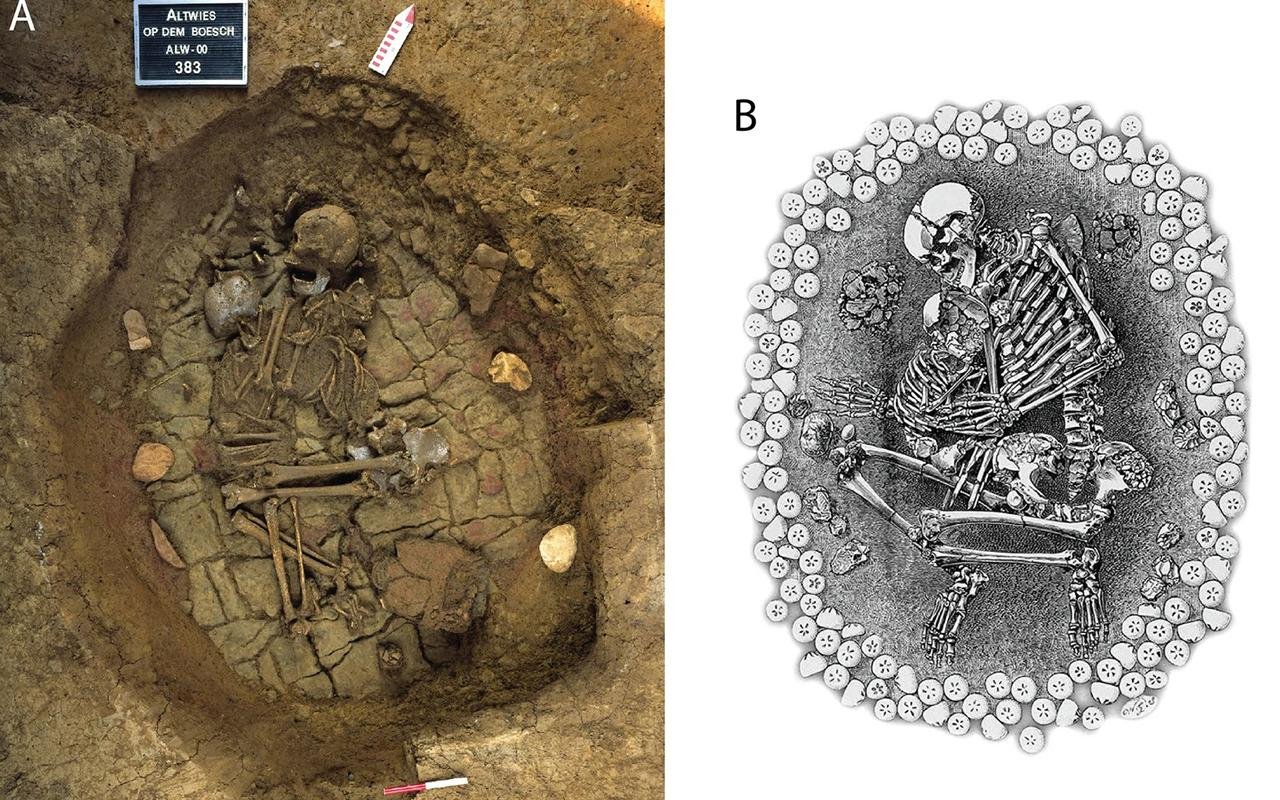
Adult–child graves sampled for this study, Bell Beaker period. (A) Altwies ‘‘Op dem Boesch’’, Luxembourg (photograph: Le Brun-Ricalens et al. 2011; Institut National de Recherches Archéologiques); (B) Dunstable Downs, Southern Bedfordshire, UK (etching: W.G. Smith 1894). Credit: Zedda et al., Scientific Reports (2023)

In Altwies, a burial site discovered in 2000 during a construction project revealed the skeletons of a woman and a 3-year-old boy facing each other, with the woman holding the boy’s head in her hand. Meanwhile, the site in Dunstable Downs, England, uncovered in 1887, featured a young woman buried with a 6-year-old girl, identified as paternal aunt and niece through DNA analysis, challenging expectations of a mother-daughter relationship.

Dr. Nicoletta Zedda from the University of Ferrara, a lead author of the study, explained, “The skeletons from Altwies were of a woman and a boy of around three years of age, and DNA analysis revealed that they were indeed mother and son. The picture looks different for Dunstable Downs: a young woman and a girl about 6 years old, but DNA revealed they are, in fact, paternal aunt and niece.”
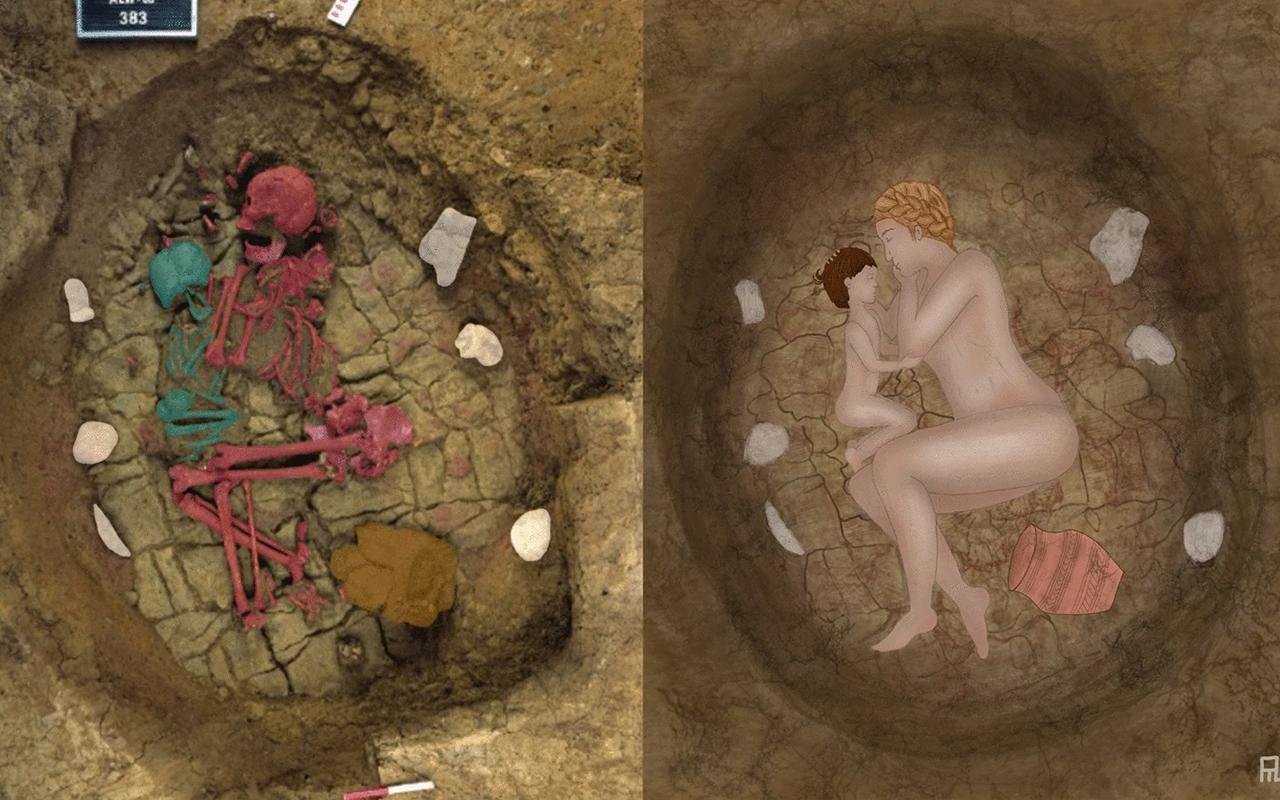
New research sheds light on family relationships in western Eurasian Bell Beaker communities
The grave of Altwies, left: the bones of the mother and child highlighted; right: hypothetical reconstruction of the grave based on phenotypic traits partly inferred from the ancient genomes. Credit: Zedda et al., Scientific Reports (2023)

The research, published in Scientific Reports, presented genetic evidence suggesting a patrilineal descent system for Bell Beaker communities in western Eurasia. The study involved a multidisciplinary analysis, incorporating archaeology, anthropology, and ancient DNA techniques, revealing shared ancestry and cultural connections among the early European farmers.

RelatedStories

Bronze Age loom found inside ancient Spanish home reveals early textile production

Bronze Age loom found inside ancient Spanish home reveals early textile production

April 8, 2026
How ancient communities adapted their diets and farming strategies in prehistoric Poland

How ancient communities adapted their diets and farming strategies in prehistoric Poland

February 26, 2026

Dr. Maxime Brami of Johannes Gutenberg University Mainz, one of the lead authors, explained: “The data might hint at a patrilineal descent system for Western Eurasian Bell Beaker people. Our findings suggest that, at least in some Early Bronze Age communities, extended families lived and buried their dead together, placing emphasis on biological and kin relationships.”

The orientation of Bell Beaker graves in continental Europe followed strict rules based on the individual’s sex. In Altwies, the orientation of the grave matched the child’s sex, while at Dunstable Downs, the adult and child were second-degree relatives on the paternal side, indicating a potential substitute parent or primary caregiver role played by the paternal aunt.

Despite the geographical separation of over 500 kilometers between the Luxembourg and England burial sites, the study uncovered over a hundred joint burials across Eurasia from the 3rd and 2nd millennium BCE. The widespread occurrence of the practice suggested a commonality in mourning rituals among Bell Beaker communities, perhaps indicative of shared cultural traditions.
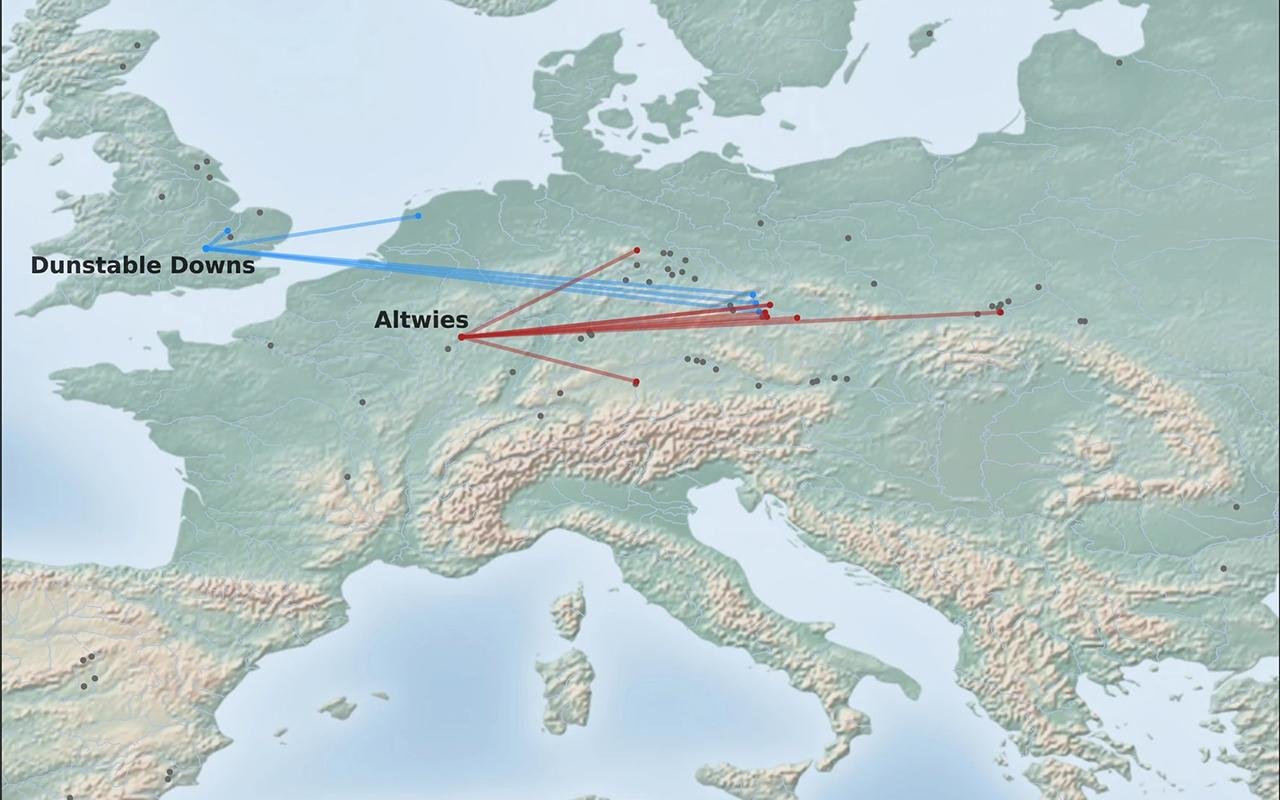
New research sheds light on family relationships in western Eurasian Bell Beaker communities
Location of Altwies “Op dem Boesch” (red dot) and Dunstable Downs (blue dot). Credit: Zedda et al., Scientific Reports (2023)

While the direct causes of the individuals’ deaths remain unknown, the study proposed possibilities such as violence, infections, or pandemics. However, the consistency in the ritual treatment and positioning of bodies in burial highlighted the deep symbolic significance adhered to across different regions.

“The body of a woman, lying as though sleeping, clasping a child in her arms, is poignant and emotive. Although that peaceful image may be deceptive, it still reflects a lost meaning retained across thousands of miles and amongst many diverse cultures,” remarked Dr. Brami.

The research project not only unraveled the complexities of family relationships and burial customs but also showcased the interconnectedness of Bell Beaker communities in western Eurasia during the Bronze Age.
More information: Zedda, N., Meheux, K., Blöcher, J. et al. (2023). Biological and substitute parents in Beaker period adult–child graves. Sci Rep 13, 18765. doi.org/10.1038/s41598-023-45612-3
Share3Tweet2ShareShareSend

You May Also Like...

Roman cemetery in Egypt reveals golden tongues, mummies, and rare Iliad papyrus
Anthropology

Roman cemetery in Egypt reveals golden tongues, mummies, and rare Iliad papyrus

April 19, 2026
Basel plague study finds young workers had highest death rates in 17th century outbreak
Anthropology

Basel plague study finds young workers had highest death rates in 17th century outbreak

April 17, 2026
Ancient DNA reveals male lineage and family ties in Neolithic Scotland tombs
Anthropology

Ancient DNA reveals male lineage and family ties in Neolithic Scotland tombs

April 16, 2026
Council houses reveal shift from royal rule to collective governance in Terminal Classic Maya society
Archaeology

Council houses reveal shift from royal rule to collective governance in Terminal Classic Maya society

April 11, 2026
Bronze Age loom found inside ancient Spanish home reveals early textile production
Archaeology

Bronze Age loom found inside ancient Spanish home reveals early textile production

April 8, 2026
Pompeii ash analysis reveals Romans burned wine and imported frankincense in household rituals
Archaeology

Pompeii ash analysis reveals Romans burned wine and imported frankincense in household rituals

April 3, 2026

Follow us


Instagram
244K

Facebook
118K

Threads
46K

LinkedIn
14K

Twitter
6K

YouTube
1K
  • Trending
  • Comments
  • Latest
Shipwreck Salvage. Credit: rawpixel.com / Public Domain

2,000-year-old shipwreck discovered off Turkish coast with remarkably preserved stacked ceramics

July 2, 2025
Viking age DNA reveals 9,000-year-old HIV-resistant gene originating near the Black Sea

Viking age DNA reveals 9,000-year-old HIV-resistant gene originating near the Black Sea

May 18, 2025
A new study suggests the mysterious Voynich Manuscript may be a medieval cipher

A new study suggests the mysterious Voynich Manuscript may be a medieval cipher

January 3, 2026
3D analysis reveals Shroud of Turin image likely came from sculpture, not Jesus’ body

3D analysis reveals Shroud of Turin image likely came from sculpture, not Jesus’ body

August 3, 2025
Moses may be named in ancient Egyptian mine inscriptions, sparking debate over earliest biblical references

Moses may be named in ancient Egyptian mine inscriptions, sparking debate over earliest biblical references

July 31, 2025
3D analysis reveals Shroud of Turin image likely came from sculpture, not Jesus’ body

3D analysis reveals Shroud of Turin image likely came from sculpture, not Jesus’ body

Moses may be named in ancient Egyptian mine inscriptions, sparking debate over earliest biblical references

Moses may be named in ancient Egyptian mine inscriptions, sparking debate over earliest biblical references

$1 million prize offered to decipher 5,300-year-old Indus Valley script

$1 million prize offered to decipher 5,300-year-old Indus Valley script

Oldest ever genetic data from a human relative found in 2-million-year-old fossilized teeth

Oldest ever genetic data from a human relative found in 2-million-year-old fossilized teeth

Exceptionally large Roman shoes discovered at Magna fort near Hadrian’s Wall

Exceptionally large Roman shoes discovered at Magna fort near Hadrian’s Wall

Roman cemetery in Egypt reveals golden tongues, mummies, and rare Iliad papyrus

Roman cemetery in Egypt reveals golden tongues, mummies, and rare Iliad papyrus

April 19, 2026
Basel plague study finds young workers had highest death rates in 17th century outbreak

Basel plague study finds young workers had highest death rates in 17th century outbreak

April 17, 2026
Ancient DNA reveals male lineage and family ties in Neolithic Scotland tombs

Ancient DNA reveals male lineage and family ties in Neolithic Scotland tombs

April 16, 2026
Council houses reveal shift from royal rule to collective governance in Terminal Classic Maya society

Council houses reveal shift from royal rule to collective governance in Terminal Classic Maya society

April 11, 2026
Bronze Age loom found inside ancient Spanish home reveals early textile production

Bronze Age loom found inside ancient Spanish home reveals early textile production

April 8, 2026

Archaeology News online magazine

Archaeology News is an international online magazine that covers all aspects of archaeology.


Categories

  • Academics
    • Books
    • Conferences
    • Universities
  • Articles
  • Download
  • Game
  • News
    • Anthropology
    • Archaeology
    • Paleontology
  • Quiz
  • Tours

Subscribe to our newsletter

© 2024 - Archaeology News Online Magazine. All Rights Reserved.

  • About
  • Privacy Policy
  • Terms of Use
  • Donation
  • Contact

Manage Consent
To provide the best experiences, we use technologies like cookies to store and/or access device information. Consenting to these technologies will allow us to process data such as browsing behavior or unique IDs on this site. Not consenting or withdrawing consent, may adversely affect certain features and functions.
Functional Always active
The technical storage or access is strictly necessary for the legitimate purpose of enabling the use of a specific service explicitly requested by the subscriber or user, or for the sole purpose of carrying out the transmission of a communication over an electronic communications network.
Preferences
The technical storage or access is necessary for the legitimate purpose of storing preferences that are not requested by the subscriber or user.
Statistics
The technical storage or access that is used exclusively for statistical purposes. The technical storage or access that is used exclusively for anonymous statistical purposes. Without a subpoena, voluntary compliance on the part of your Internet Service Provider, or additional records from a third party, information stored or retrieved for this purpose alone cannot usually be used to identify you.
Marketing
The technical storage or access is required to create user profiles to send advertising, or to track the user on a website or across several websites for similar marketing purposes.
  • Manage options
  • Manage services
  • Manage {vendor_count} vendors
  • Read more about these purposes
View preferences
  • {title}
  • {title}
  • {title}
  • Home
  • News
    • Archaeology
    • Anthropology
    • Paleontology
  • Academic
    • Books
    • Conferences
    • Universities
  • Articles
  • VR Tours
  • Quiz & Game
  • Download
  • Encyclopedia
  • Forum

About  .  Contact  .  Donation

© 2024 - Archaeology News Online Magazine. All Rights Reserved