• About
  • Privacy Policy
  • Terms of Use
  • Donation
  • Contact
No Result
View All Result
Archaeology News
  • Home
  • News
    • Archaeology
    • Anthropology
    • Paleontology
  • Academic
    • Books
    • Conferences
    • Universities
  • Articles
  • VR Tours
  • Quiz & Game
  • Download
  • Encyclopedia
  • Forum
Archaeology News
No Result
View All Result
Home News Archaeology

Archaeologists unearth moated medieval windmill in England

by Dario Radley
May 10, 2024

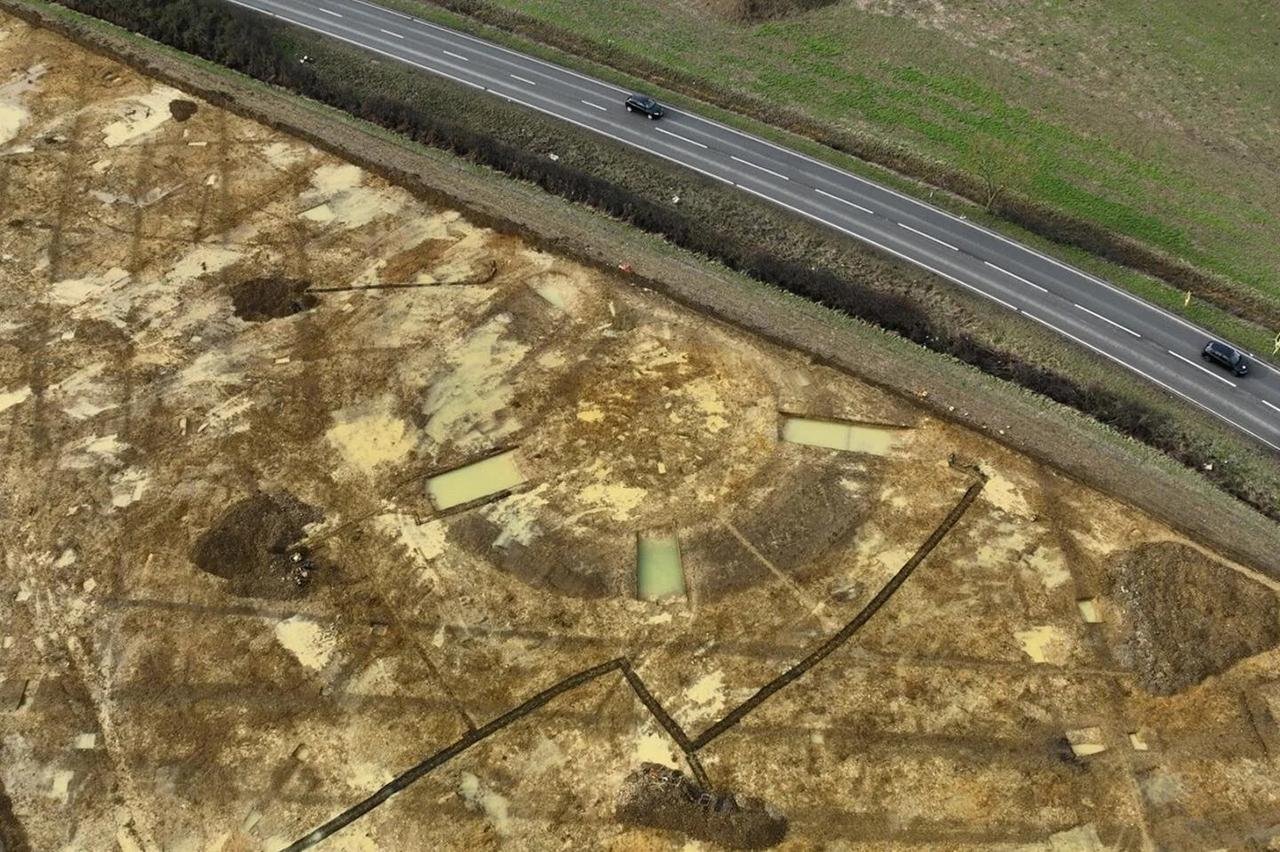
Archaeologists from the Museum of London Archaeology (MOLA) have unearthed a moated medieval windmill during the construction of the National Highways A428 Black Cat to Caxton Gibbet improvement scheme in Bedfordshire, England. The windmill dates from between 1066 to 1485 during the medieval period.
Archaeologists unearth moated medieval windmill in England
Aerial photo of the mill excavations. Credit: Museum of London Archaeology (MOLA)

The windmill, once a symbol of power for the local lord of the manor, served as a crucial center for grinding grain. This structure is positioned on high ground surrounded by farmland. Villagers farmed the surrounding land, paying rent to the lord and providing grain for milling.

The windmill itself was a marvel of engineering for its time. Featuring a large central post, it operated as a sunken type of Post Mill, a design prevalent in Europe from the 1100s to 1200s. The central post, partly buried within a supporting mound, allowed for the orientation of the sails towards the wind, enabling efficient grain milling.

Despite the absence of physical remnants above ground, traces of the mill’s structure were discernible upon excavation. Excavations revealed the presence of a moat, a common feature for such mills, which collected water from the naturally wet area. This feature likely served to protect the mill and its valuable operations.

Archaeologists unearth moated medieval windmill in England
A tired miller leaving their mill. courtesy of the British Library, Yates Thompson 13, f.176v/MOLA

The excavation yielded a plethora of artifacts, including pottery sherds, animal bones, iron nails, farming tools, and clay tobacco pipe stems. Notably, 17 pieces of millstones were discovered, including a distinctive ‘lava’ millstone imported from Germany, prized for its rough surface ideal for milling.


RelatedStories

Nondestructive DNA sampling uncovers 1,300 years of history preserved in ancient parchments

Nondestructive DNA sampling uncovers 1,300 years of history preserved in ancient parchments

May 22, 2026
800-year-old medieval notebook found in German latrine still contains readable Latin writing

800-year-old medieval notebook found in German latrine still contains readable Latin writing

May 16, 2026

According to the Museum of London Archaeology, “The miller poured heavy sacks of grain into the hopper, which fed the grain between the two millstones. The top stone, called the runner stone, was moved by gears attached to the central post of the windmill, turning as the sails spun round in the wind.” This intricate process highlights the skill and craftsmanship required of medieval millers.

As National Mills Weekend approaches, the unveiling of this medieval windmill provides a distinctive window into history.

More information: Museum of London Archaeology

Share:

Share on Facebook Share on X (Twitter) Share on LinkedIn Share on Pinterest Share on WhatsApp Share on Email

You May Also Like...

Nondestructive DNA sampling uncovers 1,300 years of history preserved in ancient parchments
Archaeology

Nondestructive DNA sampling uncovers 1,300 years of history preserved in ancient parchments

May 22, 2026
2,300-year-old Iron Age riverside structure discovered beneath German city astonishes archaeologists
Archaeology

2,300-year-old Iron Age riverside structure discovered beneath German city

May 22, 2026
100 Abbasid-era gold jewelry pieces found at ancient Dariyah site in Saudi Arabia
Archaeology

100 Abbasid-era gold jewelry pieces found at ancient Dariyah site in Saudi Arabia

May 22, 2026
Neanderthals gathered shellfish like modern humans 115,000 years ago, study finds
Anthropology

Neanderthals gathered shellfish like modern humans 115,000 years ago, study finds

May 21, 2026
Ancient pigeons were already living alongside humans 3,400 years ago, study finds
Archaeology

Ancient pigeons were already living alongside humans 3,400 years ago, study finds

May 21, 2026
Ancient Venetic sanctuary with rare inscriptions unearthed beneath road project in Italy
Archaeology

Ancient Venetic sanctuary with rare inscriptions unearthed beneath road project in Italy

May 21, 2026

Follow us


Instagram
242K

Facebook
117K

Threads
46K

LinkedIn
14K

Twitter
6K

YouTube
1K
Nondestructive DNA sampling uncovers 1,300 years of history preserved in ancient parchments

Nondestructive DNA sampling uncovers 1,300 years of history preserved in ancient parchments

May 22, 2026
2,300-year-old Iron Age riverside structure discovered beneath German city astonishes archaeologists

2,300-year-old Iron Age riverside structure discovered beneath German city

May 22, 2026
100 Abbasid-era gold jewelry pieces found at ancient Dariyah site in Saudi Arabia

100 Abbasid-era gold jewelry pieces found at ancient Dariyah site in Saudi Arabia

May 22, 2026
Neanderthals gathered shellfish like modern humans 115,000 years ago, study finds

Neanderthals gathered shellfish like modern humans 115,000 years ago, study finds

May 21, 2026

Archaeology News online magazine

Archaeology News is an international online magazine that covers all aspects of archaeology.


Categories

  • Academics
    • Books
    • Conferences
    • Universities
  • Articles
  • Download
  • Game
  • News
    • Anthropology
    • Archaeology
    • Paleontology
  • Quiz
  • Tours

Subscribe to our newsletter

© 2024 - Archaeology News Online Magazine. All Rights Reserved.

  • About
  • Privacy Policy
  • Terms of Use
  • Donation
  • Contact

Manage Consent
To provide the best experiences, we use technologies like cookies to store and/or access device information. Consenting to these technologies will allow us to process data such as browsing behavior or unique IDs on this site. Not consenting or withdrawing consent, may adversely affect certain features and functions.
Functional Always active
The technical storage or access is strictly necessary for the legitimate purpose of enabling the use of a specific service explicitly requested by the subscriber or user, or for the sole purpose of carrying out the transmission of a communication over an electronic communications network.
Preferences
The technical storage or access is necessary for the legitimate purpose of storing preferences that are not requested by the subscriber or user.
Statistics
The technical storage or access that is used exclusively for statistical purposes. The technical storage or access that is used exclusively for anonymous statistical purposes. Without a subpoena, voluntary compliance on the part of your Internet Service Provider, or additional records from a third party, information stored or retrieved for this purpose alone cannot usually be used to identify you.
Marketing
The technical storage or access is required to create user profiles to send advertising, or to track the user on a website or across several websites for similar marketing purposes.
  • Manage options
  • Manage services
  • Manage {vendor_count} vendors
  • Read more about these purposes
View preferences
  • {title}
  • {title}
  • {title}
  • Home
  • News
    • Archaeology
    • Anthropology
    • Paleontology
  • Academic
    • Books
    • Conferences
    • Universities
  • Articles
  • VR Tours
  • Quiz & Game
  • Download
  • Encyclopedia
  • Forum

About  .  Contact  .  Donation

© 2024 - Archaeology News Online Magazine. All Rights Reserved