• About
  • Privacy Policy
  • Terms of Use
  • Donation
  • Contact
No Result
View All Result
Archaeology News
  • Home
  • News
    • Archaeology
    • Anthropology
    • Paleontology
  • Academic
    • Books
    • Conferences
    • Universities
  • Articles
  • VR Tours
  • Quiz & Game
  • Download
  • Encyclopedia
  • Forum
Archaeology News
No Result
View All Result
Home News Archaeology

Researchers identify Japan’s oldest multiplication table in Nara, dating back 1,300 years

by Dario Radley
September 8, 2024

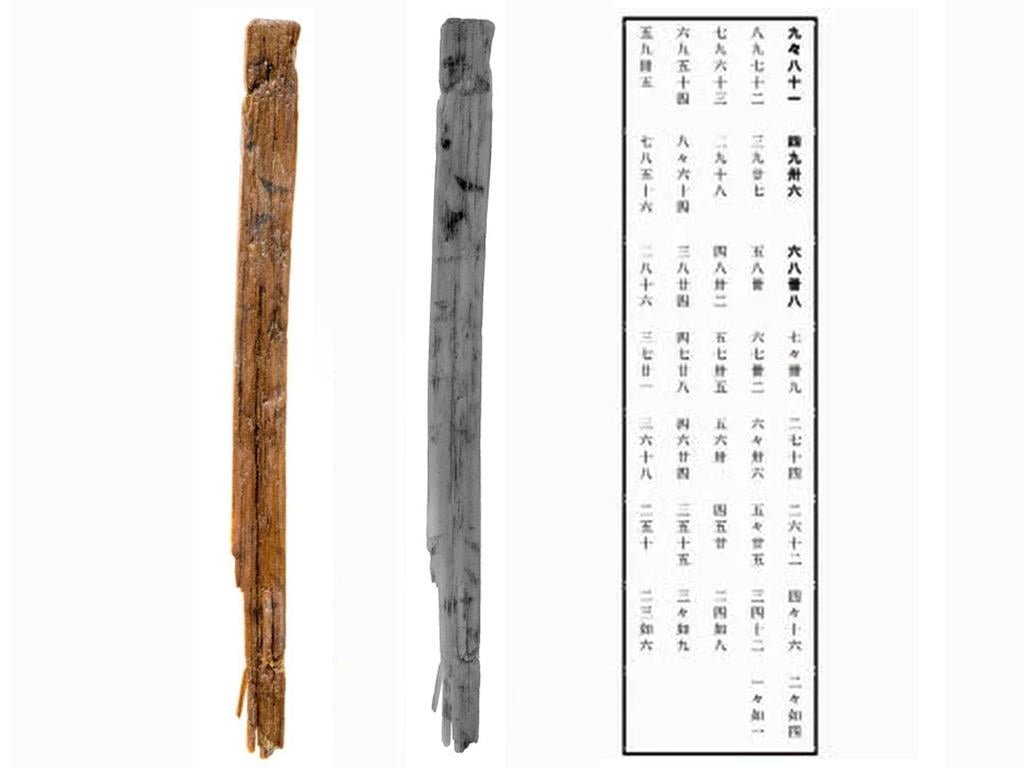
Researchers from Japan’s Nara National Research Institute for Cultural Properties have uncovered a 1,300-year-old wooden tablet that appears to be part of Japan’s oldest known multiplication table.
Researchers identify Japan's oldest multiplication table in Nara, dating back 1,300 years
Japan’s oldest multiplication table is discovered. Credit: Nara National Research Institute for Cultural Properties

Unearthed in 2001 at the site of Fujiwara-kyo, Japan’s ancient capital, the artifact was found in what is believed to have been the office of the “Emon-fu,” the guards’ bureau responsible for security and administrative duties within the central government. After extensive analysis, the research team confirmed its significance on September 4, 2024.

The fragment, measuring 16.2 centimeters long and 1.2 centimeters wide, was initially difficult to decipher due to the irregularity of the characters. The researchers initially thought it was a practice tablet. However, further investigation using infrared imaging revealed equations such as “9 x 9 = 81,” “4 x 9 = 36,” and “6 x 8 = 48” inscribed in kanji (Chinese characters), arranged in five rows from right to left. This organization mirrored the layout of Chinese multiplication tables from the Qin and Han dynasties, which existed between the 3rd century BCE and 3rd century CE.

“If the multiplication table were complete, the wooden tablet would measure 33 centimeters in length with all the equations written out,” said Kuniya Kuwata, senior researcher at the Nara National Research Institute for Cultural Properties. Kuwata, who led the study, was surprised by the tablet’s sophisticated layout. “I initially thought Japanese multiplication charts only had two to three equations per line, so I was genuinely surprised to find one with so many, similar to those in China and Korea.”
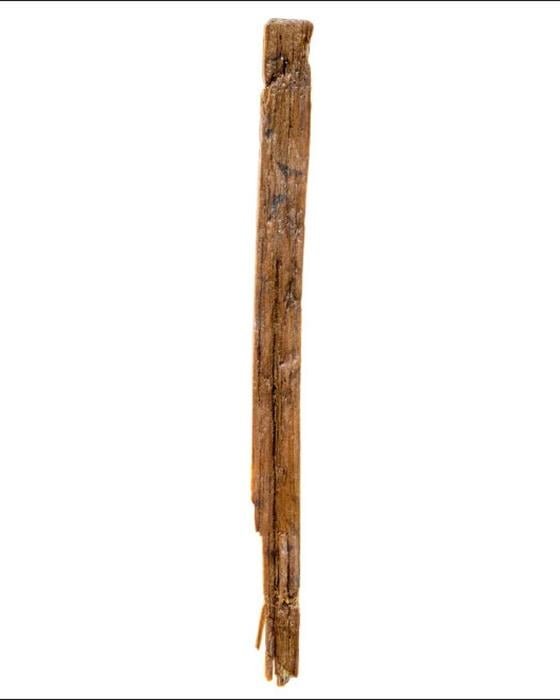
Researchers identify Japan's oldest multiplication table in Nara, dating back 1,300 years
Wood fragment of a multiplication table. Credit: Nara National Research Institute for Cultural Properties

While earlier multiplication tables found in Japan were much simpler, often featuring only two to three rows, this artifact’s five-row style represents a more advanced form of mathematical recording. Scholars believe the multiplication table was likely used by the Emon-fu for administrative purposes, such as calculating taxes or organizing the work schedules of government officials.

Fujiwara-kyo, where the tablet was found, was Japan’s first capital modeled after Chinese cities, as described in the Nihon Shoki chronicle. The city was established in 694 and served as the political and cultural hub of Japan until 710. The site of the discovery, the ruins of Fujiwara Palace, is located in present-day Kashihara in Nara Prefecture.

What makes this find even more remarkable is the possibility that the multiplication table might have been created during the Kofun Period, which spanned from the mid-third to the seventh century, long before Fujiwara-kyo became the capital. The researchers have speculated that such tables could have been employed in the design of the era’s massive burial mounds, further emphasizing the practical application of mathematics in ancient Japan.

The team’s findings were published in the 2024 Annual Bulletin of the Nara National Research Institute for Cultural Properties, contributing a pivotal piece to the puzzle of early Japanese mathematics and administration.

Share:

Share on Facebook Share on X (Twitter) Share on LinkedIn Share on Pinterest Share on WhatsApp Share on Email

Related Posts

Buried church bell found in Poland after decades hidden beneath roadside
Archaeology

Buried church bell found in Poland after decades hidden beneath roadside

May 31, 2026
Stone Age humans built complex grass beds at Border Cave 200,000 years ago, study finds
Archaeology

Stone Age humans built complex grass beds at Border Cave 200,000 years ago, study finds

May 30, 2026
Radiocarbon dating confirms Teutonic Knights built Feldioara Fortress in 13th-century Transylvania
Archaeology

Radiocarbon dating confirms Teutonic Knights built Feldioara Fortress in 13th-century Transylvania

May 30, 2026
Ancient shipwreck with 300 amphorae found off Italy could reshape views of Mediterranean wine trade
Archaeology

Ancient shipwreck with 300 amphorae found off Italy could reshape views of Mediterranean wine trade

May 29, 2026
Ancient DNA reveals 700-kilometer migration along Peru’s coast before the Inca Empire
Anthropology

Ancient DNA reveals 700-kilometer migration along Peru’s coast before the Inca Empire

May 29, 2026
6,000-year-old mega-structure unearthed at prehistoric settlement in Romania
Archaeology

6,000-year-old mega-structure unearthed at prehistoric settlement in Romania

May 29, 2026

Follow us


Instagram
242K

Facebook
117K

Threads
47K

LinkedIn
15K

Twitter
6K

YouTube
1K

Archaeology News online magazine

Archaeology News is an international online magazine that covers all aspects of archaeology.


Categories

  • Academics
    • Books
    • Conferences
    • Universities
  • Articles
  • Download
  • Game
  • News
    • Anthropology
    • Archaeology
    • Paleontology
  • Quiz
  • Tours

Subscribe to our newsletter

© 2024 - Archaeology News Online Magazine. All Rights Reserved.

  • About
  • Privacy Policy
  • Terms of Use
  • Donation
  • Contact

Manage Consent
To provide the best experiences, we use technologies like cookies to store and/or access device information. Consenting to these technologies will allow us to process data such as browsing behavior or unique IDs on this site. Not consenting or withdrawing consent, may adversely affect certain features and functions.
Functional Always active
The technical storage or access is strictly necessary for the legitimate purpose of enabling the use of a specific service explicitly requested by the subscriber or user, or for the sole purpose of carrying out the transmission of a communication over an electronic communications network.
Preferences
The technical storage or access is necessary for the legitimate purpose of storing preferences that are not requested by the subscriber or user.
Statistics
The technical storage or access that is used exclusively for statistical purposes. The technical storage or access that is used exclusively for anonymous statistical purposes. Without a subpoena, voluntary compliance on the part of your Internet Service Provider, or additional records from a third party, information stored or retrieved for this purpose alone cannot usually be used to identify you.
Marketing
The technical storage or access is required to create user profiles to send advertising, or to track the user on a website or across several websites for similar marketing purposes.
  • Manage options
  • Manage services
  • Manage {vendor_count} vendors
  • Read more about these purposes
View preferences
  • {title}
  • {title}
  • {title}
  • Home
  • News
    • Archaeology
    • Anthropology
    • Paleontology
  • Academic
    • Books
    • Conferences
    • Universities
  • Articles
  • VR Tours
  • Quiz & Game
  • Download
  • Encyclopedia
  • Forum

About  .  Contact  .  Donation

© 2024 - Archaeology News Online Magazine. All Rights Reserved