• About
  • Privacy Policy
  • Terms of Use
  • Donation
  • Contact
No Result
View All Result
Archaeology News
  • Home
  • News
    • Archaeology
    • Anthropology
    • Paleontology
  • Academic
    • Books
    • Conferences
    • Universities
  • Articles
  • VR Tours
  • Quiz & Game
  • Download
  • Encyclopedia
  • Forum
Archaeology News
No Result
View All Result
Home News Archaeology

Ancient Roman basilica from 80 CE discovered beneath London office block

by Dario Radley
February 14, 2025

Beneath a London office block lies a remarkable discovery that has revealed the foundations of the city’s first Roman basilica—one of the most substantial archaeological finds in recent years. Situated at 85 Gracechurch Street, the remains of this 2,000-year-old structure have deepened knowledge of the founding and development of Londinium, a Roman settlement that preceded modern London.
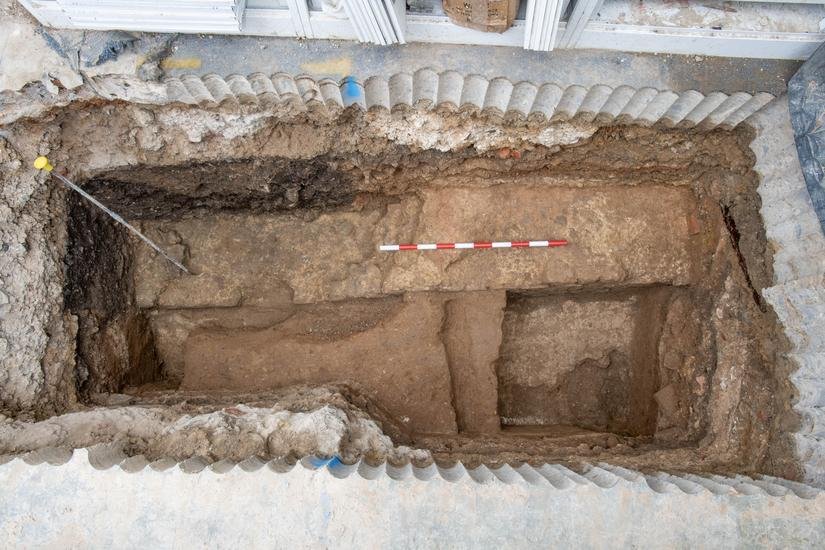
Ancient Roman basilica from 80 CE discovered beneath London office block
Archaeologists found foundations and walls under the basement of a building in London. Credit: Museum of London Archaeology (MOLA)

A team of archaeologists from the Museum of London Archaeology (MOLA) unearthed substantial remnants of the basilica’s foundations built from flint, ragstone, and Roman tiles. The basilica was about 40m long and 20m wide, two-and-a-half stories tall, and was the administrative, economic, and political center of Roman Britain.

According to Sophie Jackson, the Director of Development at MOLA, “This is one of the most significant discoveries made in the City in recent years. It’s like discovering the Speaker’s Chair and chamber of the House of Commons, 2,000 years into the future. The level of preservation of the Basilica has far exceeded our expectations, and we have possibly the most important part of the building. We look forward to discovering more about these remains.”

The basilica was part of Londinium’s forum, a magnificent complex that served as the city’s epicenter of social, commercial, and legal activity. Constructed initially circa 80 CE, when Agricola was governor (78-84 CE), this building was a symbol of Roman authority, with an open courtyard providing the necessary meeting space for merchants, officials, and citizens to trade, conduct judicial proceedings, or deliver civic proclamations. The tribunal (a raised platform within the basilica) was likely where magistrates and officials made crucial decisions that shaped Roman London.
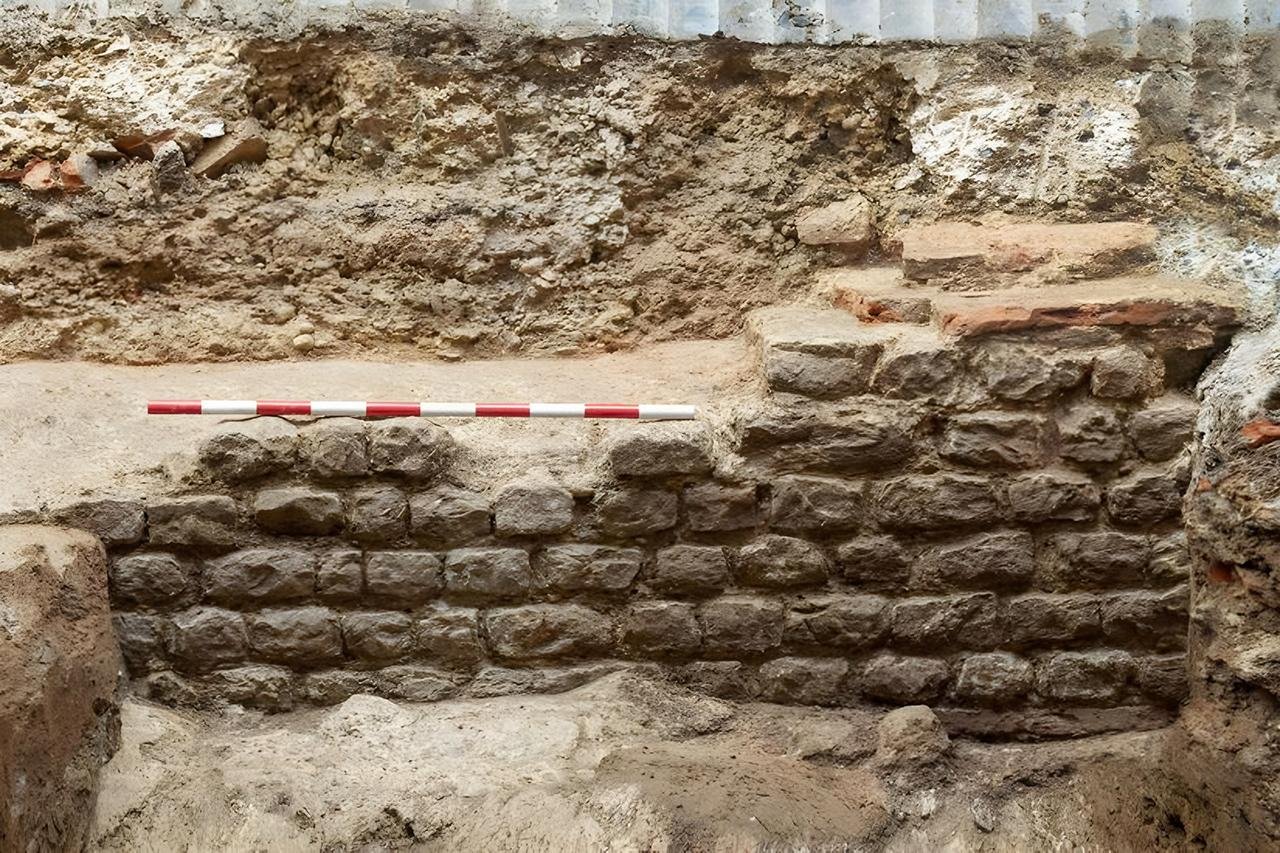
Ancient Roman basilica from 80 CE discovered beneath London office block
2,000-year-old Roman walls unearthed in London. Credit: Museum of London Archaeology

However, this forum and basilica were in use for only about 20 years before being replaced by a much larger structure. By the second century CE, Londinium had become one of the largest cities in Roman Britain, surpassing Camulodunum (modern Colchester) as the provincial capital, with an estimated population of 45,000-60,000.

The discovery has prompted a major change in redevelopment plans for the site’s owners, Hertshten Properties. Plans are underway for all the remains to be excavated and incorporated into the new office development. Meanwhile, the architects at Woods Bagot, in conjunction with the contractors and the archaeologists, have redesigned the project to include a public exhibition and an events space in the basement level, allowing public access to the ancient structure.

Ancient Roman basilica from 80 CE discovered beneath London office block
Reconstruction drawing of Londinium in 120 CE, Museum of London. Credit: Carole Raddato, CC BY-SA 2.0

These discoveries are part of a broader mosaic of discoveries from London’s Roman past. Other finds include portions of a Roman amphitheater on display beneath the Guildhall Art Gallery and the Temple of Mithras, currently an immersive exhibition in Bloomberg’s London offices.

More information: Museum of London Archaeology
Share:

Share on Facebook Share on X (Twitter) Share on LinkedIn Share on Pinterest Share on WhatsApp Share on Email

Related Posts

Buried church bell found in Poland after decades hidden beneath roadside
Archaeology

Buried church bell found in Poland after decades hidden beneath roadside

May 31, 2026
Stone Age humans built complex grass beds at Border Cave 200,000 years ago, study finds
Archaeology

Stone Age humans built complex grass beds at Border Cave 200,000 years ago, study finds

May 30, 2026
Radiocarbon dating confirms Teutonic Knights built Feldioara Fortress in 13th-century Transylvania
Archaeology

Radiocarbon dating confirms Teutonic Knights built Feldioara Fortress in 13th-century Transylvania

May 30, 2026
Ancient shipwreck with 300 amphorae found off Italy could reshape views of Mediterranean wine trade
Archaeology

Ancient shipwreck with 300 amphorae found off Italy could reshape views of Mediterranean wine trade

May 29, 2026
Ancient DNA reveals 700-kilometer migration along Peru’s coast before the Inca Empire
Anthropology

Ancient DNA reveals 700-kilometer migration along Peru’s coast before the Inca Empire

May 29, 2026
6,000-year-old mega-structure unearthed at prehistoric settlement in Romania
Archaeology

6,000-year-old mega-structure unearthed at prehistoric settlement in Romania

May 29, 2026

Follow us


Instagram
242K

Facebook
117K

Threads
47K

LinkedIn
15K

Twitter
6K

YouTube
1K

Archaeology News online magazine

Archaeology News is an international online magazine that covers all aspects of archaeology.


Categories

  • Academics
    • Books
    • Conferences
    • Universities
  • Articles
  • Download
  • Game
  • News
    • Anthropology
    • Archaeology
    • Paleontology
  • Quiz
  • Tours

Subscribe to our newsletter

© 2024 - Archaeology News Online Magazine. All Rights Reserved.

  • About
  • Privacy Policy
  • Terms of Use
  • Donation
  • Contact

Manage Consent
To provide the best experiences, we use technologies like cookies to store and/or access device information. Consenting to these technologies will allow us to process data such as browsing behavior or unique IDs on this site. Not consenting or withdrawing consent, may adversely affect certain features and functions.
Functional Always active
The technical storage or access is strictly necessary for the legitimate purpose of enabling the use of a specific service explicitly requested by the subscriber or user, or for the sole purpose of carrying out the transmission of a communication over an electronic communications network.
Preferences
The technical storage or access is necessary for the legitimate purpose of storing preferences that are not requested by the subscriber or user.
Statistics
The technical storage or access that is used exclusively for statistical purposes. The technical storage or access that is used exclusively for anonymous statistical purposes. Without a subpoena, voluntary compliance on the part of your Internet Service Provider, or additional records from a third party, information stored or retrieved for this purpose alone cannot usually be used to identify you.
Marketing
The technical storage or access is required to create user profiles to send advertising, or to track the user on a website or across several websites for similar marketing purposes.
  • Manage options
  • Manage services
  • Manage {vendor_count} vendors
  • Read more about these purposes
View preferences
  • {title}
  • {title}
  • {title}
  • Home
  • News
    • Archaeology
    • Anthropology
    • Paleontology
  • Academic
    • Books
    • Conferences
    • Universities
  • Articles
  • VR Tours
  • Quiz & Game
  • Download
  • Encyclopedia
  • Forum

About  .  Contact  .  Donation

© 2024 - Archaeology News Online Magazine. All Rights Reserved