• About
  • Privacy Policy
  • Terms of Use
  • Donation
  • Contact
No Result
View All Result
Archaeology News
  • Home
  • News
    • Archaeology
    • Anthropology
    • Paleontology
  • Academic
    • Books
    • Conferences
    • Universities
  • Articles
  • VR Tours
  • Quiz & Game
  • Download
  • Encyclopedia
  • Forum
Archaeology News
No Result
View All Result
Home News Archaeology

Rare Roman and British coin hoard discovered in Netherlands

by Dario Radley
February 3, 2025

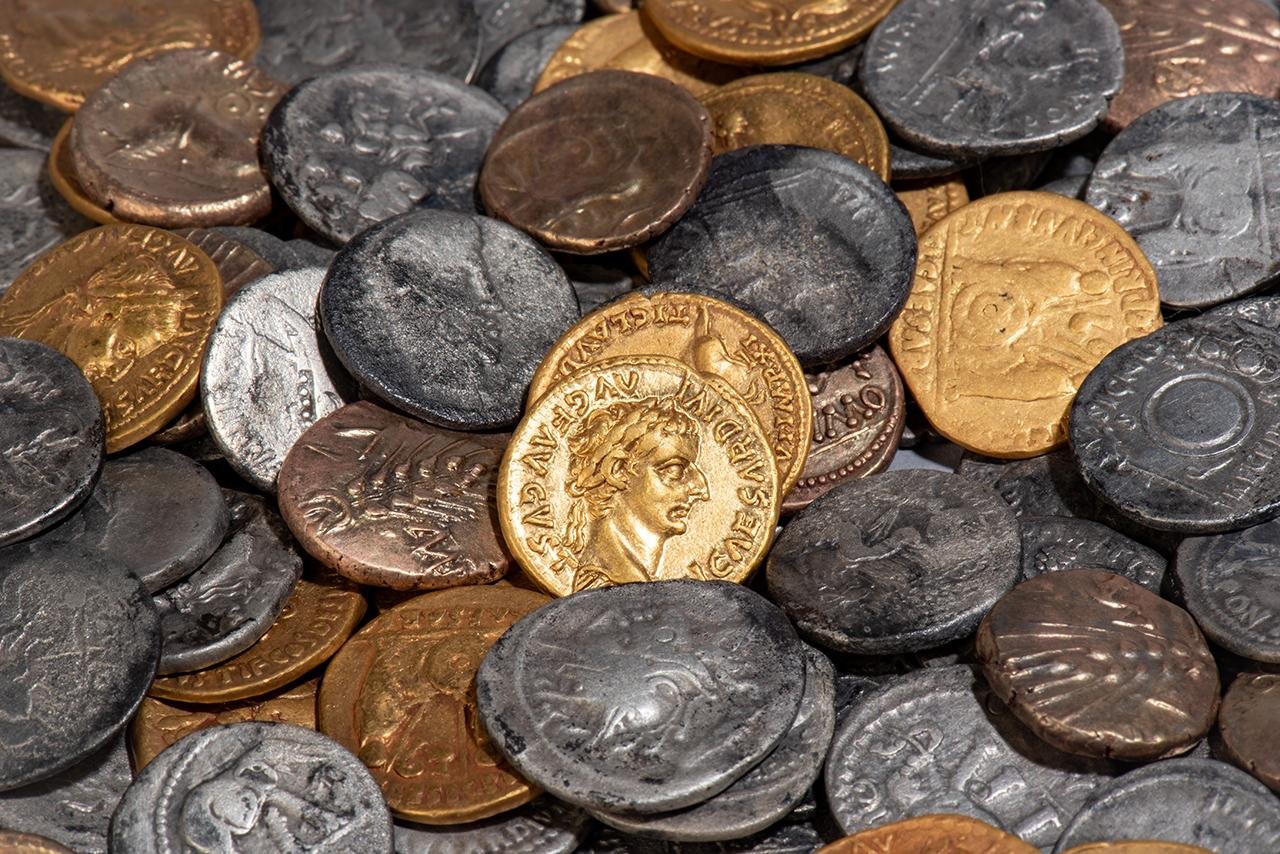
In the autumn of 2023, two metal detectorists, Gert-Jan Messelaar and Reinier Koelink, unearthed an outstanding hoard of 404 Roman and British gold and silver coins in the Dutch municipality of Bunnik. It is one of the largest hoards of Roman antiquity ever discovered in the province of Utrecht and the first to contain both Roman and British currency on mainland Europe.
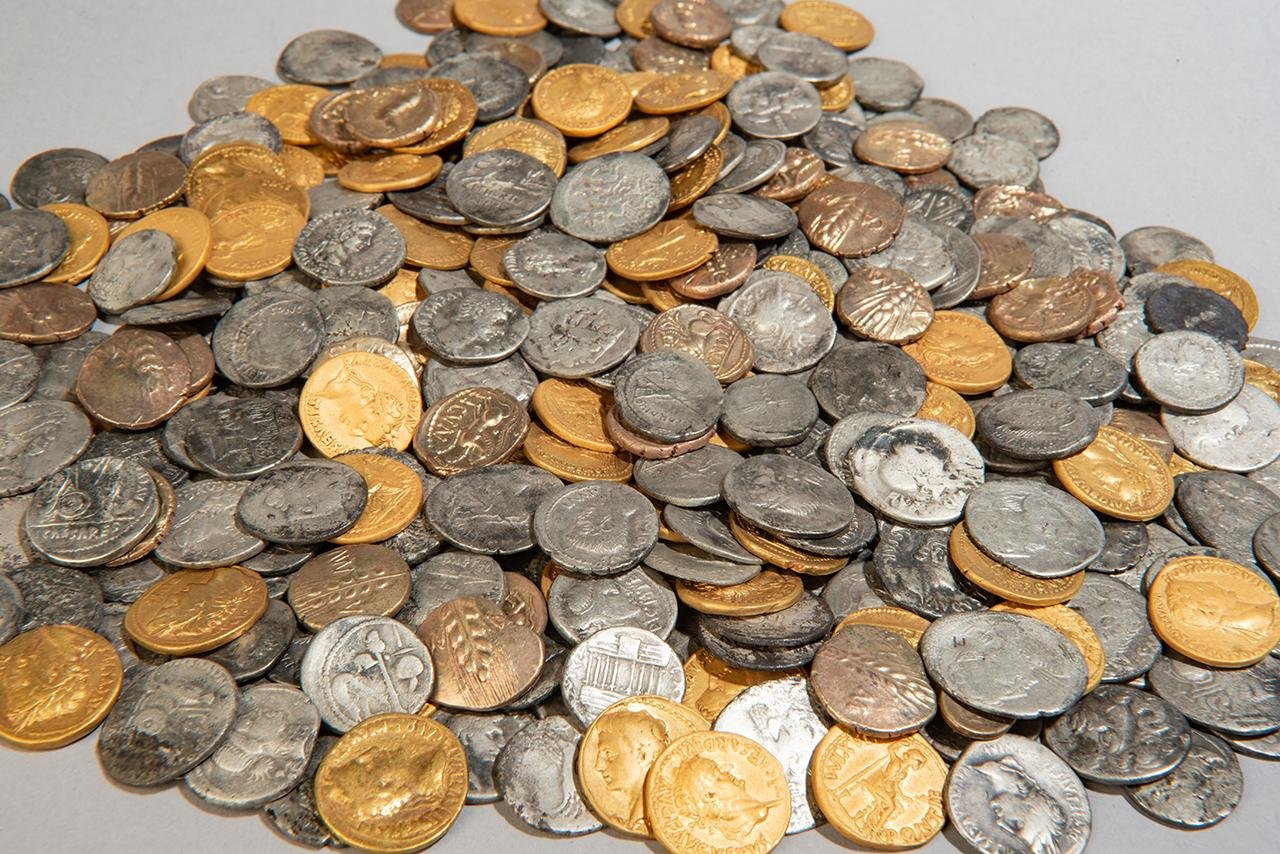
Rare Roman and British coin hoard discovered in Netherlands
The hoard of mixed Roman and British coins. Credit: National Museum of Antiquities (RMO)

The discovery was reported to the Archaeology Reporting Center of Landschap Erfgoed Utrecht, leading to the Cultural Heritage Agency of the Netherlands (RCE) to launch a full-scale investigation. The coins were confirmed to have been buried around 47 CE shortly after the Roman conquest of Britain. The hoard comprises 288 silver denarii dated between 200 BCE and 47 CE; 72 Roman gold aurei from 19 BCE to 47 CE; and 44 British gold staters struck between 5 and 43 CE. In Latin, the staters are inscribed “CVNO[BELINVS],” which refers to Cunobelinus, an important ruler in pre-Roman Britain. Some of the staters were probably issued by his successors, Togodumnus and Caratacus, after his death.

With the presence of these coins, strong speculation has arisen that they are related to the Roman invasion of Britain under Emperor Claudius. The British coins probably came into circulation as spoils of war, while the Roman currency was likely used as military pay.

Noteworthy is the hoard’s two Roman aurei struck in 47 CE. These are in pristine condition, and as they show no signs of circulation, they were probably part of a batch of newly minted coins. This adds credence to the idea that the hoard belonged to a Roman soldier returning from Britain.
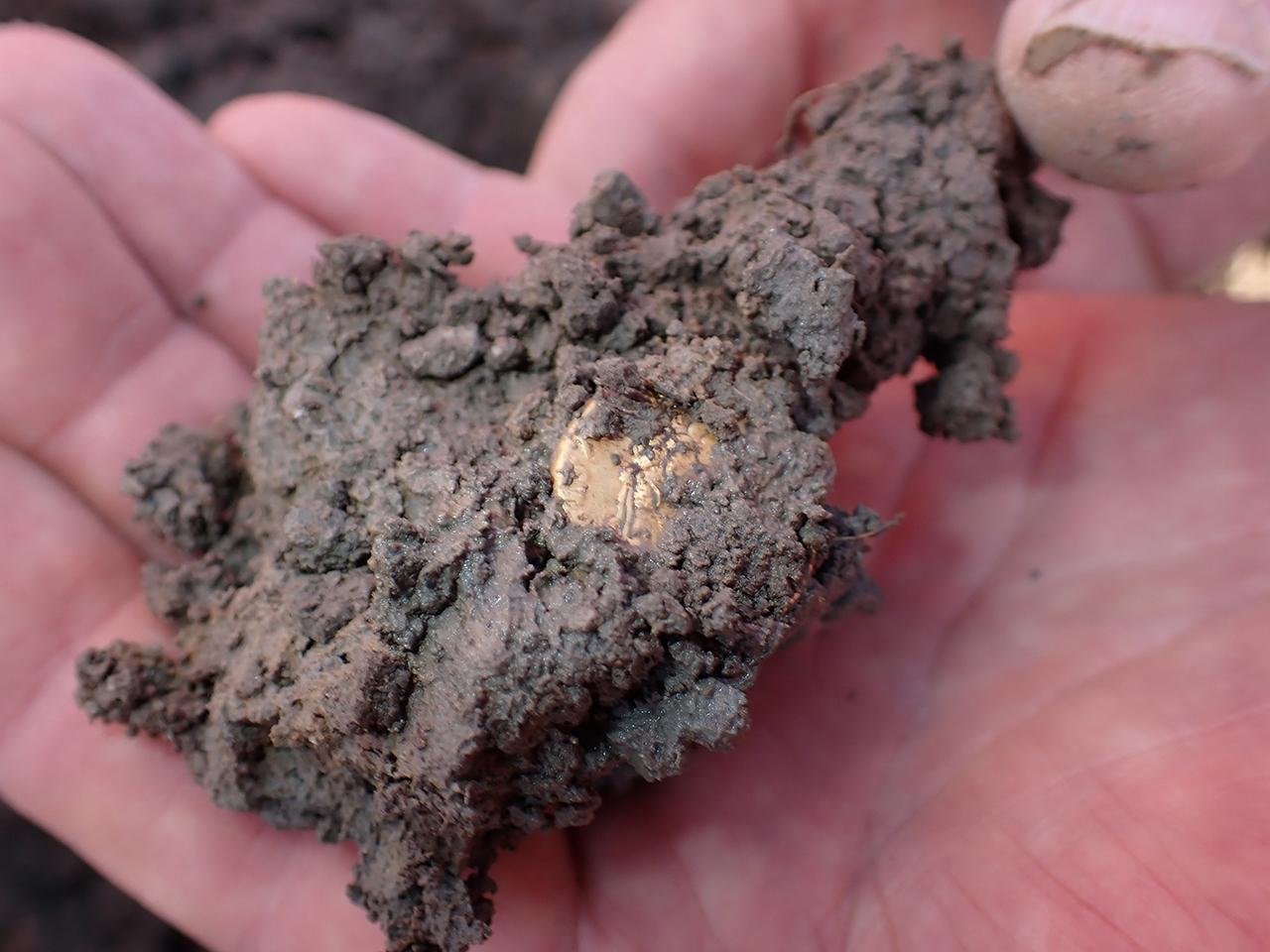
Rare Roman and British coin hoard discovered in Netherlands
The discovery of a Roman gold coin ( aureus ). Credit: Rijksdienst voor het Cultureel Erfgoed

Since such large quantities of gold were found, the suggestion has arisen that the owner was possibly a centurion or a high-ranking officer, not an ordinary soldier. A centurion’s salary at the time was around 3,375 denarii per year, which makes this collection a considerable sum.


RelatedStories

Ancient settlement with weaving workshop and longhouses uncovered in Germany gravel pit

Ancient settlement with weaving workshop and longhouses uncovered in Germany gravel pit

May 17, 2026
Pompeii victim identified as Roman physician killed while fleeing Vesuvius eruption

Pompeii victim identified as Roman physician killed while fleeing Vesuvius eruption

May 17, 2026

Bunnik, located along the Lower Germanic Limes—the northern border of the Roman Empire—was indeed an important strategic location within the first century. Though it lacked major settlements like Fort Trajectum (Utrecht) or Ulpia Noviomagus (Nijmegen), a Roman watchtower once stood in the vicinity. The context of the hoard’s burial indicates that it was located in an originally wetland area where construction or agriculture would not have been feasible; hence, the coins may have been buried purposely for safekeeping or in gratitude to the gods for a safe return from battle.
Rare Roman and British coin hoard discovered in Netherlands
Part of the Roman coin find in Bunnik. Credit: National Museum of Antiquities (RMO)

The coins were examined by archaeologist Anton Cruysheer before they were recorded in the Portable Antiquities of the Netherlands (PAN) database. They were subsequently cleaned by specialists at the Restoration Workshop Restaura in Heerlen. Out of the 404 coins discovered, 381 were acquired by the National Museum of Antiquities in Leiden and are now on display as part of the exhibit “The Netherlands in Roman Times.”

More information: RMO
ShareTweetShareShareSend

You May Also Like...

World War II mass grave in Poland reveals remains of German officer killed during Battle of Lauban
Anthropology

World War II mass grave in Poland reveals remains of German officer killed during Battle of Lauban

May 19, 2026
massive jar in Laos contained remains of 37 people, revealing ancient burial rituals and Asian trade links
Anthropology

Massive jar in Laos contained remains of 37 people, revealing ancient burial rituals and Asian trade links

May 19, 2026
6,000-year-old necropolis in Spain rewrites origins of Europe’s first megalithic tombs
Archaeology

6,000-year-old necropolis in Spain rewrites origins of Europe’s first megalithic tombs

May 18, 2026
Ancient settlement with weaving workshop and longhouses uncovered in Germany gravel pit
Archaeology

Ancient settlement with weaving workshop and longhouses uncovered in Germany gravel pit

May 17, 2026
Pompeii victim identified as Roman physician killed while fleeing Vesuvius eruption
Anthropology

Pompeii victim identified as Roman physician killed while fleeing Vesuvius eruption

May 17, 2026
Archaeologists uncover hidden whisky smuggler bothy in Scottish Highlands with rare copper still piece
Archaeology

Archaeologists uncover hidden whisky smuggler bothy in Scottish Highlands with rare copper still piece

May 16, 2026

Follow us


Instagram
242K

Facebook
117K

Threads
46K

LinkedIn
14K

Twitter
6K

YouTube
1K
World War II mass grave in Poland reveals remains of German officer killed during Battle of Lauban

World War II mass grave in Poland reveals remains of German officer killed during Battle of Lauban

May 19, 2026
massive jar in Laos contained remains of 37 people, revealing ancient burial rituals and Asian trade links

Massive jar in Laos contained remains of 37 people, revealing ancient burial rituals and Asian trade links

May 19, 2026
6,000-year-old necropolis in Spain rewrites origins of Europe’s first megalithic tombs

6,000-year-old necropolis in Spain rewrites origins of Europe’s first megalithic tombs

May 18, 2026
Ancient settlement with weaving workshop and longhouses uncovered in Germany gravel pit

Ancient settlement with weaving workshop and longhouses uncovered in Germany gravel pit

May 17, 2026

Archaeology News online magazine

Archaeology News is an international online magazine that covers all aspects of archaeology.


Categories

  • Academics
    • Books
    • Conferences
    • Universities
  • Articles
  • Download
  • Game
  • News
    • Anthropology
    • Archaeology
    • Paleontology
  • Quiz
  • Tours

Subscribe to our newsletter

© 2024 - Archaeology News Online Magazine. All Rights Reserved.

  • About
  • Privacy Policy
  • Terms of Use
  • Donation
  • Contact

Manage Consent
To provide the best experiences, we use technologies like cookies to store and/or access device information. Consenting to these technologies will allow us to process data such as browsing behavior or unique IDs on this site. Not consenting or withdrawing consent, may adversely affect certain features and functions.
Functional Always active
The technical storage or access is strictly necessary for the legitimate purpose of enabling the use of a specific service explicitly requested by the subscriber or user, or for the sole purpose of carrying out the transmission of a communication over an electronic communications network.
Preferences
The technical storage or access is necessary for the legitimate purpose of storing preferences that are not requested by the subscriber or user.
Statistics
The technical storage or access that is used exclusively for statistical purposes. The technical storage or access that is used exclusively for anonymous statistical purposes. Without a subpoena, voluntary compliance on the part of your Internet Service Provider, or additional records from a third party, information stored or retrieved for this purpose alone cannot usually be used to identify you.
Marketing
The technical storage or access is required to create user profiles to send advertising, or to track the user on a website or across several websites for similar marketing purposes.
  • Manage options
  • Manage services
  • Manage {vendor_count} vendors
  • Read more about these purposes
View preferences
  • {title}
  • {title}
  • {title}
  • Home
  • News
    • Archaeology
    • Anthropology
    • Paleontology
  • Academic
    • Books
    • Conferences
    • Universities
  • Articles
  • VR Tours
  • Quiz & Game
  • Download
  • Encyclopedia
  • Forum

About  .  Contact  .  Donation

© 2024 - Archaeology News Online Magazine. All Rights Reserved