• About
  • Privacy Policy
  • Terms of Use
  • Donation
  • Contact
No Result
View All Result
Archaeology News
  • Home
  • News
    • Archaeology
    • Anthropology
    • Paleontology
  • Academic
    • Books
    • Conferences
    • Universities
  • Articles
  • VR Tours
  • Quiz & Game
  • Download
  • Encyclopedia
  • Forum
Archaeology News
No Result
View All Result
Home News Anthropology

1,500-year-old female ascetic buried in chains discovered near Jerusalem

by Dario Radley
March 3, 2025

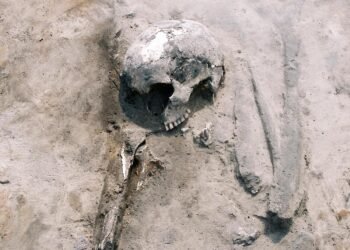
Archaeologists in Israel have made revolutionary discoveries that question previous long-held assumptions about religious asceticism in the Byzantine period. Recently, excavations at the Khirbat el-Masani monastery, northwest of Jerusalem, revealed the remains of an individual wrapped in heavy metal chains. Generally, this was a theme associated with male ascetics, but scientific analyses revealed a surprising truth: the remains belonged to a woman.

1,500-year-old female ascetic buried in chains discovered near Jerusalem
The Byzantine individual buried in chains near Jerusalem was actually a woman. Credit: Matan Chocron, Israel Antiquities Authority

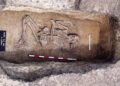
The excavation by the Israel Antiquities Authority and researchers from the Weizmann Institute of Science uncovered a number of burial crypts dating between the 4th and 7th centuries CE. Among these, one burial stood out. Though the skeleton was poorly preserved, extreme asceticism was signaled by the presence of chains—an intense religious practice in which devotees renounced worldly comforts to achieve spiritual purity. Traditionally, such self-imposed suffering, including bodily restraints and self-mortification, has been associated with male monks.

The poor condition of the bones proved inadequate for conventional osteological approaches to determining the sex of the skeleton, which forced the researchers to use an innovative technique known as dental enamel proteomics. Upon examining peptides within the enamel of a single tooth, they identified the presence of AMELX, a protein encoded on the X chromosome, and the absence of AMELY, which is present only in males. This conclusively indicated that the individual was female.

The significance of this discovery is highlighted in a study published in the Journal of Archaeological Science: Reports. According to the researchers, the evidence of a female ascetic practicing such extreme bodily penance is unprecedented in the archaeological record.

1,500-year-old female ascetic buried in chains discovered near Jerusalem
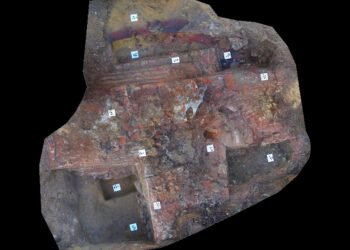
El-Masani church with the tomb (T3) indicated with an arrow. Credit: Matan Chocron, Israel Antiquities Authority

Asceticism became an important phenomenon in early Christianity, especially following the year 380 CE when Christianity became the dominant faith of the Roman Empire. Monasticism flourished, and practitioners sought ways to discipline the body to strengthen the soul. While some monks lived atop pillars for years, others wore chains or engaged in prolonged fasting and isolation.

RelatedStories

Christians and Zoroastrians lived side by side in 5th-century Iraq, archaeologists find

Christians and Zoroastrians coexisted peacefully in 5th-century Iraq, archaeologists find

December 19, 2025
Denmark’s early brickwork came via Germany, not directly from Italy, new study finds

Denmark’s early brickwork came via Germany, not directly from Italy, new study finds

November 20, 2025

Although historical sources confirm the existence of female ascetics, including Melania the Younger, a noblewoman who lived in seclusion for prayer and fasting, there had, until this discovery, been no similar material evidence to suggest women participated in the most extreme forms of bodily self-mortification. This discovery thus fundamentally changes the perception of women’s role in this ascetic community and raises questions about the extent of their participation in rigorous monastic traditions.

The Khirbat el-Masani monastery was built along a pilgrimage route to Jerusalem, which became a major religious center during the Byzantine period. Not only did this monastery serve as a place of worship and learning, but it also acted as a residence for pilgrims who came from afar to the Holy City. The presence of a female ascetic here may suggest that women actively and rigorously participated in monastic life.

Archaeologists believe this discovery challenges previously held beliefs about gender roles in early Christian monasticism. While asceticism among women was known, the identification of a female practitioner of extreme bodily mortification shifts the narrative.

The researchers plan to investigate other Byzantine monastic sites to determine whether more such cases exist.


More information: Kotli, P., Morgenstern, D., Nagar, Y., Katina, C., ’Adawi, Z., Arbiv, K., & Boaretto, E. (2025). Sexing remains of a Byzantine ascetic burial using enamel proteomics. Journal of Archaeological Science, Reports, 62(104972), 104972. doi:10.1016/j.jasrep.2025.104972
Share10Tweet6Share2ShareSend

You May Also Like...

60,000-year-old poison arrows from South Africa reveal the world’s earliest poisoned weapons and advanced hunting techniques
Archaeology

60,000-year-old poison arrows from South Africa reveal the world’s earliest poisoned weapons and advanced hunting techniques

January 8, 2026
Inscribed clay cylinders reveal Nebuchadnezzar II’s restoration of the Kish Ziggurat
Archaeology

Inscribed clay cylinders reveal Nebuchadnezzar II’s restoration of the Kish Ziggurat

January 7, 2026
Rare Late Roman mosaic with Solomon’s Knot discovered beneath modern İzmir
Archaeology

Rare Late Roman mosaic with Solomon’s Knot discovered beneath modern İzmir

January 7, 2026
1130 depiction of Saxons, Jutes, and Angles crossing the sea to Britain. Credit: Wikimedia / CC BY-SA 4.0. Roots of medieval migration into England uncovered by large-scale bioarchaeological study
Anthropology

Roots of medieval migration into England uncovered by large-scale bioarchaeological study

January 6, 2026
Rare Celtic gold coins found in Swiss bog may reveal ancient ritual offerings
Archaeology

Rare Celtic gold coins found in Swiss bog may reveal ancient ritual offerings

January 5, 2026
Rare medieval gold ring unearthed in Tønsberg
Archaeology

Rare medieval gold ring unearthed in Tønsberg reveals beliefs and craftsmanship of its time

January 5, 2026

Follow us


Instagram
244K

Facebook
118K

Threads
45K

LinkedIn
14K

Twitter
6K

YouTube
1K
  • Trending
  • Comments
  • Latest
Shipwreck Salvage. Credit: rawpixel.com / Public Domain

2,000-year-old shipwreck discovered off Turkish coast with remarkably preserved stacked ceramics

July 2, 2025
Viking age DNA reveals 9,000-year-old HIV-resistant gene originating near the Black Sea

Viking age DNA reveals 9,000-year-old HIV-resistant gene originating near the Black Sea

May 18, 2025
A new study suggests the mysterious Voynich Manuscript may be a medieval cipher

A new study suggests the mysterious Voynich Manuscript may be a medieval cipher

January 3, 2026
Moses may be named in ancient Egyptian mine inscriptions, sparking debate over earliest biblical references

Moses may be named in ancient Egyptian mine inscriptions, sparking debate over earliest biblical references

July 31, 2025
Mystery of Armenia’s 6,000-year-old dragon stones solved

Mystery of Armenia’s 6,000-year-old dragon stones solved

September 23, 2025
3D analysis reveals Shroud of Turin image likely came from sculpture, not Jesus’ body

3D analysis reveals Shroud of Turin image likely came from sculpture, not Jesus’ body

Moses may be named in ancient Egyptian mine inscriptions, sparking debate over earliest biblical references

Moses may be named in ancient Egyptian mine inscriptions, sparking debate over earliest biblical references

$1 million prize offered to decipher 5,300-year-old Indus Valley script

$1 million prize offered to decipher 5,300-year-old Indus Valley script

Oldest ever genetic data from a human relative found in 2-million-year-old fossilized teeth

Oldest ever genetic data from a human relative found in 2-million-year-old fossilized teeth

Exceptionally large Roman shoes discovered at Magna fort near Hadrian’s Wall

Exceptionally large Roman shoes discovered at Magna fort near Hadrian’s Wall

60,000-year-old poison arrows from South Africa reveal the world’s earliest poisoned weapons and advanced hunting techniques

60,000-year-old poison arrows from South Africa reveal the world’s earliest poisoned weapons and advanced hunting techniques

January 8, 2026
Inscribed clay cylinders reveal Nebuchadnezzar II’s restoration of the Kish Ziggurat

Inscribed clay cylinders reveal Nebuchadnezzar II’s restoration of the Kish Ziggurat

January 7, 2026
Rare Late Roman mosaic with Solomon’s Knot discovered beneath modern İzmir

Rare Late Roman mosaic with Solomon’s Knot discovered beneath modern İzmir

January 7, 2026
1130 depiction of Saxons, Jutes, and Angles crossing the sea to Britain. Credit: Wikimedia / CC BY-SA 4.0. Roots of medieval migration into England uncovered by large-scale bioarchaeological study

Roots of medieval migration into England uncovered by large-scale bioarchaeological study

January 6, 2026
Rare Celtic gold coins found in Swiss bog may reveal ancient ritual offerings

Rare Celtic gold coins found in Swiss bog may reveal ancient ritual offerings

January 5, 2026

Archaeology News online magazine

Archaeology News is an international online magazine that covers all aspects of archaeology.


Categories

  • Academics
    • Books
    • Conferences
    • Universities
  • Articles
  • Download
  • Game
  • News
    • Anthropology
    • Archaeology
    • Paleontology
  • Quiz
  • Tours

Subscribe to our newsletter

© 2024 - Archaeology News Online Magazine. All Rights Reserved.

  • About
  • Privacy Policy
  • Terms of Use
  • Donation
  • Contact

Welcome Back!

Login to your account below

Forgotten Password? Sign Up

Create New Account!

Fill the forms below to register

All fields are required. Log In

Retrieve your password

Please enter your username or email address to reset your password.

Log In

Add New Playlist

Manage Consent
To provide the best experiences, we use technologies like cookies to store and/or access device information. Consenting to these technologies will allow us to process data such as browsing behavior or unique IDs on this site. Not consenting or withdrawing consent, may adversely affect certain features and functions.
Functional Always active
The technical storage or access is strictly necessary for the legitimate purpose of enabling the use of a specific service explicitly requested by the subscriber or user, or for the sole purpose of carrying out the transmission of a communication over an electronic communications network.
Preferences
The technical storage or access is necessary for the legitimate purpose of storing preferences that are not requested by the subscriber or user.
Statistics
The technical storage or access that is used exclusively for statistical purposes. The technical storage or access that is used exclusively for anonymous statistical purposes. Without a subpoena, voluntary compliance on the part of your Internet Service Provider, or additional records from a third party, information stored or retrieved for this purpose alone cannot usually be used to identify you.
Marketing
The technical storage or access is required to create user profiles to send advertising, or to track the user on a website or across several websites for similar marketing purposes.
  • Manage options
  • Manage services
  • Manage {vendor_count} vendors
  • Read more about these purposes
View preferences
  • {title}
  • {title}
  • {title}
  • Home
  • News
    • Archaeology
    • Anthropology
    • Paleontology
  • Academic
    • Books
    • Conferences
    • Universities
  • Articles
  • VR Tours
  • Quiz & Game
  • Download
  • Encyclopedia
  • Forum

About  .  Contact  .  Donation

© 2024 - Archaeology News Online Magazine. All Rights Reserved