• About
  • Privacy Policy
  • Terms of Use
  • Donation
  • Contact
No Result
View All Result
Archaeology News
  • Home
  • News
    • Archaeology
    • Anthropology
    • Paleontology
  • Academic
    • Books
    • Conferences
    • Universities
  • Articles
  • VR Tours
  • Quiz & Game
  • Download
  • Encyclopedia
  • Forum
Archaeology News
No Result
View All Result
Home News Anthropology

400,000-year-old ivory tools found in Ukraine rewrite human innovation timeline

by Dario Radley
April 11, 2025

In a discovery that pushes the history of human innovation back nearly 300,000 years, archaeologists in Ukraine have excavated the oldest deliberately modified ivory artifacts. Discovered at the Lower Paleolithic site of Medzhibozh A in western Ukraine, these tiny fragments of mammoth ivory—some of them intentionally shaped—suggest a previously unknown dimension to the behavior and technological creativity of early hominins.
400,000-year-old ivory tools found in Ukraine rewrite human innovation timeline
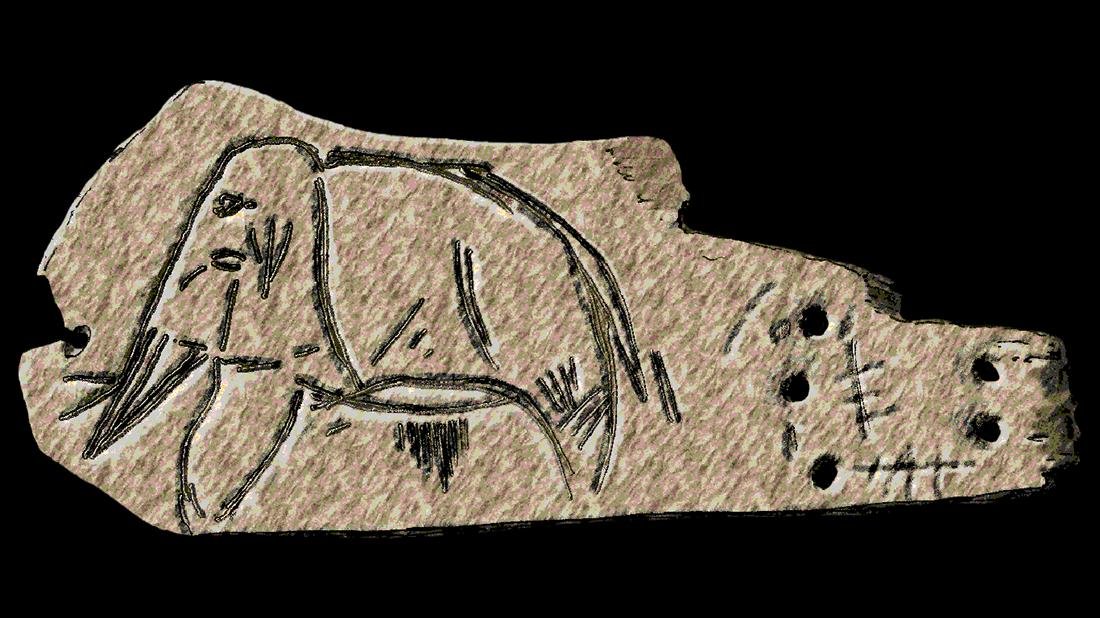
Engraving of a mammoth on a slab of mammoth ivory, from the Upper Paleolithic Mal’ta deposits at Lake Baikal, Siberia. Credit: José-Manuel Benito

The findings, published in a study by Dr. Vadim Stepanchuk and Dr. Oleksandr O. Naumenko in the International Journal of Osteoarchaeology, reveal that ivory was used by hominins at least 400,000 years ago—much earlier than the previously known oldest examples, which are about 120,000 years old.

Medzhibozh A, on the Southern Bug River near the town of Medzhybizh, was discovered in 2011 and excavated intermittently through 2018. The layers at this site span much of the Pleistocene epoch, and the ivory items recovered there were from layers that could be dated to Marine Isotope Stage (MIS) 11. Using electron spin resonance (ESR) and other geological analyses, researchers were able to date these upper layers to approximately 400,000 years ago.

Twenty-four small fragments of ivory were recovered, eleven of which showed definitive signs of human modification. Included among them were instances of sophisticated techniques usually reserved for the production of stone tools, including bipolar-on-anvil knapping, trimming of the edges, and flake removal. One of the fragments was a core, and another was a pointed tool, both of which provide a strong indication of deliberate shaping.

Mammoths and early human society
Credit: Mauricio Antón

However, the utility of ivory as a material for tools is questionable. With a Mohs hardness of only 2–4—considerably softer than flint or quartz—ivory is no match for stone. This led researchers to suggest that these objects may not have been designed exclusively for practical use.


RelatedStories

Study finds dog meat was consumed at Iron Age feasts in ancient Bulgaria

Study finds dog meat was consumed at Iron Age feasts in ancient Bulgaria

January 26, 2026
New study finds evidence that Aztec King Moctezuma kept a zoo for ritual purposes

New study finds evidence that Aztec King Moctezuma kept a zoo for ritual purposes

January 22, 2026

Dr. Stepanchuk suggests that the artifacts could have been created either due to a scarcity of good-quality stone in the area or as a way to experiment with new materials. Others may also have been used as practice pieces for teaching purposes.

That these early humans, likely a now-extinct hominin species, were not only capable of experimenting with novel materials but were also engaging in social learning behaviors such as teaching and imitation suggests a more sophisticated level of cognitive development than was previously assumed.

Though the scientists acknowledge potential uncertainties, such as the possibility of misdating or natural modification, they argue that the complexity and recurrence of the toolmaking techniques make natural origins unlikely.


More information: Stepanchuk, V. N., & Naumenko, O. O. (2025). The earliest evidence of deliberate ivory processing dates back to around 0.4 million years ago. International Journal of Osteoarchaeology. doi:10.1002/oa.3403
Share8Tweet5Share1ShareSend

You May Also Like...

Study finds dog meat was consumed at Iron Age feasts in ancient Bulgaria
Archaeology

Study finds dog meat was consumed at Iron Age feasts in ancient Bulgaria

January 26, 2026
South African San rock art shows evidence of trance dances and initiation rituals
Archaeology

South African San rock art shows evidence of trance dances and initiation rituals

January 25, 2026
Rare 10th-century bronze wheel cross found in Brandenburg reveals early Christian influence among Slavic populations
Archaeology

Rare 10th-century bronze wheel cross found in Brandenburg reveals early Christian influence among Slavic populations

January 25, 2026
Large Roman cemetery excavation at Brougham reveals diverse burial practices on Britain’s northern frontier
Archaeology

Large Roman cemetery excavation at Brougham reveals diverse burial practices on Britain’s northern frontier

January 24, 2026
5,500-year-old human skeleton in Colombia reveals earliest evidence of syphilis in the Americas
Anthropology

5,500-year-old human skeleton in Colombia reveals earliest evidence of syphilis in the Americas

January 23, 2026
Republican-era tombs and a Hercules shrine unearthed in eastern Rome reveal centuries of suburban life
Archaeology

Republican-era tombs and a Hercules shrine unearthed in eastern Rome reveal centuries of suburban life

January 23, 2026

Follow us


Instagram
244K

Facebook
118K

Threads
45K

LinkedIn
14K

Twitter
6K

YouTube
1K
  • Trending
  • Comments
  • Latest
Shipwreck Salvage. Credit: rawpixel.com / Public Domain

2,000-year-old shipwreck discovered off Turkish coast with remarkably preserved stacked ceramics

July 2, 2025
Viking age DNA reveals 9,000-year-old HIV-resistant gene originating near the Black Sea

Viking age DNA reveals 9,000-year-old HIV-resistant gene originating near the Black Sea

May 18, 2025
A new study suggests the mysterious Voynich Manuscript may be a medieval cipher

A new study suggests the mysterious Voynich Manuscript may be a medieval cipher

January 3, 2026
Moses may be named in ancient Egyptian mine inscriptions, sparking debate over earliest biblical references

Moses may be named in ancient Egyptian mine inscriptions, sparking debate over earliest biblical references

July 31, 2025
Mystery of Armenia’s 6,000-year-old dragon stones solved

Mystery of Armenia’s 6,000-year-old dragon stones solved

September 23, 2025
3D analysis reveals Shroud of Turin image likely came from sculpture, not Jesus’ body

3D analysis reveals Shroud of Turin image likely came from sculpture, not Jesus’ body

Moses may be named in ancient Egyptian mine inscriptions, sparking debate over earliest biblical references

Moses may be named in ancient Egyptian mine inscriptions, sparking debate over earliest biblical references

$1 million prize offered to decipher 5,300-year-old Indus Valley script

$1 million prize offered to decipher 5,300-year-old Indus Valley script

Oldest ever genetic data from a human relative found in 2-million-year-old fossilized teeth

Oldest ever genetic data from a human relative found in 2-million-year-old fossilized teeth

Exceptionally large Roman shoes discovered at Magna fort near Hadrian’s Wall

Exceptionally large Roman shoes discovered at Magna fort near Hadrian’s Wall

Study finds dog meat was consumed at Iron Age feasts in ancient Bulgaria

Study finds dog meat was consumed at Iron Age feasts in ancient Bulgaria

January 26, 2026
South African San rock art shows evidence of trance dances and initiation rituals

South African San rock art shows evidence of trance dances and initiation rituals

January 25, 2026
Rare 10th-century bronze wheel cross found in Brandenburg reveals early Christian influence among Slavic populations

Rare 10th-century bronze wheel cross found in Brandenburg reveals early Christian influence among Slavic populations

January 25, 2026
Large Roman cemetery excavation at Brougham reveals diverse burial practices on Britain’s northern frontier

Large Roman cemetery excavation at Brougham reveals diverse burial practices on Britain’s northern frontier

January 24, 2026
5,500-year-old human skeleton in Colombia reveals earliest evidence of syphilis in the Americas

5,500-year-old human skeleton in Colombia reveals earliest evidence of syphilis in the Americas

January 23, 2026

Archaeology News online magazine

Archaeology News is an international online magazine that covers all aspects of archaeology.


Categories

  • Academics
    • Books
    • Conferences
    • Universities
  • Articles
  • Download
  • Game
  • News
    • Anthropology
    • Archaeology
    • Paleontology
  • Quiz
  • Tours

Subscribe to our newsletter

© 2024 - Archaeology News Online Magazine. All Rights Reserved.

  • About
  • Privacy Policy
  • Terms of Use
  • Donation
  • Contact

Welcome Back!

Login to your account below

Forgotten Password? Sign Up

Create New Account!

Fill the forms below to register

All fields are required. Log In

Retrieve your password

Please enter your username or email address to reset your password.

Log In

Add New Playlist

Manage Consent
To provide the best experiences, we use technologies like cookies to store and/or access device information. Consenting to these technologies will allow us to process data such as browsing behavior or unique IDs on this site. Not consenting or withdrawing consent, may adversely affect certain features and functions.
Functional Always active
The technical storage or access is strictly necessary for the legitimate purpose of enabling the use of a specific service explicitly requested by the subscriber or user, or for the sole purpose of carrying out the transmission of a communication over an electronic communications network.
Preferences
The technical storage or access is necessary for the legitimate purpose of storing preferences that are not requested by the subscriber or user.
Statistics
The technical storage or access that is used exclusively for statistical purposes. The technical storage or access that is used exclusively for anonymous statistical purposes. Without a subpoena, voluntary compliance on the part of your Internet Service Provider, or additional records from a third party, information stored or retrieved for this purpose alone cannot usually be used to identify you.
Marketing
The technical storage or access is required to create user profiles to send advertising, or to track the user on a website or across several websites for similar marketing purposes.
  • Manage options
  • Manage services
  • Manage {vendor_count} vendors
  • Read more about these purposes
View preferences
  • {title}
  • {title}
  • {title}
  • Home
  • News
    • Archaeology
    • Anthropology
    • Paleontology
  • Academic
    • Books
    • Conferences
    • Universities
  • Articles
  • VR Tours
  • Quiz & Game
  • Download
  • Encyclopedia
  • Forum

About  .  Contact  .  Donation

© 2024 - Archaeology News Online Magazine. All Rights Reserved