• About
  • Privacy Policy
  • Terms of Use
  • Donation
  • Contact
No Result
View All Result
Archaeology News
  • Home
  • News
    • Archaeology
    • Anthropology
    • Paleontology
  • Academic
    • Books
    • Conferences
    • Universities
  • Articles
  • VR Tours
  • Quiz & Game
  • Download
  • Encyclopedia
  • Forum
Archaeology News
No Result
View All Result
Home News Anthropology

New study debunks Roman massacre myth at Maiden Castle, Britain’s iconic ‘war cemetery’

by Dario Radley
May 24, 2025

A new archaeological report by Bournemouth University (BU) is redrafting one of the most important pages of British history. Long believed to be the location of a bloody massacre during the Roman conquest of Britain, the “war cemetery” at Maiden Castle in Dorset now appears to have a more complex—and less Roman-centered—story to tell.

roman-massacre-myth-at-maiden-castle-1
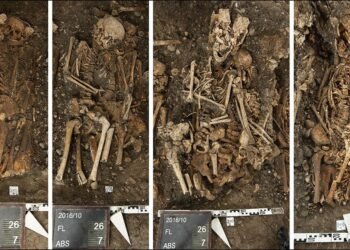
Two of the skeletons excavated by Mortimer Wheeler in the 1930s, dating from the 1st century AD. Both these individuals exhibit bladed weapon injuries, whilst one has a spear head lodged in his spine, previously interpreted (wrongly) as a Roman ballista bolt. Credit: Martin Smith

In a study published in the Oxford Journal of Archaeology, BU researchers conducted a new re-analysis of the Maiden Castle burials, complete with new radiocarbon dates. In contrast to the long-held presumption that the dozens of bodies discovered at the site were victims of a single, catastrophic Roman attack, current evidence suggests that these individuals died over a period of decades, between the late first century BCE and the early first century CE. The research suggests episodic outbreaks of violence, possibly due to internal conflict, dynastic power struggles, or regional executions, as opposed to a single battle against Roman forces.

Dr. Martin Smith, a BU Associate Professor of Forensic and Biological Anthropology, emphasized the significance of this find. “The discovery of dozens of human skeletons displaying lethal weapon injuries was never in doubt,” explained Smith. “However, by undertaking a systematic programme of radiocarbon dating, we have been able to establish that these individuals died over a period of decades, rather than in a single terrible event.”

Maiden Castle, an Iron Age hillfort, gained attention in 1936 when archaeologist Sir Mortimer Wheeler excavated it. Wheeler declared at the time that the hillfort had fallen to a Roman legion, displaying the dead as the last defenders of native Britain. His sensational story, set against the background of an approaching World War, took hold in popular culture and was widely accepted in academic and popular imagination.

roman-massacre-myth-at-maiden-castle-1
Aerial view of Maiden Castle, Dorset, the largest Iron Age hillfort in Britain. Credit: Jo and Sue Crane

But BU’s Principal Academic in Prehistoric and Roman Archaeology and excavation director, Dr. Miles Russell, now believes that this account is more myth than fact. “Since the 1930s, the story of Britons fighting Romans at one of the largest hillforts in the country has become a fixture in historical literature,” Russell said. “The tale of innocent men and women of the local Durotriges tribe being slaughtered by Rome is powerful and poignant… but the archaeological evidence now points to it being untrue. This was a case of Britons killing Britons, the dead being buried in a long-abandoned fortification. The Roman army committed many atrocities, but this does not appear to be one of them.”

RelatedStories

Roman cemetery in Egypt reveals golden tongues, mummies, and rare Iliad papyrus

Roman cemetery in Egypt reveals golden tongues, mummies, and rare Iliad papyrus

April 19, 2026
Pompeii ash analysis reveals Romans burned wine and imported frankincense in household rituals

Pompeii ash analysis reveals Romans burned wine and imported frankincense in household rituals

April 3, 2026

The new evidence also raises broader questions about how ancient burial grounds across Britain can be interpreted. The variety of burial practices uncovered at Maiden Castle suggests either the presence of multiple distinct cultural groups or intricate social hierarchies that dictated burial customs, according to BU Visiting Fellow Paul Cheetham. “While Wheeler’s excavation was excellent, he was only able to investigate a fraction of the site,” said Cheetham. “It is likely that a larger number of burials remain undiscovered around the immense ramparts.”

Cheetham also added that the study defies simplistic explanations of archaeological cemeteries. “The intermingling of differing cultural burial practices contemporaneously shows that simplistic approaches to interpreting archaeological cemeteries must now be questioned,” he stated.

More information: Bournemouth University
More information: Smith, M., Russell, M., & Cheetham, P. (2025). Fraught with high tragedy: A contextual and chronological reconsideration of the Maiden Castle iron age ‘war cemetery’ (England). Oxford Journal of Archaeology. doi:10.1111/ojoa.12324
Share110Tweet69Share19ShareSend

You May Also Like...

Roman cemetery in Egypt reveals golden tongues, mummies, and rare Iliad papyrus
Anthropology

Roman cemetery in Egypt reveals golden tongues, mummies, and rare Iliad papyrus

April 19, 2026
Basel plague study finds young workers had highest death rates in 17th century outbreak
Anthropology

Basel plague study finds young workers had highest death rates in 17th century outbreak

April 17, 2026
Ancient DNA reveals male lineage and family ties in Neolithic Scotland tombs
Anthropology

Ancient DNA reveals male lineage and family ties in Neolithic Scotland tombs

April 16, 2026
Council houses reveal shift from royal rule to collective governance in Terminal Classic Maya society
Archaeology

Council houses reveal shift from royal rule to collective governance in Terminal Classic Maya society

April 11, 2026
Bronze Age loom found inside ancient Spanish home reveals early textile production
Archaeology

Bronze Age loom found inside ancient Spanish home reveals early textile production

April 8, 2026
Pompeii ash analysis reveals Romans burned wine and imported frankincense in household rituals
Archaeology

Pompeii ash analysis reveals Romans burned wine and imported frankincense in household rituals

April 3, 2026

Follow us


Instagram
244K

Facebook
118K

Threads
46K

LinkedIn
14K

Twitter
6K

YouTube
1K
  • Trending
  • Comments
  • Latest
Shipwreck Salvage. Credit: rawpixel.com / Public Domain

2,000-year-old shipwreck discovered off Turkish coast with remarkably preserved stacked ceramics

July 2, 2025
Viking age DNA reveals 9,000-year-old HIV-resistant gene originating near the Black Sea

Viking age DNA reveals 9,000-year-old HIV-resistant gene originating near the Black Sea

May 18, 2025
A new study suggests the mysterious Voynich Manuscript may be a medieval cipher

A new study suggests the mysterious Voynich Manuscript may be a medieval cipher

January 3, 2026
3D analysis reveals Shroud of Turin image likely came from sculpture, not Jesus’ body

3D analysis reveals Shroud of Turin image likely came from sculpture, not Jesus’ body

August 3, 2025
Moses may be named in ancient Egyptian mine inscriptions, sparking debate over earliest biblical references

Moses may be named in ancient Egyptian mine inscriptions, sparking debate over earliest biblical references

July 31, 2025
3D analysis reveals Shroud of Turin image likely came from sculpture, not Jesus’ body

3D analysis reveals Shroud of Turin image likely came from sculpture, not Jesus’ body

Moses may be named in ancient Egyptian mine inscriptions, sparking debate over earliest biblical references

Moses may be named in ancient Egyptian mine inscriptions, sparking debate over earliest biblical references

$1 million prize offered to decipher 5,300-year-old Indus Valley script

$1 million prize offered to decipher 5,300-year-old Indus Valley script

Oldest ever genetic data from a human relative found in 2-million-year-old fossilized teeth

Oldest ever genetic data from a human relative found in 2-million-year-old fossilized teeth

Exceptionally large Roman shoes discovered at Magna fort near Hadrian’s Wall

Exceptionally large Roman shoes discovered at Magna fort near Hadrian’s Wall

Roman cemetery in Egypt reveals golden tongues, mummies, and rare Iliad papyrus

Roman cemetery in Egypt reveals golden tongues, mummies, and rare Iliad papyrus

April 19, 2026
Basel plague study finds young workers had highest death rates in 17th century outbreak

Basel plague study finds young workers had highest death rates in 17th century outbreak

April 17, 2026
Ancient DNA reveals male lineage and family ties in Neolithic Scotland tombs

Ancient DNA reveals male lineage and family ties in Neolithic Scotland tombs

April 16, 2026
Council houses reveal shift from royal rule to collective governance in Terminal Classic Maya society

Council houses reveal shift from royal rule to collective governance in Terminal Classic Maya society

April 11, 2026
Bronze Age loom found inside ancient Spanish home reveals early textile production

Bronze Age loom found inside ancient Spanish home reveals early textile production

April 8, 2026

Archaeology News online magazine

Archaeology News is an international online magazine that covers all aspects of archaeology.


Categories

  • Academics
    • Books
    • Conferences
    • Universities
  • Articles
  • Download
  • Game
  • News
    • Anthropology
    • Archaeology
    • Paleontology
  • Quiz
  • Tours

Subscribe to our newsletter

© 2024 - Archaeology News Online Magazine. All Rights Reserved.

  • About
  • Privacy Policy
  • Terms of Use
  • Donation
  • Contact

Manage Consent
To provide the best experiences, we use technologies like cookies to store and/or access device information. Consenting to these technologies will allow us to process data such as browsing behavior or unique IDs on this site. Not consenting or withdrawing consent, may adversely affect certain features and functions.
Functional Always active
The technical storage or access is strictly necessary for the legitimate purpose of enabling the use of a specific service explicitly requested by the subscriber or user, or for the sole purpose of carrying out the transmission of a communication over an electronic communications network.
Preferences
The technical storage or access is necessary for the legitimate purpose of storing preferences that are not requested by the subscriber or user.
Statistics
The technical storage or access that is used exclusively for statistical purposes. The technical storage or access that is used exclusively for anonymous statistical purposes. Without a subpoena, voluntary compliance on the part of your Internet Service Provider, or additional records from a third party, information stored or retrieved for this purpose alone cannot usually be used to identify you.
Marketing
The technical storage or access is required to create user profiles to send advertising, or to track the user on a website or across several websites for similar marketing purposes.
  • Manage options
  • Manage services
  • Manage {vendor_count} vendors
  • Read more about these purposes
View preferences
  • {title}
  • {title}
  • {title}
  • Home
  • News
    • Archaeology
    • Anthropology
    • Paleontology
  • Academic
    • Books
    • Conferences
    • Universities
  • Articles
  • VR Tours
  • Quiz & Game
  • Download
  • Encyclopedia
  • Forum

About  .  Contact  .  Donation

© 2024 - Archaeology News Online Magazine. All Rights Reserved