• About
  • Privacy Policy
  • Terms of Use
  • Donation
  • Contact
No Result
View All Result
Archaeology News
  • Home
  • News
    • Archaeology
    • Anthropology
    • Paleontology
  • Academic
    • Books
    • Conferences
    • Universities
  • Articles
  • VR Tours
  • Quiz & Game
  • Download
  • Encyclopedia
  • Forum
Archaeology News
No Result
View All Result
Home News Anthropology

300,000-year-old teeth in China suggest interbreeding between early humans and Homo erectus

by Dario Radley
August 6, 2025

A recent study of ancient teeth unearthed at South China’s Hualongdong site is revolutionizing scientists’ understanding of human evolution in Asia. The 300,000-year-old dental remains from an enigmatic group of hominins reveal an unprecedented mix of primitive and modern characteristics, suggesting the evolutionary landscape in the Middle Pleistocene was more complex than previously believed.

Homo erectus in Java: 140,000-year-old fossils found in submerged river valley
Facial reconstruction of Homo erectus, photographed at the David H. Koch Hall of Human Origins, Smithsonian National Museum of Natural History. Credit: Ryan Somma, CC BY-SA 2.0

The research, published in the Journal of Human Evolution, is the result of an international research collaboration between the Institute of Vertebrate Paleontology and Paleoanthropology (IVPP) in Beijing and the Centro Nacional de Investigación sobre la Evolución Humana (CENIEH) in Spain. The researchers, led by Professor Wu Xiujie, director of the excavations at Hualongdong, analyzed 21 dental elements, including 14 that were still embedded in a well-preserved cranium unearthed between 2014 and 2015 in Anhui Province.

What they discovered was a surprising anatomical mixture. The teeth possess a combination of modern features—such as small third molars and smooth buccal surfaces—combined with archaic features such as robust molar and premolar roots, traits more typically associated with Homo erectus. This reflects earlier skeletal analysis of Hualongdong hominins, which exhibited facial features typical of Homo sapiens but limb and jaw morphology more akin to H. erectus.

“It’s a mosaic of primitive and derived traits never seen before—almost as if the evolutionary clock were ticking at different speeds in different parts of the body,” explained María Martinón-Torres, Director of CENIEH and co-author of the study. Her colleague, paleobiologist José María Bermúdez de Castro, said: “The Hualongdong discovery reminds us that human evolution was neither linear nor uniform, and that Asia hosted multiple evolutionary experiments with unique anatomical outcomes.”
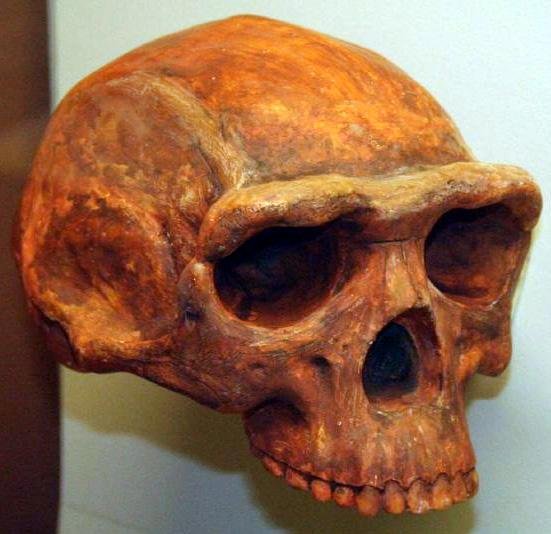
300,000-year-old teeth in China suggest interbreeding between early humans and Homo erectus (Homo erectus, Museum of Natural History, Ann Arbor, Michigan)
Homo erectus skull, Museum of Natural History, Ann Arbor, Michigan. Credit: Thomas Roche / CC BY-SA 2.0

Significantly, the teeth from Hualongdong lack the typical Neanderthal features, so this group was distinct from Neanderthals and Denisovans. This has led scientists to propose some explanations for their unusual mix of features. One possibility is gene flow or interbreeding between an early Homo sapiens-like group and a more archaic species like Homo erectus. Or the Hualongdong sample might be a special lineage related directly to modern humans but separate from any known species.

This combination of features challenges old evolutionary classifications and supports the idea that hominin diversity in Asia was far greater than previously realised.
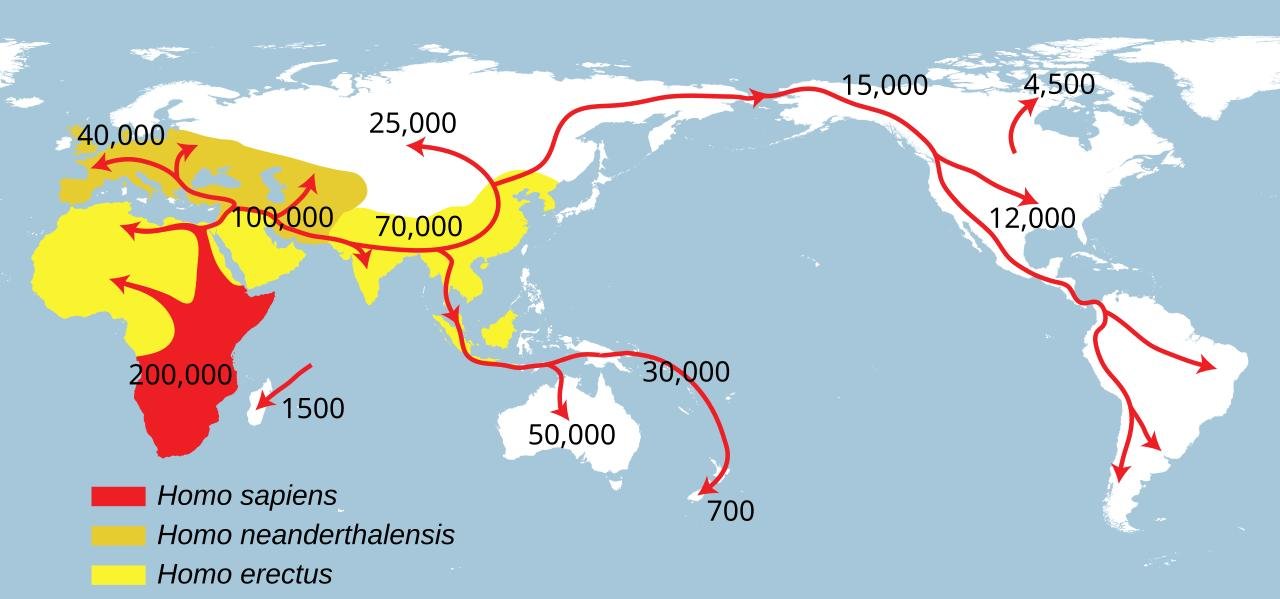
300,000-year-old teeth in China suggest interbreeding between early humans and Homo erectus (Successive dispersals of Homo erectus, Homo neanderthalensis, and Homo sapiens.)
Successive dispersals of Homo erectus, Homo neanderthalensis, and Homo sapiens.

The Hualongdong discovery is one of an increasing number of findings suggesting that the Asian continent was an evolutionary hotspot of experimentation in the Middle Pleistocene. Other new discoveries—such as Homo luzonensis in the Philippines (2019), Homo longi in northern China (2021, now thought to be Denisovan), and Homo juluensis of China (2024)—further complicate the human family tree. Some of these species lived between 300,000 and 150,000 years ago, the same time that the Hualongdong hominins lived.

Despite the fossils’ age, the Hualongdong teeth share many derived features with Late Pleistocene hominins and even with modern humans. This includes a human-like occlusal outline and advanced groove patterns in premolars, suggesting that some modern traits were already starting to emerge in Asia long before the worldwide spread of Homo sapiens.

The discovery also underscores the importance of lesser-documented Asian sites like Panxian Dadong and Jinniushan, which, like Hualongdong, yield combinations of features not easily classifiable within current species categories.

While scientists note that more evidence is needed to determine the precise identity and evolutionary position of the Hualongdong hominins, the find represents an important advance toward illuminating the complex evolutionary history of our species in Asia.

More information: CENIEH
Publication: Wu, X., Martinón-Torres, M., Xing, S., Pei, S., Cai, Y., Tong, H., … Liu, W. (2025). The hominin teeth from the late Middle Pleistocene Hualongdong site, China. Journal of Human Evolution, 206(103727), 103727. doi:10.1016/j.jhevol.2025.103727

Share:

Share on Facebook Share on X (Twitter) Share on LinkedIn Share on Pinterest Share on WhatsApp Share on Email

Related Posts

Buried church bell found in Poland after decades hidden beneath roadside
Archaeology

Buried church bell found in Poland after decades hidden beneath roadside

May 31, 2026
Stone Age humans built complex grass beds at Border Cave 200,000 years ago, study finds
Archaeology

Stone Age humans built complex grass beds at Border Cave 200,000 years ago, study finds

May 30, 2026
Radiocarbon dating confirms Teutonic Knights built Feldioara Fortress in 13th-century Transylvania
Archaeology

Radiocarbon dating confirms Teutonic Knights built Feldioara Fortress in 13th-century Transylvania

May 30, 2026
Ancient shipwreck with 300 amphorae found off Italy could reshape views of Mediterranean wine trade
Archaeology

Ancient shipwreck with 300 amphorae found off Italy could reshape views of Mediterranean wine trade

May 29, 2026
Ancient DNA reveals 700-kilometer migration along Peru’s coast before the Inca Empire
Anthropology

Ancient DNA reveals 700-kilometer migration along Peru’s coast before the Inca Empire

May 29, 2026
6,000-year-old mega-structure unearthed at prehistoric settlement in Romania
Archaeology

6,000-year-old mega-structure unearthed at prehistoric settlement in Romania

May 29, 2026

Comments 1

  1. Editorial Team says:
    1 second ago

    Disclaimer: This website is a science-focused magazine that welcomes both academic and non-academic audiences. Comments are written by users and may include personal opinions or unverified claims. They do not necessarily reflect the views of our editorial team or rely on scientific evidence.

    Comment Policy: We kindly ask all commenters to engage respectfully. Comments that contain offensive, insulting, degrading, discriminatory, or racist content will be automatically removed.

  2. Hassan Ghulam says:
    9 months ago

    The province Anhui is an important name. In Northern Afghanistan there is also Anhui (Andkhoi ) . The people of that region sharing facial and body characteristics with current Chinese people.
    Another name Shadian is also shared.

Follow us


Instagram
242K

Facebook
117K

Threads
47K

LinkedIn
15K

Twitter
6K

YouTube
1K

Archaeology News online magazine

Archaeology News is an international online magazine that covers all aspects of archaeology.


Categories

  • Academics
    • Books
    • Conferences
    • Universities
  • Articles
  • Download
  • Game
  • News
    • Anthropology
    • Archaeology
    • Paleontology
  • Quiz
  • Tours

Subscribe to our newsletter

© 2024 - Archaeology News Online Magazine. All Rights Reserved.

  • About
  • Privacy Policy
  • Terms of Use
  • Donation
  • Contact

Manage Consent
To provide the best experiences, we use technologies like cookies to store and/or access device information. Consenting to these technologies will allow us to process data such as browsing behavior or unique IDs on this site. Not consenting or withdrawing consent, may adversely affect certain features and functions.
Functional Always active
The technical storage or access is strictly necessary for the legitimate purpose of enabling the use of a specific service explicitly requested by the subscriber or user, or for the sole purpose of carrying out the transmission of a communication over an electronic communications network.
Preferences
The technical storage or access is necessary for the legitimate purpose of storing preferences that are not requested by the subscriber or user.
Statistics
The technical storage or access that is used exclusively for statistical purposes. The technical storage or access that is used exclusively for anonymous statistical purposes. Without a subpoena, voluntary compliance on the part of your Internet Service Provider, or additional records from a third party, information stored or retrieved for this purpose alone cannot usually be used to identify you.
Marketing
The technical storage or access is required to create user profiles to send advertising, or to track the user on a website or across several websites for similar marketing purposes.
  • Manage options
  • Manage services
  • Manage {vendor_count} vendors
  • Read more about these purposes
View preferences
  • {title}
  • {title}
  • {title}
  • Home
  • News
    • Archaeology
    • Anthropology
    • Paleontology
  • Academic
    • Books
    • Conferences
    • Universities
  • Articles
  • VR Tours
  • Quiz & Game
  • Download
  • Encyclopedia
  • Forum

About  .  Contact  .  Donation

© 2024 - Archaeology News Online Magazine. All Rights Reserved