• About
  • Privacy Policy
  • Terms of Use
  • Donation
  • Contact
No Result
View All Result
Archaeology News
  • Home
  • News
    • Archaeology
    • Anthropology
    • Paleontology
  • Academic
    • Books
    • Conferences
    • Universities
  • Articles
  • VR Tours
  • Quiz & Game
  • Download
  • Encyclopedia
  • Forum
Archaeology News
No Result
View All Result
Home News Anthropology

Iron Age Iberian DNA reveals deep roots and high maternal lineage diversity

by Dario Radley
October 20, 2025

A genetic study has now reconstructed the maternal ancestry of Iron Age Iberians in north-eastern Spain, revealing a population deeply embedded in local continuity but influenced by long-distance female movements. The research, conducted by Daniel R. Cuesta-Aguirre, Cristina Santos, of the Universitat Autònoma de Barcelona, and their colleagues, is published in the Journal of Archaeological Science.

Iron Age Iberian DNA reveals deep roots and high maternal lineage diversity
Reconstruction of an Iberian warrior’s cremation scene. Credit: Museo de Prehistoria de Valencia; CC BY-SA 2.0

The Iberian culture flourished from the 8th to the 3rd centuries BCE along the Mediterranean coast, where the Ilergetes, Cessetani, Indigetes, and Ausetani thrived through agriculture, metallurgy, and trade. Though they shared cultural features, the Iberians were far from uniform. Their common funerary practice—cremation—made genetic analysis impossible until researchers turned to an unlikely source: newborns.

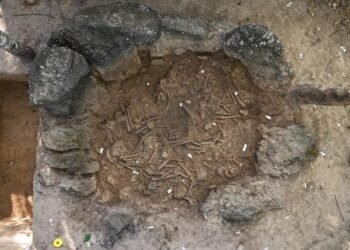
As the adults were cremated, infants were often buried beneath house floors. The researchers examined 31 newborn remains from archaeological sites in Catalonia and were able to obtain mitochondrial DNA (mtDNA) from 21 of them. They added these data to 41 previously published profiles, making up the largest genetic dataset for Iron Age Iberians.

Mitochondrial DNA, inherited only from mothers, allows researchers to trace maternal lineages. The results revealed extreme diversity in every tribe, dominated by haplogroups H, J, K, HV0, and U—lineages already present since the Bronze Age. This implies that the transition to the Iron Age was gradual, with no large-scale population replacement.

Iron Age Iberian DNA reveals deep roots and high maternal lineage diversity
Reconstruction of the Iberian city of Ullastret. Credit: Patrimoni, Generalitat de Catalunya; CC BY-SA 2.0

High mtDNA diversity is compatible with a patrilocal society in which women moved to their husbands’ communities. Such short-distance female movement maintained maternal lineages in mixed form and prevented sharp genetic separation among tribes. Though there were minor fluctuations in certain haplogroups, no trace of sharp genetic breaks was observed.
RelatedStories

massive jar in Laos contained remains of 37 people, revealing ancient burial rituals and Asian trade links

Massive jar in Laos contained remains of 37 people, revealing ancient burial rituals and Asian trade links

May 19, 2026
6,000-year-old necropolis in Spain rewrites origins of Europe’s first megalithic tombs

6,000-year-old necropolis in Spain rewrites origins of Europe’s first megalithic tombs

May 18, 2026

However, some maternal lineages showed long-distance mobility. One woman in Sant Miquel d’Olèrdola carried the North African haplogroup M1b, introduced most likely through Punic or Carthaginian contact. Another carried N1a1a1a3, which can be traced to the Near East, and the haplogroup K1a12a in Font de la Canya points to links with Anatolian or Phoenician trade.

At El Camp de les Lloses, belonging to the Ausetani tribe, there were rare haplogroups H33c and U4d2 that suggested Central European and Italian connections. Roman influence was present at the site, yet most women there appear to have been local. Nonetheless, Ullastret, a massive Indigetes settlement, exhibited an almost entirely local maternal profile despite its strong Mediterranean connections.

The study reveals a society deeply rooted in its own ancestry but subtly shaped by women’s migrations tied to trade and cultural exchange. The evidence highlights the interplay between local continuity and external influence in shaping the genetic landscape of Iron Age Iberia.
More information: Cuesta-Aguirre, D. R., Campoy-Caballero, M. R., Sandoval-Ávila, C., Busquets i Costa, C., Fàbregas i Espadaler, M., Sinner, A. G., … Santos, C. (2025). Mitochondrial DNA diversity in northeast Iberians during the Iron Age. Journal of Archaeological Science, 183(106390), 106390. doi:10.1016/j.jas.2025.106390
ShareTweetShareShareSend

You May Also Like...

World War II mass grave in Poland reveals remains of German officer killed during Battle of Lauban
Anthropology

World War II mass grave in Poland reveals remains of German officer killed during Battle of Lauban

May 19, 2026
massive jar in Laos contained remains of 37 people, revealing ancient burial rituals and Asian trade links
Anthropology

Massive jar in Laos contained remains of 37 people, revealing ancient burial rituals and Asian trade links

May 19, 2026
6,000-year-old necropolis in Spain rewrites origins of Europe’s first megalithic tombs
Archaeology

6,000-year-old necropolis in Spain rewrites origins of Europe’s first megalithic tombs

May 18, 2026
Ancient settlement with weaving workshop and longhouses uncovered in Germany gravel pit
Archaeology

Ancient settlement with weaving workshop and longhouses uncovered in Germany gravel pit

May 17, 2026
Pompeii victim identified as Roman physician killed while fleeing Vesuvius eruption
Anthropology

Pompeii victim identified as Roman physician killed while fleeing Vesuvius eruption

May 17, 2026
Archaeologists uncover hidden whisky smuggler bothy in Scottish Highlands with rare copper still piece
Archaeology

Archaeologists uncover hidden whisky smuggler bothy in Scottish Highlands with rare copper still piece

May 16, 2026

Comments 0

  1. Editorial Team says:
    1 second ago

    Disclaimer: This website is a science-focused magazine that welcomes both academic and non-academic audiences. Comments are written by users and may include personal opinions or unverified claims. They do not necessarily reflect the views of our editorial team or rely on scientific evidence.

    Comment Policy: We kindly ask all commenters to engage respectfully. Comments that contain offensive, insulting, degrading, discriminatory, or racist content will be automatically removed.

    Reply

Leave a Reply Cancel reply

Your email address will not be published. Required fields are marked *

Follow us


Instagram
242K

Facebook
117K

Threads
46K

LinkedIn
14K

Twitter
6K

YouTube
1K
World War II mass grave in Poland reveals remains of German officer killed during Battle of Lauban

World War II mass grave in Poland reveals remains of German officer killed during Battle of Lauban

May 19, 2026
massive jar in Laos contained remains of 37 people, revealing ancient burial rituals and Asian trade links

Massive jar in Laos contained remains of 37 people, revealing ancient burial rituals and Asian trade links

May 19, 2026
6,000-year-old necropolis in Spain rewrites origins of Europe’s first megalithic tombs

6,000-year-old necropolis in Spain rewrites origins of Europe’s first megalithic tombs

May 18, 2026
Ancient settlement with weaving workshop and longhouses uncovered in Germany gravel pit

Ancient settlement with weaving workshop and longhouses uncovered in Germany gravel pit

May 17, 2026

Archaeology News online magazine

Archaeology News is an international online magazine that covers all aspects of archaeology.


Categories

  • Academics
    • Books
    • Conferences
    • Universities
  • Articles
  • Download
  • Game
  • News
    • Anthropology
    • Archaeology
    • Paleontology
  • Quiz
  • Tours

Subscribe to our newsletter

© 2024 - Archaeology News Online Magazine. All Rights Reserved.

  • About
  • Privacy Policy
  • Terms of Use
  • Donation
  • Contact

Manage Consent
To provide the best experiences, we use technologies like cookies to store and/or access device information. Consenting to these technologies will allow us to process data such as browsing behavior or unique IDs on this site. Not consenting or withdrawing consent, may adversely affect certain features and functions.
Functional Always active
The technical storage or access is strictly necessary for the legitimate purpose of enabling the use of a specific service explicitly requested by the subscriber or user, or for the sole purpose of carrying out the transmission of a communication over an electronic communications network.
Preferences
The technical storage or access is necessary for the legitimate purpose of storing preferences that are not requested by the subscriber or user.
Statistics
The technical storage or access that is used exclusively for statistical purposes. The technical storage or access that is used exclusively for anonymous statistical purposes. Without a subpoena, voluntary compliance on the part of your Internet Service Provider, or additional records from a third party, information stored or retrieved for this purpose alone cannot usually be used to identify you.
Marketing
The technical storage or access is required to create user profiles to send advertising, or to track the user on a website or across several websites for similar marketing purposes.
  • Manage options
  • Manage services
  • Manage {vendor_count} vendors
  • Read more about these purposes
View preferences
  • {title}
  • {title}
  • {title}
  • Home
  • News
    • Archaeology
    • Anthropology
    • Paleontology
  • Academic
    • Books
    • Conferences
    • Universities
  • Articles
  • VR Tours
  • Quiz & Game
  • Download
  • Encyclopedia
  • Forum

About  .  Contact  .  Donation

© 2024 - Archaeology News Online Magazine. All Rights Reserved