• About
  • Privacy Policy
  • Terms of Use
  • Donation
  • Contact
No Result
View All Result
Archaeology News
  • Home
  • News
    • Archaeology
    • Anthropology
    • Paleontology
  • Academic
    • Books
    • Conferences
    • Universities
  • Articles
  • VR Tours
  • Quiz & Game
  • Download
  • Encyclopedia
  • Forum
Archaeology News
No Result
View All Result
Home News Anthropology

New genetic study reveals how modern humans first arrived in Australia 60,000 years ago

by Dario Radley
December 1, 2025

A sweeping genetic investigation is reshaping what researchers know about the first journeys of modern humans into Australia and its neighboring lands. Analysis of nearly 2,500 mitochondrial genomes from Indigenous communities across Australia, New Guinea, and the wider Pacific has produced one of the clearest timelines yet for the settlement of Sahul, an ancient continent that once connected these regions during the Pleistocene.

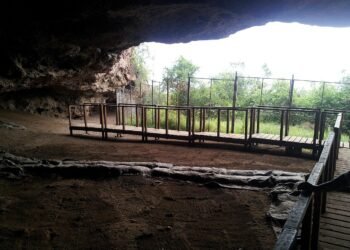
New genetic study reveals how modern humans first arrived in Australia 60,000 years ago
New genetic study reveals how modern humans first arrived in Australia 60,000 years ago. Credit: Steve Evans / CC BY 2.0

For a long time, scientists have debated whether people reached Sahul around 60,000 to 65,000 years ago or several thousand years later. The earlier date, referred to as the “long chronology,” has been supported by archaeological discoveries and oral histories from Aboriginal communities. However, some genetic models have favored a shorter timeline. The new study, published in Science Advances, details what the authors say is the strongest genetic case to date for a 60,000-year-old settlement, closely matching the long chronology.

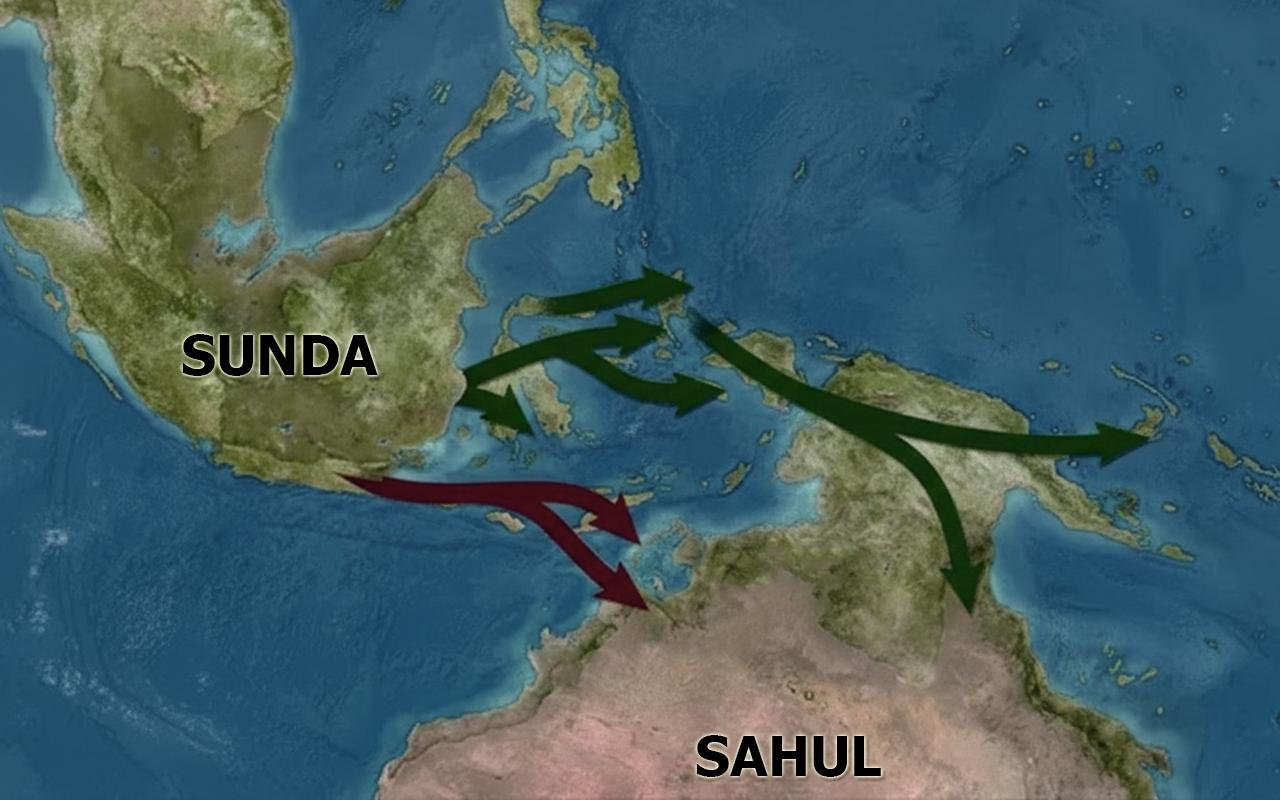
This research focused on extensive mitochondrial, Y-chromosome, and genome-wide data that provide a broad view of early population movements. With the use of refined molecular clock models—methods that estimate when DNA lineages diverged—researchers were able to more precisely determine when the ancestors of Aboriginal Australians and New Guineans first crossed from Sunda, the prehistoric landmass that included much of Southeast Asia, into Sahul. Their results point to two distinct migration routes: one moving southward from the Indonesian islands into present-day Australia and another traveling through the northern corridor, most likely through the Philippines, toward New Guinea.

These two groups were part of a larger population that migrated out of Africa some 70,000 to 80,000 years ago. Genetic evidence suggests that these groups separated somewhere in South or Southeast Asia several thousand years before they moved further east. The findings indicate strong population continuity in the region and add evidence that Aboriginal Australians and New Guineans retain some of the oldest unbroken lineages found outside Africa.
New genetic study reveals how modern humans first arrived in Australia 60,000 years ago
Map of Sunda and Sahul, illustrating possible north and south migration routes revealed by genetic analysis, based on a map by Helen Farr and Erich Fisher.

The research also sheds light on connections beyond Sahul. Near Oceania—the islands of the Bismarck Archipelago and the Solomons—appears to have been settled during the same broad time frame, with constant movement and contact continuing afterward. These genetic links challenge the long-standing tendency to treat Oceania as separate from early Sahul history.

RelatedStories

Ancient DNA from Shimao’s male skulls overturns assumptions about Neolithic rites

Ancient genomes rewrite the story of Shimao’s origins and its gendered ritual practices

November 29, 2025
Ancient DNA uncovers the true origins of China’s mysterious Hanging Coffin tradition

The true origins of China’s mysterious hanging coffin tradition revealed through ancient DNA

November 26, 2025

The analysis carries broader implications for understanding humanity’s migration out of Africa: while recent models have suggested more recent dispersal dates or proposed earlier waves of migration that left minimal trace, the new dataset supports a single major movement between 50,000 and 70,000 years ago. The authors argue that earlier proposed dispersals did not substantially shape the ancestry of present-day non-African populations.

Although the researchers remain constrained by the scarcity of ancient DNA from Southeast Asia and Sahul, the large-scale genetic approach deployed here enhances the precision of current timelines. Paired with archaeological and paleoclimate evidence, these findings form a more complete picture: early modern humans entered Sahul no earlier than 60,000 years ago, using watercraft to cross portions of the ocean, and they did so along more than one path.


More information: Gandini, F., Almeida, M., Foody, M. G. B., Nagle, N., Bergström, A., Olivieri, A., … Richards, M. B. (2025). Genomic evidence supports the ‘long chronology’ for the peopling of Sahul. Science Advances, 11(48), eady9493. doi:10.1126/sciadv.ady9493
Share57Tweet36Share10ShareSend

You May Also Like...

Ketton mosaic in Rutland reveals rare Aeschylean Trojan War scenes in late Roman Britain
Archaeology

Ketton mosaic in Rutland reveals rare Aeschylean Trojan War scenes in late Roman Britain

December 5, 2025
Denmark’s earliest iron weapons discovered: gold-plated lances unearthed at sacred Bronze Age site
Archaeology

Denmark’s earliest iron weapons discovered: gold-plated lances unearthed at sacred Bronze Age site

December 5, 2025
Oldest mule in western Europe found in an Iron Age Iberian burial site, revealing equid hybridization
Archaeology

Oldest mule in western Europe found in an Iron Age Iberian burial site, revealing equid hybridization

December 4, 2025
Archaeologists reveal 7,000 years of continuous human activity at future airport site in Poland
Archaeology

Archaeologists reveal 7,000 years of continuous human activity at future airport site in Poland

December 4, 2025
Early humans ate processed plant foods long before farming, new study shows
Archaeology

Early humans ate processed plant foods long before farming, new study shows

December 3, 2025
We built a database of 290,000 English medieval soldiers – here’s what it reveals
Archaeology

We built a database of 290,000 English medieval soldiers – here’s what it reveals

December 3, 2025

Comments 2

  1. Editorial Team says:
    1 second ago
    Disclaimer: This website is a science-focused magazine that welcomes both academic and non-academic audiences. Comments are written by users and may include personal opinions or unverified claims. They do not necessarily reflect the views of our editorial team or rely on scientific evidence.
    Reply
  2. Milton blazina says:
    4 days ago

    THANK YOU IMENSLY WISH YOU THE GREATEST OF LUCK ON YOUR EW ENDEAVORS,,!!

    Reply
  3. Mike Bond says:
    3 days ago

    Outstanding and informative article. Scientists in field are clearly making progress. Please keep up the good work. This is important for all humans to understand.

    Reply

Leave a Reply Cancel reply

Your email address will not be published. Required fields are marked *

Follow us


Instagram
245K

Facebook
117K

Threads
45K

LinkedIn
14K

Twitter
6K

YouTube
1K
  • Trending
  • Comments
  • Latest
Shipwreck Salvage. Credit: rawpixel.com / Public Domain

2,000-year-old shipwreck discovered off Turkish coast with remarkably preserved stacked ceramics

July 2, 2025
Viking age DNA reveals 9,000-year-old HIV-resistant gene originating near the Black Sea

Viking age DNA reveals 9,000-year-old HIV-resistant gene originating near the Black Sea

May 18, 2025
Complete copy of the Canopus Decree unearthed in Egypt after 150 years

Complete copy of the Canopus Decree unearthed in Egypt after 150 years

September 13, 2025
Mystery of Armenia’s 6,000-year-old dragon stones solved

Mystery of Armenia’s 6,000-year-old dragon stones solved

September 23, 2025
Moses may be named in ancient Egyptian mine inscriptions, sparking debate over earliest biblical references

Moses may be named in ancient Egyptian mine inscriptions, sparking debate over earliest biblical references

July 31, 2025
3D analysis reveals Shroud of Turin image likely came from sculpture, not Jesus’ body

3D analysis reveals Shroud of Turin image likely came from sculpture, not Jesus’ body

Moses may be named in ancient Egyptian mine inscriptions, sparking debate over earliest biblical references

Moses may be named in ancient Egyptian mine inscriptions, sparking debate over earliest biblical references

$1 million prize offered to decipher 5,300-year-old Indus Valley script

$1 million prize offered to decipher 5,300-year-old Indus Valley script

Oldest ever genetic data from a human relative found in 2-million-year-old fossilized teeth

Oldest ever genetic data from a human relative found in 2-million-year-old fossilized teeth

Exceptionally large Roman shoes discovered at Magna fort near Hadrian’s Wall

Exceptionally large Roman shoes discovered at Magna fort near Hadrian’s Wall

Ketton mosaic in Rutland reveals rare Aeschylean Trojan War scenes in late Roman Britain

Ketton mosaic in Rutland reveals rare Aeschylean Trojan War scenes in late Roman Britain

December 5, 2025
Denmark’s earliest iron weapons discovered: gold-plated lances unearthed at sacred Bronze Age site

Denmark’s earliest iron weapons discovered: gold-plated lances unearthed at sacred Bronze Age site

December 5, 2025
Oldest mule in western Europe found in an Iron Age Iberian burial site, revealing equid hybridization

Oldest mule in western Europe found in an Iron Age Iberian burial site, revealing equid hybridization

December 4, 2025
Archaeologists reveal 7,000 years of continuous human activity at future airport site in Poland

Archaeologists reveal 7,000 years of continuous human activity at future airport site in Poland

December 4, 2025
Early humans ate processed plant foods long before farming, new study shows

Early humans ate processed plant foods long before farming, new study shows

December 3, 2025

Archaeology News online magazine

Archaeology News is an international online magazine that covers all aspects of archaeology.


Categories

  • Academics
    • Books
    • Conferences
    • Universities
  • Articles
  • Download
  • Game
  • News
    • Anthropology
    • Archaeology
    • Paleontology
  • Quiz
  • Tours

Subscribe to our newsletter

© 2024 - Archaeology News Online Magazine. All Rights Reserved.

  • About
  • Privacy Policy
  • Terms of Use
  • Donation
  • Contact

Welcome Back!

Login to your account below

Forgotten Password? Sign Up

Create New Account!

Fill the forms below to register

All fields are required. Log In

Retrieve your password

Please enter your username or email address to reset your password.

Log In

Add New Playlist

Manage Consent
To provide the best experiences, we use technologies like cookies to store and/or access device information. Consenting to these technologies will allow us to process data such as browsing behavior or unique IDs on this site. Not consenting or withdrawing consent, may adversely affect certain features and functions.
Functional Always active
The technical storage or access is strictly necessary for the legitimate purpose of enabling the use of a specific service explicitly requested by the subscriber or user, or for the sole purpose of carrying out the transmission of a communication over an electronic communications network.
Preferences
The technical storage or access is necessary for the legitimate purpose of storing preferences that are not requested by the subscriber or user.
Statistics
The technical storage or access that is used exclusively for statistical purposes. The technical storage or access that is used exclusively for anonymous statistical purposes. Without a subpoena, voluntary compliance on the part of your Internet Service Provider, or additional records from a third party, information stored or retrieved for this purpose alone cannot usually be used to identify you.
Marketing
The technical storage or access is required to create user profiles to send advertising, or to track the user on a website or across several websites for similar marketing purposes.
  • Manage options
  • Manage services
  • Manage {vendor_count} vendors
  • Read more about these purposes
View preferences
  • {title}
  • {title}
  • {title}
  • Home
  • News
    • Archaeology
    • Anthropology
    • Paleontology
  • Academic
    • Books
    • Conferences
    • Universities
  • Articles
  • VR Tours
  • Quiz & Game
  • Download
  • Encyclopedia
  • Forum

About  .  Contact  .  Donation

© 2024 - Archaeology News Online Magazine. All Rights Reserved