• About
  • Privacy Policy
  • Terms of Use
  • Donation
  • Contact
No Result
View All Result
Archaeology News
  • Home
  • News
    • Archaeology
    • Anthropology
    • Paleontology
  • Academic
    • Books
    • Conferences
    • Universities
  • Articles
  • VR Tours
  • Quiz & Game
  • Download
  • Encyclopedia
  • Forum
Archaeology News
No Result
View All Result
Home News Archaeology

Bronze Age wooden constructions at Georgia’s Tabakoni mound precisely dated, revealing centuries of settlement and adaptation

by Dario Radley
December 25, 2025

A recent study has now provided the first precise chronological framework for the Bronze Age settlement mound at Tabakoni in the Colchis lowlands of western Georgia, contributing to the knowledge surrounding settlement dynamics and environmental adaptation in the eastern Black Sea region. Between 2011 and 2017, a Georgian–German team of archaeologists excavated the waterlogged site where complex wood structures were preserved, making it feasible to apply both radiocarbon dating and dendrochronology, a first in the region of the Caucasus.
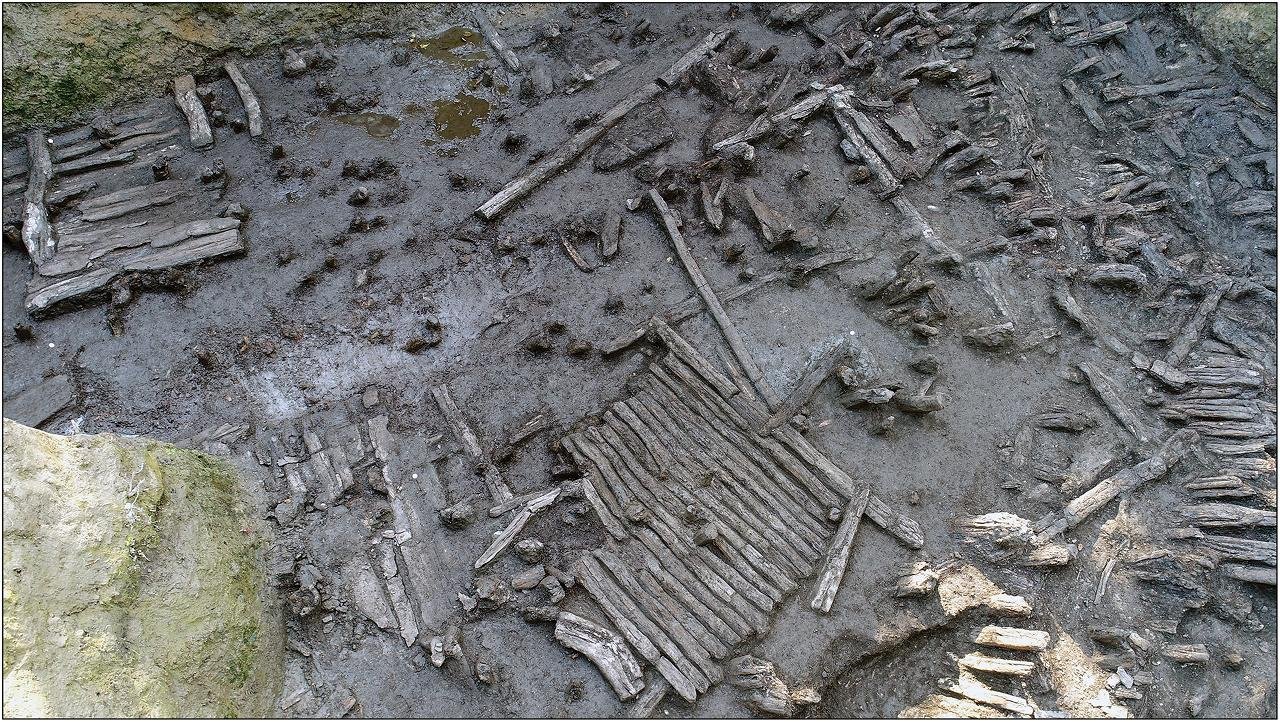
Wooden constructions at Georgia’s Tabakoni mound precisely dated, shedding new light on Bronze Age life
Wooden features from the first settlement phase in the centre of the excavation area in 2017. Credit: J. N. Meyer / T. Mörtz et al., Antiquity (2025); CC BY-NC-SA 4.0

The results suggest that people began constructing a stable foundation for the Tabakoni mound as early as the 20th century BCE, which pushes back the origins of this settlement to the Middle Bronze Age. This early phase is also marked by some of the earliest evidence for the cultivation of millet in Colchis, suggesting agricultural practices adapted to local environmental conditions.

Phases of successive occupation at the site demonstrate a sequence of leveling and intentional backfilling of earlier structures, leading to gradual accretion of the mound over centuries. The site does not appear to be simply an occupation that was abandoned and eventually reoccupied at a later date, but rather demonstrates continual modification and reuse reflecting changing settlement needs and possibly shifts in social or environmental conditions. The site was not continuously occupied without interruption, but the overall sequence spans much of the Bronze Age and extends into the first millennium BCE.
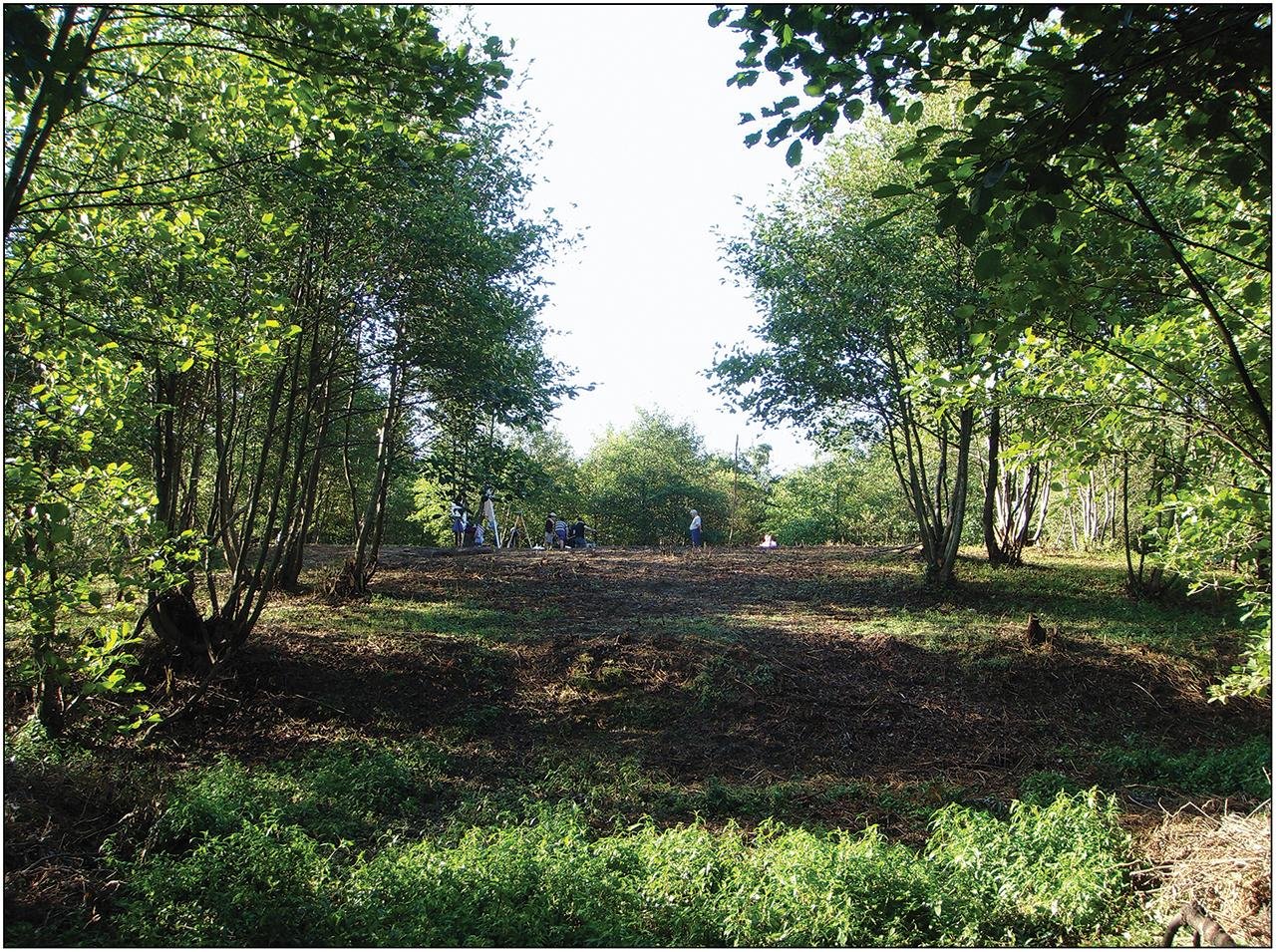
Wooden constructions at Georgia’s Tabakoni mound precisely dated, shedding new light on Bronze Age life
View of the Tabakoni settlement mound from the north-east in 2011. Credit: T. Mörtz / T. Mörtz et al., Antiquity (2025); CC BY-NC-SA 4.0

In the Tabakoni excavations, a multidisciplinary approach combining stratigraphic excavation with cutting-edge dating techniques has led to a more refined temporal framework for understanding human activity in Colchis. Radiocarbon measurements were anchored by tree-ring sequences obtained from preserved timbers, which enabled a finer distinction between discrete construction events within the mound’s long history.
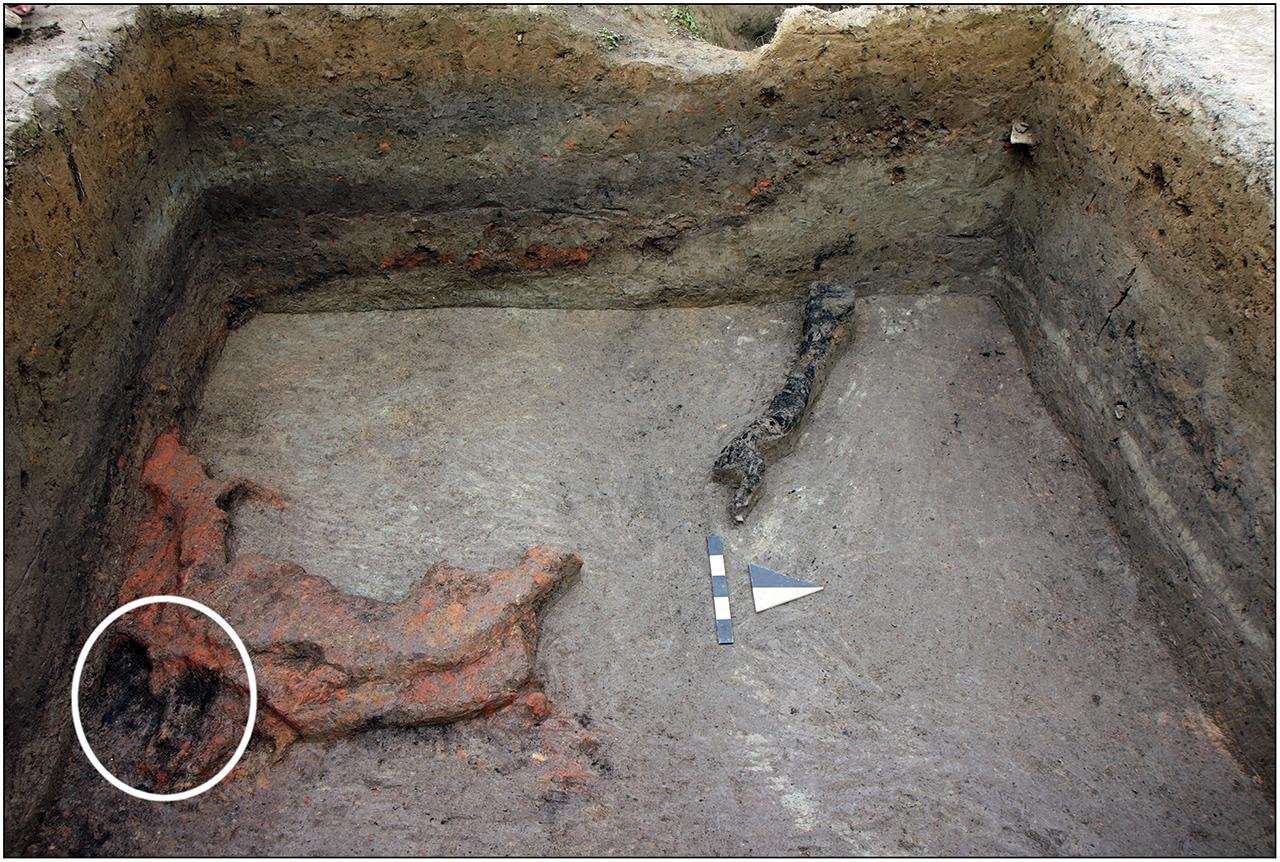
Wooden constructions at Georgia’s Tabakoni mound precisely dated, shedding new light on Bronze Age life
Clay agglomeration with charred millet (circle) and a charred beam in the upper Middle Bronze Age layer excavated in 2014. Credit: L. Tchabashvili / T. Mörtz et al., Antiquity (2025); CC BY-NC-SA 4.0

In addition to its chronological importance, another key significance of the Tabakoni archaeological project is its contribution to debates regarding Bronze Age settlement patterns in the South Caucasus. The evidence of millet cultivation corresponds with a new understanding of varied agricultural strategies in this region, incorporating cereals that were well adapted to local climate and soil conditions in the Colchian plain. The repeated remodeling of the mound also parallels developments seen in other Eurasian tell sites.

RelatedStories

Scientists uncover Ireland’s largest prehistoric hillfort settlement, reshaping views of Bronze Age society

Scientists uncover Ireland’s largest prehistoric hillfort settlement, reshaping views of Bronze Age society

January 1, 2026
A 4,000-year-old sheep may reveal how the Bronze Age plague spread across Eurasia

A 4,000-year-old sheep may reveal how the Bronze Age plague spread across Eurasia

December 28, 2025

Finally, the Tabakoni mound was abandoned in the second half of the first millennium BCE, after several centuries of intermittent occupation and reconfiguration. The dating of human occupation at this crucial site within the ancient Black Sea world has been greatly clarified by the researchers’ findings.

The work sets a new level of chronological precision for the archaeology of Colchis and heralds further research into the social, economic, and environmental changes that shaped the region during the Bronze and Iron Ages.
More information: Mörtz, T., Tchabashvili, L., Apakidze, J., Hansen, S., & Heußner, K.-U. (2025). Dating Tabakoni: the chronology of a Bronze Age settlement mound in Colchis. Antiquity, 1–19. doi:10.15184/aqy.2025.10254
Share122Tweet76Share21ShareSend

You May Also Like...

60,000-year-old poison arrows from South Africa reveal the world’s earliest poisoned weapons and advanced hunting techniques
Archaeology

60,000-year-old poison arrows from South Africa reveal the world’s earliest poisoned weapons and advanced hunting techniques

January 8, 2026
Inscribed clay cylinders reveal Nebuchadnezzar II’s restoration of the Kish Ziggurat
Archaeology

Inscribed clay cylinders reveal Nebuchadnezzar II’s restoration of the Kish Ziggurat

January 7, 2026
Rare Late Roman mosaic with Solomon’s Knot discovered beneath modern İzmir
Archaeology

Rare Late Roman mosaic with Solomon’s Knot discovered beneath modern İzmir

January 7, 2026
1130 depiction of Saxons, Jutes, and Angles crossing the sea to Britain. Credit: Wikimedia / CC BY-SA 4.0. Roots of medieval migration into England uncovered by large-scale bioarchaeological study
Anthropology

Roots of medieval migration into England uncovered by large-scale bioarchaeological study

January 6, 2026
Rare Celtic gold coins found in Swiss bog may reveal ancient ritual offerings
Archaeology

Rare Celtic gold coins found in Swiss bog may reveal ancient ritual offerings

January 5, 2026
Rare medieval gold ring unearthed in Tønsberg
Archaeology

Rare medieval gold ring unearthed in Tønsberg reveals beliefs and craftsmanship of its time

January 5, 2026

Comments 1

  1. Editorial Team says:
    1 second ago

    Disclaimer: This website is a science-focused magazine that welcomes both academic and non-academic audiences. Comments are written by users and may include personal opinions or unverified claims. They do not necessarily reflect the views of our editorial team or rely on scientific evidence.

    Comment Policy: We kindly ask all commenters to engage respectfully. Comments that contain offensive, insulting, degrading, discriminatory, or racist content will be automatically removed.

    Reply
  2. Al says:
    3 weeks ago

    A suggestion for the modern archaeologist…. When sites are dug. and discoveries of items and dates approximately learned, then an emhanced Rosetta Stone-style record should be left buried at the site. This is so that if there’s ever a human catastrophe where our electronic/written records are destroyed then future archaeologists in thousands of years time can learn what was at a location. We feel somewhat secure in this short term of modernity and its amazing technology in which we live but we all know things come to pass. Give a non-decaying gift of knowledge to those who will come later.

    Reply

Leave a Reply Cancel reply

Your email address will not be published. Required fields are marked *

Follow us


Instagram
244K

Facebook
118K

Threads
45K

LinkedIn
14K

Twitter
6K

YouTube
1K
  • Trending
  • Comments
  • Latest
Shipwreck Salvage. Credit: rawpixel.com / Public Domain

2,000-year-old shipwreck discovered off Turkish coast with remarkably preserved stacked ceramics

July 2, 2025
Viking age DNA reveals 9,000-year-old HIV-resistant gene originating near the Black Sea

Viking age DNA reveals 9,000-year-old HIV-resistant gene originating near the Black Sea

May 18, 2025
A new study suggests the mysterious Voynich Manuscript may be a medieval cipher

A new study suggests the mysterious Voynich Manuscript may be a medieval cipher

January 3, 2026
Moses may be named in ancient Egyptian mine inscriptions, sparking debate over earliest biblical references

Moses may be named in ancient Egyptian mine inscriptions, sparking debate over earliest biblical references

July 31, 2025
Mystery of Armenia’s 6,000-year-old dragon stones solved

Mystery of Armenia’s 6,000-year-old dragon stones solved

September 23, 2025
3D analysis reveals Shroud of Turin image likely came from sculpture, not Jesus’ body

3D analysis reveals Shroud of Turin image likely came from sculpture, not Jesus’ body

Moses may be named in ancient Egyptian mine inscriptions, sparking debate over earliest biblical references

Moses may be named in ancient Egyptian mine inscriptions, sparking debate over earliest biblical references

$1 million prize offered to decipher 5,300-year-old Indus Valley script

$1 million prize offered to decipher 5,300-year-old Indus Valley script

Oldest ever genetic data from a human relative found in 2-million-year-old fossilized teeth

Oldest ever genetic data from a human relative found in 2-million-year-old fossilized teeth

Exceptionally large Roman shoes discovered at Magna fort near Hadrian’s Wall

Exceptionally large Roman shoes discovered at Magna fort near Hadrian’s Wall

60,000-year-old poison arrows from South Africa reveal the world’s earliest poisoned weapons and advanced hunting techniques

60,000-year-old poison arrows from South Africa reveal the world’s earliest poisoned weapons and advanced hunting techniques

January 8, 2026
Inscribed clay cylinders reveal Nebuchadnezzar II’s restoration of the Kish Ziggurat

Inscribed clay cylinders reveal Nebuchadnezzar II’s restoration of the Kish Ziggurat

January 7, 2026
Rare Late Roman mosaic with Solomon’s Knot discovered beneath modern İzmir

Rare Late Roman mosaic with Solomon’s Knot discovered beneath modern İzmir

January 7, 2026
1130 depiction of Saxons, Jutes, and Angles crossing the sea to Britain. Credit: Wikimedia / CC BY-SA 4.0. Roots of medieval migration into England uncovered by large-scale bioarchaeological study

Roots of medieval migration into England uncovered by large-scale bioarchaeological study

January 6, 2026
Rare Celtic gold coins found in Swiss bog may reveal ancient ritual offerings

Rare Celtic gold coins found in Swiss bog may reveal ancient ritual offerings

January 5, 2026

Archaeology News online magazine

Archaeology News is an international online magazine that covers all aspects of archaeology.


Categories

  • Academics
    • Books
    • Conferences
    • Universities
  • Articles
  • Download
  • Game
  • News
    • Anthropology
    • Archaeology
    • Paleontology
  • Quiz
  • Tours

Subscribe to our newsletter

© 2024 - Archaeology News Online Magazine. All Rights Reserved.

  • About
  • Privacy Policy
  • Terms of Use
  • Donation
  • Contact

Welcome Back!

Login to your account below

Forgotten Password? Sign Up

Create New Account!

Fill the forms below to register

All fields are required. Log In

Retrieve your password

Please enter your username or email address to reset your password.

Log In

Add New Playlist

Manage Consent
To provide the best experiences, we use technologies like cookies to store and/or access device information. Consenting to these technologies will allow us to process data such as browsing behavior or unique IDs on this site. Not consenting or withdrawing consent, may adversely affect certain features and functions.
Functional Always active
The technical storage or access is strictly necessary for the legitimate purpose of enabling the use of a specific service explicitly requested by the subscriber or user, or for the sole purpose of carrying out the transmission of a communication over an electronic communications network.
Preferences
The technical storage or access is necessary for the legitimate purpose of storing preferences that are not requested by the subscriber or user.
Statistics
The technical storage or access that is used exclusively for statistical purposes. The technical storage or access that is used exclusively for anonymous statistical purposes. Without a subpoena, voluntary compliance on the part of your Internet Service Provider, or additional records from a third party, information stored or retrieved for this purpose alone cannot usually be used to identify you.
Marketing
The technical storage or access is required to create user profiles to send advertising, or to track the user on a website or across several websites for similar marketing purposes.
  • Manage options
  • Manage services
  • Manage {vendor_count} vendors
  • Read more about these purposes
View preferences
  • {title}
  • {title}
  • {title}
  • Home
  • News
    • Archaeology
    • Anthropology
    • Paleontology
  • Academic
    • Books
    • Conferences
    • Universities
  • Articles
  • VR Tours
  • Quiz & Game
  • Download
  • Encyclopedia
  • Forum

About  .  Contact  .  Donation

© 2024 - Archaeology News Online Magazine. All Rights Reserved