• About
  • Privacy Policy
  • Terms of Use
  • Donation
  • Contact
No Result
View All Result
Archaeology News
  • Home
  • News
    • Archaeology
    • Anthropology
    • Paleontology
  • Academic
    • Books
    • Conferences
    • Universities
  • Articles
  • VR Tours
  • Quiz & Game
  • Download
  • Encyclopedia
  • Forum
Archaeology News
No Result
View All Result
Home News Anthropology

Bioarchaeological evidence of one of the earliest Islamic burials in the Levant

by Dario Radley
June 9, 2022

A new study that combines archaeological, historical, and bioarchaeological data sheds new light on the early Islamic period in Syria. Initially aiming to concentrate on an era much more ancient, the research squad inadvertently stumbled upon what they believe to be early Muslim remains in the rural expanses of Syria.
Bioarchaeological evidence of one of the earliest Islamic burials in the Levant
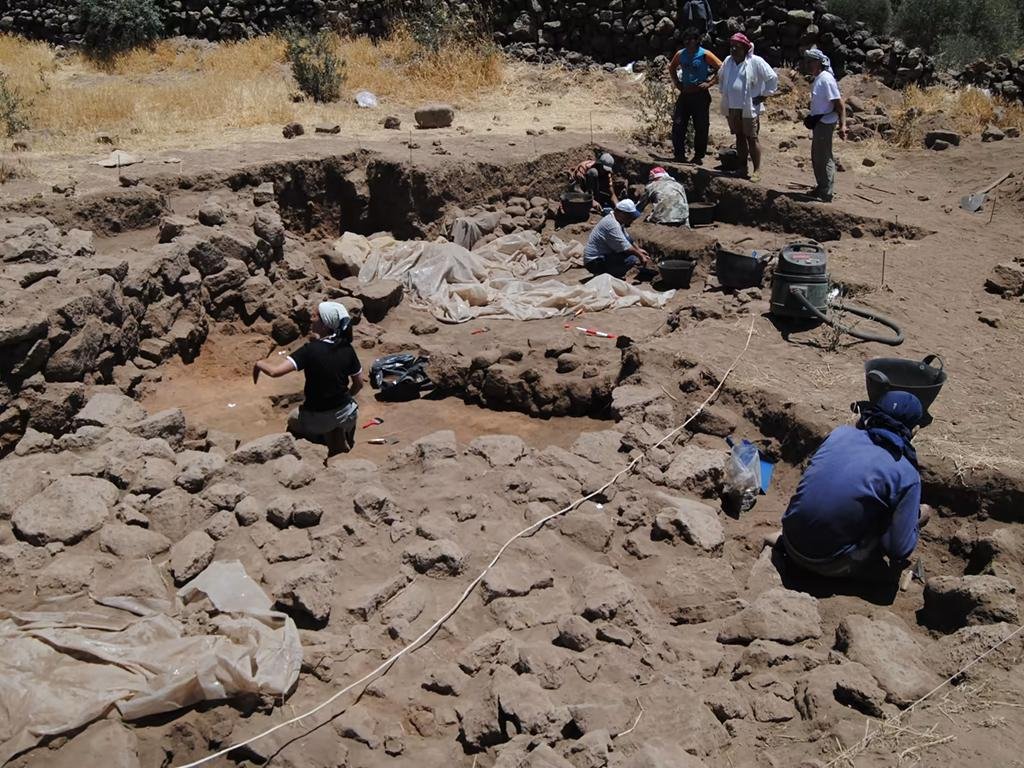
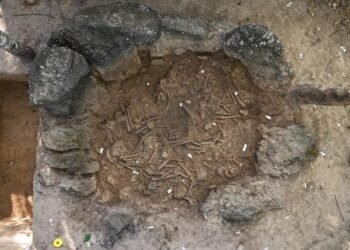
Excavationsat the Neolithic site of Tell Qarassa in modern-day Syria. Image credit: Jonathan Santana

The Middle East boasts a widely acclaimed history that encompasses an array of ethnicities, cultures, and religious traditions, offering a captivating narrative. While historical records contribute significantly to our knowledge of this diverse and vibrant history, the region’s impressive material culture and archaeological sites have been augmented recently by significant bioarcheological data.

This enhancement has been achieved through the application of new technologies capable of analyzing deteriorated materials, thus expanding our understanding of the region situated at the convergence of three continents. A team characterized by its multidisciplinary and multinational composition is now unveiling fresh bioarchaeological insights into the early Islamic age in contemporary Syria.

At the Neolithic site of Tell Qarassa in present-day Syria, numerous burials were unearthed during excavation campaigns spanning 2009 and 2010. The coordination of these excavations was a joint effort by a Spanish-French team, inclusive of Syrian students participating in every archaeological endeavor, augmenting their training in archaeology.

The research proceeded under the authorization and continual cooperation of the Syrian Arab Republic’s General Directorate of Antiquities and Museums (DGAM). It’s noteworthy that the Syrian civil war commenced shortly after these excavations and continues to persist.
RelatedStories

Basel plague study finds young workers had highest death rates in 17th century outbreak

Basel plague study finds young workers had highest death rates in 17th century outbreak

April 17, 2026
How ancient communities adapted their diets and farming strategies in prehistoric Poland

How ancient communities adapted their diets and farming strategies in prehistoric Poland

February 26, 2026

Archaeogeneticist Cristina Valdiosera of the University of Burgos, Spain, who spearheaded the study, elaborates, “With the objective of examining the earliest agricultural communities in the region, we subjected the remains of 14 individuals to analysis of ancient DNA.”

She further clarifies, “Out of these, only two individuals from the upper layers of the site contained sufficient amounts of endogenous DNA and these came from graves that we assumed belonged to a later prehistoric period. After radiocarbon dating it became clear we had something unexpected and special.”

Bioarchaeological evidence of one of the earliest Islamic burials in the Levant
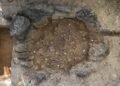
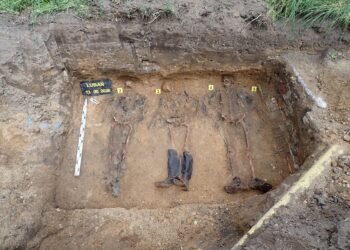
Skeletal remains of syr005 during the excavations at Tell Qarassa, Credit: Jonathan Santana

The graves, pinpointed through radiocarbon dating, traced back to the Umayyad Era, during the late 7th and early 8th centuries (the second caliphate).

In view of these remarkably recent dates, a reevaluation of the burial practices revealed a conformity to early Muslim interment customs. Devoid of the radiocarbon data, discerning this cultural identity would have remained impossible due to the absence of previously documented Muslim settlements or burial sites within the vicinity. Additionally, the archaeological site itself had exclusively been acknowledged as a prehistoric location.

“Surprisingly, the genomic findings indicate dissimilarities between the two individuals and the majority of ancient or contemporary Levantines. The most akin modern groups, albeit not identical, were found among Bedouins and Saudis, implying a potential connection to the Arabian Peninsula,” conveys evolutionary biologist Megha Srigyan, who undertook the data analysis as part of her master’s studies at Uppsala University, Sweden.

Uppsala University population geneticist Torsten Günther, who co-coordinated the study, said: “Most of our evidence is indirect but the different types of data, taken together, point to this man and woman belonging to transient groups far from home, suggesting the presence of early Muslims in the Syrian countryside.”

The scrutiny of a male and a female yielded insights into the introduction of novel cultural and religious practices to the Levant. It is extraordinary that by studying just two individuals, we were able to uncover a small but remarkable piece of the colossal puzzle that makes up the history of the Levant,” says Cristina Valdiosera,” remarks Cristina Valdiosera.

In this particular instance, the amalgamation of archaeological, historical, and bioarchaeological data was imperative to reach a conclusion, given that each facet provided crucial clues. This underscores the significance of embracing a multidisciplinary approach, concludes Torsten Günther.

The human remains retrieved from Qarassa, along with the remainder of the archaeological artifacts, found their resting place in the Archaeological Museum of Sweida, Syria. These artifacts have since been under the guardianship of the Syrian DGAM, in compliance with their regulations.

Provided by Uppsala University

More information: Megha Srigyan et al. (2022). Bioarchaeological evidence of one of the earliest Islamic burials in the Levant, Communications Biology. DOI: 10.1038/s42003-022-03508-4
Share1Tweet1ShareShareSend

You May Also Like...

Rare 2,000-year-old Roman bread found at Vindonissa reveals early military life in Switzerland
Archaeology

Rare 2,000-year-old Roman bread found at Vindonissa reveals early military life in Switzerland

April 25, 2026
Over 1,000 archaeological features uncovered along Czech railway
Archaeology

Over 1,000 archaeological features uncovered along Czech railway

April 25, 2026
Ancient ship burial in Norway dates to CE 700, rewriting early Viking Age origins
Archaeology

Ancient ship burial in Norway dates to CE 700, rewriting early Viking Age origins

April 25, 2026
Ramses II statue found in Egypt’s eastern Nile Delta shows ancient reuse of royal monuments
Archaeology

Ramses II statue found in Egypt’s eastern Nile Delta shows ancient reuse of royal monuments

April 24, 2026
Late Bronze Age bronze ring hoard near Dresden reveals ritual practices and social life 1300–1100 BCE
Archaeology

Late Bronze Age bronze ring hoard near Dresden reveals ritual practices and social life 1300–1100 BCE

April 21, 2026
Roman cemetery in Egypt reveals golden tongues, mummies, and rare Iliad papyrus
Anthropology

Roman cemetery in Egypt reveals golden tongues, mummies, and rare Iliad papyrus

April 19, 2026

Follow us


Instagram
244K

Facebook
118K

Threads
46K

LinkedIn
14K

Twitter
6K

YouTube
1K
  • Trending
  • Comments
  • Latest
Shipwreck Salvage. Credit: rawpixel.com / Public Domain

2,000-year-old shipwreck discovered off Turkish coast with remarkably preserved stacked ceramics

July 2, 2025
Viking age DNA reveals 9,000-year-old HIV-resistant gene originating near the Black Sea

Viking age DNA reveals 9,000-year-old HIV-resistant gene originating near the Black Sea

May 18, 2025
A new study suggests the mysterious Voynich Manuscript may be a medieval cipher

A new study suggests the mysterious Voynich Manuscript may be a medieval cipher

January 3, 2026
3D analysis reveals Shroud of Turin image likely came from sculpture, not Jesus’ body

3D analysis reveals Shroud of Turin image likely came from sculpture, not Jesus’ body

August 3, 2025
Moses may be named in ancient Egyptian mine inscriptions, sparking debate over earliest biblical references

Moses may be named in ancient Egyptian mine inscriptions, sparking debate over earliest biblical references

July 31, 2025
3D analysis reveals Shroud of Turin image likely came from sculpture, not Jesus’ body

3D analysis reveals Shroud of Turin image likely came from sculpture, not Jesus’ body

Moses may be named in ancient Egyptian mine inscriptions, sparking debate over earliest biblical references

Moses may be named in ancient Egyptian mine inscriptions, sparking debate over earliest biblical references

$1 million prize offered to decipher 5,300-year-old Indus Valley script

$1 million prize offered to decipher 5,300-year-old Indus Valley script

Oldest ever genetic data from a human relative found in 2-million-year-old fossilized teeth

Oldest ever genetic data from a human relative found in 2-million-year-old fossilized teeth

Exceptionally large Roman shoes discovered at Magna fort near Hadrian’s Wall

Exceptionally large Roman shoes discovered at Magna fort near Hadrian’s Wall

Rare 2,000-year-old Roman bread found at Vindonissa reveals early military life in Switzerland

Rare 2,000-year-old Roman bread found at Vindonissa reveals early military life in Switzerland

April 25, 2026
Over 1,000 archaeological features uncovered along Czech railway

Over 1,000 archaeological features uncovered along Czech railway

April 25, 2026
Ancient ship burial in Norway dates to CE 700, rewriting early Viking Age origins

Ancient ship burial in Norway dates to CE 700, rewriting early Viking Age origins

April 25, 2026
Ramses II statue found in Egypt’s eastern Nile Delta shows ancient reuse of royal monuments

Ramses II statue found in Egypt’s eastern Nile Delta shows ancient reuse of royal monuments

April 24, 2026
Late Bronze Age bronze ring hoard near Dresden reveals ritual practices and social life 1300–1100 BCE

Late Bronze Age bronze ring hoard near Dresden reveals ritual practices and social life 1300–1100 BCE

April 21, 2026

Archaeology News online magazine

Archaeology News is an international online magazine that covers all aspects of archaeology.


Categories

  • Academics
    • Books
    • Conferences
    • Universities
  • Articles
  • Download
  • Game
  • News
    • Anthropology
    • Archaeology
    • Paleontology
  • Quiz
  • Tours

Subscribe to our newsletter

© 2024 - Archaeology News Online Magazine. All Rights Reserved.

  • About
  • Privacy Policy
  • Terms of Use
  • Donation
  • Contact

Manage Consent
To provide the best experiences, we use technologies like cookies to store and/or access device information. Consenting to these technologies will allow us to process data such as browsing behavior or unique IDs on this site. Not consenting or withdrawing consent, may adversely affect certain features and functions.
Functional Always active
The technical storage or access is strictly necessary for the legitimate purpose of enabling the use of a specific service explicitly requested by the subscriber or user, or for the sole purpose of carrying out the transmission of a communication over an electronic communications network.
Preferences
The technical storage or access is necessary for the legitimate purpose of storing preferences that are not requested by the subscriber or user.
Statistics
The technical storage or access that is used exclusively for statistical purposes. The technical storage or access that is used exclusively for anonymous statistical purposes. Without a subpoena, voluntary compliance on the part of your Internet Service Provider, or additional records from a third party, information stored or retrieved for this purpose alone cannot usually be used to identify you.
Marketing
The technical storage or access is required to create user profiles to send advertising, or to track the user on a website or across several websites for similar marketing purposes.
  • Manage options
  • Manage services
  • Manage {vendor_count} vendors
  • Read more about these purposes
View preferences
  • {title}
  • {title}
  • {title}
  • Home
  • News
    • Archaeology
    • Anthropology
    • Paleontology
  • Academic
    • Books
    • Conferences
    • Universities
  • Articles
  • VR Tours
  • Quiz & Game
  • Download
  • Encyclopedia
  • Forum

About  .  Contact  .  Donation

© 2024 - Archaeology News Online Magazine. All Rights Reserved