
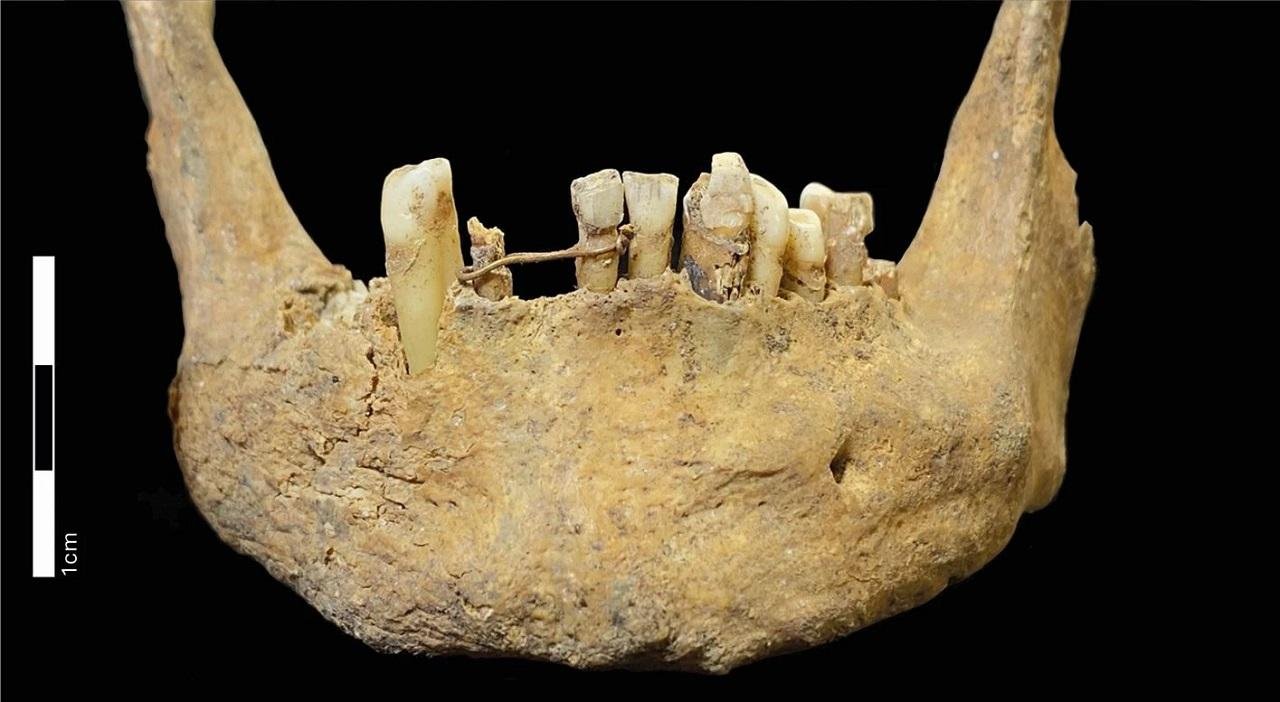
Archaeologists in Scotland have identified the earliest known case of restorative dentistry ever found in the country. The find comes from a middle-aged man buried in medieval Aberdeen with a gold dental bridge attached to his lower front teeth.
The study appeared in the British Dental Journal. The finding adds another example of how people treated dental problems long before dentistry became an official profession in the 19th century.
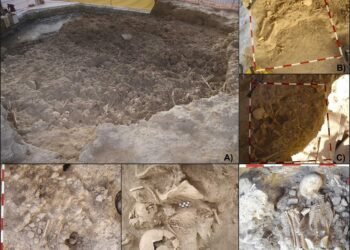
Researchers found the dental work during a later study of skeletal remains from the East Kirk of St. Nicholas in Aberdeen. Excavations at the church in 2006 uncovered around 900 individuals and nearly 3.5 metric tons of human bone. The church was one of the largest and wealthiest in Scotland during the 14th to 16th centuries.
Among these remains, researchers examined one mandible with a thin gold wire fixed across the lower incisors. The wire linked the right lateral incisor to the left central incisor, crossing the gap of a missing tooth. Researchers believe the device served one of two purposes. The wire likely held a loose tooth in place, or formed a bridge structure for a replacement tooth.
Researchers studied 100 individuals as part of a project on health trends in Scotland. Only one person showed this type of dental treatment.
Radiocarbon dating placed the individual between 1460 and 1670 CE. Bone features and tooth wear suggest he was a middle-aged adult male. Marks on the teeth show the gold wire stayed in place for a long time before death, which means the device was worn during life.
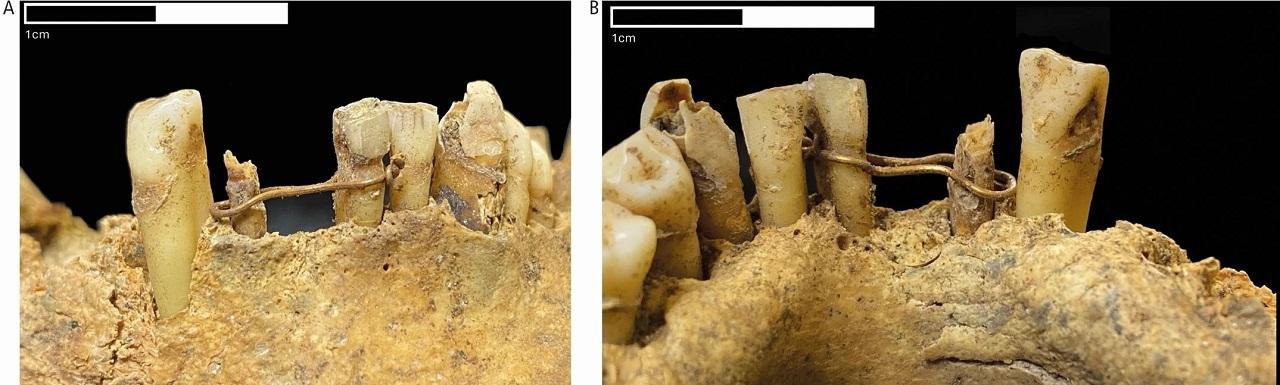
The research team used scanning electron microscopy and X-ray spectroscopy to study the material. Results showed the wire was made from a 20-carat gold alloy.
Gold dental ligatures have appeared in earlier archaeological contexts. Similar examples date to ancient Egypt around 2500 BCE, where gold or silver wires were attached to teeth. In some Egyptian burials, researchers think these wires were placed after death to present a complete body during burial.
Examples from Europe before the 17th century are rare. No earlier case had been identified in Scotland.
The study suggests a semi-skilled practitioner likely carried out the procedure. During the Middle Ages, physicians and surgeons rarely treated teeth. Dental care often fell to barbers, dentatores, or people with metalworking skills.
A jeweler is one likely candidate. Historical records show at least 22 goldsmiths worked in Aberdeen during this period. Producing a fine gold wire and securing the knot required technical skill, though not formal dental training.
The burial location points to a high social status. The man was buried inside the East Kirk of St. Nicholas, a burial place linked to wealth and privilege. Access to gold and custom dental work would have been expensive.
Researchers suggest practical needs were only part of the reason for this treatment. In Late Medieval and Early Modern Europe, physical appearance carried strong social meaning. People often linked visible health and appearance to personal character and morality.
A complete smile likely mattered for social reasons, especially for wealthier members of society.
Researchers could not determine whether the procedure took place in Aberdeen or elsewhere. Even so, the find adds new evidence for pre-modern restorative dentistry in Scotland.
The case joins a longer history of dental treatment. Archaeological evidence has shown modified teeth dating back about 14,000 years, along with a 6,500-year-old tooth filling made from beeswax in Slovenia.
This Scottish example shows people sought ways to repair damaged teeth centuries before modern dentistry existed.



Disclaimer: This website is a science-focused magazine that welcomes both academic and non-academic audiences. Comments are written by users and may include personal opinions or unverified claims. They do not necessarily reflect the views of our editorial team or rely on scientific evidence.
Comment Policy: We kindly ask all commenters to engage respectfully. Comments that contain offensive, insulting, degrading, discriminatory, or racist content will be automatically removed.