• About
  • Privacy Policy
  • Terms of Use
  • Donation
  • Contact
No Result
View All Result
Archaeology News
  • Home
  • News
    • Archaeology
    • Anthropology
    • Paleontology
  • Academic
    • Books
    • Conferences
    • Universities
  • Articles
  • VR Tours
  • Quiz & Game
  • Download
  • Encyclopedia
  • Forum
Archaeology News
No Result
View All Result
Home News Archaeology

New study reveals the hidden role of the Milky Way in Egyptian mythology

by Dario Radley
April 11, 2024

A new study published in the Journal of Astronomical History and Heritage has unveiled a captivating link between the ancient Egyptian sky goddess Nut and our galaxy, the Milky Way.
New study reveals the hidden role of the Milky Way in Egyptian mythology
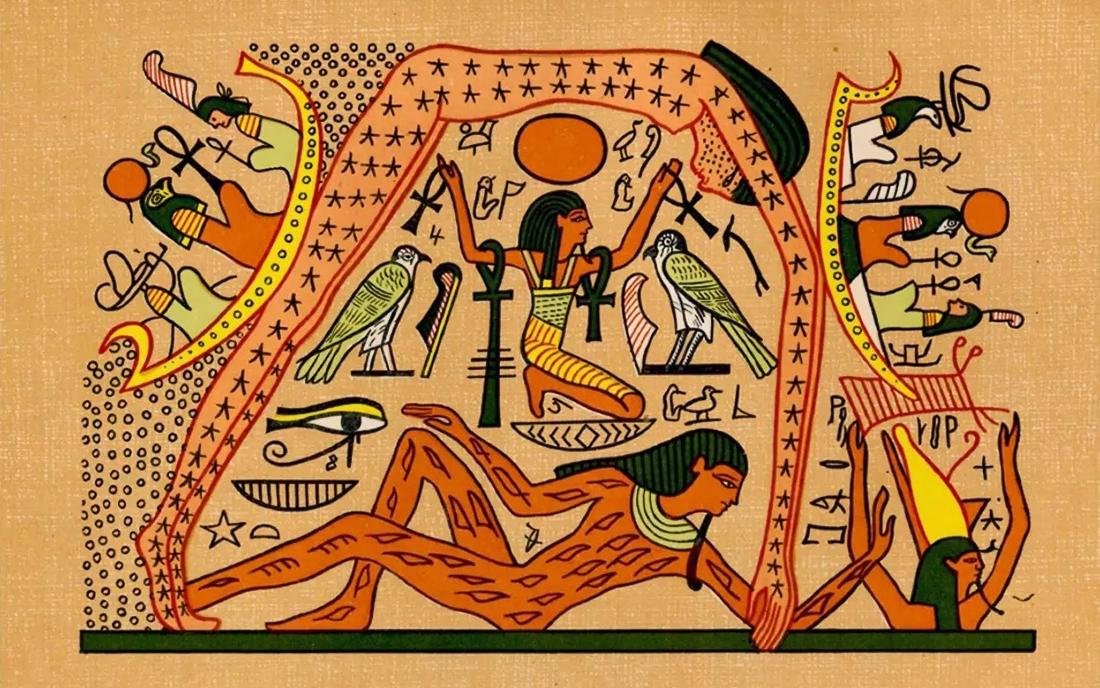
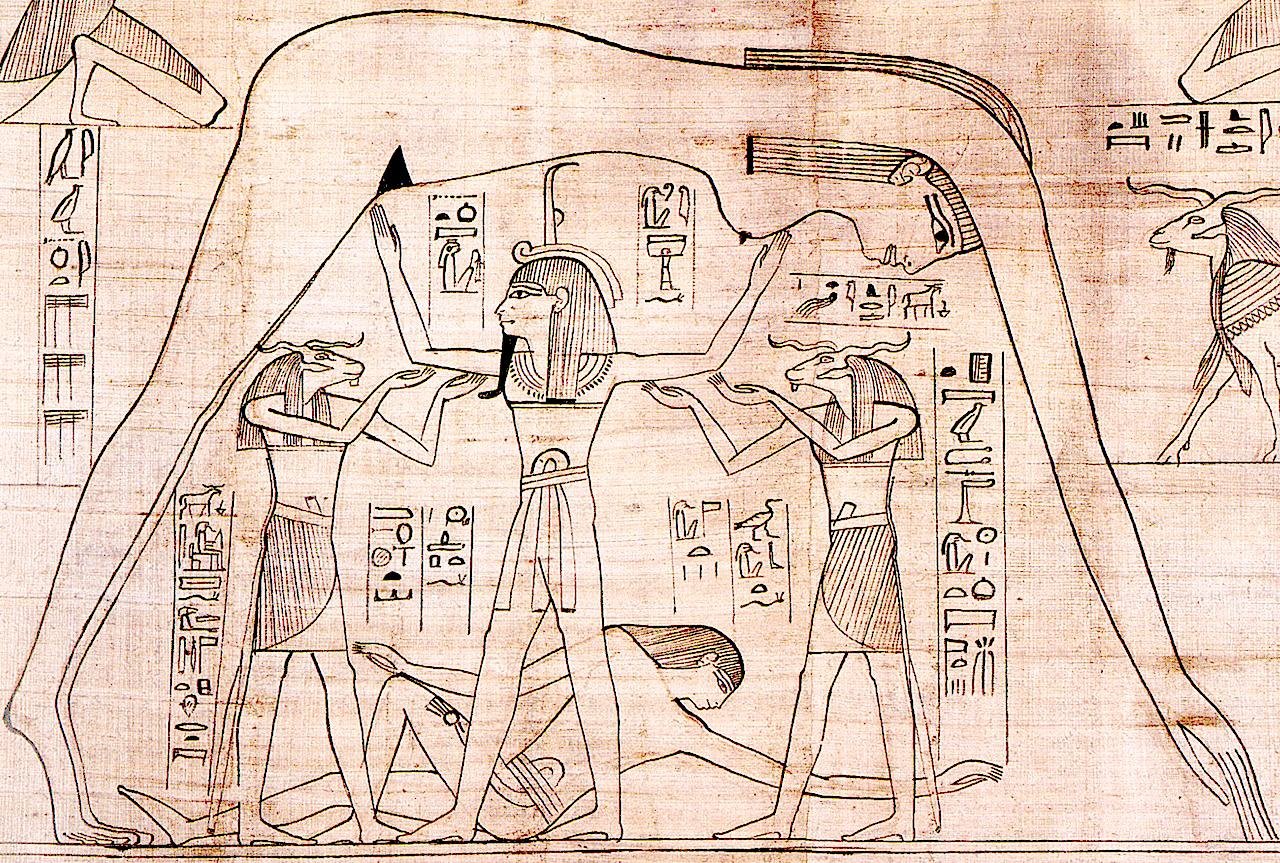
The sky goddess Nut, covered in stars, is held aloft by her father, Shu, and is arched over Geb, her brother the Earth god. On the left, the rising sun (the falcon-headed god Re) sails up Nut’s legs. On the right, the setting sun sails down her arms towards the outstretched arms of Osiris, who will regenerate the sun in the netherworld during the night. Credit: E. A. Wallis Budge, The Gods of the Egyptians, Vol. 2 (Methuen & Co., 1904).

Ancient Egyptian civilization, renowned for its keen observations of the celestial realm, intertwined astronomical phenomena seamlessly into their religious narratives, mythology, and timekeeping practices. While their reverence for the Sun, Moon, and planets is well-documented, the role of the Milky Way in Egyptian culture has long remained elusive.

Drawing upon a diverse array of ancient Egyptian texts such as the Pyramid Texts, Coffin Texts, and the Book of Nut, alongside advanced astronomical simulations, the study presents a compelling argument that Nut, the celestial goddess of the sky, stars, and the universe, served as a symbolic representation of the Milky Way.

Nut, often depicted as a star-adorned woman arching over her brother Geb, the earth god, played a pivotal role in Egyptian cosmology. She safeguarded the earth from the encroaching void and orchestrated the solar cycle, symbolically swallowing the Sun at dusk and giving birth to it at dawn. While ancient texts and archaeological evidence have long showcased the Egyptians’ adeptness at observing celestial bodies, the precise role of the Milky Way in their religious worldview remained elusive.
New study reveals the hidden role of the Milky Way in Egyptian mythology
Detail from the Greenfield Papyrus (the Book of the Dead of Nesitanebtashru). It depicts the air god Shu, assisted by the ram-headed Heh deities, supporting the sky goddess Nut as the earth god Geb reclines beneath. c. 950 BCE. Credit: What Life Was Like on the Banks of the Nile, edited by Denise Dersin, photographed by the British Museum/Wikipedia

The study posits that during winter, the Milky Way illuminated Nut’s outstretched arms, while in summer, it traced her backbone across the heavens. This celestial choreography, echoing the cyclical rhythm of the seasons, underscored Nut’s divine presence in the night sky.

RelatedStories

Ancient Egyptian tombs, painted coffins, and cat mummies unearthed in Luxor necropolis

Ancient Egyptian tombs, painted coffins, and cat mummies unearthed in Luxor necropolis

May 16, 2026
Ancient bathhouse and Roman villa with mosaics unearthed in Alexandria during rescue excavation

Ancient bathhouse and Roman villa with mosaics unearthed in Alexandria during rescue excavation

May 3, 2026

Dr. Graur’s exploration into the multifaceted symbolism of Nut extends beyond the boundaries of ancient Egypt, revealing striking parallels with diverse cultural interpretations of the Milky Way. Notably, Nut’s role in guiding the departed souls to the afterlife and her association with annual bird migrations resonate with analogous motifs found in North and Central American indigenous beliefs, as well as in Finnish and Baltic folklore.

By bridging the realms of astrophysics and Egyptology, this research marks a crucial step towards cataloging and studying the multicultural mythology of the Milky Way.

More information: Graur, O. (2024). The ancient Egyptian personification of the milky way as the sky-goddess nut: An astronomical and cross-cultural analysis. Journal of Astronomical History and Heritage, 27(1), 28–45. doi:10.3724/sp.j.1440-2807.2024.01.02

Share:

Share on Facebook Share on X (Twitter) Share on LinkedIn Share on Pinterest Share on WhatsApp Share on Email

You May Also Like...

Svalbard whalers show scurvy and extreme labor stress in “corpse point” cemetery
Anthropology

Svalbard whalers show scurvy and extreme labor stress in “corpse point” cemetery

May 25, 2026
'Patchwork families' lived in Europe over 5,000 years ago, Neolithic DNA study finds
Anthropology

‘Patchwork families’ lived in Europe over 5,000 years ago, Neolithic DNA study finds

May 25, 2026
100,000-year-old Homo sapiens bones from Ethiopia may preserve earliest evidence of human cremation
Anthropology

100,000-year-old Homo sapiens bones from Ethiopia may preserve earliest evidence of human cremation

May 24, 2026
Ancient Peruvian hairless dogs buried with Wari elites 1,200 years ago
Archaeology

Ancient Peruvian hairless dogs buried with Wari elites 1,200 years ago

May 24, 2026
4,000-year-old Mohenjo-daro study finds ancient city grew more equal over time
Archaeology

4,000-year-old Mohenjo-daro study finds ancient city grew more equal over time

May 24, 2026
Bronze Age towers in Sardinia remained centers of worship and ritual in the Iron Age
Archaeology

Bronze Age towers in Sardinia remained centers of worship and ritual in the Iron Age

May 23, 2026

Follow us


Instagram
242K

Facebook
117K

Threads
46K

LinkedIn
14K

Twitter
6K

YouTube
1K
Svalbard whalers show scurvy and extreme labor stress in “corpse point” cemetery

Svalbard whalers show scurvy and extreme labor stress in “corpse point” cemetery

May 25, 2026
'Patchwork families' lived in Europe over 5,000 years ago, Neolithic DNA study finds

‘Patchwork families’ lived in Europe over 5,000 years ago, Neolithic DNA study finds

May 25, 2026
100,000-year-old Homo sapiens bones from Ethiopia may preserve earliest evidence of human cremation

100,000-year-old Homo sapiens bones from Ethiopia may preserve earliest evidence of human cremation

May 24, 2026
Ancient Peruvian hairless dogs buried with Wari elites 1,200 years ago

Ancient Peruvian hairless dogs buried with Wari elites 1,200 years ago

May 24, 2026

Archaeology News online magazine

Archaeology News is an international online magazine that covers all aspects of archaeology.


Categories

  • Academics
    • Books
    • Conferences
    • Universities
  • Articles
  • Download
  • Game
  • News
    • Anthropology
    • Archaeology
    • Paleontology
  • Quiz
  • Tours

Subscribe to our newsletter

© 2024 - Archaeology News Online Magazine. All Rights Reserved.

  • About
  • Privacy Policy
  • Terms of Use
  • Donation
  • Contact

Manage Consent
To provide the best experiences, we use technologies like cookies to store and/or access device information. Consenting to these technologies will allow us to process data such as browsing behavior or unique IDs on this site. Not consenting or withdrawing consent, may adversely affect certain features and functions.
Functional Always active
The technical storage or access is strictly necessary for the legitimate purpose of enabling the use of a specific service explicitly requested by the subscriber or user, or for the sole purpose of carrying out the transmission of a communication over an electronic communications network.
Preferences
The technical storage or access is necessary for the legitimate purpose of storing preferences that are not requested by the subscriber or user.
Statistics
The technical storage or access that is used exclusively for statistical purposes. The technical storage or access that is used exclusively for anonymous statistical purposes. Without a subpoena, voluntary compliance on the part of your Internet Service Provider, or additional records from a third party, information stored or retrieved for this purpose alone cannot usually be used to identify you.
Marketing
The technical storage or access is required to create user profiles to send advertising, or to track the user on a website or across several websites for similar marketing purposes.
  • Manage options
  • Manage services
  • Manage {vendor_count} vendors
  • Read more about these purposes
View preferences
  • {title}
  • {title}
  • {title}
  • Home
  • News
    • Archaeology
    • Anthropology
    • Paleontology
  • Academic
    • Books
    • Conferences
    • Universities
  • Articles
  • VR Tours
  • Quiz & Game
  • Download
  • Encyclopedia
  • Forum

About  .  Contact  .  Donation

© 2024 - Archaeology News Online Magazine. All Rights Reserved