• About
  • Privacy Policy
  • Terms of Use
  • Donation
  • Contact
No Result
View All Result
Archaeology News
  • Home
  • News
    • Archaeology
    • Anthropology
    • Paleontology
  • Academic
    • Books
    • Conferences
    • Universities
  • Articles
  • VR Tours
  • Quiz & Game
  • Download
  • Encyclopedia
  • Forum
Archaeology News
No Result
View All Result
Home News Archaeology

2,000-year-old artifacts from mysterious culture discovered in Kazakhstan

by Dario Radley
May 31, 2024

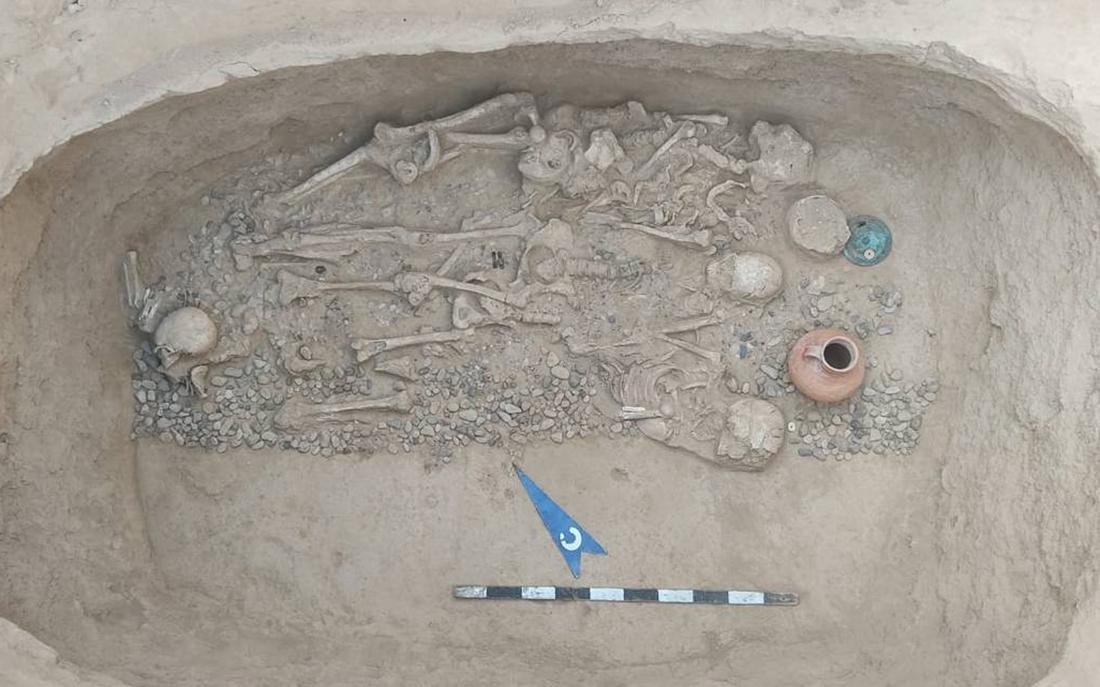
In the Turkistan region of southern Kazakhstan, archaeologists have made a significant discovery of ancient artifacts, including gold jewelry, arrowheads, and a large bronze mirror, dating back approximately 2,000 years.
2,000-year-old artifacts from mysterious culture discovered in Kazakhstan
Archaeologists excavated three ancient graves in the Tolebaitobe burial ground. Credit: Ozbekali Zhanibekov South Kazakhstan Pedagogical University

The discoveries were made at the Tolebaitobe burial ground in the Karaaspan rural district of the Ordabasy district. The artifacts are thought to have been made at the time of the Kangju state, a relatively obscure entity that controlled this area between the fifth century BCE and the fourth century CE.

The excavations were conducted by a team from Kazakhstan’s Ozbekali Zhanibekov University and local government archaeologists. They explored three burial mounds in the Ordabasinsky district. While two of these mounds had been looted in antiquity, the third remained intact, revealing a treasure trove of artifacts that demonstrate the high level of craftsmanship and the extensive trade connections of the Kangju state.

Among the most notable discoveries was a bronze mirror believed to originate from China during the Han dynasty (206 BCE to 220 CE). The mirror is circular, with an eight-sided arched design on the back and a central hole for threading. Similar mirrors have been found across Eurasia, including in Afghanistan and the southern Ural region. This particular mirror was found in the grave of a high-status woman, suggesting her wealth and influence.
2,000-year-old artifacts from mysterious culture discovered in Kazakhstan
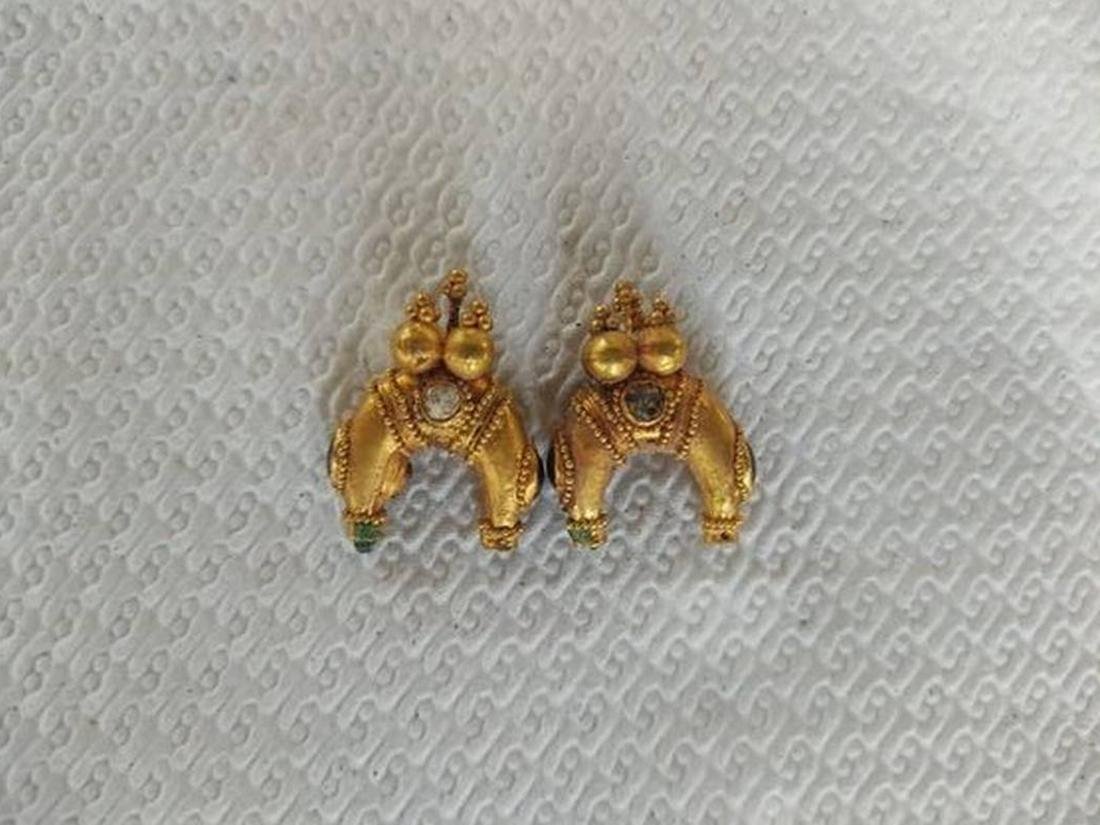
Two highly ornate gold earrings found at the site. Credit: Ozbekali Zhanibekov South Kazakhstan Pedagogical University

The archaeologists also uncovered a range of other artifacts, including a Roman-style brooch known as a fibula, various beads, a pottery jug, a shoe, a belt buckle, and an arrowhead designed for hunting birds.

RelatedStories

100 Abbasid-era gold jewelry pieces found at ancient Dariyah site in Saudi Arabia

100 Abbasid-era gold jewelry pieces found at ancient Dariyah site in Saudi Arabia

May 22, 2026
Ancient texts reveal how Persian and Greek rule shaped language in Central Asia

Ancient texts reveal how Persian and Greek rule shaped language in Central Asia

May 20, 2026

Among these items were two highly ornate gold earrings dating back to the first century BCE. These earrings, crafted from a colorful alloy known as polychromatic gold, are crescent-shaped to represent the moon and adorned with turquoise and rubies. Their intricate design, featuring decorations resembling clusters of grapes, was intended to reflect sunlight.

According to officials from the regional government of Turkistan, these artifacts demonstrate the sophisticated craftsmanship of the Kangju state and its connections with powerful empires such as Rome, Byzantium, the Kushan Empire, and China.”

The Kangju state was a federation of different peoples, including nomadic groups such as the Sarmatians, Xiongnu, and Saka (possibly Scythians). Its location along the Great Silk Road facilitated diplomatic and trade relations across the ancient world.”

The Kangju state, sometimes referred to as “Kanly,” thrived as a major economic and cultural hub along the Silk Road, the ancient trade routes that linked China with the Mediterranean. Despite its eventual decline, the state’s legacy is evident in the artifacts unearthed in Turkistan.

Researchers involved in the excavation noted that the artifacts found in the third mound had been well-preserved. The artifacts will soon be displayed at the National Museum of the Republic of Kazakhstan in Astana.

Share:

Share on Facebook Share on X (Twitter) Share on LinkedIn Share on Pinterest Share on WhatsApp Share on Email

You May Also Like...

2,300-year-old Iron Age riverside structure discovered beneath German city astonishes archaeologists
Archaeology

2,300-year-old Iron Age riverside structure discovered beneath German city

May 22, 2026
100 Abbasid-era gold jewelry pieces found at ancient Dariyah site in Saudi Arabia
Archaeology

100 Abbasid-era gold jewelry pieces found at ancient Dariyah site in Saudi Arabia

May 22, 2026
Neanderthals gathered shellfish like modern humans 115,000 years ago, study finds
Anthropology

Neanderthals gathered shellfish like modern humans 115,000 years ago, study finds

May 21, 2026
Ancient pigeons were already living alongside humans 3,400 years ago, study finds
Archaeology

Ancient pigeons were already living alongside humans 3,400 years ago, study finds

May 21, 2026
Ancient Venetic sanctuary with rare inscriptions unearthed beneath road project in Italy
Archaeology

Ancient Venetic sanctuary with rare inscriptions unearthed beneath road project in Italy

May 21, 2026
1,000-year-old dingo burial in Australia reveals deep ties between Barkindji people and dingoes
Archaeology

1,000-year-old ritually buried dingo in Australia reveals deep ties between Barkindji people and dingoes

May 20, 2026

Follow us


Instagram
242K

Facebook
117K

Threads
46K

LinkedIn
14K

Twitter
6K

YouTube
1K
2,300-year-old Iron Age riverside structure discovered beneath German city astonishes archaeologists

2,300-year-old Iron Age riverside structure discovered beneath German city

May 22, 2026
100 Abbasid-era gold jewelry pieces found at ancient Dariyah site in Saudi Arabia

100 Abbasid-era gold jewelry pieces found at ancient Dariyah site in Saudi Arabia

May 22, 2026
Neanderthals gathered shellfish like modern humans 115,000 years ago, study finds

Neanderthals gathered shellfish like modern humans 115,000 years ago, study finds

May 21, 2026
Ancient pigeons were already living alongside humans 3,400 years ago, study finds

Ancient pigeons were already living alongside humans 3,400 years ago, study finds

May 21, 2026

Archaeology News online magazine

Archaeology News is an international online magazine that covers all aspects of archaeology.


Categories

  • Academics
    • Books
    • Conferences
    • Universities
  • Articles
  • Download
  • Game
  • News
    • Anthropology
    • Archaeology
    • Paleontology
  • Quiz
  • Tours

Subscribe to our newsletter

© 2024 - Archaeology News Online Magazine. All Rights Reserved.

  • About
  • Privacy Policy
  • Terms of Use
  • Donation
  • Contact

Manage Consent
To provide the best experiences, we use technologies like cookies to store and/or access device information. Consenting to these technologies will allow us to process data such as browsing behavior or unique IDs on this site. Not consenting or withdrawing consent, may adversely affect certain features and functions.
Functional Always active
The technical storage or access is strictly necessary for the legitimate purpose of enabling the use of a specific service explicitly requested by the subscriber or user, or for the sole purpose of carrying out the transmission of a communication over an electronic communications network.
Preferences
The technical storage or access is necessary for the legitimate purpose of storing preferences that are not requested by the subscriber or user.
Statistics
The technical storage or access that is used exclusively for statistical purposes. The technical storage or access that is used exclusively for anonymous statistical purposes. Without a subpoena, voluntary compliance on the part of your Internet Service Provider, or additional records from a third party, information stored or retrieved for this purpose alone cannot usually be used to identify you.
Marketing
The technical storage or access is required to create user profiles to send advertising, or to track the user on a website or across several websites for similar marketing purposes.
  • Manage options
  • Manage services
  • Manage {vendor_count} vendors
  • Read more about these purposes
View preferences
  • {title}
  • {title}
  • {title}
  • Home
  • News
    • Archaeology
    • Anthropology
    • Paleontology
  • Academic
    • Books
    • Conferences
    • Universities
  • Articles
  • VR Tours
  • Quiz & Game
  • Download
  • Encyclopedia
  • Forum

About  .  Contact  .  Donation

© 2024 - Archaeology News Online Magazine. All Rights Reserved