• About
  • Privacy Policy
  • Terms of Use
  • Donation
  • Contact
No Result
View All Result
Archaeology News
  • Home
  • News
    • Archaeology
    • Anthropology
    • Paleontology
  • Academic
    • Books
    • Conferences
    • Universities
  • Articles
  • VR Tours
  • Quiz & Game
  • Download
  • Encyclopedia
  • Forum
Archaeology News
No Result
View All Result
Home News Anthropology

450,000-year-old human tooth unearthed in Qaleh Kurd Cave, Iran

by Dario Radley
May 27, 2024

A collaborative team of French and Iranian archaeologists has unearthed evidence of early human occupation in Iran’s Central Plateau.
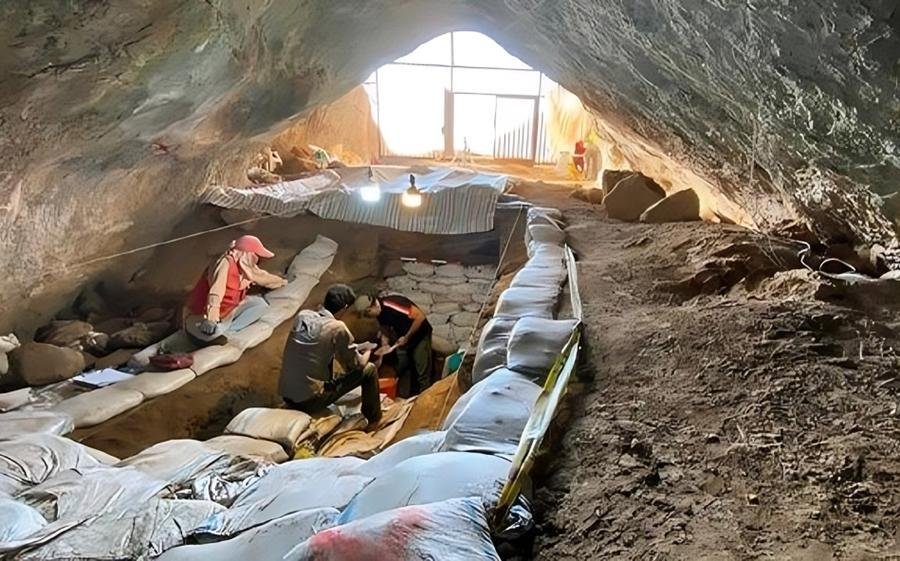
450,000-year-old human tooth unearthed in Qaleh Kurd Cave, Iran
Qaleh Kurd Cave in Iran

The discovery at Qaleh Kurd Cave in Qazvin has extended the timeline of human settlement in the region by over 300,000 years, according to research published in the Journal of Paleolithic Archaeology on May 23. This significant finding includes a human deciduous tooth and a rich assemblage of lithic and faunal materials, providing new insights into early human dispersals and cultural interactions across the region.

The Iranian Central Plateau, flanked by the Alborz and Zagros Mountains, is a critical archaeological area due to its strategic position at the crossroads of the Levant, the Caucasus, Central Asia, and East Asia. This location has historically served as a vital corridor for human migration and interaction during the Pleistocene epoch.

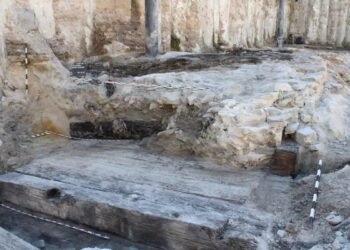
The joint Iranian and French Paleoanthropological Project focused on Qaleh Kurd Cave, situated at the western edge of the Central Plateau near the Zagros Mountains. The excavations revealed that the cave was occupied by humans between approximately 452,000 and 165,000 years ago. This period predates the previously known evidence of human habitation in the area, which had been dated to around 80,000 years ago.

450,000-year-old human tooth unearthed in Qaleh Kurd Cave, Iran
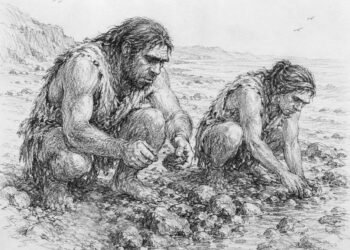
A reconstruction of a Neanderthal child.

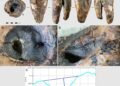
Central to this discovery is a human deciduous first upper molar, found in the upper part of the Middle Pleistocene sequence. This tooth, along with a diverse collection of lithic tools and faunal remains, indicates that the cave was recurrently occupied by early Middle Paleolithic cultures. The faunal assemblage, predominantly composed of horse bones, shows extensive evidence of butchery.

RelatedStories

Ancient herpesvirus genomes reveal a 2,500-year history of human infection

Ancient herpesvirus genomes reveal a 2,500-year history of human infection

January 4, 2026
Inside scoop: the 2,500-year history of ice-cream

Inside scoop: the 2,500-year history of ice-cream

January 3, 2026

The findings at Qaleh Kurd Cave suggest cultural connections with contemporary assemblages in the Caucasus and the Levant, and later Middle Paleolithic cultures in the Zagros region. This discovery enriches our understanding of human evolution during the Middle Pleistocene and underscores the significance of the Iranian Plateau as a crossroads for ancient human populations moving between the Levant, the Caucasus, Central Asia, and East Asia.

A researcher from the University of Tehran, who spoke with bne IntelliNews, emphasized the discovery’s importance: “This discovery not only enriches our understanding of human evolution in the Middle Pleistocene but also underscores the significance of the Iranian Plateau as a crossroads for ancient human populations.”

With 27 sites, Iran is among the top 10 countries with the most cultural heritage sites on UNESCO’s World Heritage List and remains a focal point for archaeological research and conservation efforts. While significant discoveries continue to be made, conducting archaeological research in the region is not without challenges. Political instability, logistical issues such as visa restrictions, and environmental factors like increasing rainfall pose threats to archaeological sites.

Despite the challenges, each discovery, such as the 450,000-year-old tooth at Qaleh Kurd Cave, reaffirms the region’s pivotal role in the mosaic of human history.

More information: Vahdati Nasab, H., Berillon, G., Hashemi, S.M. et al. (2024). Qaleh Kurd Cave (Qazvin, Iran): Oldest Evidence of Middle Pleistocene Hominin Occupations and a Human Deciduous Tooth in the Iranian Central Plateau. J Paleo Arch 7, 16. doi:10.1007/s41982-024-00180-4
Share6Tweet4Share1ShareSend

You May Also Like...

60,000-year-old poison arrows from South Africa reveal the world’s earliest poisoned weapons and advanced hunting techniques
Archaeology

60,000-year-old poison arrows from South Africa reveal the world’s earliest poisoned weapons and advanced hunting techniques

January 8, 2026
Inscribed clay cylinders reveal Nebuchadnezzar II’s restoration of the Kish Ziggurat
Archaeology

Inscribed clay cylinders reveal Nebuchadnezzar II’s restoration of the Kish Ziggurat

January 7, 2026
Rare Late Roman mosaic with Solomon’s Knot discovered beneath modern İzmir
Archaeology

Rare Late Roman mosaic with Solomon’s Knot discovered beneath modern İzmir

January 7, 2026
1130 depiction of Saxons, Jutes, and Angles crossing the sea to Britain. Credit: Wikimedia / CC BY-SA 4.0. Roots of medieval migration into England uncovered by large-scale bioarchaeological study
Anthropology

Roots of medieval migration into England uncovered by large-scale bioarchaeological study

January 6, 2026
Rare Celtic gold coins found in Swiss bog may reveal ancient ritual offerings
Archaeology

Rare Celtic gold coins found in Swiss bog may reveal ancient ritual offerings

January 5, 2026
Rare medieval gold ring unearthed in Tønsberg
Archaeology

Rare medieval gold ring unearthed in Tønsberg reveals beliefs and craftsmanship of its time

January 5, 2026

Follow us


Instagram
244K

Facebook
118K

Threads
45K

LinkedIn
14K

Twitter
6K

YouTube
1K
  • Trending
  • Comments
  • Latest
Shipwreck Salvage. Credit: rawpixel.com / Public Domain

2,000-year-old shipwreck discovered off Turkish coast with remarkably preserved stacked ceramics

July 2, 2025
Viking age DNA reveals 9,000-year-old HIV-resistant gene originating near the Black Sea

Viking age DNA reveals 9,000-year-old HIV-resistant gene originating near the Black Sea

May 18, 2025
A new study suggests the mysterious Voynich Manuscript may be a medieval cipher

A new study suggests the mysterious Voynich Manuscript may be a medieval cipher

January 3, 2026
Moses may be named in ancient Egyptian mine inscriptions, sparking debate over earliest biblical references

Moses may be named in ancient Egyptian mine inscriptions, sparking debate over earliest biblical references

July 31, 2025
Mystery of Armenia’s 6,000-year-old dragon stones solved

Mystery of Armenia’s 6,000-year-old dragon stones solved

September 23, 2025
3D analysis reveals Shroud of Turin image likely came from sculpture, not Jesus’ body

3D analysis reveals Shroud of Turin image likely came from sculpture, not Jesus’ body

Moses may be named in ancient Egyptian mine inscriptions, sparking debate over earliest biblical references

Moses may be named in ancient Egyptian mine inscriptions, sparking debate over earliest biblical references

$1 million prize offered to decipher 5,300-year-old Indus Valley script

$1 million prize offered to decipher 5,300-year-old Indus Valley script

Oldest ever genetic data from a human relative found in 2-million-year-old fossilized teeth

Oldest ever genetic data from a human relative found in 2-million-year-old fossilized teeth

Exceptionally large Roman shoes discovered at Magna fort near Hadrian’s Wall

Exceptionally large Roman shoes discovered at Magna fort near Hadrian’s Wall

60,000-year-old poison arrows from South Africa reveal the world’s earliest poisoned weapons and advanced hunting techniques

60,000-year-old poison arrows from South Africa reveal the world’s earliest poisoned weapons and advanced hunting techniques

January 8, 2026
Inscribed clay cylinders reveal Nebuchadnezzar II’s restoration of the Kish Ziggurat

Inscribed clay cylinders reveal Nebuchadnezzar II’s restoration of the Kish Ziggurat

January 7, 2026
Rare Late Roman mosaic with Solomon’s Knot discovered beneath modern İzmir

Rare Late Roman mosaic with Solomon’s Knot discovered beneath modern İzmir

January 7, 2026
1130 depiction of Saxons, Jutes, and Angles crossing the sea to Britain. Credit: Wikimedia / CC BY-SA 4.0. Roots of medieval migration into England uncovered by large-scale bioarchaeological study

Roots of medieval migration into England uncovered by large-scale bioarchaeological study

January 6, 2026
Rare Celtic gold coins found in Swiss bog may reveal ancient ritual offerings

Rare Celtic gold coins found in Swiss bog may reveal ancient ritual offerings

January 5, 2026

Archaeology News online magazine

Archaeology News is an international online magazine that covers all aspects of archaeology.


Categories

  • Academics
    • Books
    • Conferences
    • Universities
  • Articles
  • Download
  • Game
  • News
    • Anthropology
    • Archaeology
    • Paleontology
  • Quiz
  • Tours

Subscribe to our newsletter

© 2024 - Archaeology News Online Magazine. All Rights Reserved.

  • About
  • Privacy Policy
  • Terms of Use
  • Donation
  • Contact

Welcome Back!

Login to your account below

Forgotten Password? Sign Up

Create New Account!

Fill the forms below to register

All fields are required. Log In

Retrieve your password

Please enter your username or email address to reset your password.

Log In

Add New Playlist

Manage Consent
To provide the best experiences, we use technologies like cookies to store and/or access device information. Consenting to these technologies will allow us to process data such as browsing behavior or unique IDs on this site. Not consenting or withdrawing consent, may adversely affect certain features and functions.
Functional Always active
The technical storage or access is strictly necessary for the legitimate purpose of enabling the use of a specific service explicitly requested by the subscriber or user, or for the sole purpose of carrying out the transmission of a communication over an electronic communications network.
Preferences
The technical storage or access is necessary for the legitimate purpose of storing preferences that are not requested by the subscriber or user.
Statistics
The technical storage or access that is used exclusively for statistical purposes. The technical storage or access that is used exclusively for anonymous statistical purposes. Without a subpoena, voluntary compliance on the part of your Internet Service Provider, or additional records from a third party, information stored or retrieved for this purpose alone cannot usually be used to identify you.
Marketing
The technical storage or access is required to create user profiles to send advertising, or to track the user on a website or across several websites for similar marketing purposes.
  • Manage options
  • Manage services
  • Manage {vendor_count} vendors
  • Read more about these purposes
View preferences
  • {title}
  • {title}
  • {title}
  • Home
  • News
    • Archaeology
    • Anthropology
    • Paleontology
  • Academic
    • Books
    • Conferences
    • Universities
  • Articles
  • VR Tours
  • Quiz & Game
  • Download
  • Encyclopedia
  • Forum

About  .  Contact  .  Donation

© 2024 - Archaeology News Online Magazine. All Rights Reserved