• About
  • Privacy Policy
  • Terms of Use
  • Donation
  • Contact
No Result
View All Result
Archaeology News
  • Home
  • News
    • Archaeology
    • Anthropology
    • Paleontology
  • Academic
    • Books
    • Conferences
    • Universities
  • Articles
  • VR Tours
  • Quiz & Game
  • Download
  • Encyclopedia
  • Forum
Archaeology News
No Result
View All Result
Home News Anthropology

33 Greco-Roman era tombs uncovered in Aswan

by Dario Radley
June 25, 2024

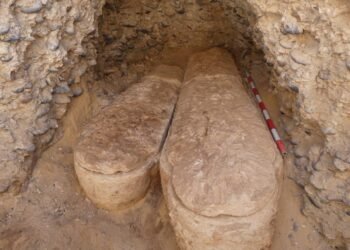
An Egyptian-Italian archaeological mission has uncovered 33 family tombs from the Greco-Roman period near the Aga Khan Mausoleum in Aswan, Egypt.

The joint mission, led by Dr. Mohamed Ismail Khaled, Secretary-General of the Supreme Council of Antiquities, and Professor Patrizia Piacentini from the University of Milan, made the announcement earlier this month. The tombs, discovered west of Aswan’s Nile, date back to the Late Period and the Greco-Roman era, spanning from the sixth century BCE to the third century CE.

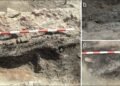
The Aga Khan Mausoleum, the resting place of Aga Khan III, Sir Sultan Muhammed Shah, who passed away in 1957, now sits above a necropolis with over 400 tombs. Dr. Khaled noted that it adds a new historical dimension to the Aga Khan area. The tombs vary in architectural style, with some featuring arched entrances and open courtyards made from mudbrick, while others are directly carved into the mountain rock. This diversity reflects the social stratification of the period.

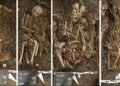
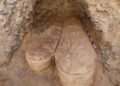
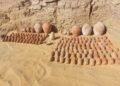
Among the notable finds are mummified remains and funerary objects, including clay figures, sacrificial tables, ceramics, and painted cartonnages. An intriguing discovery within a stone coffin revealed the mummified remains of an adult and a child, likely adhered together by embalming fluids. Further analysis is planned to understand their relationship.

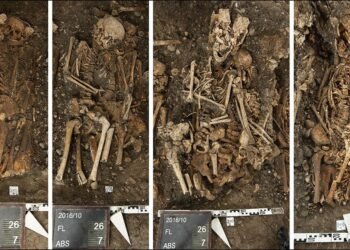
Anthropological and radiological studies have provided insights into the health conditions of buried individuals. Dr. Patricia Piachenti from the University of Milan noted that 30% to 40% of the deceased were infants, children, or adolescents. This high mortality rate among the young offers clues about prevalent diseases during that period. The remains of several adult women showed signs of pelvic bone trauma, suggesting childbirth complications or other medical conditions. Other mummies exhibited evidence of anemia, malnutrition, chest diseases, tuberculosis, and osteoporosis.
RelatedStories

Ancient Egyptian tombs, painted coffins, and cat mummies unearthed in Luxor necropolis

Ancient Egyptian tombs, painted coffins, and cat mummies unearthed in Luxor necropolis

May 16, 2026
Ancient bathhouse and Roman villa with mosaics unearthed in Alexandria during rescue excavation

Ancient bathhouse and Roman villa with mosaics unearthed in Alexandria during rescue excavation

May 3, 2026

“Initial studies reveal that many individuals suffered from infectious diseases and bone disorders,” said Dr. Piacentini. “Some adult females showed signs of medical interventions such as amputations and bone trauma, indicating that ancient Aswan had developed some medical practices.”

Dr. Ayman Ashmawy, Head of the Egyptian Antiquities Sector, said that the lower parts of the necropolis were likely reserved for the middle-class residents of Aswan Island, including physicians, artisans, merchants, and storekeepers. The upper parts of the necropolis, however, appear to have been reserved for the wealthier upper class. This social stratification is reflected in the differing architectural styles and the types of artifacts found within the tombs.

The discoveries also include remains of colored cartonnage, clay and stone figurines, wooden coffins, and offering tables. The tombs’ architectural complexity reflects the advanced skills of the ancient craftsmen who overcame the challenges of digging into rock and constructing low-ceilinged funerary rooms and galleries.

The mission has employed the latest technology, including X-ray and CT scans, to analyze the mummies and artifacts. These technologies have allowed researchers to create three-dimensional reconstructions of the mummies and identify items such as bracelets found on some individuals.
Share:

Share on Facebook Share on X (Twitter) Share on LinkedIn Share on Pinterest Share on WhatsApp Share on Email

You May Also Like...

Svalbard whalers show scurvy and extreme labor stress in “corpse point” cemetery
Anthropology

Svalbard whalers show scurvy and extreme labor stress in “corpse point” cemetery

May 25, 2026
'Patchwork families' lived in Europe over 5,000 years ago, Neolithic DNA study finds
Anthropology

‘Patchwork families’ lived in Europe over 5,000 years ago, Neolithic DNA study finds

May 25, 2026
100,000-year-old Homo sapiens bones from Ethiopia may preserve earliest evidence of human cremation
Anthropology

100,000-year-old Homo sapiens bones from Ethiopia may preserve earliest evidence of human cremation

May 24, 2026
Ancient Peruvian hairless dogs buried with Wari elites 1,200 years ago
Archaeology

Ancient Peruvian hairless dogs buried with Wari elites 1,200 years ago

May 24, 2026
4,000-year-old Mohenjo-daro study finds ancient city grew more equal over time
Archaeology

4,000-year-old Mohenjo-daro study finds ancient city grew more equal over time

May 24, 2026
Bronze Age towers in Sardinia remained centers of worship and ritual in the Iron Age
Archaeology

Bronze Age towers in Sardinia remained centers of worship and ritual in the Iron Age

May 23, 2026

Follow us


Instagram
242K

Facebook
117K

Threads
46K

LinkedIn
14K

Twitter
6K

YouTube
1K
Svalbard whalers show scurvy and extreme labor stress in “corpse point” cemetery

Svalbard whalers show scurvy and extreme labor stress in “corpse point” cemetery

May 25, 2026
'Patchwork families' lived in Europe over 5,000 years ago, Neolithic DNA study finds

‘Patchwork families’ lived in Europe over 5,000 years ago, Neolithic DNA study finds

May 25, 2026
100,000-year-old Homo sapiens bones from Ethiopia may preserve earliest evidence of human cremation

100,000-year-old Homo sapiens bones from Ethiopia may preserve earliest evidence of human cremation

May 24, 2026
Ancient Peruvian hairless dogs buried with Wari elites 1,200 years ago

Ancient Peruvian hairless dogs buried with Wari elites 1,200 years ago

May 24, 2026

Archaeology News online magazine

Archaeology News is an international online magazine that covers all aspects of archaeology.


Categories

  • Academics
    • Books
    • Conferences
    • Universities
  • Articles
  • Download
  • Game
  • News
    • Anthropology
    • Archaeology
    • Paleontology
  • Quiz
  • Tours

Subscribe to our newsletter

© 2024 - Archaeology News Online Magazine. All Rights Reserved.

  • About
  • Privacy Policy
  • Terms of Use
  • Donation
  • Contact

Manage Consent
To provide the best experiences, we use technologies like cookies to store and/or access device information. Consenting to these technologies will allow us to process data such as browsing behavior or unique IDs on this site. Not consenting or withdrawing consent, may adversely affect certain features and functions.
Functional Always active
The technical storage or access is strictly necessary for the legitimate purpose of enabling the use of a specific service explicitly requested by the subscriber or user, or for the sole purpose of carrying out the transmission of a communication over an electronic communications network.
Preferences
The technical storage or access is necessary for the legitimate purpose of storing preferences that are not requested by the subscriber or user.
Statistics
The technical storage or access that is used exclusively for statistical purposes. The technical storage or access that is used exclusively for anonymous statistical purposes. Without a subpoena, voluntary compliance on the part of your Internet Service Provider, or additional records from a third party, information stored or retrieved for this purpose alone cannot usually be used to identify you.
Marketing
The technical storage or access is required to create user profiles to send advertising, or to track the user on a website or across several websites for similar marketing purposes.
  • Manage options
  • Manage services
  • Manage {vendor_count} vendors
  • Read more about these purposes
View preferences
  • {title}
  • {title}
  • {title}
  • Home
  • News
    • Archaeology
    • Anthropology
    • Paleontology
  • Academic
    • Books
    • Conferences
    • Universities
  • Articles
  • VR Tours
  • Quiz & Game
  • Download
  • Encyclopedia
  • Forum

About  .  Contact  .  Donation

© 2024 - Archaeology News Online Magazine. All Rights Reserved