• About
  • Privacy Policy
  • Terms of Use
  • Donation
  • Contact
No Result
View All Result
Archaeology News
  • Home
  • News
    • Archaeology
    • Anthropology
    • Paleontology
  • Academic
    • Books
    • Conferences
    • Universities
  • Articles
  • VR Tours
  • Quiz & Game
  • Download
  • Encyclopedia
  • Forum
Archaeology News
No Result
View All Result
Home News Archaeology

South America reveals largest known prehistoric rock art worldwide

by Dario Radley
June 4, 2024

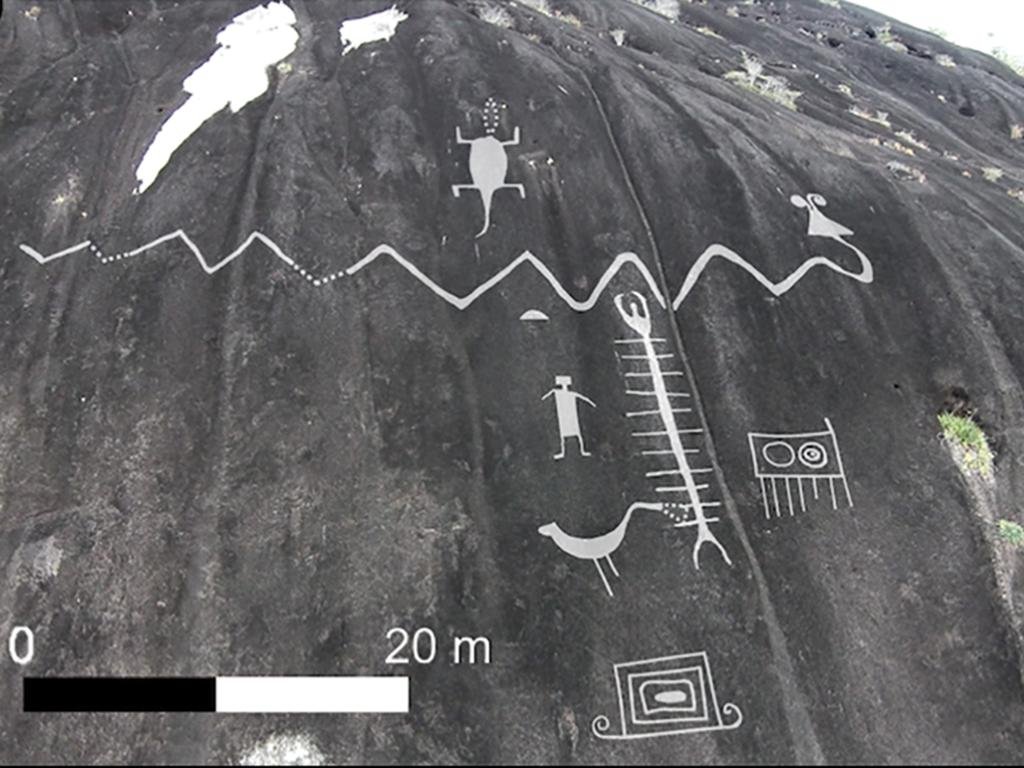
A monumental discovery of prehistoric rock engravings along the Upper and Middle Orinoco River in Venezuela and Colombia has revealed what researchers believe to be the largest prehistoric rock art in the world.
South America reveals largest known prehistoric rock art worldwide
Monumental snake engravings: Pintado, approximately 42m long. Credit: Riris, P. et al. Antiquity, (2024)

This research, conducted by an international team from Bournemouth University, University College London (UCL), and Universidad de los Andes, highlights the cultural and historical significance of these massive carvings, which include depictions of giant snakes, human figures, and Amazonian centipedes.

The engravings, found on rock faces along the Orinoco River, feature motifs that span tens of meters in length. The largest known engraving measures over 40 meters, making it the biggest single rock engraving ever recorded. The team’s efforts, which included working with local guides and employing drone photography, have led to the mapping of 14 monumental rock engraving sites—defined as those more than four meters wide or high.

South America reveals largest known prehistoric rock art worldwide
Snake, bird and human motifs at Raudal Palomazón. Note size of the snake relative to other motifs. Credit: Riris, P. et al. Antiquity, (2024)

Many of the largest engravings depict snakes, believed to represent boa constrictors or anacondas. These creatures hold a significant place in the myths and beliefs of the Indigenous populations of the region. According to Dr. Phil Riris, Senior Lecturer in Archaeological Environmental Modelling at Bournemouth University and lead author of the study, “Anacondas and boas are associated with the creator deity of some Indigenous groups in the region and are also seen as lethal beings that can kill people and large animals.”

South America reveals largest known prehistoric rock art worldwide
Anthropomorphic mask motif (known as ‘the television’) at Raudal Mesetas. Credit: Riris, P. et al. Antiquity, (2024)

These engravings are thought to serve multiple purposes. Dr. Riris explains, “We believe the engravings could have been used by prehistoric groups to mark territory, letting people know that this is where they live and that appropriate behavior is expected. Snakes are generally interpreted as quite threatening, so where the rock art is located could be a signal that these are places where you need to mind your manners.”

RelatedStories

40,000-year-old European engravings reveal structured sign systems, study finds

40,000-year-old European engravings reveal structured sign systems, study finds

February 25, 2026
10,000 years of rock art discovered at Umm Arak Plateau in Egypt’s southern Sinai

10,000 years of rock art discovered at Umm Arak Plateau in Egypt’s southern Sinai

February 15, 2026

The rock engravings are believed to date back up to 2,000 years, although their precise age remains difficult to determine. Similar motifs found on pottery in the area support this estimation. Since 2015, a research project initiated by Dr. José Oliver with the UCL Institute of Archaeology has been focused on understanding the pre-Columbian occupation and history of the region. The project has produced a comprehensive database of over 100 rock art locations, featuring thousands of individual motifs.

South America reveals largest known prehistoric rock art worldwide
Material culture parallels to Orinoco rock art: A) snake motif recorded in Cerro Palomazón (Colombia); B) a similar snake motif in appliqué with horned head and spiral tail (inset) on a Valloid vessel from a burial in Cueva Osario (Colombia); C) a widespread triangular head motif with spiral appendages from the Picure site; D) surface-collected Arauquinoid series sherd from the Rabo Cochino site (Venezuela). Credit: Riris, P. et al. Antiquity, (2024)

“The engravings are mainly concentrated along a stretch of the Orinoco River called the Atures Rapids. This would have been an important prehistoric trade and travel route,” Dr. Oliver said. “We think that they are meant to be seen specifically from the Orinoco because most travel at the time would have been on the river.”

In their publication in Antiquity, the research team emphasizes the crucial importance of safeguarding these monumental rock art sites for their preservation and ongoing exploration. Dr. Natalia Lozada Mendieta from Universidad de los Andes noted, “We’ve registered these sites with the Colombian and Venezuelan national heritage bodies as a matter of course, but some of the communities around it feel a very strong connection to the rock art. Moving forward, we believe they are likely to be the best custodians.”

Funding for this research was provided by the Leverhulme Trust, The Society of Antiquaries of London, Universidad de los Andes, the Fundación de Investigaciones Arqueológicas Nacionales (Colombia), and the British Academy.
More information: Riris, P., Oliver, J. R., & Lozada Mendieta, N. (2024). Monumental snake engravings of the Orinoco River. Antiquity, 98(399), 724–742. doi:10.15184/aqy.2024.55

Share:

Share on Facebook Share on X (Twitter) Share on LinkedIn Share on Pinterest Share on WhatsApp Share on Email

You May Also Like...

Bronze Age towers in Sardinia remained centers of worship and ritual in the Iron Age
Archaeology

Bronze Age towers in Sardinia remained centers of worship and ritual in the Iron Age

May 23, 2026
Rare 19th-century bone dental bridge found in Portugal points to early cosmetic tooth replacement
Anthropology

Rare 19th-century bone dental bridge found in Portugal points to early cosmetic tooth replacement

May 23, 2026
Medieval well hidden beneath Sheffield Castle surveyed with drone technology
Archaeology

Medieval well hidden beneath Sheffield Castle surveyed with drone technology

May 23, 2026
Nondestructive DNA sampling uncovers 1,300 years of history preserved in ancient parchments
Archaeology

Nondestructive DNA sampling uncovers 1,300 years of history preserved in ancient parchments

May 22, 2026
2,300-year-old Iron Age riverside structure discovered beneath German city astonishes archaeologists
Archaeology

2,300-year-old Iron Age riverside structure discovered beneath German city

May 22, 2026
100 Abbasid-era gold jewelry pieces found at ancient Dariyah site in Saudi Arabia
Archaeology

100 Abbasid-era gold jewelry pieces found at ancient Dariyah site in Saudi Arabia

May 22, 2026

Follow us


Instagram
242K

Facebook
117K

Threads
46K

LinkedIn
14K

Twitter
6K

YouTube
1K
Bronze Age towers in Sardinia remained centers of worship and ritual in the Iron Age

Bronze Age towers in Sardinia remained centers of worship and ritual in the Iron Age

May 23, 2026
Rare 19th-century bone dental bridge found in Portugal points to early cosmetic tooth replacement

Rare 19th-century bone dental bridge found in Portugal points to early cosmetic tooth replacement

May 23, 2026
Medieval well hidden beneath Sheffield Castle surveyed with drone technology

Medieval well hidden beneath Sheffield Castle surveyed with drone technology

May 23, 2026
Nondestructive DNA sampling uncovers 1,300 years of history preserved in ancient parchments

Nondestructive DNA sampling uncovers 1,300 years of history preserved in ancient parchments

May 22, 2026

Archaeology News online magazine

Archaeology News is an international online magazine that covers all aspects of archaeology.


Categories

  • Academics
    • Books
    • Conferences
    • Universities
  • Articles
  • Download
  • Game
  • News
    • Anthropology
    • Archaeology
    • Paleontology
  • Quiz
  • Tours

Subscribe to our newsletter

© 2024 - Archaeology News Online Magazine. All Rights Reserved.

  • About
  • Privacy Policy
  • Terms of Use
  • Donation
  • Contact

Manage Consent
To provide the best experiences, we use technologies like cookies to store and/or access device information. Consenting to these technologies will allow us to process data such as browsing behavior or unique IDs on this site. Not consenting or withdrawing consent, may adversely affect certain features and functions.
Functional Always active
The technical storage or access is strictly necessary for the legitimate purpose of enabling the use of a specific service explicitly requested by the subscriber or user, or for the sole purpose of carrying out the transmission of a communication over an electronic communications network.
Preferences
The technical storage or access is necessary for the legitimate purpose of storing preferences that are not requested by the subscriber or user.
Statistics
The technical storage or access that is used exclusively for statistical purposes. The technical storage or access that is used exclusively for anonymous statistical purposes. Without a subpoena, voluntary compliance on the part of your Internet Service Provider, or additional records from a third party, information stored or retrieved for this purpose alone cannot usually be used to identify you.
Marketing
The technical storage or access is required to create user profiles to send advertising, or to track the user on a website or across several websites for similar marketing purposes.
  • Manage options
  • Manage services
  • Manage {vendor_count} vendors
  • Read more about these purposes
View preferences
  • {title}
  • {title}
  • {title}
  • Home
  • News
    • Archaeology
    • Anthropology
    • Paleontology
  • Academic
    • Books
    • Conferences
    • Universities
  • Articles
  • VR Tours
  • Quiz & Game
  • Download
  • Encyclopedia
  • Forum

About  .  Contact  .  Donation

© 2024 - Archaeology News Online Magazine. All Rights Reserved