• About
  • Privacy Policy
  • Terms of Use
  • Donation
  • Contact
No Result
View All Result
Archaeology News
  • Home
  • News
    • Archaeology
    • Anthropology
    • Paleontology
  • Academic
    • Books
    • Conferences
    • Universities
  • Articles
  • VR Tours
  • Quiz & Game
  • Download
  • Encyclopedia
  • Forum
Archaeology News
No Result
View All Result
Home News Anthropology

Rare 19th-century bone dental bridge found in Portugal points to early cosmetic tooth replacement

by Dario Radley
May 23, 2026

A small bone dental bridge found in a 19th century burial in Porto is giving researchers a rare look at early dental care in Portugal. The object, described in the International Journal of Osteoarchaeology, marks the first documented fixed bone dental bridge recovered from a Portuguese archaeological site.
Rare 19th-century bone dental bridge found in Portugal points to early cosmetic tooth replacement
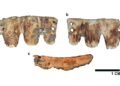
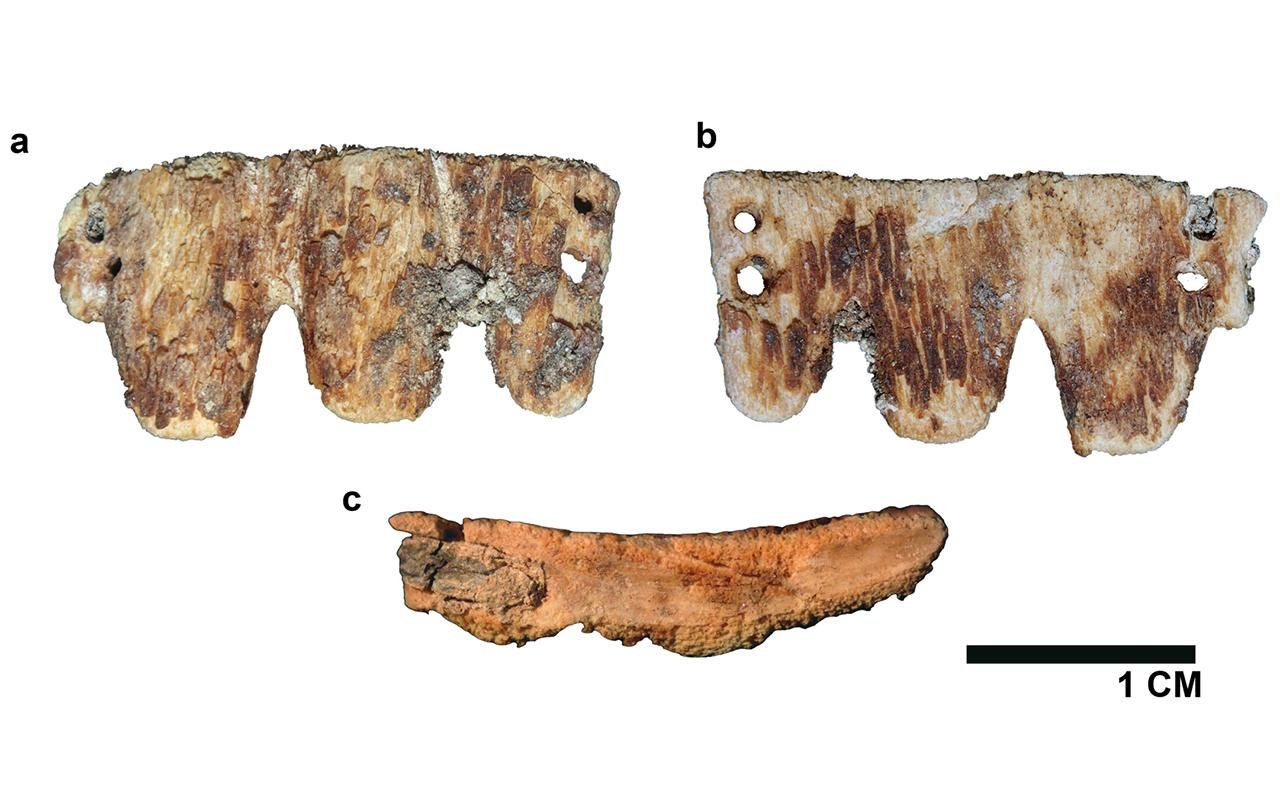
Macro stereomicroscopic images of the dental bridge. (a) Anterior, (b) posterior, and (c) superior aspects. Credit: Vassallo et al., International Journal of Osteoarchaeology (2026)

The prosthetic device came from the burial ground of the 3rd Order of Our Lady of Carmo hospital in Porto. Researchers linked the burial to the early 1800s, between 1801 and 1831, through the study of the grave and an associated crucifix. The remains belonged to a young adult, likely female, although the individual’s exact sex could not be confirmed with certainty because parts of the skull and lower jaw were missing.

The upper jaw showed severe tooth loss long before death. Empty tooth sockets had already begun to heal, showing the teeth had been missing for some time. Only two loose lower teeth survived with the remains.

Researchers recovered the prosthetic near the skull. The piece measured 24 millimeters long, 6 millimeters wide, and 12 millimeters high. It had been carved into three rough U-shaped teeth that increased in size from one side to the other. Small perforations on each end suggest the bridge was tied into place with thread or wire.
Rare 19th-century bone dental bridge found in Portugal points to early cosmetic tooth replacement
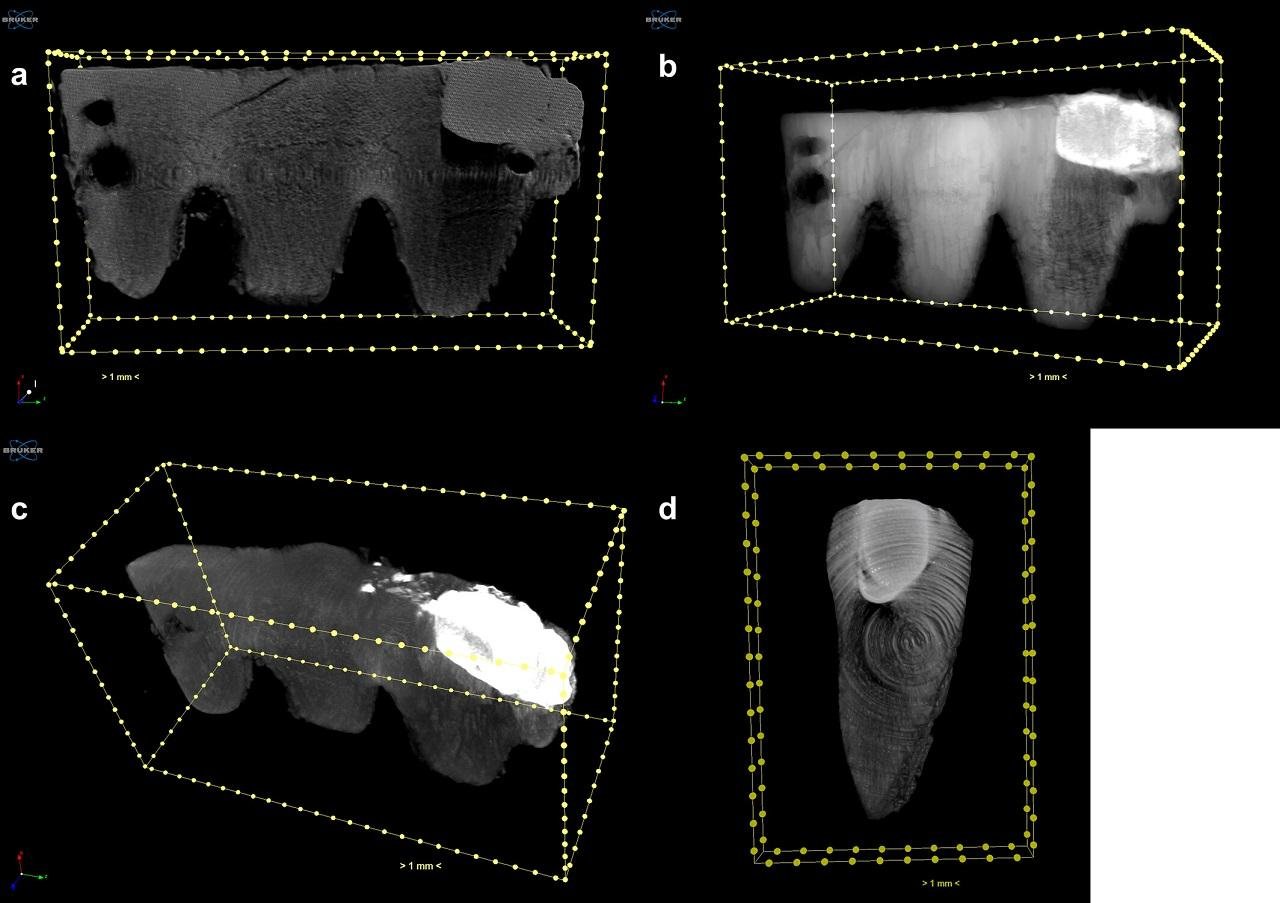
Micro-CT slices of the dental bridge. A cuboid-shaped object, a small dispersed amount of the material, a linear crack/fissure and a radiolucent area are visible. (a) Posterior, (b) posterior, (c) supero-posterior, and (d) medial views. Ring artifacts visible in image d. Credit: Vassallo et al., International Journal of Osteoarchaeology (2026)

To study the object, the team used several non-destructive techniques, including micro-CT imaging, x-ray diffraction, stereomicroscopy, and Zooarchaeology by Mass Spectrometry, known as ZooMS. These methods allowed the researchers to examine the bridge without damaging the artifact.

RelatedStories

massive jar in Laos contained remains of 37 people, revealing ancient burial rituals and Asian trade links

Massive jar in Laos contained remains of 37 people, revealing ancient burial rituals and Asian trade links

May 19, 2026
Pompeii victim identified as Roman physician killed while fleeing Vesuvius eruption

Pompeii victim identified as Roman physician killed while fleeing Vesuvius eruption

May 17, 2026

The analysis showed the prosthetic was made from animal bone belonging to the Bovidae family, which includes cattle, bison, and several antelope species. Cattle bone appears the most likely source because of its common use in Europe during the period. Still, the researchers noted Portugal’s trade connections with Africa raise the possibility of an African antelope origin.

The scans also revealed an unusual cube-shaped material embedded in one corner of the bridge. Chemical analysis identified the substance as lead compounds, mainly pyromorphite and cerussite. Researchers think the lead material strengthened or repaired the attachment holes. Lead was widely used in historical crafts and medicine despite its toxic effects, though no evidence tied the material to the individual’s death.

The exact purpose of the bridge remains uncertain. Its thin structure and simple shape would have provided little support for chewing. The design instead points toward cosmetic use. Researchers believe the device likely covered the visible surface of the lower front teeth, helping hide damage, discoloration, or missing teeth. The bridge might also have improved speech by filling gaps in the mouth.

Dental prosthetics from earlier Portuguese contexts are extremely rare. Previous finds include a wire dental ligature from the late 15th century and an ivory bridge dating between the 16th and 17th centuries. More advanced crowns and dentures appeared later during the formal development of Portuguese dentistry in the 19th and 20th centuries.

The researchers noted dental care during this period was expensive and usually limited to wealthier members of society. The presence of such a customized prosthetic suggests the individual likely belonged to a higher social class.

The study forms part of the BeFRAIL project, which examines human frailty and health in 19th century Porto through archaeological evidence from sites linked to the Carmo institution. The burial grounds were active during decades shaped by cholera outbreaks and military conflict.

Researchers hope future excavations at the site will uncover additional dental devices. Each new find adds detail to the history of dentistry and shows how people in the past attempted to deal with tooth loss long before modern dental treatment became widely available.

More information: Vassallo, S., Esteves, A. P. L., Assis, S., Rodrigues, Z., Márquez-Grant, N., Malcherek, A., … Alves Cardoso, F. (2026). A smile from the past: Exploring a fixed bone dental bridge from eighteenth/nineteenth century Porto (Portugal). International Journal of Osteoarchaeology, (oa.70115). doi:10.1002/oa.70115

Share:

Share on Facebook Share on X (Twitter) Share on LinkedIn Share on Pinterest Share on WhatsApp Share on Email

You May Also Like...

Medieval well hidden beneath Sheffield Castle surveyed with drone technology
Archaeology

Medieval well hidden beneath Sheffield Castle surveyed with drone technology

May 23, 2026
Nondestructive DNA sampling uncovers 1,300 years of history preserved in ancient parchments
Archaeology

Nondestructive DNA sampling uncovers 1,300 years of history preserved in ancient parchments

May 22, 2026
2,300-year-old Iron Age riverside structure discovered beneath German city astonishes archaeologists
Archaeology

2,300-year-old Iron Age riverside structure discovered beneath German city

May 22, 2026
100 Abbasid-era gold jewelry pieces found at ancient Dariyah site in Saudi Arabia
Archaeology

100 Abbasid-era gold jewelry pieces found at ancient Dariyah site in Saudi Arabia

May 22, 2026
Neanderthals gathered shellfish like modern humans 115,000 years ago, study finds
Anthropology

Neanderthals gathered shellfish like modern humans 115,000 years ago, study finds

May 21, 2026
Ancient pigeons were already living alongside humans 3,400 years ago, study finds
Archaeology

Ancient pigeons were already living alongside humans 3,400 years ago, study finds

May 21, 2026

Comments 0

  1. Editorial Team says:
    1 second ago

    Disclaimer: This website is a science-focused magazine that welcomes both academic and non-academic audiences. Comments are written by users and may include personal opinions or unverified claims. They do not necessarily reflect the views of our editorial team or rely on scientific evidence.

    Comment Policy: We kindly ask all commenters to engage respectfully. Comments that contain offensive, insulting, degrading, discriminatory, or racist content will be automatically removed.

    Reply

Leave a Reply Cancel reply

Your email address will not be published. Required fields are marked *

Follow us


Instagram
242K

Facebook
117K

Threads
46K

LinkedIn
14K

Twitter
6K

YouTube
1K
Rare 19th-century bone dental bridge found in Portugal points to early cosmetic tooth replacement

Rare 19th-century bone dental bridge found in Portugal points to early cosmetic tooth replacement

May 23, 2026
Medieval well hidden beneath Sheffield Castle surveyed with drone technology

Medieval well hidden beneath Sheffield Castle surveyed with drone technology

May 23, 2026
Nondestructive DNA sampling uncovers 1,300 years of history preserved in ancient parchments

Nondestructive DNA sampling uncovers 1,300 years of history preserved in ancient parchments

May 22, 2026
2,300-year-old Iron Age riverside structure discovered beneath German city astonishes archaeologists

2,300-year-old Iron Age riverside structure discovered beneath German city

May 22, 2026

Archaeology News online magazine

Archaeology News is an international online magazine that covers all aspects of archaeology.


Categories

  • Academics
    • Books
    • Conferences
    • Universities
  • Articles
  • Download
  • Game
  • News
    • Anthropology
    • Archaeology
    • Paleontology
  • Quiz
  • Tours

Subscribe to our newsletter

© 2024 - Archaeology News Online Magazine. All Rights Reserved.

  • About
  • Privacy Policy
  • Terms of Use
  • Donation
  • Contact

Manage Consent
To provide the best experiences, we use technologies like cookies to store and/or access device information. Consenting to these technologies will allow us to process data such as browsing behavior or unique IDs on this site. Not consenting or withdrawing consent, may adversely affect certain features and functions.
Functional Always active
The technical storage or access is strictly necessary for the legitimate purpose of enabling the use of a specific service explicitly requested by the subscriber or user, or for the sole purpose of carrying out the transmission of a communication over an electronic communications network.
Preferences
The technical storage or access is necessary for the legitimate purpose of storing preferences that are not requested by the subscriber or user.
Statistics
The technical storage or access that is used exclusively for statistical purposes. The technical storage or access that is used exclusively for anonymous statistical purposes. Without a subpoena, voluntary compliance on the part of your Internet Service Provider, or additional records from a third party, information stored or retrieved for this purpose alone cannot usually be used to identify you.
Marketing
The technical storage or access is required to create user profiles to send advertising, or to track the user on a website or across several websites for similar marketing purposes.
  • Manage options
  • Manage services
  • Manage {vendor_count} vendors
  • Read more about these purposes
View preferences
  • {title}
  • {title}
  • {title}
  • Home
  • News
    • Archaeology
    • Anthropology
    • Paleontology
  • Academic
    • Books
    • Conferences
    • Universities
  • Articles
  • VR Tours
  • Quiz & Game
  • Download
  • Encyclopedia
  • Forum

About  .  Contact  .  Donation

© 2024 - Archaeology News Online Magazine. All Rights Reserved