• About
  • Privacy Policy
  • Terms of Use
  • Donation
  • Contact
No Result
View All Result
Archaeology News
  • Home
  • News
    • Archaeology
    • Anthropology
    • Paleontology
  • Academic
    • Books
    • Conferences
    • Universities
  • Articles
  • VR Tours
  • Quiz & Game
  • Download
  • Encyclopedia
  • Forum
Archaeology News
No Result
View All Result
Home News Archaeology

Archaeologists uncover the long-lost homestead of King Pompey, early black landowner and leader

by Dario Radley
July 3, 2024

Archaeologists from the University of New Hampshire and Northeastern University have uncovered what they believe to be the homestead of King Pompey, an enslaved African who gained freedom and became one of the first Black property owners in colonial New England. This significant find, located along the Saugus River in Lynn, Massachusetts, provides a window into the life of an influential figure in the 18th-century Black community.
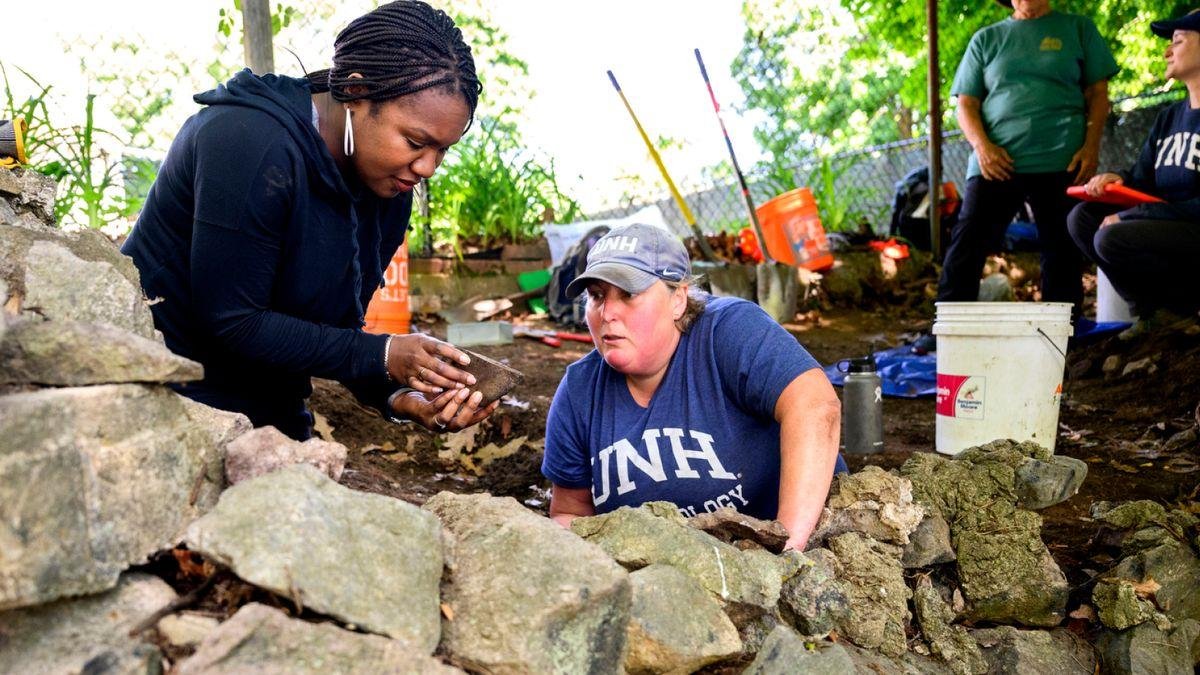
Archaeologists uncover the long-lost homestead of King Pompey, early black landowner and leader
Kabria Baumgartner, a historian from Northeastern University (left), and Meghan Howey, an archaeologist from the University of New Hampshire (right), are pictured at the dig site believed to be the home of King Pompey. They examine the handmade pebble foundation that may be the remains of his home. Credit: Matthew Modoono/Northeastern University

King Pompey, also known as Pompey Mansfield, was a West African man who was likely born into royalty before being trafficked across the Atlantic and enslaved in Massachusetts in the early 1700s. Historical records suggest that Pompey was a community leader and an esteemed figure among both free and enslaved Blacks. He hosted the annual Negro Election Day festival at his property, an event where Black men elected their own leaders who mediated disputes and enforced laws within their community.

The search for Pompey’s homestead was spearheaded by a team of researchers, including Kabria Baumgartner, dean’s associate professor of history and Africana studies at Northeastern University, and Meghan Howey, professor of anthropology at the University of New Hampshire. Baumgartner, who had spent years researching King Pompey, shared an 1829 map with Howey during an event focused on reteaching colonialism. Howey, inspired by the map and the historical significance of Pompey, decided to locate the homestead.

The team meticulously analyzed public records, historical deeds, and genealogical records. They compared historical maps with contemporary lidar-derived topographic maps and cross-referenced them with probate records and historical newspapers to pinpoint specific landmarks. After months of research, they began excavation on private property, guided by the descriptions and landmarks identified in their research.

About four feet below the surface, they uncovered a foundation constructed from hand-chiseled river rocks, consistent with 18th-century building techniques described in historical documents. “I’m extremely confident this is a foundation from the 1700s, and everything that points to this being the home of King Pompey is very compelling,” Howey stated. The discovery of this handmade pebble foundation was a pivotal moment, revealing the resourcefulness and determination of someone building a home with limited resources.

Pompey’s homestead, a small stone house built on the two acres of land he purchased in 1762, served as a gathering place for the annual Negro Election Day. This festival, coinciding with the colonies-wide Election Day for white male property owners, was a vibrant celebration where Black people in New England elected their leaders. The event, marked by music, dancing, singing, and parades, allowed Black individuals to maintain their African cultural heritage and foster a sense of community.

“I’ve always been fascinated by those fleeting private and intimate moments outside of the watchful eye of an enslaver when Black people could be themselves and enjoy each other and be in community,” Baumgartner remarked.

The researchers are hopeful that the site will gain recognition and support from the National Park Service to establish a historical marker and create exhibits sharing the story of King Pompey and Negro Election Day. However, further funding is needed to continue this work. The initial research was funded by the New England Humanities Consortium and Northeastern University, but additional resources are required to preserve and promote this historical site.

Baumgartner noted that climate change poses a threat to many historical sites. Rising sea levels and storm surges could potentially submerge locations like Pompey’s homestead in the future. “It’s hundreds of years later, and it is washing away the chance we have to find those overlooked stories,” Howey added, underscoring the importance of preserving these hidden histories.
Northeastern University / University of New Hampshire

Share:

Share on Facebook Share on X (Twitter) Share on LinkedIn Share on Pinterest Share on WhatsApp Share on Email

You May Also Like...

17,000-year-old cave paintings in Wales confirmed as the oldest rock art in the British Isles
Archaeology

17,000-year-old cave paintings in Wales confirmed as the oldest rock art in the British Isles

June 3, 2026
4-million-year-old juvenile tapir skeleton unearthed in Spain is the most complete ever found in Europe
Paleontology

4-million-year-old juvenile tapir skeleton unearthed in Spain is the most complete ever found in Europe

June 3, 2026
Langobard woman with healed skull injuries challenges assumptions about violence in early medieval society
Anthropology

Langobard woman with healed skull injuries challenges assumptions about violence in early medieval society

June 2, 2026
Ancient city of Ihnasya reveals Aphrodite statue, Senusret III inscription, and Roman basilica remains in Egypt
Archaeology

Ancient city of Ihnasya reveals Aphrodite statue, Senusret III inscription, and Roman basilica remains in Egypt

June 2, 2026
Rare funerary cache discovered at ancient Heliopolis site
Archaeology

Rare funerary cache discovered at ancient Heliopolis site

June 2, 2026
Archaeologists find Queen Elisenda’s remains among 25 medieval skeletons, including individuals with unexplained stab wounds
Anthropology

Archaeologists find Queen Elisenda’s remains among 25 medieval skeletons, including individuals with unexplained stab wounds

June 1, 2026

Follow us


Instagram
242K

Facebook
117K

Threads
47K

LinkedIn
15K

Twitter
6K

YouTube
1K

Archaeology News online magazine

Archaeology News is an international online magazine that covers all aspects of archaeology.


Categories

  • Academics
    • Books
    • Conferences
    • Universities
  • Articles
  • Download
  • Game
  • News
    • Anthropology
    • Archaeology
    • Paleontology
  • Quiz
  • Tours

Subscribe to our newsletter

© 2024 - Archaeology News Online Magazine. All Rights Reserved.

  • About
  • Privacy Policy
  • Terms of Use
  • Donation
  • Contact

Manage Consent
To provide the best experiences, we use technologies like cookies to store and/or access device information. Consenting to these technologies will allow us to process data such as browsing behavior or unique IDs on this site. Not consenting or withdrawing consent, may adversely affect certain features and functions.
Functional Always active
The technical storage or access is strictly necessary for the legitimate purpose of enabling the use of a specific service explicitly requested by the subscriber or user, or for the sole purpose of carrying out the transmission of a communication over an electronic communications network.
Preferences
The technical storage or access is necessary for the legitimate purpose of storing preferences that are not requested by the subscriber or user.
Statistics
The technical storage or access that is used exclusively for statistical purposes. The technical storage or access that is used exclusively for anonymous statistical purposes. Without a subpoena, voluntary compliance on the part of your Internet Service Provider, or additional records from a third party, information stored or retrieved for this purpose alone cannot usually be used to identify you.
Marketing
The technical storage or access is required to create user profiles to send advertising, or to track the user on a website or across several websites for similar marketing purposes.
  • Manage options
  • Manage services
  • Manage {vendor_count} vendors
  • Read more about these purposes
View preferences
  • {title}
  • {title}
  • {title}
  • Home
  • News
    • Archaeology
    • Anthropology
    • Paleontology
  • Academic
    • Books
    • Conferences
    • Universities
  • Articles
  • VR Tours
  • Quiz & Game
  • Download
  • Encyclopedia
  • Forum

About  .  Contact  .  Donation

© 2024 - Archaeology News Online Magazine. All Rights Reserved