• About
  • Privacy Policy
  • Terms of Use
  • Donation
  • Contact
No Result
View All Result
Archaeology News
  • Home
  • News
    • Archaeology
    • Anthropology
    • Paleontology
  • Academic
    • Books
    • Conferences
    • Universities
  • Articles
  • VR Tours
  • Quiz & Game
  • Download
  • Encyclopedia
  • Forum
Archaeology News
No Result
View All Result
Home News Archaeology

17,000-year-old cave paintings in Wales confirmed as the oldest rock art in the British Isles

by Dario Radley
June 3, 2026

Scientists have confirmed that a series of red markings inside a cave in Wales represent the oldest known rock art in the British Isles, bringing an end to a debate that lasted for more than a century.
17,000-year-old cave paintings in Wales confirmed as the oldest rock art in the British Isles
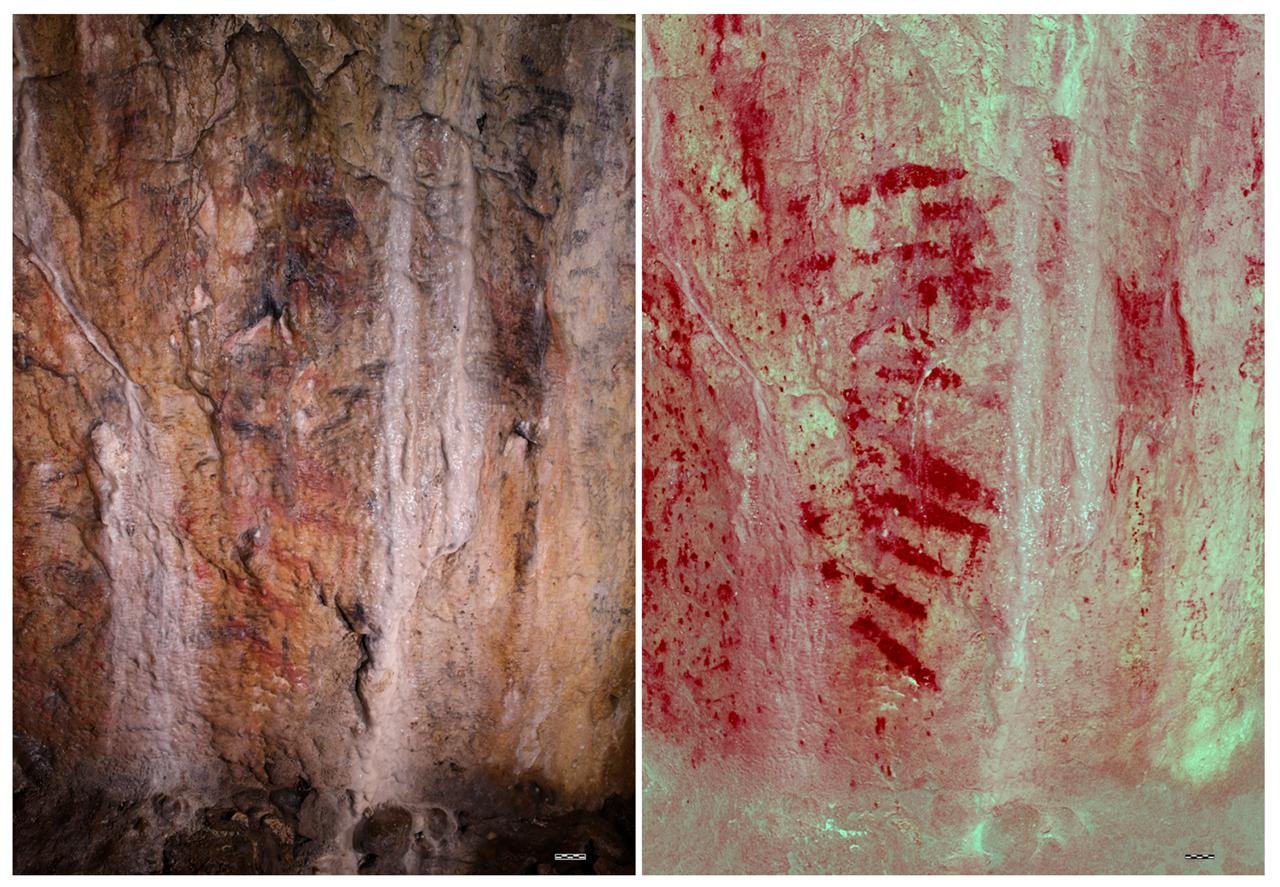
The panel in 2024 (left); D-Stretch filtered photo in 2024 (right). Credit: Nash et al., Quaternary (2026); CC BY 4.0

The artwork lies deep inside Bacon Hole, a cave in the limestone cliffs of the Gower Peninsula in South Wales. Archaeologists first identified the markings in 1912. At the time, researchers believed they had found the first example of Upper Paleolithic cave art in Britain. Their interpretation soon faced criticism, and by the late 1920s many scholars argued that the lines were natural features rather than human-made paintings.

The painted panel then faded from academic attention. Its exact location inside the cave was gradually forgotten, leaving the question unresolved for decades.

A new international research project returned to the site in 2022 and relocated the panel. The team carried out pigment studies, dating work, and detailed surveys of the cave wall. Their findings support the original conclusion reached by the first investigators more than 100 years ago.
17,000-year-old cave paintings in Wales confirmed as the oldest rock art in the British Isles
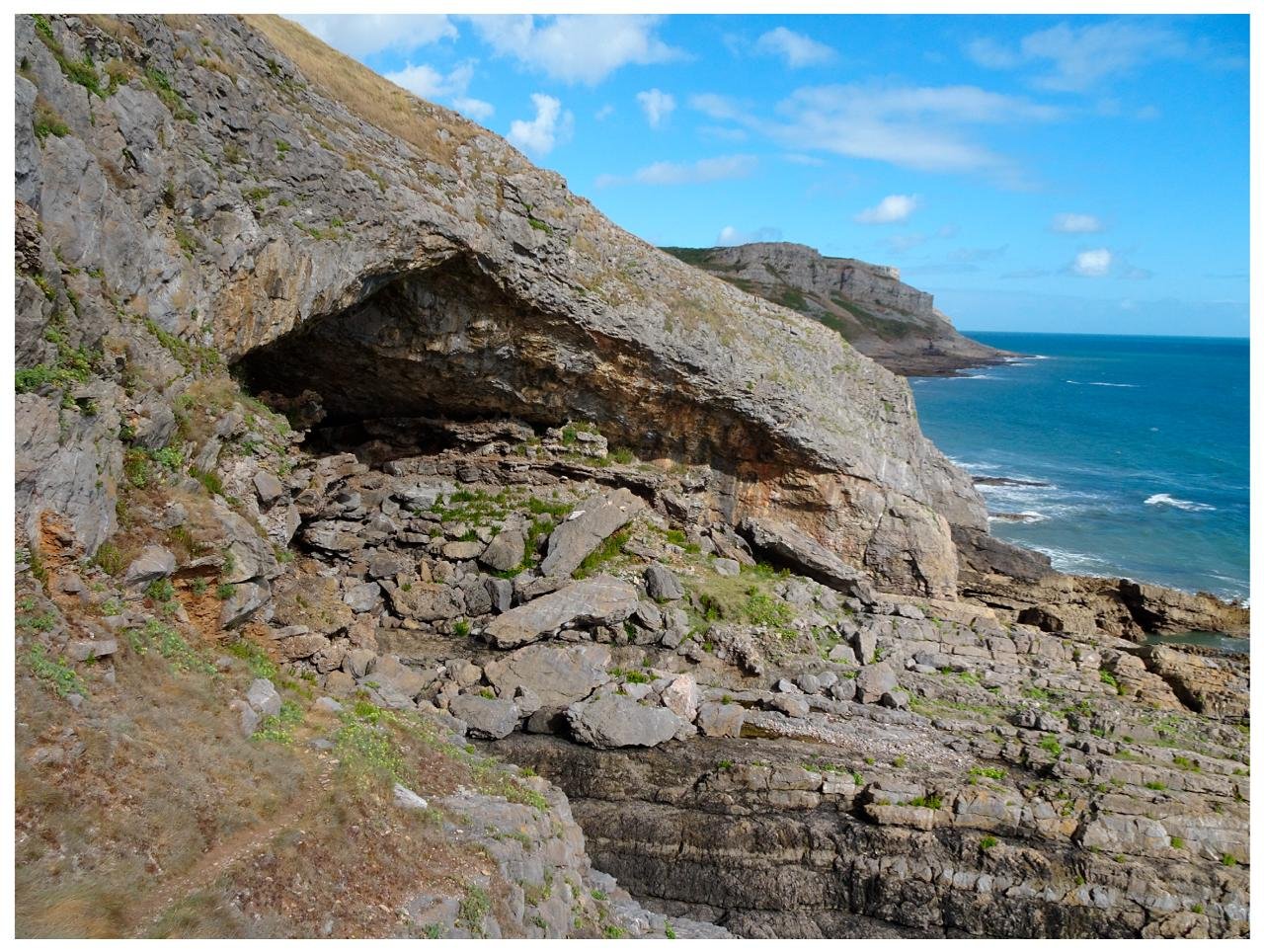
Eastern view of the cave entrance and the Bristol Channel. Credit: Nash et al., Quaternary (2026); CC BY 4.0

The panel consists of at least ten horizontal red lines arranged in a regular pattern. Researchers found that the pigment contains high levels of hematite, an iron-rich mineral widely used as a red coloring material in prehistoric art. Laboratory analysis showed traces of clay mixed with the pigment, suggesting deliberate preparation before application.

The spacing of the lines provided another clue. Each line runs parallel to the others, creating a pattern unlikely to result from natural processes. Researchers found no similar formations elsewhere on the cave walls. Finger marks, dots, and small pigment splashes found in the chamber strengthen the case for human activity.

To determine the age of the artwork, scientists collected samples from calcite deposits that formed over the painted surface. Uranium-thorium dating placed the paintings between about 18,300 and 15,700 years old. The results suggest an age of roughly 17,000 years, making Bacon Hole the earliest known rock art site in the British Isles.

The paintings were created during a period when Wales was emerging from one of the coldest phases of the last Ice Age. Around 17,000 years ago, the landscape looked very different from today. Large areas remained treeless, and the region around the present-day Bristol Channel formed part of an open plain where grazing animals moved seasonally across the landscape.
17,000-year-old cave paintings in Wales confirmed as the oldest rock art in the British Isles
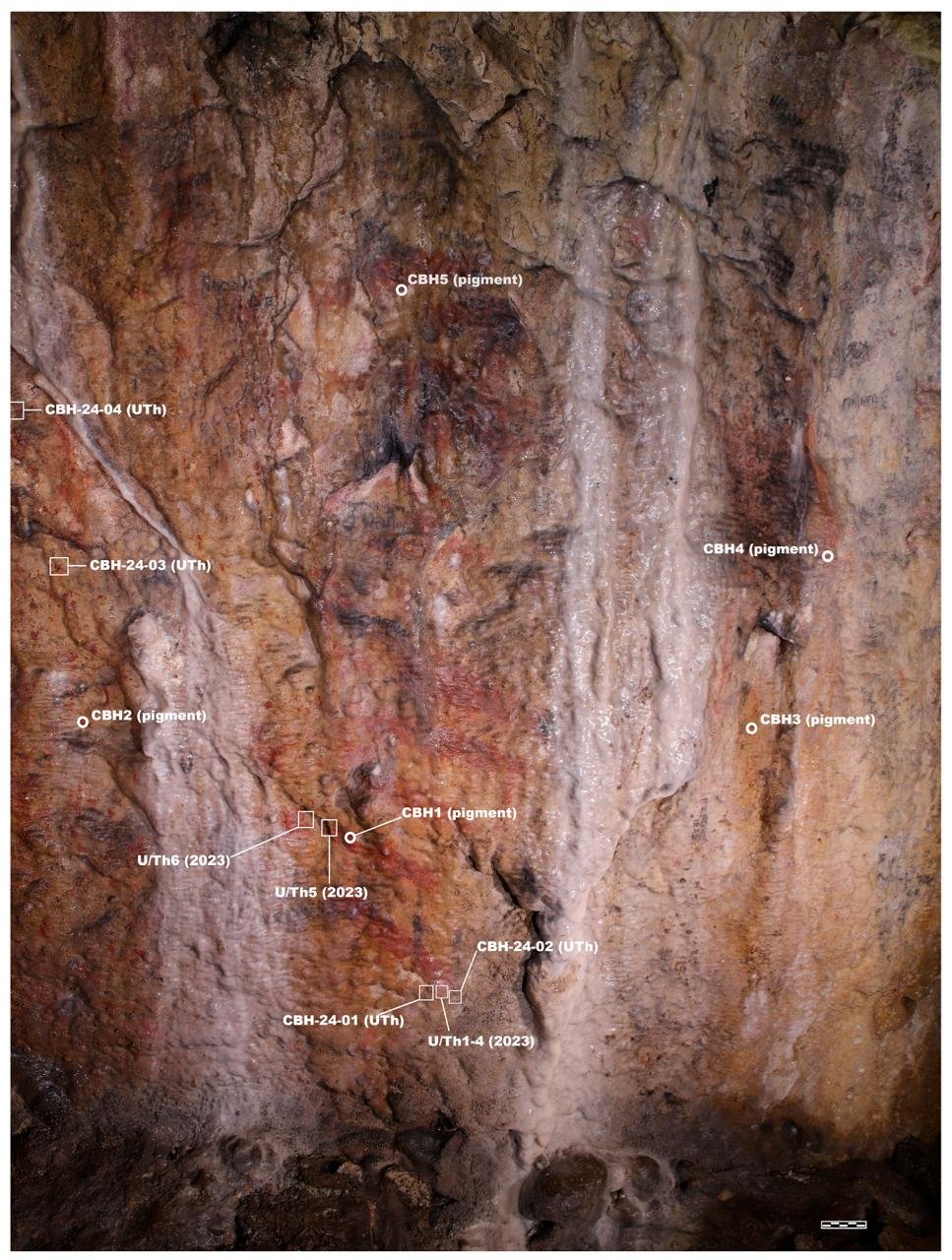
Bacon Hole cave panel sampling spot distribution. Credit: Nash et al., Quaternary (2026); CC BY 4.0

Although archaeologists have found no evidence of permanent occupation inside Bacon Hole from this period, the cave would have offered shelter to groups of hunter-fisher-gatherers living in the area. The painted panel occupies a secluded chamber at the rear of the cave, far beyond natural daylight.

Researchers believe the location itself holds significance. Creating art in a dark and isolated part of the cave suggests the space served a purpose beyond daily activities. The meaning of the red lines remains unknown, and no evidence links them to a specific ritual or belief. Even so, the paintings point to symbolic behavior among people living in Britain near the end of the Ice Age.

Bacon Hole continued to attract visitors long after the paintings were created. Archaeologists have recovered artifacts from many different periods, including pre-Roman pottery, Roman objects, early medieval jewelry, Saxon beads, and medieval household items. The repeated visits suggest that generations of people returned to the cave over thousands of years.

Researchers stress that further sampling and analysis are needed. Additional studies of other painted surfaces inside the cave could provide a clearer picture of human activity at the site. Current evidence leaves little doubt about one point. The red lines at Bacon Hole represent genuine Paleolithic art, restoring the cave’s place among the earliest known centers of symbolic expression in the British Isles.

More information: Nash, G. H., Collado, H., Gomes, H., Garcês, S., Lattao, V., Rosina, P., … Shao, Q. (2026). Rediscovered late upper Palaeolithic painted imagery at Bacon Hole, Gower Peninsula, South Wales. Quaternary, 9(3), 43. doi:10.3390/quat9030043

Share:

Share on Facebook Share on X (Twitter) Share on LinkedIn Share on Pinterest Share on WhatsApp Share on Email

You May Also Like...

4-million-year-old juvenile tapir skeleton unearthed in Spain is the most complete ever found in Europe
Paleontology

4-million-year-old juvenile tapir skeleton unearthed in Spain is the most complete ever found in Europe

June 3, 2026
Langobard woman with healed skull injuries challenges assumptions about violence in early medieval society
Anthropology

Langobard woman with healed skull injuries challenges assumptions about violence in early medieval society

June 2, 2026
Ancient city of Ihnasya reveals Aphrodite statue, Senusret III inscription, and Roman basilica remains in Egypt
Archaeology

Ancient city of Ihnasya reveals Aphrodite statue, Senusret III inscription, and Roman basilica remains in Egypt

June 2, 2026
Rare funerary cache discovered at ancient Heliopolis site
Archaeology

Rare funerary cache discovered at ancient Heliopolis site

June 2, 2026
Archaeologists find Queen Elisenda’s remains among 25 medieval skeletons, including individuals with unexplained stab wounds
Anthropology

Archaeologists find Queen Elisenda’s remains among 25 medieval skeletons, including individuals with unexplained stab wounds

June 1, 2026
Copper Age children in Spain suffered widespread respiratory disease, skeletal study suggests
Anthropology

Copper Age children in Spain suffered widespread respiratory disease, skeletal study suggests

June 1, 2026

Comments 0

  1. Editorial Team says:
    1 second ago

    Disclaimer: This website is a science-focused magazine that welcomes both academic and non-academic audiences. Comments are written by users and may include personal opinions or unverified claims. They do not necessarily reflect the views of our editorial team or rely on scientific evidence.

    Comment Policy: We kindly ask all commenters to engage respectfully. Comments that contain offensive, insulting, degrading, discriminatory, or racist content will be automatically removed.

    Reply

Leave a Reply Cancel reply

Your email address will not be published. Required fields are marked *

Follow us


Instagram
242K

Facebook
117K

Threads
47K

LinkedIn
15K

Twitter
6K

YouTube
1K

Archaeology News online magazine

Archaeology News is an international online magazine that covers all aspects of archaeology.


Categories

  • Academics
    • Books
    • Conferences
    • Universities
  • Articles
  • Download
  • Game
  • News
    • Anthropology
    • Archaeology
    • Paleontology
  • Quiz
  • Tours

Subscribe to our newsletter

© 2024 - Archaeology News Online Magazine. All Rights Reserved.

  • About
  • Privacy Policy
  • Terms of Use
  • Donation
  • Contact

Manage Consent
To provide the best experiences, we use technologies like cookies to store and/or access device information. Consenting to these technologies will allow us to process data such as browsing behavior or unique IDs on this site. Not consenting or withdrawing consent, may adversely affect certain features and functions.
Functional Always active
The technical storage or access is strictly necessary for the legitimate purpose of enabling the use of a specific service explicitly requested by the subscriber or user, or for the sole purpose of carrying out the transmission of a communication over an electronic communications network.
Preferences
The technical storage or access is necessary for the legitimate purpose of storing preferences that are not requested by the subscriber or user.
Statistics
The technical storage or access that is used exclusively for statistical purposes. The technical storage or access that is used exclusively for anonymous statistical purposes. Without a subpoena, voluntary compliance on the part of your Internet Service Provider, or additional records from a third party, information stored or retrieved for this purpose alone cannot usually be used to identify you.
Marketing
The technical storage or access is required to create user profiles to send advertising, or to track the user on a website or across several websites for similar marketing purposes.
  • Manage options
  • Manage services
  • Manage {vendor_count} vendors
  • Read more about these purposes
View preferences
  • {title}
  • {title}
  • {title}
  • Home
  • News
    • Archaeology
    • Anthropology
    • Paleontology
  • Academic
    • Books
    • Conferences
    • Universities
  • Articles
  • VR Tours
  • Quiz & Game
  • Download
  • Encyclopedia
  • Forum

About  .  Contact  .  Donation

© 2024 - Archaeology News Online Magazine. All Rights Reserved