• About
  • Privacy Policy
  • Terms of Use
  • Donation
  • Contact
No Result
View All Result
Archaeology News
  • Home
  • News
    • Archaeology
    • Anthropology
    • Paleontology
  • Academic
    • Books
    • Conferences
    • Universities
  • Articles
  • VR Tours
  • Quiz & Game
  • Download
  • Encyclopedia
  • Forum
Archaeology News
No Result
View All Result
Home News Anthropology

Archaeologists discover rare Alemannic chamber grave in Gerstetten, Germany

by Dario Radley
August 28, 2024

During recent excavations in Gerstetten, located in the Heidenheim district of Germany, archaeologists uncovered a rare Alemannic chamber grave dating back to the early 4th century.

Archaeologists discover rare Alemannic chamber grave in Gerstetten, Germany
Alemannic chamber grave discovered in Germany. Credit: ArchaeoBW / State Office for Monument Preservation in the Stuttgart Regional Council

This significant discovery was made by a team from the archaeological firm ArchaeoBW, working under the commission of the State Office for Monument Preservation (LAD) in the Stuttgart Regional Council. The excavation was initiated as part of a rescue operation in preparation for a new housing development project in the area.

The grave, found unexpectedly in the village center, was constructed as a wooden chamber and contained the skeletal remains of a man approximately 60 years old. The burial site, which dates back to between CE 263 and 342, was characterized by its solitary location, a typical feature for graves from this period.

The archaeologists were able to confirm the age of the deceased and the dating of the grave through radiocarbon analysis of one of the man’s rib bones. The bone sample was sent directly from the excavation site to a laboratory in Mannheim, where it was analyzed.
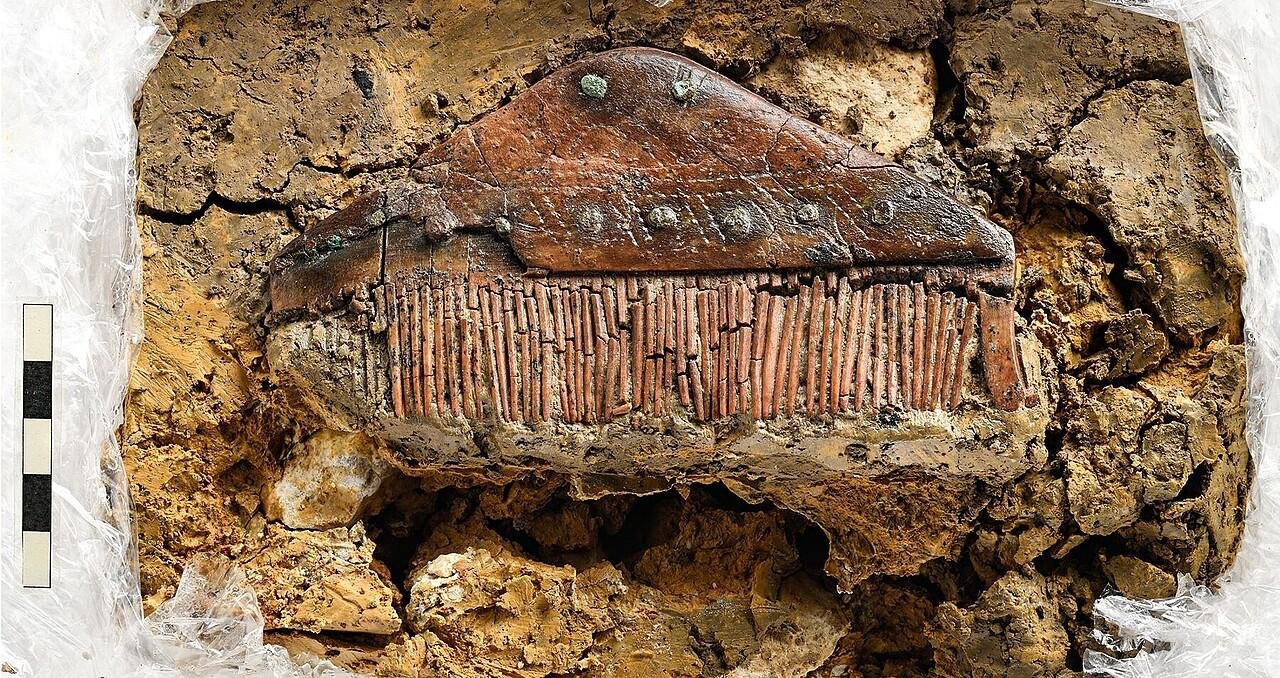
Archaeologists discover rare Alemannic chamber grave in Gerstetten, Germany
A small decorated comb discovered inside the grave. Credit: Yvonne Mühleis / State Office for Monument Preservation in the Stuttgart Regional Council

Inside the grave, several valuable grave goods were discovered, including ceramic and glass vessels, a small decorated comb, and a high-quality glass cup. The glass cup is believed to have originated from the nearby late Roman fort of Guntia (modern-day Günzburg). The presence of such items suggests that the deceased was a person of some status within the Alemannic society.

The discovery is particularly significant as early Alemannic graves are rare in the Baden-Württemberg region. Most early Alemannic graves are usually found in small groups of five to twelve. This solitary grave, however, stands out due to its elaborate design and the quality of the artifacts found within it.

Following the excavation, the artifacts were transported to the LAD restoration workshop in Esslingen for further analysis and preservation. Two ceramic vessels have already been restored, and the remaining finds, including the human bones, are still being documented by the excavation team.

The Stuttgart Regional Council has expressed hope that more graves could be discovered in the area to the south of the current excavation site, which has not yet been investigated.

The Alemanni, also known as the Alamanni, were a confederation of Germanic tribes that emerged on the east bank of the Rhine River. First mentioned in CE 213 by the Roman historian Cassius Dio, the Alemanni inhabited regions that now encompass southwestern Germany, as well as parts of modern-day France, Switzerland, Liechtenstein, and Austria.

They were known for their distinctive burial practices, which often involved interring the deceased with various grave goods, as seen in the recent discovery in Gerstetten.
Stuttgart Regional Council

Share:

Share on Facebook Share on X (Twitter) Share on LinkedIn Share on Pinterest Share on WhatsApp Share on Email

You May Also Like...

17,000-year-old cave paintings in Wales confirmed as the oldest rock art in the British Isles
Archaeology

17,000-year-old cave paintings in Wales confirmed as the oldest rock art in the British Isles

June 3, 2026
4-million-year-old juvenile tapir skeleton unearthed in Spain is the most complete ever found in Europe
Paleontology

4-million-year-old juvenile tapir skeleton unearthed in Spain is the most complete ever found in Europe

June 3, 2026
Langobard woman with healed skull injuries challenges assumptions about violence in early medieval society
Anthropology

Langobard woman with healed skull injuries challenges assumptions about violence in early medieval society

June 2, 2026
Ancient city of Ihnasya reveals Aphrodite statue, Senusret III inscription, and Roman basilica remains in Egypt
Archaeology

Ancient city of Ihnasya reveals Aphrodite statue, Senusret III inscription, and Roman basilica remains in Egypt

June 2, 2026
Rare funerary cache discovered at ancient Heliopolis site
Archaeology

Rare funerary cache discovered at ancient Heliopolis site

June 2, 2026
Archaeologists find Queen Elisenda’s remains among 25 medieval skeletons, including individuals with unexplained stab wounds
Anthropology

Archaeologists find Queen Elisenda’s remains among 25 medieval skeletons, including individuals with unexplained stab wounds

June 1, 2026

Follow us


Instagram
242K

Facebook
117K

Threads
47K

LinkedIn
15K

Twitter
6K

YouTube
1K

Archaeology News online magazine

Archaeology News is an international online magazine that covers all aspects of archaeology.


Categories

  • Academics
    • Books
    • Conferences
    • Universities
  • Articles
  • Download
  • Game
  • News
    • Anthropology
    • Archaeology
    • Paleontology
  • Quiz
  • Tours

Subscribe to our newsletter

© 2024 - Archaeology News Online Magazine. All Rights Reserved.

  • About
  • Privacy Policy
  • Terms of Use
  • Donation
  • Contact

Manage Consent
To provide the best experiences, we use technologies like cookies to store and/or access device information. Consenting to these technologies will allow us to process data such as browsing behavior or unique IDs on this site. Not consenting or withdrawing consent, may adversely affect certain features and functions.
Functional Always active
The technical storage or access is strictly necessary for the legitimate purpose of enabling the use of a specific service explicitly requested by the subscriber or user, or for the sole purpose of carrying out the transmission of a communication over an electronic communications network.
Preferences
The technical storage or access is necessary for the legitimate purpose of storing preferences that are not requested by the subscriber or user.
Statistics
The technical storage or access that is used exclusively for statistical purposes. The technical storage or access that is used exclusively for anonymous statistical purposes. Without a subpoena, voluntary compliance on the part of your Internet Service Provider, or additional records from a third party, information stored or retrieved for this purpose alone cannot usually be used to identify you.
Marketing
The technical storage or access is required to create user profiles to send advertising, or to track the user on a website or across several websites for similar marketing purposes.
  • Manage options
  • Manage services
  • Manage {vendor_count} vendors
  • Read more about these purposes
View preferences
  • {title}
  • {title}
  • {title}
  • Home
  • News
    • Archaeology
    • Anthropology
    • Paleontology
  • Academic
    • Books
    • Conferences
    • Universities
  • Articles
  • VR Tours
  • Quiz & Game
  • Download
  • Encyclopedia
  • Forum

About  .  Contact  .  Donation

© 2024 - Archaeology News Online Magazine. All Rights Reserved