• About
  • Privacy Policy
  • Terms of Use
  • Donation
  • Contact
No Result
View All Result
Archaeology News
  • Home
  • News
    • Archaeology
    • Anthropology
    • Paleontology
  • Academic
    • Books
    • Conferences
    • Universities
  • Articles
  • VR Tours
  • Quiz & Game
  • Download
  • Encyclopedia
  • Forum
Archaeology News
No Result
View All Result
Home News Archaeology

Ancient astronomical observatory discovered in Egypt

by Dario Radley
August 24, 2024

An Egyptian mission led by the Supreme Council of Antiquities has uncovered what is believed to be the first and largest astronomical observatory from the 6th century BCE at the ancient Buto Temple, located at the Tell El-Fara’in archaeological site in Egypt’s Kafr El-Sheikh Governorate.

The observatory, constructed from mudbrick, was a significant center for tracking and recording astronomical phenomena. It was used to observe the movements of the sun, moon, and stars, and played a crucial role in establishing the dates of religious festivals and official ceremonies, such as royal coronations and the beginning of the agricultural year.

“It highlights the advanced astronomical knowledge of the ancient Egyptians, including their ability to determine the solar calendar and significant religious and agricultural dates,” Dr. Mohamed Ismail Khaled, Secretary-General of the Supreme Council of Antiquities, told Ahram Online. The observatory’s design and artifacts demonstrate how the Egyptians used astronomy to align their religious and daily practices with celestial events.

The observatory itself is an expansive structure covering approximately 850 square meters and features a central L-shaped hall made of mudbrick, resembling the pylon entrances of ancient Egyptian temples. The entrance faces east, allowing sunlight to illuminate the interior during specific times of the year, further emphasizing the building’s purpose in astronomical observation. Within this hall, a stone platform engraved with depictions of astronomical alignments, such as the sunrise and sunset during the different seasons of the Egyptian year, was uncovered. The engravings also include measurements that were likely taken through the temple’s eastern and western doors.

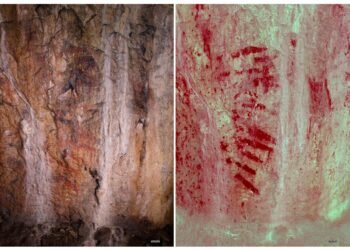
One of the key findings at the site is an inclined stone sundial, known as a shadow clock, which was used to measure time based on the sun’s position. This sundial consists of a straight row of limestone slabs, approximately 4.80 meters long, with several vertical and horizontal blocks that may have been used to measure the angle and shadow of the sun throughout the day. Dr. Ayman Ashmawy, head of the Egyptian Antiquities Sector at the Supreme Council of Antiquities, described this sundial as one of the most significant artifacts found, illustrating the Egyptians’ skill in timekeeping and their understanding of solar movements.

In addition to the observatory itself, the excavation team discovered a wealth of artifacts. Among these are a statue from the 26th Dynasty depicting the priest Psammetichus Smen holding a statue of the god Osiris, various measuring tools including a “merkhet” used for astronomical calculations, and several faience necklaces and pottery pieces used in religious ceremonies and daily life. These findings underscore the observatory’s dual role as both a scientific and a religious site.

Located between the branches of the Nile and near Butic Lake, Tell El-Fara’in, also known as the ancient city of Buto, was a ceremonial center dedicated to the goddess Wadjet, the matron and protector of Egypt. The city’s proximity to natural waterways and its position in the fertile Nile Delta likely contributed to its prominence as a center for both religious worship and scientific observation.

Ministry of Tourism and Antiquities 

Share:

Share on Facebook Share on X (Twitter) Share on LinkedIn Share on Pinterest Share on WhatsApp Share on Email

You May Also Like...

17,000-year-old cave paintings in Wales confirmed as the oldest rock art in the British Isles
Archaeology

17,000-year-old cave paintings in Wales confirmed as the oldest rock art in the British Isles

June 3, 2026
4-million-year-old juvenile tapir skeleton unearthed in Spain is the most complete ever found in Europe
Paleontology

4-million-year-old juvenile tapir skeleton unearthed in Spain is the most complete ever found in Europe

June 3, 2026
Langobard woman with healed skull injuries challenges assumptions about violence in early medieval society
Anthropology

Langobard woman with healed skull injuries challenges assumptions about violence in early medieval society

June 2, 2026
Ancient city of Ihnasya reveals Aphrodite statue, Senusret III inscription, and Roman basilica remains in Egypt
Archaeology

Ancient city of Ihnasya reveals Aphrodite statue, Senusret III inscription, and Roman basilica remains in Egypt

June 2, 2026
Rare funerary cache discovered at ancient Heliopolis site
Archaeology

Rare funerary cache discovered at ancient Heliopolis site

June 2, 2026
Archaeologists find Queen Elisenda’s remains among 25 medieval skeletons, including individuals with unexplained stab wounds
Anthropology

Archaeologists find Queen Elisenda’s remains among 25 medieval skeletons, including individuals with unexplained stab wounds

June 1, 2026

Follow us


Instagram
242K

Facebook
117K

Threads
47K

LinkedIn
15K

Twitter
6K

YouTube
1K

Archaeology News online magazine

Archaeology News is an international online magazine that covers all aspects of archaeology.


Categories

  • Academics
    • Books
    • Conferences
    • Universities
  • Articles
  • Download
  • Game
  • News
    • Anthropology
    • Archaeology
    • Paleontology
  • Quiz
  • Tours

Subscribe to our newsletter

© 2024 - Archaeology News Online Magazine. All Rights Reserved.

  • About
  • Privacy Policy
  • Terms of Use
  • Donation
  • Contact

Manage Consent
To provide the best experiences, we use technologies like cookies to store and/or access device information. Consenting to these technologies will allow us to process data such as browsing behavior or unique IDs on this site. Not consenting or withdrawing consent, may adversely affect certain features and functions.
Functional Always active
The technical storage or access is strictly necessary for the legitimate purpose of enabling the use of a specific service explicitly requested by the subscriber or user, or for the sole purpose of carrying out the transmission of a communication over an electronic communications network.
Preferences
The technical storage or access is necessary for the legitimate purpose of storing preferences that are not requested by the subscriber or user.
Statistics
The technical storage or access that is used exclusively for statistical purposes. The technical storage or access that is used exclusively for anonymous statistical purposes. Without a subpoena, voluntary compliance on the part of your Internet Service Provider, or additional records from a third party, information stored or retrieved for this purpose alone cannot usually be used to identify you.
Marketing
The technical storage or access is required to create user profiles to send advertising, or to track the user on a website or across several websites for similar marketing purposes.
  • Manage options
  • Manage services
  • Manage {vendor_count} vendors
  • Read more about these purposes
View preferences
  • {title}
  • {title}
  • {title}
  • Home
  • News
    • Archaeology
    • Anthropology
    • Paleontology
  • Academic
    • Books
    • Conferences
    • Universities
  • Articles
  • VR Tours
  • Quiz & Game
  • Download
  • Encyclopedia
  • Forum

About  .  Contact  .  Donation

© 2024 - Archaeology News Online Magazine. All Rights Reserved