• About
  • Privacy Policy
  • Terms of Use
  • Donation
  • Contact
No Result
View All Result
Archaeology News
  • Home
  • News
    • Archaeology
    • Anthropology
    • Paleontology
  • Academic
    • Books
    • Conferences
    • Universities
  • Articles
  • VR Tours
  • Quiz & Game
  • Download
  • Encyclopedia
  • Forum
Archaeology News
No Result
View All Result
Home News Archaeology

12,000-year-old stones may be early evidence of the wheel

by Dario Radley
November 14, 2024

Archaeologists have unearthed what may be some of the earliest evidence of wheel-like technology in human history at the Nahal-Ein Gev II site in northern Israel.
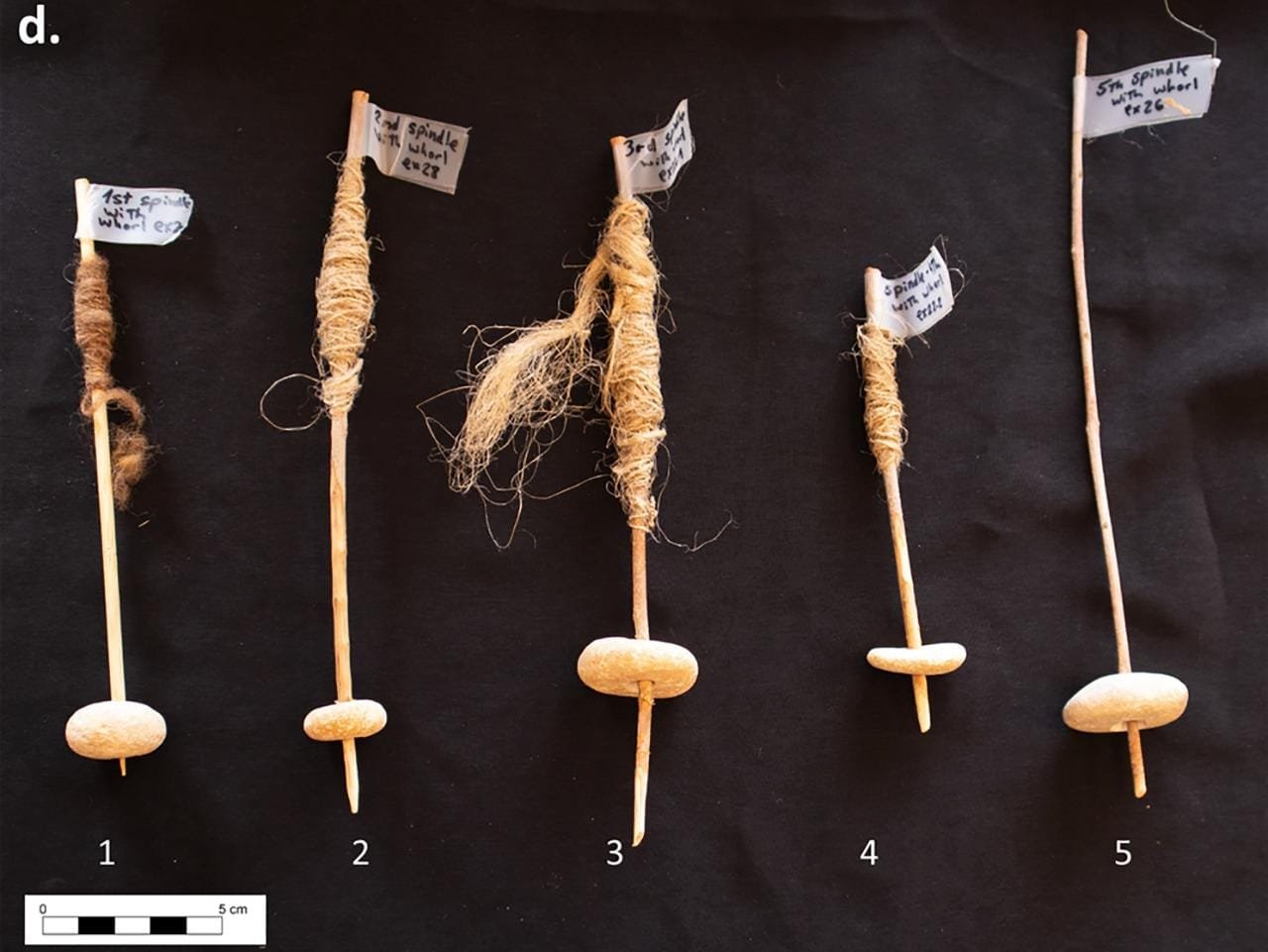
12,000-year-old stones may be early evidence of the wheel
The experimental spindles and whorls, the 3D scans of the pebbles and their negative perforations. Credit: Yashuv, Grosman, 2024, PLOS One, CC-BY 4.0

A recent study published on November 13, 2024, in the open-access journal PLOS ONE by Talia Yashuv and Leore Grosman of the Hebrew University of Jerusalem suggests that a collection of perforated, donut-shaped pebbles dating back approximately 12,000 years were likely spindle whorls. This discovery significantly predates the traditional invention of the wheel, which is generally dated to around 6,000 years ago.

Spindle whorls are small, weighted objects attached to a spindle stick to facilitate the spinning of fibers such as flax or wool into yarn. These tools operate on a wheel-and-axle principle, enabling prolonged and efficient rotation essential for textile production.

Yashuv and Grosman utilized innovative digital 3D scanning technology to create detailed models of over a hundred limestone pebbles recovered from the site. Their analysis revealed that these stones featured consistent circular shapes with central perforations, indicative of deliberate craftsmanship rather than natural formation. To test their hypothesis, the researchers replicated the spindle whorls and collaborated with Yonit Crystal, an expert in traditional craft making, who successfully used the replicas to spin flax and wool. The experiments confirmed that the pebbles functioned effectively as spindle whorls, supporting the study’s conclusion that these ancient tools represent an early form of rotational technology.
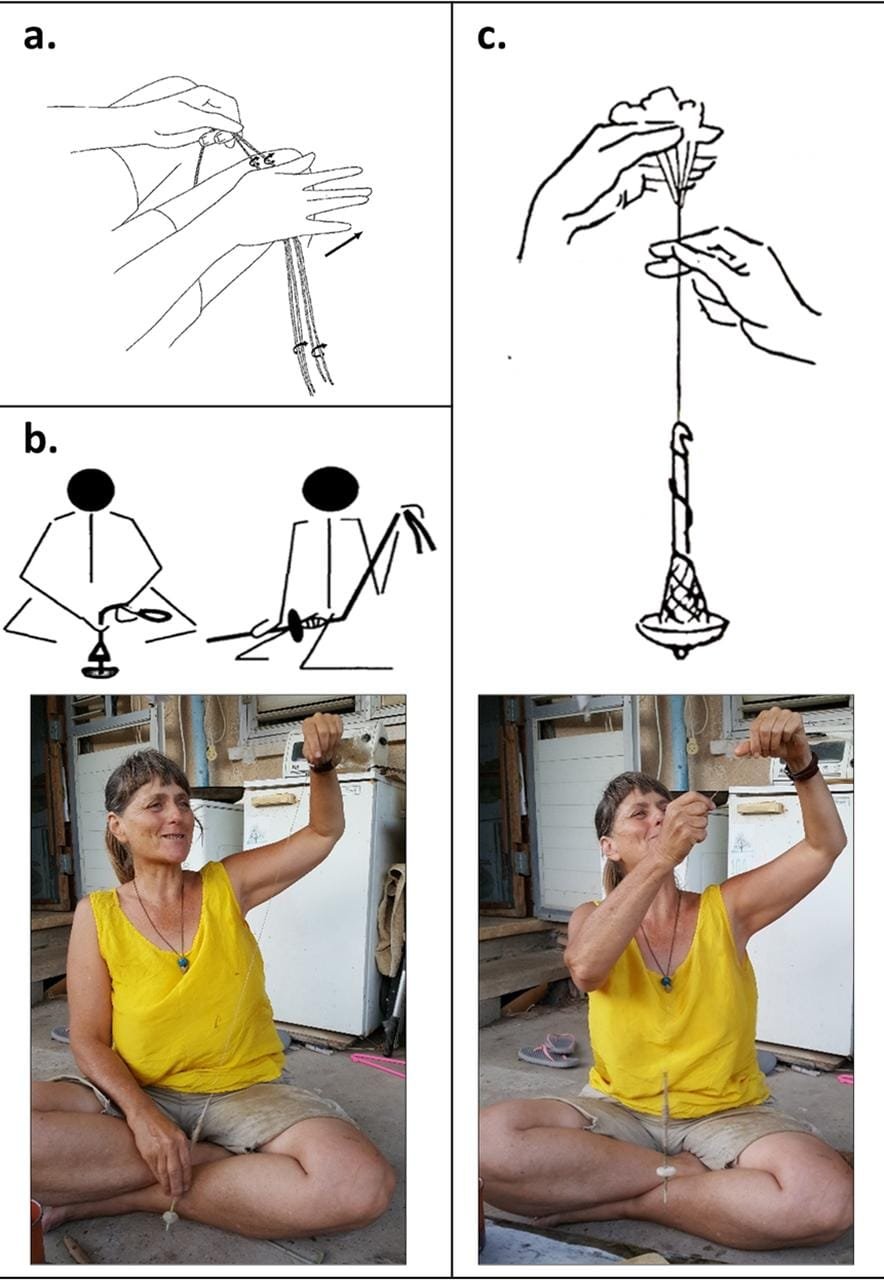
12,000-year-old stones may be early evidence of the wheel
(a) Manual thigh-spinning; (b) Spindle-and-whorl “supported spinning”; (c) “drop spinning”; Credit: Yashuv, Grosman, 2024, PLOS One, CC-BY 4.0

“This collection of spindle whorls would represent a very early example of humans using rotation with a wheel-shaped tool,” Yashuv explained. “They might have paved the way for later rotational technologies, such as the potter’s wheel and the cart wheel, which were vital to the development of early human civilizations.”

“This study not only highlights the innovativeness of prehistoric artisans but also bridges ancient technologies with our present-day capabilities,” Yashuv added. “By reconstructing and testing these tools, researchers are able to connect modern technology with the resourcefulness of our ancient ancestors, revealing a continuous link between early invention and current-day scientific methods.”
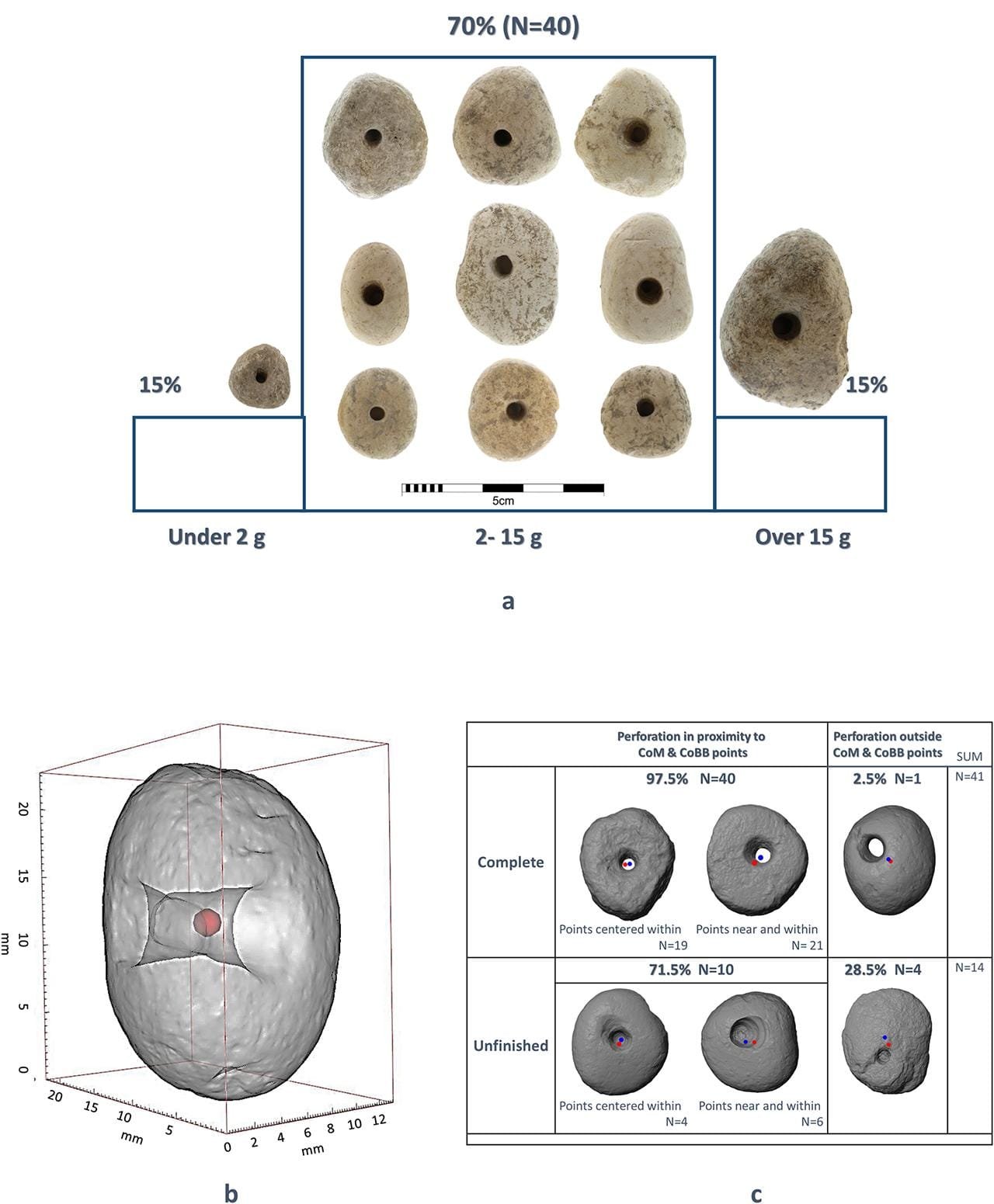
12,000-year-old stones may be early evidence of the wheel
Complete shape 3D analysis of the perforated pebbles. Credit: Yashuv, Grosman, 2024, PLOS One, CC-BY 4.0

The findings encourage a reevaluation of the timeline and progression of rotational technologies in human history.

More information:Yashuv T, Grosman L (2024) 12,000-year-old spindle whorls and the innovation of wheeled rotational technologies. PLoS ONE 19(11): e0312007. doi:10.1371/journal.pone.0312007

Share:

Share on Facebook Share on X (Twitter) Share on LinkedIn Share on Pinterest Share on WhatsApp Share on Email

You May Also Like...

4-million-year-old juvenile tapir skeleton unearthed in Spain is the most complete ever found in Europe
Paleontology

4-million-year-old juvenile tapir skeleton unearthed in Spain is the most complete ever found in Europe

June 3, 2026
Langobard woman with healed skull injuries challenges assumptions about violence in early medieval society
Anthropology

Langobard woman with healed skull injuries challenges assumptions about violence in early medieval society

June 2, 2026
Ancient city of Ihnasya reveals Aphrodite statue, Senusret III inscription, and Roman basilica remains in Egypt
Archaeology

Ancient city of Ihnasya reveals Aphrodite statue, Senusret III inscription, and Roman basilica remains in Egypt

June 2, 2026
Rare funerary cache discovered at ancient Heliopolis site
Archaeology

Rare funerary cache discovered at ancient Heliopolis site

June 2, 2026
Archaeologists find Queen Elisenda’s remains among 25 medieval skeletons, including individuals with unexplained stab wounds
Anthropology

Archaeologists find Queen Elisenda’s remains among 25 medieval skeletons, including individuals with unexplained stab wounds

June 1, 2026
Copper Age children in Spain suffered widespread respiratory disease, skeletal study suggests
Anthropology

Copper Age children in Spain suffered widespread respiratory disease, skeletal study suggests

June 1, 2026

Follow us


Instagram
242K

Facebook
117K

Threads
47K

LinkedIn
15K

Twitter
6K

YouTube
1K

Archaeology News online magazine

Archaeology News is an international online magazine that covers all aspects of archaeology.


Categories

  • Academics
    • Books
    • Conferences
    • Universities
  • Articles
  • Download
  • Game
  • News
    • Anthropology
    • Archaeology
    • Paleontology
  • Quiz
  • Tours

Subscribe to our newsletter

© 2024 - Archaeology News Online Magazine. All Rights Reserved.

  • About
  • Privacy Policy
  • Terms of Use
  • Donation
  • Contact

Manage Consent
To provide the best experiences, we use technologies like cookies to store and/or access device information. Consenting to these technologies will allow us to process data such as browsing behavior or unique IDs on this site. Not consenting or withdrawing consent, may adversely affect certain features and functions.
Functional Always active
The technical storage or access is strictly necessary for the legitimate purpose of enabling the use of a specific service explicitly requested by the subscriber or user, or for the sole purpose of carrying out the transmission of a communication over an electronic communications network.
Preferences
The technical storage or access is necessary for the legitimate purpose of storing preferences that are not requested by the subscriber or user.
Statistics
The technical storage or access that is used exclusively for statistical purposes. The technical storage or access that is used exclusively for anonymous statistical purposes. Without a subpoena, voluntary compliance on the part of your Internet Service Provider, or additional records from a third party, information stored or retrieved for this purpose alone cannot usually be used to identify you.
Marketing
The technical storage or access is required to create user profiles to send advertising, or to track the user on a website or across several websites for similar marketing purposes.
  • Manage options
  • Manage services
  • Manage {vendor_count} vendors
  • Read more about these purposes
View preferences
  • {title}
  • {title}
  • {title}
  • Home
  • News
    • Archaeology
    • Anthropology
    • Paleontology
  • Academic
    • Books
    • Conferences
    • Universities
  • Articles
  • VR Tours
  • Quiz & Game
  • Download
  • Encyclopedia
  • Forum

About  .  Contact  .  Donation

© 2024 - Archaeology News Online Magazine. All Rights Reserved