• About
  • Privacy Policy
  • Terms of Use
  • Donation
  • Contact
No Result
View All Result
Archaeology News
  • Home
  • News
    • Archaeology
    • Anthropology
    • Paleontology
  • Academic
    • Books
    • Conferences
    • Universities
  • Articles
  • VR Tours
  • Quiz & Game
  • Download
  • Encyclopedia
  • Forum
Archaeology News
No Result
View All Result
Home News Anthropology

150,000-year-old rock-shelter in Tajikistan sheds light on early human expansion

by Dario Radley
November 11, 2024

Archaeologists have unearthed an ancient rock-shelter in the Zeravshan Valley of Tajikistan, providing evidence of human presence spanning over 130,000 years.

150,000-year-old rock-shelter in Tajikistan sheds light on early human expansion
View to the south from the Soii Havzak gorge to the Zeravshan Valley. The site is believed to have been a migration route for several early human species. Credit: Zaidner Y, Kurbanov S. Soii Havzak., Antiquity (2024)

The site, known as Soii Havzak, is believed to have been a migration route for several early human species, including Neanderthals, Denisovans, and early Homo sapiens. Led by Professor Yossi Zaidner from the Institute of Archaeology at Hebrew University and Dr. Sharof Kurbanov from the National Academy of Sciences of Tajikistan, the research has been published in the journal Antiquity.

“This discovery marks a significant step toward understanding ancient human history in Central Asia,” Zaidner said in a statement. “The Zeravshan Valley, known primarily as a Silk Road route in the Middle Ages, was a key migration route for early humans long before that, dating back between 20,000 and 150,000 years.” The valley’s location within the Inner Asian Mountain Corridor (IAMC) likely facilitated human movement across regions and supported encounters between different human species. Researchers have long recognized the IAMC’s importance in Stone Age migrations, yet the region remains underexplored, according to Zaidner. The team’s findings from Soii Havzak could offer essential clues on how human groups, such as modern humans, Neanderthals, and Denisovans, interacted in the area.

150,000-year-old rock-shelter in Tajikistan sheds light on early human expansion
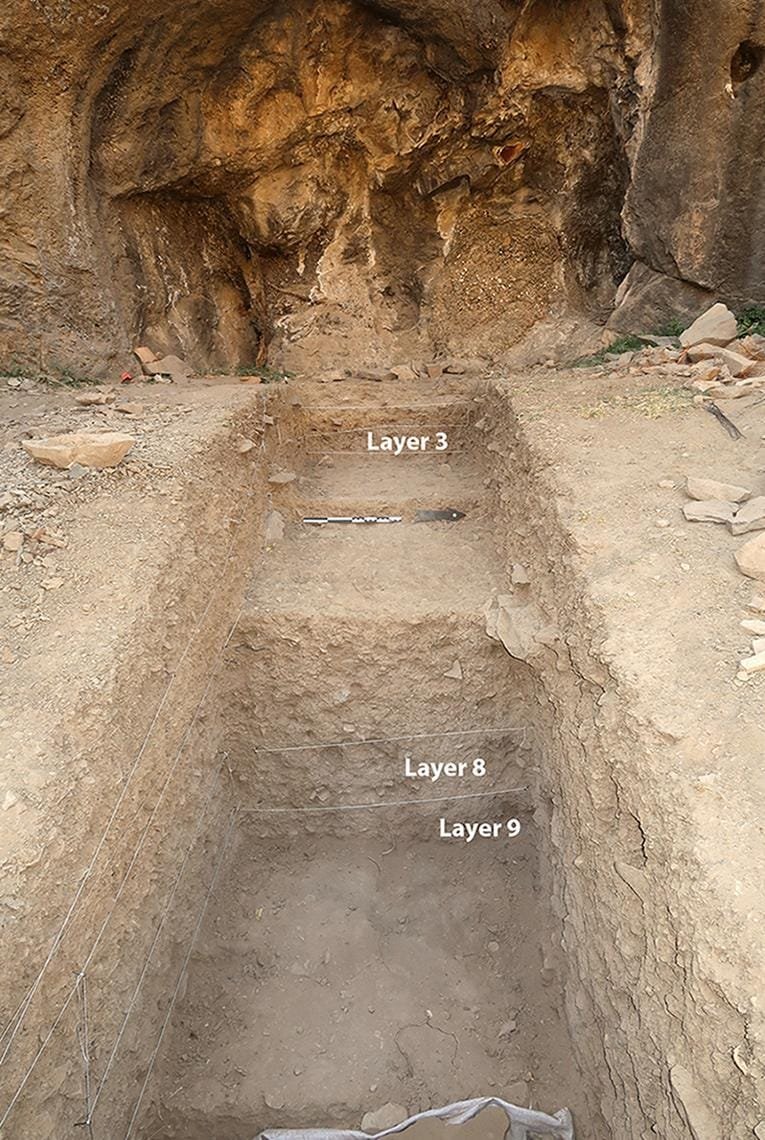
Photograph of the site and Soii Havzak stream, with trenches I, II and III marked. Credit: Zaidner Y, Kurbanov S. Soii Havzak., Antiquity (2024)

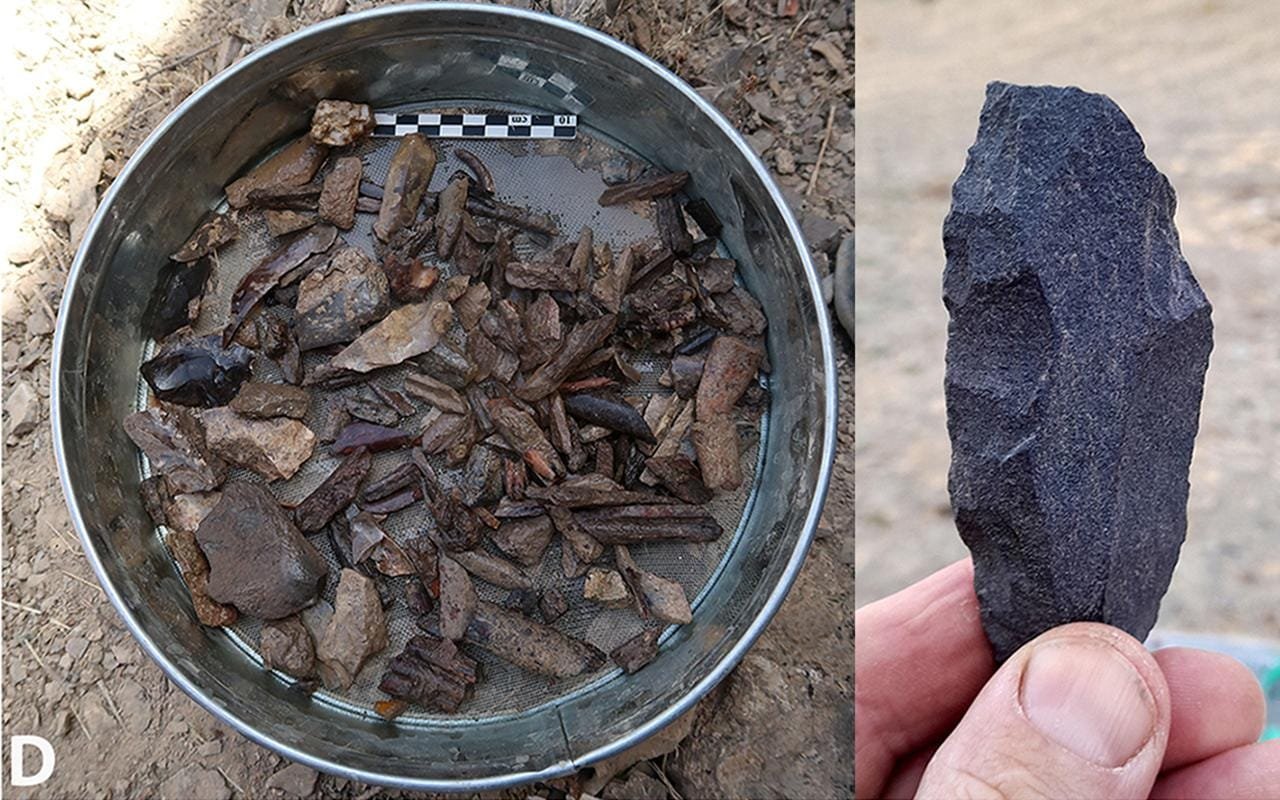
Soii Havzak is situated along a small tributary of the Zeravshan River, approximately 10 kilometers north of Panjakent and close to the Uzbekistan border. The site itself is a natural rock-shelter carved into a cliff face, about 40 meters above the stream. During excavations, the team uncovered over 500 artifacts, including stone tools, blades, and flakes, many of which date back to the Middle and Upper Paleolithic periods. Additionally, bones and organic materials, such as burnt wood and charcoal, were found in the shelter, suggesting fire use and possible settlement.
150,000-year-old rock-shelter in Tajikistan sheds light on early human expansion
Archaeologists uncovered more than 500 artifacts at the site, including stone tools, blades, and flakes, many of which date to the Middle and Upper Paleolithic periods. Credit: Zaidner Y, Kurbanov S. Soii Havzak., Antiquity (2024)

The artifacts point to several phases of human occupation, with evidence of early human activity dating back as far as 150,000 years. “The preservation of organic materials, such as burnt wood remains and bones, is remarkable,” said Zaidner, adding that these findings could provide valuable information on the ancient climate of the Zeravshan Valley. This preservation offers researchers the potential to reconstruct past environments and climates, which may illuminate how early human populations adapted and evolved within this mountainous region.

Dr. Sharof Kurbanov emphasized the importance of this site as a transition point that enabled ancient human populations to spread across Central Asia and beyond. “The rich findings from Soii Havzak add to our understanding of the development of human populations and behaviors in Central Asia,” Kurbanov noted.
150,000-year-old rock-shelter in Tajikistan sheds light on early human expansion
The team’s findings could offer essential clues on how human groups interacted in the area. Credit: Zaidner Y, Kurbanov S. Soii Havzak., Antiquity (2024)

Although the initial findings are substantial, researchers hope to gain more insights from the ongoing excavations and plan to conduct radiometric dating to establish a precise timeline for the various occupation phases. According to Zaidner, further research at the site is crucial to determining which specific human populations inhabited the Zeravshan Valley and the nature of their interactions. He expressed optimism that deeper layers of excavation might reveal skeletal remains that could help identify the hominin groups represented at Soii Havzak.

More information: Zaidner Y, Kurbanov S. (2024). Soii Havzak: a new Palaeolithic sequence in Zeravshan Valley, central Tajikistan. Antiquity:1-8. doi:10.15184/aqy.2024.149

Share:

Share on Facebook Share on X (Twitter) Share on LinkedIn Share on Pinterest Share on WhatsApp Share on Email

You May Also Like...

4-million-year-old juvenile tapir skeleton unearthed in Spain is the most complete ever found in Europe
Paleontology

4-million-year-old juvenile tapir skeleton unearthed in Spain is the most complete ever found in Europe

June 3, 2026
Langobard woman with healed skull injuries challenges assumptions about violence in early medieval society
Anthropology

Langobard woman with healed skull injuries challenges assumptions about violence in early medieval society

June 2, 2026
Ancient city of Ihnasya reveals Aphrodite statue, Senusret III inscription, and Roman basilica remains in Egypt
Archaeology

Ancient city of Ihnasya reveals Aphrodite statue, Senusret III inscription, and Roman basilica remains in Egypt

June 2, 2026
Rare funerary cache discovered at ancient Heliopolis site
Archaeology

Rare funerary cache discovered at ancient Heliopolis site

June 2, 2026
Archaeologists find Queen Elisenda’s remains among 25 medieval skeletons, including individuals with unexplained stab wounds
Anthropology

Archaeologists find Queen Elisenda’s remains among 25 medieval skeletons, including individuals with unexplained stab wounds

June 1, 2026
Copper Age children in Spain suffered widespread respiratory disease, skeletal study suggests
Anthropology

Copper Age children in Spain suffered widespread respiratory disease, skeletal study suggests

June 1, 2026

Comments 1

  1. Editorial Team says:
    1 second ago

    Disclaimer: This website is a science-focused magazine that welcomes both academic and non-academic audiences. Comments are written by users and may include personal opinions or unverified claims. They do not necessarily reflect the views of our editorial team or rely on scientific evidence.

    Comment Policy: We kindly ask all commenters to engage respectfully. Comments that contain offensive, insulting, degrading, discriminatory, or racist content will be automatically removed.

  2. Katharine C Watson says:
    2 years ago

    Truly enjoy reads about the scientific discoveries of pre history.

Follow us


Instagram
242K

Facebook
117K

Threads
47K

LinkedIn
15K

Twitter
6K

YouTube
1K

Archaeology News online magazine

Archaeology News is an international online magazine that covers all aspects of archaeology.


Categories

  • Academics
    • Books
    • Conferences
    • Universities
  • Articles
  • Download
  • Game
  • News
    • Anthropology
    • Archaeology
    • Paleontology
  • Quiz
  • Tours

Subscribe to our newsletter

© 2024 - Archaeology News Online Magazine. All Rights Reserved.

  • About
  • Privacy Policy
  • Terms of Use
  • Donation
  • Contact

Manage Consent
To provide the best experiences, we use technologies like cookies to store and/or access device information. Consenting to these technologies will allow us to process data such as browsing behavior or unique IDs on this site. Not consenting or withdrawing consent, may adversely affect certain features and functions.
Functional Always active
The technical storage or access is strictly necessary for the legitimate purpose of enabling the use of a specific service explicitly requested by the subscriber or user, or for the sole purpose of carrying out the transmission of a communication over an electronic communications network.
Preferences
The technical storage or access is necessary for the legitimate purpose of storing preferences that are not requested by the subscriber or user.
Statistics
The technical storage or access that is used exclusively for statistical purposes. The technical storage or access that is used exclusively for anonymous statistical purposes. Without a subpoena, voluntary compliance on the part of your Internet Service Provider, or additional records from a third party, information stored or retrieved for this purpose alone cannot usually be used to identify you.
Marketing
The technical storage or access is required to create user profiles to send advertising, or to track the user on a website or across several websites for similar marketing purposes.
  • Manage options
  • Manage services
  • Manage {vendor_count} vendors
  • Read more about these purposes
View preferences
  • {title}
  • {title}
  • {title}
  • Home
  • News
    • Archaeology
    • Anthropology
    • Paleontology
  • Academic
    • Books
    • Conferences
    • Universities
  • Articles
  • VR Tours
  • Quiz & Game
  • Download
  • Encyclopedia
  • Forum

About  .  Contact  .  Donation

© 2024 - Archaeology News Online Magazine. All Rights Reserved