• About
  • Privacy Policy
  • Terms of Use
  • Donation
  • Contact
No Result
View All Result
Archaeology News
  • Home
  • News
    • Archaeology
    • Anthropology
    • Paleontology
  • Academic
    • Books
    • Conferences
    • Universities
  • Articles
  • VR Tours
  • Quiz & Game
  • Download
  • Encyclopedia
  • Forum
Archaeology News
No Result
View All Result
Home News Archaeology

Rare Dionysian fresco unearthed in Pompeii depicts rituals and mystery cults

by Dario Radley
February 26, 2025

Archaeologists have uncovered a new fresco in Pompeii that sheds light on ancient Dionysian mystery cults. The well-preserved painting dating back to the first century BCE, was discovered in a banquet hall of the House of Thiasus in Region IX of Pompeii. This find stands out as one of the most important in over a century, with experts comparing it to the famous Villa of the Mysteries frescoes.

Rare Dionysian fresco unearthed in Pompeii depicts rituals and mystery cults
A view into the newly excavated House of Thiasus at Pompeii. Courtesy of the Archaeological Park of Pompeii

The nearly life-size fresco, known as a “megalography”—a word derived from the Greek for “large painting”—covers three walls of the banquet hall, while the fourth wall opens onto a garden. The artwork depicts a procession for Dionysus, featuring maenads, or female followers of Dionysus, portrayed both as ecstatic dancers and fierce hunters. They carry slaughtered goats on their shoulders and brandish swords. Interspersed among them are young satyrs (mythological part-goat, part-human creatures) playing music and performing a ritual wine sacrifice.

At the center of the fresco, an elderly Silenus, a companion of Dionysus, holds a torch while standing beside a young woman, likely an initiate undergoing a secret ritual. This scene reinforces the longstanding association of Dionysus with transformation and rebirth, concepts central to his cult. The wall painting, rendered in vivid reds and deep hues, is part of a broader Roman tradition of Dionysian worship. This tradition had roots in earlier Greek mystery cults that promised their members a mystical experience and a form of spiritual resurrection.

The House of Thiasus got its name from the “thiasos,” or sacred procession, of Dionysus. The fresco matches the Second Style of Pompeian wall painting, which was prevalent between the 40s and 30s BCE. This means the painting had already existed for over a century when the eruption of Mount Vesuvius in CE 79 buried it under ash and pumice.
Rare Dionysian fresco unearthed in Pompeii depicts rituals and mystery cults
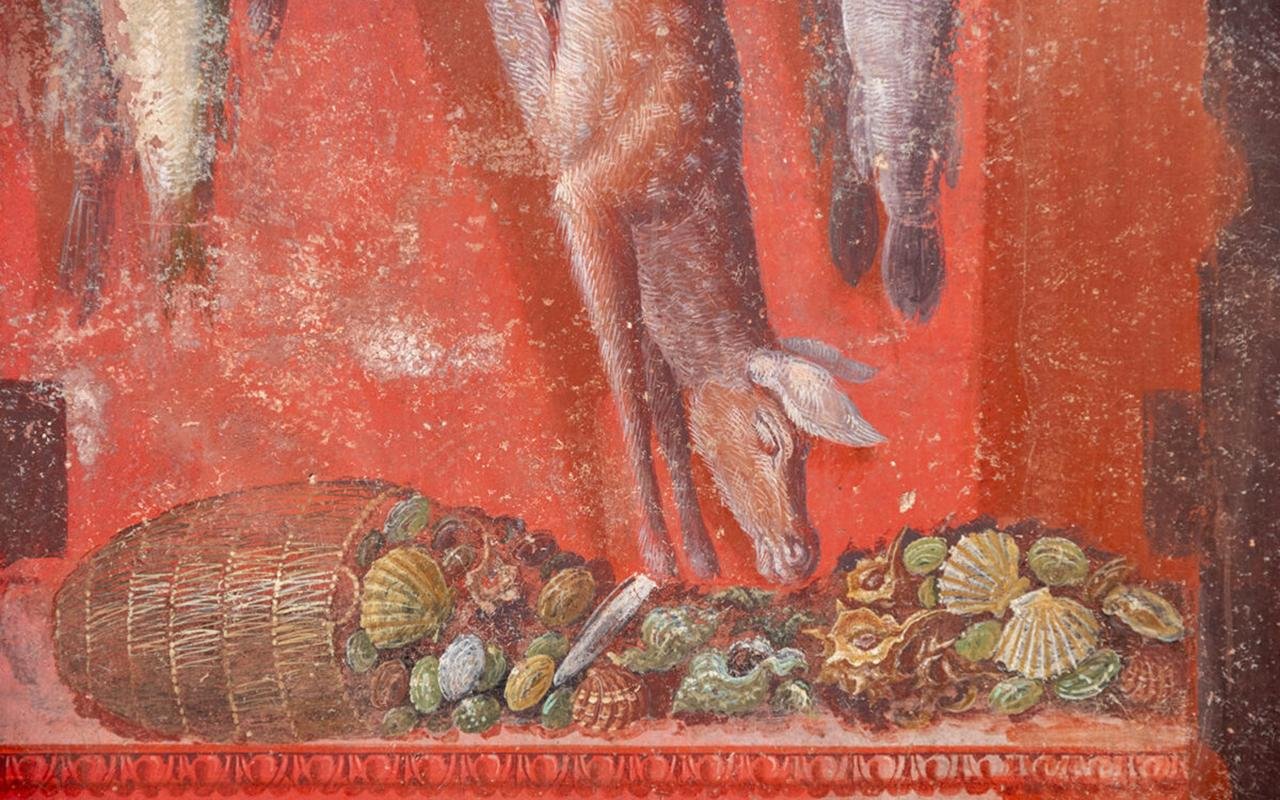
A part of the fresco showing shellfish and animals. Courtesy of the Archaeological Park of Pompeii

This find is noteworthy because it includes hunting scenes, a theme not seen in the Villa of the Mysteries frescoes. A smaller frieze above the main motif further emphasizes this theme, showing different animals—some alive, others freshly hunted—such as a gutted wild boar, a fawn, and various birds and fish. The integration of hunting into the Dionysian rituals suggests a possible connection between initiation rituals and the pursuit of wild game, which strengthens the theme of transformation and chaos inherent in the Dionysian experience.

Gabriel Zuchtriegel, director of the Archaeological Park of Pompeii and co-author of an initial study published in the E-Journal of the Pompeii excavations, said: “Beginning from the ‘Bacchae’ of Euripides, written in 405 BCE and one of the most popular tragedies in antiquity, becomes a metaphor for an unrestrained, ecstatic life that aims to achieve ’great, wondrous things’, as the chorus observe in Euripides’ play.” He also noted that the frescoes depict the contrast between the controlled, domesticated woman and the wild, untamed bacchante, illustrating a religious and social dichotomy present in Roman society.

The House of Thiasus fresco is now accessible to the public as part of ongoing guided tours of the excavation site. The broader excavation of Region IX, which began in February 2023, has uncovered a vast area covering approximately 3,200 square meters. Archaeologists have found several atrium houses that people turned into workshops in the first century CE, including a fullonica (laundry) and a bakery with areas for milling and making food.

Besides the Dionysian banquet hall, other rooms found in the House of Thiasus include a reception room with scenes from the Trojan War, a sacrarium (shrine) showing the four seasons and agricultural allegories, and a large bath complex. The excavation team continues to explore the site, with plans for permanent public access in the future.

More information: Archaeological Park of Pompeii
Share:

Share on Facebook Share on X (Twitter) Share on LinkedIn Share on Pinterest Share on WhatsApp Share on Email

You May Also Like...

Rare funerary cache discovered at ancient Heliopolis site
Archaeology

Rare funerary cache discovered at ancient Heliopolis site

June 2, 2026
Archaeologists find Queen Elisenda’s remains among 25 medieval skeletons, including individuals with unexplained stab wounds
Anthropology

Archaeologists find Queen Elisenda’s remains among 25 medieval skeletons, including individuals with unexplained stab wounds

June 1, 2026
Copper Age children in Spain suffered widespread respiratory disease, skeletal study suggests
Anthropology

Copper Age children in Spain suffered widespread respiratory disease, skeletal study suggests

June 1, 2026
Unknown World War II mass grave with 14 German soldiers uncovered at quarry site in Poland
Anthropology

Unknown World War II mass grave with 14 German soldiers uncovered at quarry site in Poland

May 31, 2026
Volunteers restore England’s mysterious Cerne Abbas Giant as climate and erosion threaten ancient landmark
Archaeology

Volunteers restore England’s mysterious Cerne Abbas Giant as climate and erosion threaten ancient landmark

May 31, 2026
Buried church bell found in Poland after decades hidden beneath roadside
Archaeology

Buried church bell found in Poland after decades hidden beneath roadside

May 31, 2026

Comments 1

  1. Editorial Team says:
    1 second ago

    Disclaimer: This website is a science-focused magazine that welcomes both academic and non-academic audiences. Comments are written by users and may include personal opinions or unverified claims. They do not necessarily reflect the views of our editorial team or rely on scientific evidence.

    Comment Policy: We kindly ask all commenters to engage respectfully. Comments that contain offensive, insulting, degrading, discriminatory, or racist content will be automatically removed.

  2. Historical Vagabond says:
    1 year ago

    Love how they just keep finding cool stuff in Pompeii.

Follow us


Instagram
242K

Facebook
117K

Threads
47K

LinkedIn
15K

Twitter
6K

YouTube
1K

Archaeology News online magazine

Archaeology News is an international online magazine that covers all aspects of archaeology.


Categories

  • Academics
    • Books
    • Conferences
    • Universities
  • Articles
  • Download
  • Game
  • News
    • Anthropology
    • Archaeology
    • Paleontology
  • Quiz
  • Tours

Subscribe to our newsletter

© 2024 - Archaeology News Online Magazine. All Rights Reserved.

  • About
  • Privacy Policy
  • Terms of Use
  • Donation
  • Contact

Manage Consent
To provide the best experiences, we use technologies like cookies to store and/or access device information. Consenting to these technologies will allow us to process data such as browsing behavior or unique IDs on this site. Not consenting or withdrawing consent, may adversely affect certain features and functions.
Functional Always active
The technical storage or access is strictly necessary for the legitimate purpose of enabling the use of a specific service explicitly requested by the subscriber or user, or for the sole purpose of carrying out the transmission of a communication over an electronic communications network.
Preferences
The technical storage or access is necessary for the legitimate purpose of storing preferences that are not requested by the subscriber or user.
Statistics
The technical storage or access that is used exclusively for statistical purposes. The technical storage or access that is used exclusively for anonymous statistical purposes. Without a subpoena, voluntary compliance on the part of your Internet Service Provider, or additional records from a third party, information stored or retrieved for this purpose alone cannot usually be used to identify you.
Marketing
The technical storage or access is required to create user profiles to send advertising, or to track the user on a website or across several websites for similar marketing purposes.
  • Manage options
  • Manage services
  • Manage {vendor_count} vendors
  • Read more about these purposes
View preferences
  • {title}
  • {title}
  • {title}
  • Home
  • News
    • Archaeology
    • Anthropology
    • Paleontology
  • Academic
    • Books
    • Conferences
    • Universities
  • Articles
  • VR Tours
  • Quiz & Game
  • Download
  • Encyclopedia
  • Forum

About  .  Contact  .  Donation

© 2024 - Archaeology News Online Magazine. All Rights Reserved